“The EU’s finances run the way they do because no one has a sense of ownership of the funds. It is always “someone else’s money” that is being abused.”
|
|||||
|
Pickup basketball is a beautiful example of the spontaneous, emergent order that arises from voluntary interaction predicated on classical liberal principles of dignity, respect for the individual, and voluntary cooperation. Every individual who has ever played pickup basketball can enumerate the rules for forming a team, playing, and interacting regardless of location, age or ethnicity- African Americans in the poorest sections of Harlem play by the same pickup rules as do those on the playgrounds of the whitest, richest suburbs in America. May 9th, 2017 | 18 comments - (Comments are closed)

The whole article makes a lot of sense. I particularly liked the point about how Putin might be annoyed that with Trump in office, he (Putin) no longer has a perceived monopoly on being That Unpredictable Guy. I think that is a very astute observation. Putin liked being the man who was constantly messing with our heads over Syria, or Ukraine, or wherever. But if he is up against a US president who makes unpredictability part of his central appeal, that changes. Then maybe Vlad. has to change, to be more predictable in certain ways. And this whole saga also somewhat undermines the “Russian spies put The Donald into the White House” narrative, although given the self-deception and insanity I see on part of the Democrat Party and its media allies, this is likely to continue for some time. Another couple of paragraphs:
Totten is right, I think, that Putin had not expected Trump’s winning last autumn. He might, naively, have hoped for such a win, but I am not sure he actually expected the result. Totten is also right to point out that Putin is not some sort of chess-playing genius from From Russia With Love. He makes mistakes.
March 10th, 2017 | 10 comments - (Comments are closed)
In 1917, as this cutting shows, the German navy shelled Margate and Broadstairs. Nothing strange in that, you might think, they had done much worse to Scarborough and Great Yarmouth. 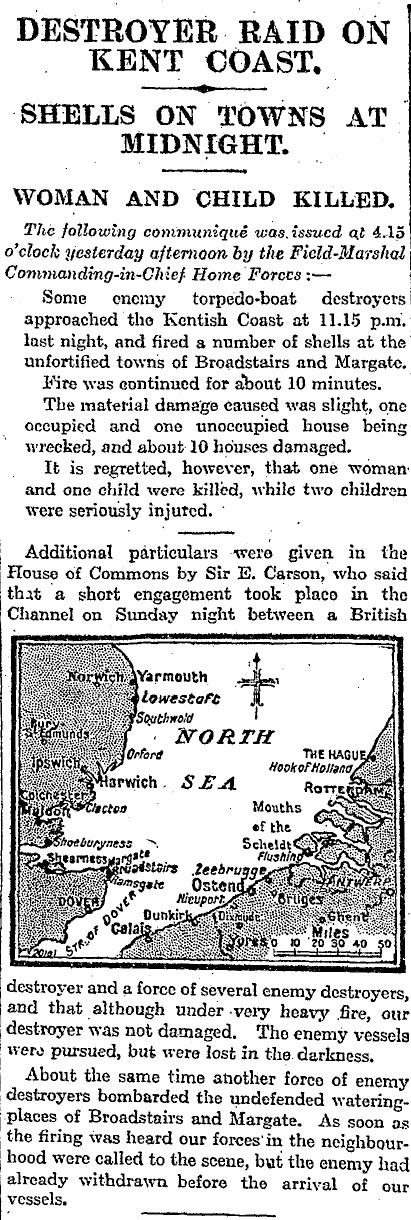 The Times 27 February 1917 p6. Right click for the whole article. However, this raid was a bit different. Far from causing general mayhem and tweaking the tail of the Royal Navy, on this occasion the target was one man: Lord Northcliffe, proprietor of The Times, The Daily Mail and – I kid you not – The Daily Mirror. Not that you would know it from this heavily censored report. Northcliffe had attracted the ire of the German government by – apparently, I get little impression of this from The Times itself – being the main cheerleader of anti-German and pro-War sentiment in Britain. In 1918, doubtless aided by the Kaiser’s ringing, if unintentional, endorsement, Northcliffe became Britain’s Director of Propaganda. I appreciate that in writing this article I may be giving the God-Emperor some ideas. So, Donald, if you’re reading, just remember: sailing a battleship up the Hudson, shelling the New York Times building and turning it into a smoking pile of rubble just so you can wipe the smile off the faces of a bunch of smug, arrogant, conceited, snobbish, self-satisfied, aloof, out-of-touch, blockheaded, group-thinking, bubble-dwelling, histrionic, paranoid, lying, devious, dissembling, childish, cry-baby, bitter, vindictive, divisive, conspiratorial, freedom-hating, progress-denying communists… is not nice. It may even be wrong. February 26th, 2017 | 23 comments - (Comments are closed)
“So much of our popular culture depends on the loudly proclaimed pose of being “rebels,” of being outside the mainstream, of being “transgressive”—while repeating clichés that have become deadly boring through decades of repetition. It reminds me of a brilliant little bit in The Onion: “Purchase of Jeans Ushers Man into Exclusive, Ultra-Cool Subculture of Jeans-Wearing Americans.” They all want to be nonconformists just like everyone else.” February 22nd, 2017 | 41 comments - (Comments are closed)
A commenter over at the Guido Fawkes blog, with the joyful name of “Rasta Pickles”, comments on the notion that the UK electorate is too thick to figure out the complexities of Brexit, and that such complex matters should be left to a political class that has done such a tremendous job down the years. He or she notes a flaw in this “argument”:
Even so, there are libertarians/classical liberals who point out that democracy, unless hedged with checks and balances, isn’t compatible with liberty and can be harmful to it. Bryan Caplan’s The Myth of The Rational Voter is a good read, as is this recent effort by Jason Brennan. But my problem with the arguments they make is that what, realistically, can they propose other than the sort of return to oligarchy of “smart people” that, as history tends to show, descends into corruption pretty damn quick? February 20th, 2017 | 53 comments - (Comments are closed)
“The really big point is that far from being a tumultuous, cacophonic, unstable, firecracker of a polity, Brexit Britain is starting to feel like a relative island of calm, more at ease with itself than it has been for many years, led by a sort of 1950s Prime Minister, who is nearly 20 points ahead in the polls. The spotlight of worry has swivelled round elsewhere, to Greece, France and to the United States. If Brexit is a revolution, it is so far turning out to be a very British and incremental one, lacking in violence or upset. More tea, vicar?” Indeed. What has struck me about some on the Remain side, for example, is that they have been coming across as a bid mad, unpleasant or utopian, not the other side. It is pretty hard to portray the likes of David Davis, for example, as fire-eating radicals when the eurozone, for example, is and remains an economic clusterfuck of Old Testament proportions. February 13th, 2017 | 10 comments - (Comments are closed)
Obama is described in the web novel Unsong:
This post was necessitated by a conversation at Brian’s Friday. January 27th, 2017 | 25 comments - (Comments are closed)
Things were looking good for the Allies at the close of 1916. The French had pushed back the Germans at Verdun. The British were consistently doing much the same on the Somme. The Russians had made huge gains at the expense of the Austrians during the Brusilov Offensive. The Italians were continuing to attack and it appeared that it was finally all systems go on the Salonika Front. The only real fly in the ointment was Romania which was being invaded. Away from the frontlines there was also plenty of scope for optimism. The British were at last getting guns and shells in sufficient quantities. The Irish rebellion had been crushed. The U-boat campaign was quiescent. Conscription seemed to be working. Even the Russians seemed to have turned the corner when it came to their supply problems. Most importantly, the Western Allies – and particularly the French under a dashing young commander – appeared to have found the formula for winning battles on the Western Front. Meanwhile the Germans were slowly and literally being starved by a combination of the Blockade and their own economic incompetence. Splits were beginning to appear with the communist, Karl Liebnecht demanding an end to the war. At the same time they were having to prop up their increasingly helpless allies. In Austria, the death of Emperor Franz Josef followed on the heels of the assassination of the Prime Minister by another communist in protest at the continuing refusal to recall parliament. It must have looked like victory was just around the corner. In such situations you often find that unscrupulous politicians like to jockey for position in order to be able to take the credit. Not that such things would ever happen in Britain. On 6 December, having out-manoeuvred his predecessor, David Lloyd George became Prime Minister. Oh and the name of that dashing French commander – he of the formula? Nivelle. Robert Nivelle. 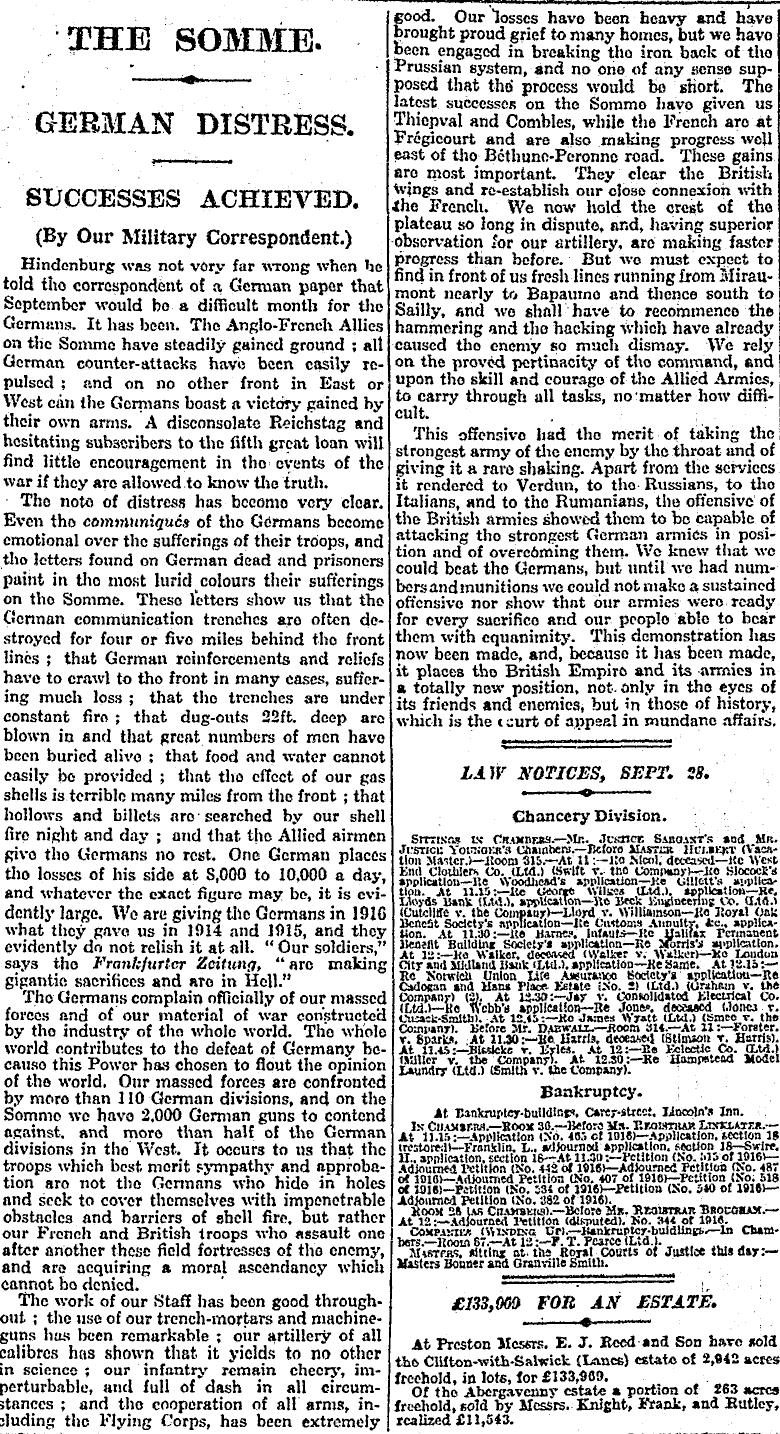 The Times 28 September 1916 December 4th, 2016 | 17 comments - (Comments are closed)
Ross Clark, having fun at the expense of Barack Obama, whose comment earlier this year that the UK would be at the “back of the queue” in trade deals with Washington if it had the temerity to quit the European Union has, along with so many others, backfired. We are often told that President Obama was going to bring us an era of smart diplomacy, unlike that that moron Bush, etc, etc. The gap between the promise, and the reality, is wider than ever. August 31st, 2016 | 9 comments - (Comments are closed)
I found this post from eleven years ago while hunting around the internet for something else. It is quite strange to read it now. The author may have been on to something:
Have they noticed even now? July 23rd, 2016 | 8 comments - (Comments are closed)
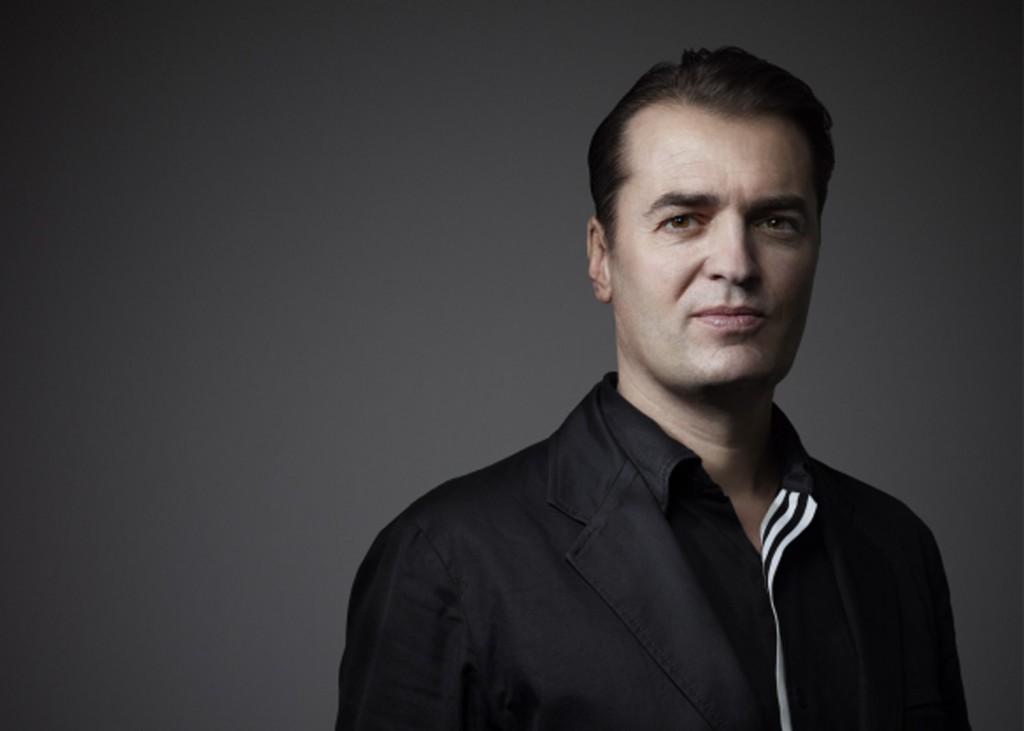
One of my daily internet visits is to a site called Dezeen. Here I learn about lots that bores me, involving designers making small buildings shaped like boxes rather than ornamented, and about lots that interests me, including such things as much bigger and (to me) much more interesting buildings that are being dreamed of, built and celebrated. On the matter of Brexit, Dezeen reported that the the overwhelming majority of “creatives”, in London and in the world generally, favoured and still favour Remain. These creatives were very angry when they learned that a majority of British voters did not share their views. But Dezeen also had a recent link to a creative who sings a very different sort of ideological song to that sung by most of the kind of creatives whose work and opinions Dezeen reports on. I give you Patrik Schumacher:
Patrik Schumacher has written an opinion piece for Archinect, with these words at the top of it:
Later on in the piece, we read stuff like this:
It’s those particular sorts of libertarian phraseology that I find so intriguing. “Roll back” the “interventionist state”. “Unleash entrepreneurial creativity”. “Nanny state”. “Heavy tax and regulatory burdens”. Above all the simple: “Economic freedom”. This guy is one of us. There really can be no doubt about it. He has been reading the same kind of stuff that Samizdata readers have read, in among training to be an architect and then working as an architect. Any libertarians who doubt the ability of libertarian ideas to spread beyond the confines of mere libertarians should read this piece, and rejoice. Patrik Schumacher works for Zaha Hadid architects. The recently deceased Zaha Hadid was rumoured to be a very “difficult” woman to work for. Bossy. Opinionated. Highly individual in her behaviour and in her designs. I don’t know much about Hadid other than noticing when she recently died (at far too young an age for an architect). But if Patrik Schumacher was the sort of man she hired to do her bidding, I am starting to suspect that she too may have been some sort of libertarian, maybe in the closet, but maybe of the in-your-face variety. There’s lots more I could say about this, but my basic point is: how interesting, and how encouraging. July 12th, 2016 | 23 comments - (Comments are closed)
|
Commentary
Economics
Politics
Specialist
Tech |
||||

All content on this website (including text, photographs, audio files, and any other original works), unless otherwise noted, is licensed under a Creative Commons License. |
|||||