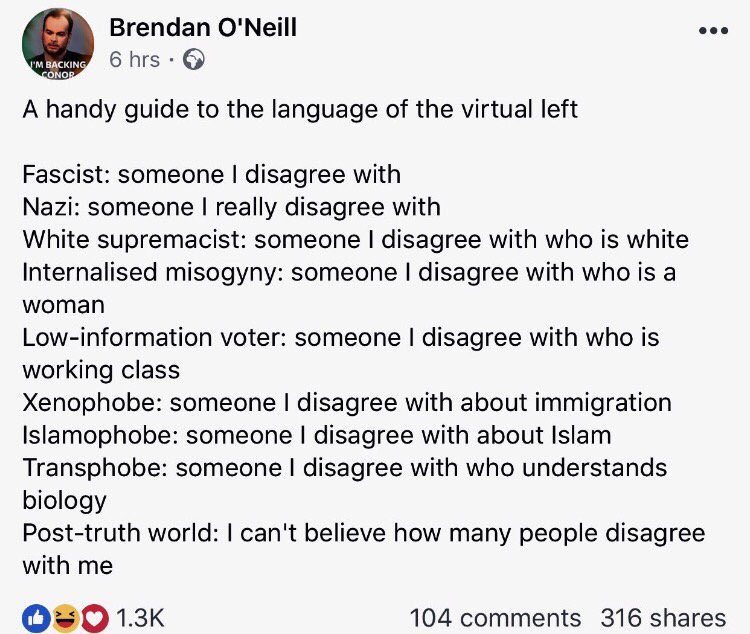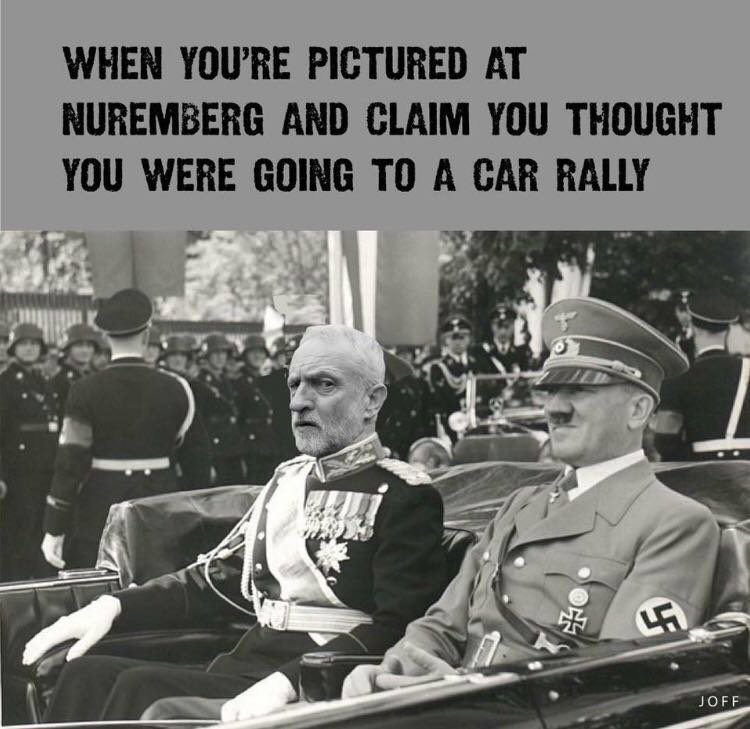
As Lord Sugar phrased it: Many a true word spoken in jest Corbyn
|
|||||
|
March 31st, 2018 | 28 comments - (Comments are closed)
 Jordan Peterson is everywhere just now, and I do not think he will soon stop being everywhere. (He was also referred to here in yesterday’s SQotD.) Was this what it was like when John Wesley got into his communicational stride? When interesting things happen now, you find yourself understanding similar events in the past much better, events which had formerly seemed almost unimaginable. I spent the small hours of this morning, the end of my version of last night, listening to this conversation, that Peterson had with an Australian politician called John Anderson, who is a new face to me. It was the video equivalent of not being able to put the book down. In this conversation, Peterson repeated one of his most characteristic ideas, to the effect that people should bear the most responsibility that they can possibly carry. This is not merely because others will appreciate this and benefit from it, although that is a likely consequence and a definite feature. It is also that when life turns bad, when tragedy strikes, when God is throwing custard pies around, the fact that you are living your life meaningfully, as opposed merely to living it pleasurably, will be a great solace, in a way that merely having lived pleasurably will not be. “We are beasts of burden.” This is what Peterson means by the word responsibility. Responsibilities are things that we all need, to make and find meaning in our lives. The happiness you get from doing something meaningful, even if often rather painful and perhaps very painful, is far deeper than the happiness you get from some merely pleasurable pastime or addictive drug or hobby. We all need fun. But we all need for our lives to be more than just fun. Sometimes, depending on his audience, Peterson expands upon the idea of responsibility by using the language of Christianity, of the sort that is being used a lot today, on Good Friday. (Interesting adjective, that.) Do as Christ did. Live your life by picking up the biggest cross you can carry. Whether Peterson is himself a Christian and will at some future time declare himself to be a Christian is now much discussed, I believe. (I am an atheist, by the way. Which is a species of thinker for whom Peterson has a lot of respect, because at least we tend to do a lot of thinking.) I have always been deeply suspicious of the word “responsibility”. It has again and again sounded like someone else telling me that I must do what he wants me to do rather than what I want to do. If he is paying my wages, then fair enough. But if he is explaining why I should vote for him, and support everything he does once he has got the job he is seeking, not so fair. The sort of thing I mean is when a British Conservative Party politician says, perhaps to a room full of people who, like me, take the idea of freedom very seriously: Yes, I believe, passionately, in freedom. The politician maybe then expands upon this idea, often with regard to how commercial life works far better if people engaged in commerce are able to make their own decisions about which projects they will undertake and which risks they will walk towards and which risks they will avoid. If business is all coerced, it won’t be nearly so beneficial. We will all get poorer. Yay freedom. But. But … “responsibility”. We should all have freedom, yes, but we also have, or should have, “responsibility”. Sometimes there then follows a list of things that we should do or should refrain from doing, for each of which alleged responsibility there is a law which he favours and which we must obey. At other times, such a list is merely implied. So, freedom, but not freedom. The problem with politicians talking about responsibility is that their particular concern is and should be the law, law being organised compulsion. And too often, their talk of responsibility serves only to drag into prominence yet more laws about what people must and must not do with their lives. But because the word “responsibility” sounds so virtuous, this list of anti-freedom laws becomes hard to argue against, even inside one’s own head. Am I opposed to “responsibility”? Increasingly, I have found myself saying: To hell with it. Yes. I have often been similarly resistant to the language of Christianity, of the sort that dominates what is being said in churches around the world today. How many times in history have acts of tyranny been justified by the tyrant saying something like: We must all bear our crosses in life, and here, this cross is yours. “God is on my side. Obey my orders.” The truth about the potential of life to inflict pain becomes the excuse to inflict further pain. I suffered the final spasms of this way of thinking at the schools I went to, not long after the Second World War. “Life is cruel, Micklethwait, and I am now going to prove it to you by making it even more cruel. I am preparing you for life.” This kind of cruelty may now have been more or less replaced by over-protectiveness, by excessively shielding children from activities that might prove painful. Peterson has a lot to say about that also. Much modern law-making, of the you-must-not-eat-too-many-sticky-buns sort, is motivated partly by this sort of thinking. But getting back to what Peterson says about “responsibility”, the deeply refreshing thing about how he uses this word is that, because he is not a politician, he separates the benefits to me of me choosing to live responsibly from the idea of him deciding what he thinks these responsibilities of mine should be, and then compelling me to accept them whether I judge them to be wise or appropriate or meaningful for me or not. The process he wants to set in motion in my mind is of me thinking about what my responsibilities should be. He is arguing that I should choose my own cross, as best I can, and then carry it as best I can, because this is what will be best for me. He is not telling me which cross it should be, in a way that he calculates will be advantageous for him. It helps a lot that Peterson chose his moment to step upon the political stage by vehemently opposing a law that might compel him merely to speak in a certain way. As he himself says, you see what someone truly believes by watching what he does. Peterson really does believe in freedom, as well as in a great many other interesting things. Maybe, sometimes, a politician may actually mean what Jordan Peterson means when he talks about responsibility. Trouble is, if he does not make himself crystal clear about what he is and is not saying, you are liable to mishear him as just wanting to boss you around. Jordan Peterson is not the boss of me, and he is not trying to be. He is simply presenting me, and all the other multitudes of people who are listening to him now, with an argument, an argument that I for one find very persuasive. Another way of putting all this is that Peterson is not telling me anything I didn’t already know. (He gets this a lot, apparently.) What he is doing is reclaiming and cleansing an important word. March 30th, 2018 | 36 comments - (Comments are closed)
February 23 2018:
I posted about it here. March 28 2018:
And I’m posting about it here. March 29th, 2018 | 17 comments - (Comments are closed)
It’s dangerous to enjoy the sight of the Labour Party – home of cynical grievance-mongers for decades – hoist by its own petard over anti-Semitism. It’s perilous to succumb to anger over the way that Leftist political correctness has thrown thousands of white girls in Telford or Rotherham to the wolves for fear of the juju word “Racist”. Lives are being lost (and many more lives degraded) in the United States as the uncontroversial assertions that “Black Lives Matter” and “All lives matter” are used as tribal battle cries. The Alt-Right’s so-called “fascism” would evoke snorts of derision from history’s real Fascists, as it amounts to White people lamely joining the destructive game of identity politics. – ‘Tom Paine‘ March 29th, 2018 | 6 comments - (Comments are closed)
Peterson wryly remarked, as swarms of Antifa clones were pounding at the door and breaking windows during his brilliant presentation at Queen’s, that “the barbarians are at the gate.” In a way, this was not quite accurate. They are here milling among us, inhabiting the universities, marching in the streets, dismantling the civil order, engaged in the perversion of values, and, like Marcuse, promoting tyranny in the name of freedom. Their freedom. The barbarians are not at the gate. The barbarians are inside the gate. March 28th, 2018 | 16 comments - (Comments are closed)
“Labour’s plan to tackle inequality can revive the ailing development sector”, writes Nick Dearden in the Guardian. Clicking on Mr Dearden’s name took me to a link that said, in true Grauniad style, “Nick Dearden is director of the Global Justice Now (formerly World Development Movement)” The faltering fortunes of “the Global Justice Now” and similar organizations in what is called the aid “sector” (as if were part of the economy rather than a drain on it) distress Mr Dearden for understandable reasons. No man likes to see his prospects of a secure and comfortable living imperilled. I do not see why the rest of us should care. I would be quite happy to issue the development sector with a one way ticket to Switzerland. Mr Dearden writes,
And the problem with this was…?
Emphasis added. Libertarians and similarly inclined folk often see the Guardian commentariat as being no less daft than the Guardian writers. That is not always true. Nearly all the most popular comments to this piece make pretty good sense and I am going to quote several of them. For instance take this one from someone called ‘Humza’, who says,
Mr Dearden continues,
In other words, Labour’s policy is unworkable.
Neocolonialism! British interference in the policies of sovereign African nations! (Hat tip to commenter ‘daveg861’ for that point.)
In other words, Labour’s policy is unworkable. Wait, didn’t I say that only a minute ago? Yes, I did, but if Mr Dearden is going to repeatedly state that reducing inequality cannot be done unless the Labour party conquers the world I am just going to have to repeatedly point out that it ain’t gonna happen.
Those policies require further clarity in office the way a fish requires further water on the deck of a trawler.
As ‘FatherChewyLouie’ says in the most recommended comment, “What exactly do Labour mean by providing “global leadership” on the refugee crisis? If it’s what I think it means then I can guarantee it won’t be a vote winner.” Meanwhile, back in the The Global Justice Now! universe:
Countries like Britain might have, but Britain grew rich because of the Industrial Revolution before it had African colonies. When it got them it turned out they were a net cost to the British government and were unpopular thereby. The original “Little Englanders” were opposed to expansion of the British Empire for that reason. (I swear, I had already written that when I saw a comment by ‘YEverKnot’ saying the very same thing. Of course it is a fairly obvious point to make.)
Reparations? That might not go down well with voters. However, the point about aid being largesse which can be cut off on a whim is true. And thus Mr Dearden unintentionally makes an excellent argument against government-to-government foreign aid and against the very existence of his beloved “development sector”. March 27th, 2018 | 15 comments - (Comments are closed)
If you’re a Labour MP, if you take Corbyn’s whip, if you sit behind him in the House of Commons, then you can roll your eyes when he speaks or tell us how distraught you are on Twitter all you like; it counts for nothing. Your arithmetical function is to combine with other Labour MPs in order to give Jeremy Corbyn a majority in Parliament. No amount of election leaflet drivel or chuntering on about “fighting Tory cuts to save my community/the NHS/insert name of local school here” can wash away the permanent stain of your complicity with wickedness. How such people sleep at night or meet their reflection’s eye is their own affair and not my problem, thank God. But as the repellent psychodrama of their monstrous party staggers on to its terrifying conclusion, I’d ask them, in the meantime, to shut up about how good they are, how nasty the Conservatives are, how kindness entails a vote for Labour. Tories don’t succour anti-Semitism, comrade. In my book, that makes them better than you. March 26th, 2018 | 23 comments - (Comments are closed)
That’s the heading. The sub-heading gives us a bit more detail:
Well, I may have changed things a bit there. See which version you prefer by comparing what I put with the original version. I can’t fault paragraph one of the actual story:
I had already been thinking to myself that Trump might do this. I didn’t think he would start making such noises quite so soon after signing the bill. Next: actually not spending the money. But, never make that old “we demand action not words” mistake. Demand words, and then actions in accordance with those words, which is a hell of a lot more difficult if there have been no words to start with. If words didn’t count for anything, why the hell would we here bother with them, day after day? March 26th, 2018 | 14 comments - (Comments are closed)
This is a recent Spiked tweet. And that’s all it says, so no need to follow that link, unless to you want to chase up other Spikednesses. As well you might. March 25th, 2018 | 15 comments - (Comments are closed)
Zuckerberg must also be contemplating a second oddity. There was no privacy outcry when Barack Obama’s 2012 campaign took advantage of the same Graph API to exfiltrate information of tens of millions of Facebook users without each voter’s knowledge and consent. – Declan McCullagh, writing: Obama harvested data from Facebook and bragged about it. Why are we only freaking out about this now? Of course we actually all know the reason why. March 24th, 2018 | 19 comments - (Comments are closed)
In Britain, the EU is often thought about as a single entity — and one that in the end will do whatever Germany says. But Angela Merkel is struggling to exert control over her own government, let alone the continent. Juncker and Barnier see an EU that does not take its orders from member states, but draws (or claims to draw) its own democratic legitimacy from the European Parliament. The EU member states have an interest in a good deal with Britain. But the European Commission — the apparatus in Brussels — has an interest in Britain being seen to be worse off after leaving the EU. The Commission would also receive 80 per cent of the tariff revenue from UK exports to the EU, making ‘no deal’ more appealing to Brussels than to member states. – Editorial in the UK’s Spectator magazine (£). March 23rd, 2018 | 11 comments - (Comments are closed)
Mises sees ideologies – sets of ideas – as guiding people’s actions such that they extend or curtail the growth of the division of labour. But people can participate in an extended division of labour while still holding to an ideology of violence which must run counter to, and undermine, peaceful cooperation. Many who joined this extended order by moving into urban areas remained strangers to the ideas which made wider specialisation and exchange possible: “One cannot make a social philosophy one’s own as easily as a new costume. It must be earned – earned with the effort of thought.” Hence in history there appear periods in which the division of labour is extended and others in which it regresses: “More menacing than the barbarians storming the walls from without are the seeming citizens within – those who are citizens in gesture, but not in thought.” – Hayek too excoriates those “non-domesticated barbarians in our midst” who “refuse to accept” the “acquired discipline” of a world-wide division of labour while “they still claim all its benefits”. – Sudha Shenoy, Towards a Theoretical Framework for British and International Economic History: Early modern England, a case study, p283. Don’t be confused by the title – not a dicky bird so far about post-Black Death cesspit management – this is an overview of Austrian economics. And a rather good one at that. March 23rd, 2018 | 10 comments - (Comments are closed)
|
   |
||||

All content on this website (including text, photographs, audio files, and any other original works), unless otherwise noted, is licensed under a Creative Commons License. |
|||||