A sample text widget
Etiam pulvinar consectetur dolor sed malesuada. Ut convallis
euismod dolor nec pretium. Nunc ut tristique massa.
Nam sodales mi vitae dolor ullamcorper et vulputate enim accumsan.
Morbi orci magna, tincidunt vitae molestie nec, molestie at mi. Nulla nulla lorem,
suscipit in posuere in, interdum non magna.
|
I found this on Gay.com UK, so the language may be a bit distorted (e.g the phrase ‘the Pope’s anti-gay document…) but still worth a post:
The Irish Council for Civil Liberties says it will prosecute any priests found distributing or quoting the Pope’s anti-gay document for hate crimes.
Any clergy found handling the 12-page document, released last week as a statement of the Catholic Church’s response to gay marriages, will face charges under the country’s hatred legislation reports suggest.
Although the document itself is not illegal, it could lead to an increase in hatred, the Council said, and by stirring up hatred in the parish, the clergy could face jail terms of six months.
According to their website the Irish Council for Civil Liberties is an independent governmental organisation promoting and defending human rights and civil liberties.
Update: Here is the same news from Irish Times quoting Ms Aisling Reidy, director of the ICCL:
The document itself may not violate the Act, but if you were to use the document to say that gays are evil, it is likely to give rise to hatred, which is against the Act. The wording is very strong and certainly goes against the spirit of the legislation.
Just following up on what I was saying this morning on the dangers of anti-terrorism laws being applied to situations that do not involve terrorism, Eugene Volokh provides an example of the way in which too broadly worded anti-terrorism laws can be misused. A prosecuter in North Carolina has charged someone who has been manufacturing methamphetamine with two counts of “manufacturing a nuclear or chemical weapon”, because the definition of chemical weapons under the law is
any substance that is designed or has the capability to cause death or serious injury and . . . is or contains toxic or poisonous chemicals or their immediate precursors
and methamphetamines can clearly be described that way. Because the accused is being prosecuted under the anti-terrorism law, the penalties are harsher (and he may have less legal protection – I am not sure of the details of that particular law) than he would have if he were charged with a normal drugs offence.
I suppose we can observe that this is another example of the general way in which people’s rights and liberties tend to get brushed aside as part of the war on drugs, too.
David Farrer comments here on the case of a someone who may be sent to jail for using a mobile telephone to record and transmit proceedings in the Perth Sheriff Court.
Apparently they don’t like it so much when we use technology to keep tabs on them.
Instapundit links to this story, and quotes a fellow lawyer who alerted him to it that it shows you shouldn’t automatically disbelieve a client who says he doesn’t know how some porn found its way onto his hard drive.
A man accused of storing child pornography on his computer has been cleared after it emerged that his computer had been infected by a Trojan horse, which was responsible for transferring the images onto his PC.
[XXXX XXXX] … was taken into custody last October after police with a search warrant raided his house. He then spent a night in a police cell, nine days in Exeter prison and three months in a bail hostel. During this time, his ex-wife won custody of his seven year old daughter and possession of his house.
In a world where simply being charged with a crime causes millions to presume some degree of guilt, and gives personal enemies their chance straight away to move in for the kill by making use of other bits of the legal system, then the decision merely to prosecute becomes a sentence in its own right.
Virginia Postrel has a small piece on her blog about the civil liberties implications of the war on terror. (She also links to this Reason article by Jacob Sullum). Essentially her point is that if you give the authorities arbitrary and unaccountable powers of arrest (or to violate civil liberties in other ways) in order to fight terrorism, then eventually these powers are going to be used on other people as well, particularly the opponents of whoever is in power. Therefore, accountability and openness is crucial.
From the Telegraph yesterday:
Closed-circuit television cameras are to be installed in every classroom at a school for the first time in Britain in a development that has raised alarm among parents and teachers.
CCTV will operate throughout the new school, King’s Academy in Middlesbrough, when it opens in September. The cameras are intended to make it easier to monitor and control bad behaviour by pupils.
The school says they will also watch over expensive computer equipment and will assist staff by providing evidence to clear teachers if they are falsely accused of abuse or assault.
This last is to counter the fear among the teachers that the cameras will also be used to spy on them.
King’s is the latest of the Government’s trumpeted city academies, funded jointly by state and private money. It will specialise in business and enterprise. Although CCTV is used for security reasons around many schools, King’s is the first to use it throughout classrooms.
Manchester city council is now seeking funds to install cameras in five schools as part of a discipline crackdown. A CCTV network of 40 to 50 cameras, which would cover the average school, would cost about £16,000.
Not for the first time, my reaction to being told the cost of some surveillance kit is: that’s cheap. Soon, if they want it to be everywhere, and they do, it will be.
Supermarkets have begun trials on coordinating RFID tags and security cameras in order to reduce theft as the first step in converging logistical and surveillance technologies.
The first step has already been taken through trials at a supermarket in Cambridge, where RFID tags were used to identify a purchaser through a security camera. In this particular case, a second camera at the checkout was used to ensure that the item was purchased legally.
The technology is also utilised on the London Tube.
Transport for London is also using RFID-style chips in its new Oyster smart cards to allow users to travel around the tube network. The intention is that registered users will have information such as their names and addresses stored on the cards, which would eventually replace season tickets.
A spokesperson for TfL said that the entry and exit points of each journey made by Oyster users were recorded and that, technically, it would be possible to track people through the tube network. Nicole Carroll, marketing director for TranSys, the consortium responsible for implementing the system, told the Guardian that all the journeys made by a user would remain stored in a central computer for the lifetime of the card.
The article produced a link to one of the lesser known groups within civil liberties and demonstrates the diversity of organisation that these concerns attracts. The campaign, known as Consumers Against Supermarket Privacy and Invasion and Numbering, or CASPIAN, is opposed to loyalty cards as those who opt out of obtaining a card tend to pay higher prices as the cost of preserving their privacy.
They also provide the answer for that burning question…With all the pain and suffering in the world and people starving in [fill in location here], how can you justify spending your time on supermarket club cards?
The answer includes: My passion happens to be preserving personal freedom, staving off totalitarianism, and resisting Orwellian intrusions.
Sentiments we can all agree with.
Over wide areas of the urban first world, the Panopticon State is already very much a reality. Folks like us, the contributors to White Rose, Samizdata.net and the grizzled veterans over at Privacy International cry out warning pretty much daily alerting people not so much about the simple fact of surveillance per se but rather surveillance plus data-pooling.
Yet it is important to draw people attention to the basic facts and encourage them to notice the evidence right in front of their eyes, peering down at them like menacing mechanical crows perched on metal branches jutting from walls everywhere, that we are increasing under surveillance by the state directly…

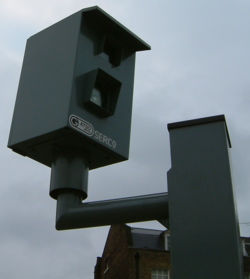
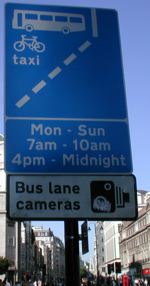
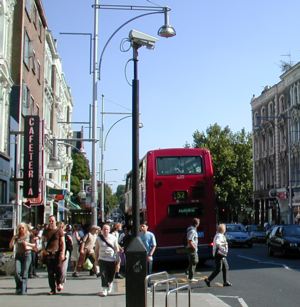
…and by companies whose surveillance footage states are increasingly reserving themselves the right to gain access to on demand…
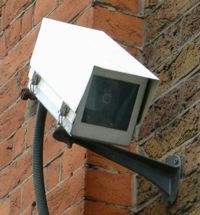
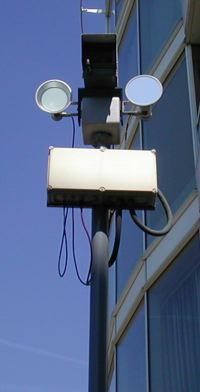
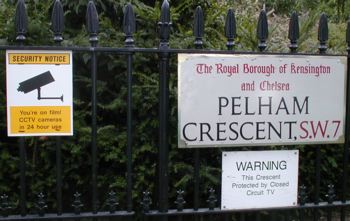
But the people who would like our every move recorded and subject to analysis are not fools. They would rather you did not actually notice what is before your very eyes and so we are seeing the second age of CCTV: more aesthetically pleasing and less intrusive cameras, rather than the stark utilitarian carrion crows which currently predominate…

…rounder, blending in with the background…
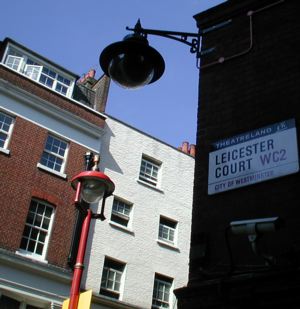
…looking more like the lighting fixtures than the all-seeing-eye.
The second age of security cameras is at hand…still quite literally staring you in the face, but increasingly hiding in plain sight, counting on a mixture of clever design and the fact that familiarity breeds contempt. But Big Brother is still watching, only with a little more style and taste now. That just makes it more dangerous.

From WorldNetDaily:
Congressional investigators say they can’t assure the public that individuals’ personal data is being adequately protected from unauthorized reading, alteration or disclosure.
In a survey of 25 federal agencies and departments, the General Accounting Office, the investigative arm of Congress, found a lack of compliance with the federal Privacy Act of 1974 significant enough to conclude “the government cannot assure the public that individual privacy rights are being protected.”
“Federal agencies are not following the law and, as a result, the personal data of citizens may be improperly collected and poorly protected,” Brase adds, “One system of records holds data on 290 million people. If that system happens to be one of the systems that’s out of compliance, the privacy rights of every citizen have already been violated, perhaps many times.”
This from Harry Mount in the Telegraph today, on speed cameras:
Speed cameras are no longer about safety – even the official at the Department of Transport, who I talked to yesterday, acknowledged, “We’re moving away from calling them safety cameras” – and all about raising cash. And when policemen’s eyes are full of pound signs, they can’t see whether your driving is dangerous, and they couldn’t care less, even when they claim otherwise.
It’s worth reading more of it of course, but that struck me as the killer para.
Silicon.com reports that David Blunkett is being called upon to incorporate his national ID card proposals into wider strategy to boost the adoption of smart cards for authenticating use of e-government services.
Concerns have been raised in a new policy framework on a ‘joined-up’ e-government smart card strategy issued by the e-Envoy this week that local and central government bodies will develop their own card schemes that will not be interoperable and result in people carrying a wallet full of different cards for different services. The document said:
The rollout and development of smart card schemes across the public sector has to date been somewhat fragmented and co-ordinated, resulting in duplication. If this continues, smart cards will not fulfil their potential to impact significantly on the e-government agenda and support e-commerce.
‘Multi-application’ cards have been touted by the e-Envoy for some time and another possibility put forward in the framework is the piggybacking of government services onto new or existing private sector schemes.
The Telegraph reports:
The introduction of identity cards is still some years away, Tony Blair indicated yesterday. Although he supported ID cards in principle, he said huge logistical and cost issues must be resolved.
In the long term it was right to move towards a system of ID cards. But it was not a quick fix for dealing with the influx of asylum seekers.
Mr Blair’s concerns are well-placed given Whitehall’s experience with less-ambitious IT projects.
The ID card is to be backed up by a “citizen’s database” on to which the details of 50 million people aged over 16 would have to be entered. The intention is to use biometric data – such as an iris recognition system – to verify a person’s identity. But this technology would be hugely expensive.
So no change of mind, just an administrative delay. In the meantime, we blog away…
|
Commentary
Economics
Politics
Specialist
Tech
|

