A sample text widget
Etiam pulvinar consectetur dolor sed malesuada. Ut convallis
euismod dolor nec pretium. Nunc ut tristique massa.
Nam sodales mi vitae dolor ullamcorper et vulputate enim accumsan.
Morbi orci magna, tincidunt vitae molestie nec, molestie at mi. Nulla nulla lorem,
suscipit in posuere in, interdum non magna.
|
Something tells me that HMG does not expect their proposed fox-hunting ban to be awfully popular with the country folk:
Police are planning to use spy cameras in the countryside to enforce a ban on fox hunting.
Chief constables intend to site CCTV cameras on hedgerows, fences and trees along known hunting routes to enable them to photograph hunt members who break the law after hunting with hounds is outlawed.
They used to warn that ‘walls have ears’. Now walls will have eyes as well. I suppose the panopticon countryside is nothing more than a logical extension of our panoptican cities. It is merely a matter of time before every workplace and every home is wired up to the Big Eye of Big Brother. Then the nightmare really begins.
There exist all manner of varying justifications for this surveillance-fever but there is only one reason that our political masters are deploying it with such alacrity: because they can.
The same technology that enables us to chatter with each other across national boundaries is being used to create a tightly-wrapped police state.
What a very, very grim future we face.
Cross-posted from Samizdata.net
Mayor of the City of Chicago has outlined elaborate camera network. The plan is to monitor the city a vast security network from a hi-tech command center. Thousands of surveillance cameras will be linked – and authorities will be alerted to crimes and terrorist acts.
Some people are concerned about “Big Brother” invading their privacy but Mayor Daley says the cameras will be located in public areas. The city’s plan is to route the live images provided by those cameras on the public way into a unified network piped into the 911 Center. There are well over 2,000 cameras that the city and its sister agencies – like the school system – monitor everyday. The city is adding another 250 cameras to potential high risk areas, most of them downtown.
That includes every city department. That includes the Chicago public schools, the CTA, city colleges. That includes the park district, any other sister agencies that have cameras out there.
Remind me exactly, how that is not Big Brother…
The Mayor retors:
You could photograph me walking down the street. They do it every day. I don’t object. You do it every day. You have that right. Why do you have that right?
Hm, I never thought that someone in his position would equate the rights of the individual (to take pictures in public places) to the ‘rights’ of the state (to monitor its citizens in public).

Department of Defense (DoD) Biometrics announced that it has released a new Biometrics 101 Tutorial video and a publication entitled What DoD Thinks of Biometrics on its website. Both informational pieces – designed to contribute to the DoD community’s understanding of biometrics – can be accessed here.
The Biometrics 101 Tutorial video is a collaborative effort between the National Defense University at Fort McNair, Washington D.C. and DoD Biometrics. Presented by Lieutenant Colonel Craig Kaucher (U.S. Army Ret.), the video provides an introduction to biometric technologies, basic concepts, and societal issues associated with biometrics.
I missed this one earlier in August about shoppers in Swansea joining a trial of a high-tech ID card that could become compulsory under Home Office plans. But better late than never.
Volunteers are being asked to have fingerprints, irises, and facial details recorded as part of the UK Passport Service (UKPS) trial. The experiment aims to weed out problems and get public feedback before the planned introduction date of 2007.
It is the only Welsh trial as the UK Passport Service looks for 10,000 volunteers across the UK over six months. Volunteers will get a demonstrator “smart card” containing their details on an electronic chip. It is planned to include biometrics (facial features) in passports and to build a base for the national compulsory identity cards scheme.
CNet news reports that when it comes to radio frequency identification tags for humans, the people have spoken. They hate it.
CNET News.com recently ran a report on companies with technologies that involve implanting RFID chips under people’s skin or inside a bracelet. Advocates say the tags could help paramedics deliver medical help to people in the field, reduce prison violence or give police a way to track victims of kidnapping, a major problem in Latin America.
The issue has united people with fairly strong religious beliefs and libertarian privacy advocates.
The fear that the technology will enable governments to keep tabs on everyone was the concern raised most often. Hypothetically, law enforcement agencies or even private security companies will be able to track where you’ve been, with whom you associate and what you own with this technology. Imagine a semiretired senior citizen in a rented maroon blazer knowing everything about your day.
A large number of letters also asserted that human RFID tags are a demonic tool.
There is much interesting stuff, read the whole thing.
During the 2003 fiscal year, the federal government spent more than $6.5 billion securing classified information, according to a new “Secrecy Report Card” from OpenTheGovernment.org, a coalition of government watchdog and civil liberties groups. That’s an increase of more than $800 million from the previous year, according to the group, and a nearly $2 billion jump since 2001. But it’s only a best guess, really; the report card’s accounting doesn’t include a penny from the Central Intelligence Agency, which keeps even its overall budget classified.
The big problem with having too many secrets isn’t that it’s a waste of money; it’s that it jeopardizes security, according to William Leonard. He’s the director of the ISOO, and, essentially, the man in charge of the government’s classification policies.
By keeping knowledgeable parties from sharing what they know, “secrecy guarantees a less-than-optimal outcome,” Leonard told Wired News. “In analyzing intelligence, in developing military plans, there’s a price that gets paid.”
That’s a view echoed by both the 9/11 Commission, in its final report (PDF), and several of the Defense Department’s top current and former spies.
ZDNet has an article about the implanted RDIF chips and the debate about its pros and cons.
Advocates of technologies like radio frequency identification tags say their potentially life-saving benefits far outweigh any Orwellian concerns about privacy. RFID tags sewn into clothing or even embedded under people’s skin could curb identity theft, help identify disaster victims and improve medical care.
Critics, however, say such technologies would make it easier for government agencies to track a person’s every movement and allow widespread invasion of privacy. Abuse could take countless other forms, including corporations surreptitiously identifying shoppers for relentless sales pitches. Critics also speculate about a day when people’s possessions will be tagged – allowing nosy subway riders with the right technology to examine the contents of nearby purses and backpacks.
The notion of embedding RFID tags in the human body, though, remained largely theoretical until the 11 September, 2001, terrorist attacks, when a technology executive saw firefighters writing their badge numbers on their arms so that they could be identified in case they became disfigured or trapped.
Richard Seelig, vice president of medical applications at security specialist Applied Digital Solutions, inserted a tracking tag in his own arm and told the company’s chief executive that it worked. A new product, the VeriChip, was born.
Washington Post has an article about a test project, which aims to give frequent fliers a quicker pass through security checkpoints, is underway at four US airports. It relies on the latest biometric technologies to verify a passenger’s identity with increased precision. Digital fingerprint scans and photographs are already used to identify foreigners traveling on a visa, and U.S. officials plan to encode a facial recognition technology into passports.
The program offers the first wide application of iris-scanning technology, which had previously been used only for government employees with access to classified sites or for employees with access to nuclear facilities, said Paul Mirenda, director of field operations for LG Electronics Inc., one of the TSA’s contractors that makes the scanners. The technology takes a close-up photograph of the iris, which has more unique characteristics than a fingerprint, and applies digital codes to the photograph to store it as a bar code. The photograph and fingerprint are then stored in a file along with other information about the passenger.
But some security experts worry that terrorists could apply to become a registered traveler and score an easier pass through security checkpoints. “If you look at 9/11 hijackers, some of them would have qualified as frequent fliers. All they had to do is run a few tests and find out what the parameters were and get people registered.”
Travelers who signed up for the program yesterday said they were impressed with the technology and were eager to be afforded special privileges at the checkpoint. None of the enrollees said they had a problem with providing the government with their personal information.
Mark Ellott has a thing or two to say about the Norwich Union’s pilot scheme for pay-as-you-drive motor insurance.
While we are sleepwalking into a surveillance society, the Norwich Union is egging us on… They are trialling a system of in-car monitoring (a black box by any other name) that records details of the vehicle’s journey. Where it went, how fast it travelled etc.
The box records real-time vehicle usage and sends the data to Norwich Union securely using mobile technology.
Each month or quarter, the motorist will receive a document similar to their mobile phone bill advising them of their journey details. Pay as you go insurance – sounds innocuous enough. During the BBC piece it was suggested that the monthly or quarterly bill may provide advice for improving the cost effectiveness of one’s driving (from an insurance point of view) by providing alternatives to the routes taken.
Even more worrying, perhaps is the quote from the Norwich Union director of the pay-as-you-drive scheme, Robert Ledger:
The interest in the pilot scheme has been phenomenal. We could have filled the pilot twice over with the amount of requests we’ve had from interested motorists, not just within the UK but from drivers around the world.
Sleepwalking indeed…
According to the BBC’s Breakfast programme, there is no clear indication yet about how the data will be stored, used and accessed – will the Norwich Union sell it? Will the police or other agencies have access to it? So far these are unanswered questions.
One motorist volunteer thinks this will give her control over her insurance costs. For a low mileage user, this may be so. For the rest of us? It is always worth remembering that insurance companies are not charities – they are investing in this because they see a revenue opportunity. Oh, how simple it all could be – analysing a driver’s record and declaring his insurance void due to, say driving several hours without a break or breaking the speed limit – or, just hiking the premium.
Personally, I prefer to control my insurance costs by playing them off against each other come renewal time.
New Scientist has an article looking at the US$312 million surveillance system installed for the 2004 Olympics in Athens. The eyes and ears consist of 1,000 high-res and infrared videocameras peppering the city. Cell and landline telephone calls are being recorded, converted into text, and “scanned for phrases that could be linked to terrorist activity.” The software’s developers say it speaks Greek, English, Arabic, Farsi, and other major languages.
John Pike [a defence analyst] believes other undisclosed measures are undoubtedly in place, such as face recognition from video footage. He says such surveillance technology has already proven its worth in intelligence gathering. “They’re basically the sort of stuff the National Security Agency has been using for some time,” he told New Scientist. “And they seem to place great faith in it.”
via Boing Boing
It was with something akin to delight that I saw the Times, not a newspaper overly concerned with civil liberties, have on its front page* an article about objections to Britain’s developing surveillance state.
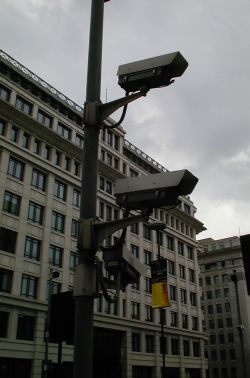
This is modern Britain
If we cannot get these issues out in the open, we will indeed see Britain ‘sleepwalking’ into what may some time in the future be a panoptic nightmare. Blair or Howard are not going to be having the security services doing ‘midnight knocks’ on the doors of those they disfavour (well, maybe for a few people in the Finsbury Park area) but make no mistake about it, the infrastructure of repression is being put in place at an astonishing rate and someday (hopefully long after I have decamped to New Hampshire) this information is going to be used by statists of both left and right with fewer qualms than Tony Blair to order every single aspect of people’s lives in Britain in ways that places the state at the centre of everything you do in ways earlier totalitarianisms could only dream of… for your own good, of course.
We have a serious battle to win and the more these issues are out of the committee rooms and in the more general public arena, the better we can argue the case for resisting the emerging Panopticon State.
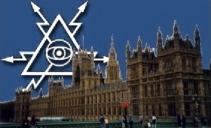
When the state watches you, dare to stare back
* = Readers outside the UK may have difficulties accessing this link once it is archived due to the benighted policies of the Times newspaper.
Biometric testing of face, eye and fingerprints could soon be used on every resident of the UK to create compulsory identity cards. BBC News Online’s Tom Geoghegan volunteered for a pilot scheme and looked, unblinking, into the future.
What was interesting about article that it is obvious that Home Office is trying to make the process as ‘palatable’ to people, so it is not too Big Brotherish…
This isn’t a test of the technology – that’s likely to change in the future as things move on – it’s the process. We’re looking for customer reactions and perceptions, and any particular difficulties.
Just don’t make it feel like Big Brother although that’s what you’ll be getting.
|
Commentary
Economics
Politics
Specialist
Tech
|

