A sample text widget
Etiam pulvinar consectetur dolor sed malesuada. Ut convallis
euismod dolor nec pretium. Nunc ut tristique massa.
Nam sodales mi vitae dolor ullamcorper et vulputate enim accumsan.
Morbi orci magna, tincidunt vitae molestie nec, molestie at mi. Nulla nulla lorem,
suscipit in posuere in, interdum non magna.
|
Well, I had to return to normality eventually. I have just come back with the new Mrs Pearce from Mauritius, an island in the Indian Ocean lying off the east coast of Africa and south of the Equator. An extremely interesting island with a mixed history and a heady brew of different cultures, part Anglosphere, part French, part Indian and part African.(Here is a good collection of literature linked to it). About 11 hours direct flying time from London, the island is pretty much geared these days as a “romantic destination in the tropics”. I liked the place and its people a lot as we travelled around the various nature parks, looking at the coral reefs, the fish, birdlife and assorted animals. If I have one grumble it is that, much to my amazement, the whole island is besotted with English football. Egads, I go all this way and they are still raving about the World Cup.
It is funny what sticks in the mind, often completely unexpected. I discovered that the island produces some of the finest and most fantastically detailed model boats I have ever seen. You can, for a fraction of what it would cost in Britain, buy a scale model wooden Victory, or Constitution, or Sovereign of the Seas, or an America’s Cup racer, WW2 battleship, cruiser or Blue Riband liner. There is a substantial industry of locals churning out these boats. The Napoleonic era – when Mauritius was seized by the British from the French – seems to provide the inspiration for most of the models. Unable to resist – I am an amateur sailor anyway – my wife and I bought a model of the 1840s U.S. schooner Albatros, now sitting proudly on the mantelpiece. Hardwoods are the base for much of the boats that are made and as a result, will last for years. The detailing on the rigging, sails, tiny cannon and masts are incredible. (Okay, I am an overgrown boy at heart).
And of course while on the island I read Patrick O’Brien’s The Mauritius Command. For a moment, sitting on the beach sipping a beer, I thought I saw Lucky Jack Aubrey walking along, staring out to sea to spot French raiders…
Anyway, it has been good to give blogging a miss for a while and re-charge the writing batteries. Thanks to everyone for their good wishes and messages. I really appreciate it.
The refrain that “environmentalism is the new religion” is common enough, and there is much truth in such a statement. Several years ago, when I was a confused, largely ignorant and idealistic socialist – thus environmentalist – someone (who was also partly responsible for my enlightenment) challenged me to consider the way I critically analyse the various doomsday statements environmentalists were and are prone to making. Even then, in a deep state of group-think, I had to admit to myself that the illiterate peasants of 16th century Europe probably responded to their priests’ exhortations in a similar way.
However, why is this? As a species, most of us are profoundly limited to our own tiny perspectives. For example, we look out over what is actually a gleaming Western city of unparalleled cleanliness, temporarily cloaked in off-coloured smoke caused by a transient climatic event known as a temperature inversion. This event gets us thinking. We think about how we live in only one of a great many cities. Many cities are bigger than ours and many cities are dirtier than ours. Our city is so ugly right now – imagine what effect this ugliness, multiplied across the world, is having on ‘the environment’. It looks bad here, and there must be a lot worse elsewhere. What is the cumulative effect of all this ugliness? It must be appalling. We are ruining our environment.
Of course, such considerations ignore the phenomenal machinations of the earth’s natural processes which dwarf our own so-called ‘footprint’. For all our technological advances, if humankind were to be deleted from the planet overnight, I believe our impact on the surface of the earth would be more or less completely erased within half a millennium – the blink of an eye in terms of this planet’s history. Our earth’s environment is durable because it’s been forged by billions of years of evolution. However, we humans only have an interest in our short lifespans. A priest tells you the marauding army that swept through your village, raped your wife and burnt your house is down to the fact that you have sinned by not obeying some political expedience which nevertheless failed to appear in the popularly-unread bible. An environmentalist tells you your dirty city – as evidenced by an unsightly, temporary smog or something similar – is destroying the earth, despite the fact that the science your environmentalist stakes their legitimacy on is less than kind to such a thesis. Both scenarios resonate with a huge number of individuals in their respective ages.
Humanity’s limited perspectives are a terrifying prospect, and today the most threatening manifestation of this can be found in the widespread acceptance of the environmentalist movement and its demands. We hear environmentalists claiming to act in the names of their unborn children and grandchildren, yet so many of the rest of us do not realise that if their demands were played out to a logical conclusion, the children of tomorrow would be considerably less comfortable; their future considerably less secure than at present.
And here I am, stumped by my own meagre perspective. I am an individual butting against the forces of vast armies who pressure and reassure each other into forwarding a creed I know will be ruinous for our species. They appear to be gaining a considerable amount of traction. How could I, an individual who firmly believes in the power of individuals, combat such a homogenous tide? Where to start, for starters. One thing I am sure of, however – the natural earth will go on, regardless of whether we decide to consign ourselves to misery and decline in our efforts to ensure that fact.
Articles often reveal more about their author than their subject. A case in point is a fairly bizarre article by Martin Samuel in the Times. He writes about US warships being named to commemorate the 9/11 atrocities and moreover being contructed in part using steel salvaged from the WTC (I have no idea if this is true but I will take his word for it). He then goes on to say:
The ships would commemorate the attacks, if that is the right word, which it is plainly not.
If a warship named after something does not thereby ‘commemorate’ it, then what is the right word?
Exactly what is being commemorated anyway? Not the memory of the victims, as nothing is known of how they want to be remembered, and certainly not whether they would wish a warship to be dedicated in their name.
And so by that logic, the cenotaph in Whitehall and all those Great War memorials in almost every town and village in the UK do not ‘commemorate’ the victims of Britain’s various wars either, unless a Ouija board was used to conduct a post-mortem opinion poll of Britain’s war dead to see how they might like to be remembered. Or perhaps, seeing as how we British are so much more insightful than those funny Americans, the wise old Ministry of Defence as a matter of policy asks all servicemen “In the event you buy the farm for Queen and Country in some godforsaken hole we sent you to, what sort of edifice would you like us to use to commemorate your demise?”
Who knows in which direction their anger would be channelled? It could be that some of the dead might have thought over-reliance on warships was their downfall in the first place.
Well call me presumptuous if you like but from what I know of human nature in general and Americans in particular, my money is on the hypothetical post-mortem anger of 9/11’s victims being directed at the sons of bitches who murdered them, rather than at Presidents Clinton or Bush or the US Navy. Just a guess mind you.
While not excusing wicked acts committed by terrorists, it would be foolish to view the behaviour of terrorists as motiveless. If we regard terrorism as the work of madmen and unrelated to our relationship with their world, we learn nothing from history.
I love it when ‘sophisticated’ and ‘nuanced’ Brits and Europeans lecture Americans about history, given the millions and millions of corpses littered across Europe within living memory. Attacks by people from abroad are caused by interventionist foreign policies, clever Mr. Samuel tells us, with his wise Old World perspectives, which of course explains how places like Poland, Belgium, Denmark, Norway, Greece, Czechoslovakia etc. managed to sit out World War II in peace by minding their own business.
Moreover whilst nothing is guaranteed in this life, as close to certainty as you may ever come is when someone says “While not excusing wicked acts committed by terrorists…” they are about to do exactly that.
His entire article tells us nothing about America, American foreign policy, the people who committed mass murder on 9/11, the people who died on 9/11 or even how to commemorate the untimely dead. All his article tells us is that Martin Samuel neither likes nor understands Americans. It also reveals that unlike many in the Muslim world whose perpectives have changed considerably since that fateful day in 2001, it is Martin Samuel who has a very poor understanding of cause and effect.
On a recent trip to the English city to Sheffield I was reminded of the cause of our problem with the growth of statism – and the threat it poses to civilization.
The purpose of my visit was to meet up with an old friend, be shown round the centre of the city (some interesting buildings, and good parks in walking distance – offering a fine view of the city) and to go out into the hills over the Yorkshire border in Derbyshire (fine hills right next to the road).
However, there was a sale at the central library in Sheffield and we visited it. Library sales are a common thing in Britain, to “make space for new books” – but also to get rid of books that are no longer tolerated, without having to actually destroy them (book burning is still considered a thing to be avoided). One of the works on sale was the four volume ‘The Science of Society’ produced by William Graham Sumner Associates at Yale in 1927 (Sumner himself having died in 1910). The four volume work was on sale for a Pound (no surprise – I was got a 1949 edition of Human Action for ten pence from a British Library sale).
In those days, even at an elite University like Yale, it was still not uncommon for academics to be free market folk and Sumner had been the best known pro freedom sociologist in the United States. The Sumner club carried on Sumner’s opinions and was to provide resistance to President Roosevelt and the other “New Dealers” in the 1930’s. So one would expect a scholarly examination of the customs of various societies (in those days the lines between sociology and anthropology were less rigid), but an examination from a pro private property point of view. Just as modern examinations are scholarly, but written from a point of view which favours violations of private property.
Well what is there?
The first thing I noticed I was expecting – the evolutionist philosophy. Just as with Hayek, private property is not supported as a matter of metaphysical (by ‘metaphysical’ I mean something that does not depend on material advantage, i.e. something that is supported on principle – Hayek’s talk of rights in the Road to Serfdom is lip surface, Hayek neither believed in metaphysical rights or even free will).
Private property is supported because it is good for society – a larger population can be sustained over the long term, and all sorts of development can occur. Cultural evolution is an older idea than biological evolution. Work on the evolution of such social institutions as language goes back to at least the 18th century. → Continue reading: How a trip to Sheffield reminded me of the cause of our problem
Ever read something you wrote not all that long ago and pondered how you could have got it so epically wrong? Take this article I wrote last year about forcing the Middle East into a strategic decline. My prescription? Government action – tax breaks, subsidies, strategic state investment; a Keynesian smorgasbord. Ugh! Why did I not think this through more fully? Five years of sky-high oil prices will go an awful long way towards solving the problems mentioned in the article, courtesy of the market. No government meddling required. As it happens, I submitted the essay for a university assignment and received a pleasing mark. A bit regrettable that I felt sticking the bloody thing up around this rather more intellectually rigorous domain was a good idea.
Gary Jason – a writer I had not heard of before, has an interesting review about a book chronicling how filthy rich some prominent American leftists are. The usual collection of intellectual gargoyles are on show: Ralph Nader, Nancy Pelosi and Michael Moore. I must admit I was taken aback as to how much money Nader is worth, although that is probably my naivete. Jason asks the interesting question about how leftists who decry business are so easy with a life of affluence, and takes a stab at a few answers.
For example, I rather liked this paragraph:
I suspect that there is also a subtler phenomenon at work, one that I would call “warding off the evil eye.” I suspect that some successful people — here I have in mind certain businessmen who have become enormously rich — fear that the envious lower classes will possibly do them harm. Considering the long history of class warfare politics, this is not an irrational fear. To ward off envy, these captains of industry make a conspicuous show of being kind and caring, setting up foundations that prominently feature their names.
This sort of ground has been trodden a few times before. What intrigues me is why there are so few seriously, stinkingly, rich folk on the libertarian side of the street, so to speak. There are a few libertarian friends of mine with decent jobs, nice houses; some have inherited fairly serious money and do not have to work; but I don’t know any of our number who has the sort of wealth described in Jason’s book review. It is a paradox that celebrants of capitalism and market economics are often on their uppers, financially, in my experience, although my impressions are just that, impressions.
I guess it may be partly down to the fact that folk who are good at handling ideas and making arguments for this and that tend not to have the sort of skills to make pots of money. It may also be that, in today’s largely corporate world, being known as a holder of controversial ideas (such as legalising heroin, zero state welfare, etc) is not good for the prospects of a person trying to clamber up the corporate ladder. And if a person wants to create their own business, they tend not to have the time to ponder the Big Questions, write The Road To Serfdom or Atlas Shrugged.
Even so, it remains for me a bit of a puzzle why so few of us are not rolling in cash, given our views about the benefits of the marketplace.
On a related theme, I can recommend this article on why intellectuals often hate capitalism, by the late Harvard University professor, Robert Nozick, and this book, by Ludwig von Mises.
There are few topics in the world that get people heated up more then immigration, and in both Australia and the United States, societies that have been built by mass immigration, the topic is in the news.
In the United States, the question is based more on what to do about the millions of illegal immigrants that have consistently been keen to seek opportunity in that great country, and have taken the dubious path of avoiding the proper legal channels to do so. In ordinary times this would not have been such an issue. However, since 2001 the United States has become naturally very sensitive about who enters its borders. I am actually surprised that it has taken this long to surface.
The United States immigration question is particularly interesting. You might think that a society that has built itself on mass immigration would be in favour of more immigration, but this is not the case, and generally never has been the case. In general immigration is tolerated, rather then actively embraced by the general populace, but when times get tough, the political mood can turn quite quickly on newcomers. This was as true in the recession of 1819 as it is today.
This is because the costs of immigration are felt and paid for by individuals, but the benefits of immigration are diffuse and spread right across society. It is a shame that many defenders of the right of the free movement of people refuse to admit that there are costs to immigration. The worker who finds his wages undercut or loses his job entirely, or the victim of violence or the householder who finds his property values eroded is naturally going to feel distressed and angry at what he or she sees as the ‘cause’ of his or her loss. People find themselves surrounded by people of different appearance, religion, and cultural conditions, and worry about how the newcomers will assimilate. → Continue reading: Three cheers for immigrants!
Have a glorious and happy Easter.
More official exhortation from the British state. This a poster on the underground.
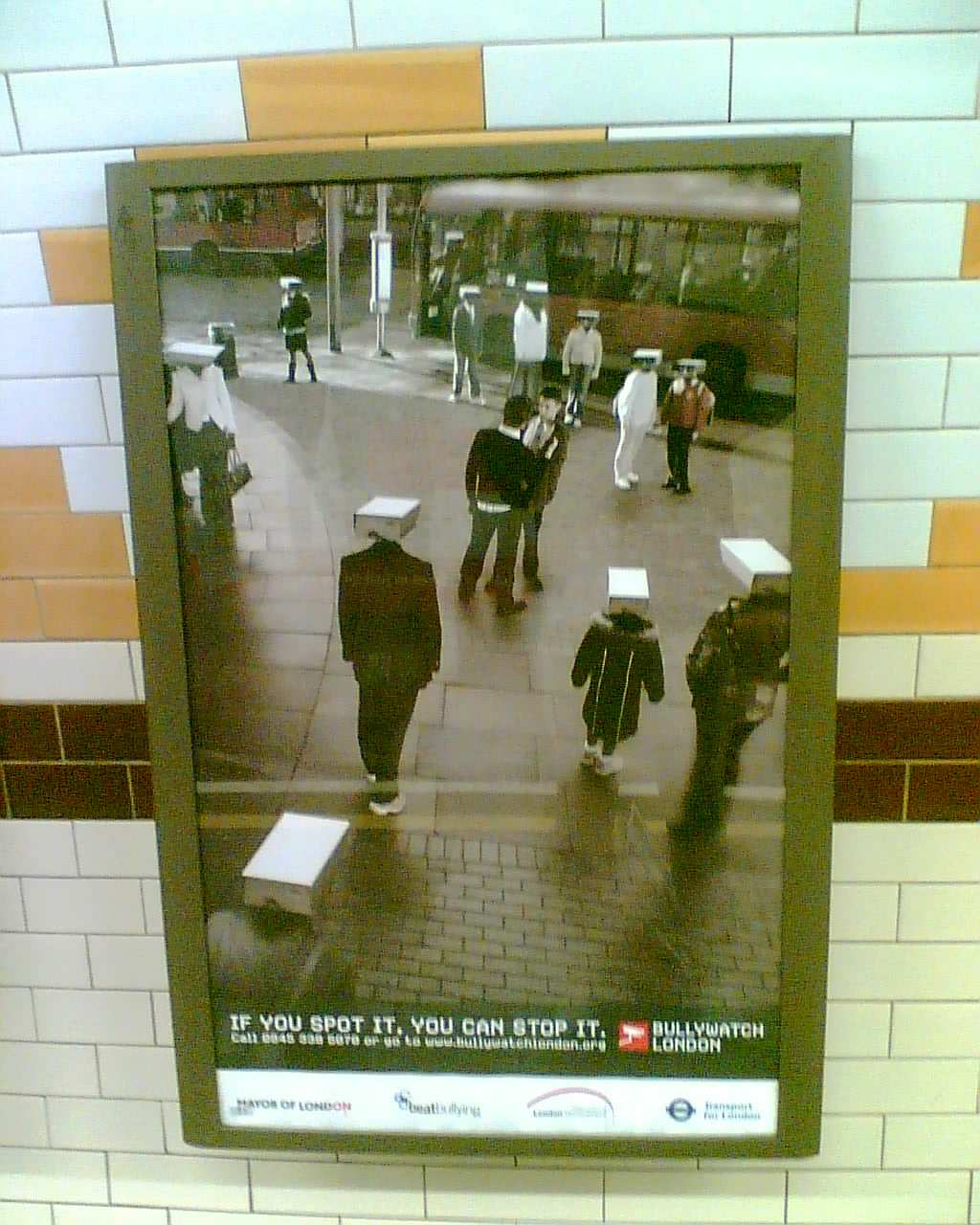
Quite an interesting case, I think, because it isn’t the standard minatory approach: Do X as the Y agency demands, or get a big fine. This has the superficially laudable object of preventing children from bullying one another.
You may think (I do) that it ought to be unnecessary to urge people to protect children against bullies, and that this is not a suitable topic for state propaganda – that most adults could be counted on to intervene as a matter of ordinary humanity. But that reckons without the passivity and inanition fostered by 60 years of welfarism, and 30 years or so of ‘child protection’ doctrine under which speaking roughly to a little boy (let alone touching him), makes one the wickedest of criminals. You might have to work on people these days to get them to do something.
But plainly that isn’t the object of the exercise here. This ad doesn’t encourage people to stop bullying. For all the empty vapourings about ‘active citizenship’ (See here for an example of the Government propaganda on that topic that is churned out by notionally independent organisations), nothing may undermine the dependency culture. What this campaign is for is to get people to report incidents they think might be bullying to the authorities. There is a website and a subsidised telephone line for you to do so.
It is obviously impossible that this could help the unfortunate smaller boy. One has to conclude that isn’t really the point. The point is to get members of the public to adopt official attitudes, and engrain them by providing a mechanism to rehearse, to act out, concern. It is for to prove you are a compliant member of society by watching others carefully and reporting deviant behaviour. The state will deal with the problem, however minor, however fleeting, however apparently amenable to personal decision.
I don’t think that this is a deliberate, explicit project. I think it is a natural outcome of the cultural assumptions of those who commission such ads. We are not just supposed to love the surveillance camera, but to identify with it. The ideal citizen is a passive tool that reports back as requested; that fits in with the total bureaucracy’s demand for record.
For those of us – left and right – who still hold to the western liberal tradition of individual moral responsibility, this is a sickening, vertiginous conception of social life. The life of ants, not human beings. For those who are broadly conservative communitarians – right and left – who would like embedded institutions, direct relationships and personal responsibilities to dominate, likewise. The possibility that we may – all taken together – be in the minority should be a source of terror.
Secure beneath the watching eyes? Not in the slightest, me.
Recently I had the pleasure of watching a Zulu choir perform the South African national anthem. Even though mostly incomprehensible to me, it was incredibly moving – perfectly combining the men’s deep basses and baritones with the higher ranges of the female vocalists. The South Africans are lucky to have such an inspiring anthem, although the version linked here is not the best rendition around.
The Russian anthem is also particularly stirring, if you can overlook the Soviet connection regarding the tune. I didn’t much care for the Chinese national song the first time I heard it, but it grew on me. The lyrics of the Star Spangled Banner are poetically pleasing, if a little thematically blood spattered in the lesser known verses.
As for the not-so-good anthems, I think Australia’s is down there. Tedious lyrics, boring tune. Britain’s is somewhat lacking, too; as a symbol of the nation, an anthem should do more than just beseech God to look out for the monarch. Granted, the monarch is a symbol of the nation too, but it is arguably an outdated, practically irrelevant symbol. I am sure there are far more miserable anthems than those two – give us your worst!
UPDATE: I do not mean to gloat, but oh dear.
There has been much gnashing of teeth at the death of Slobodan Milosevich. Apparently justice was not served. So what is justice? The man was ignominiously removed from his position of authority, forced to cower in safe houses until the time came when his people sold him out because they valued engagement with the outside world more than his worthless hide. He spent the rest of his days in a prison cell interspersed with trial appointments at a court with questionable legitimacy. He is dead now. If there were any direct positive benefits culminating from his rule, they will almost universally be forgotten and at the very least massively overshadowed. Those that openly claim to admire him will be shunned by wider society. Billions upon billions will learn of him and regard him odiously, even though he died before their birth. History will curse his existence – each and every unchoking breath he took upon this earth.
Hitler was never tried. Does anyone lament this fact? What do people like Hitler or Milosevich gain by not being tried after their downfall?
‘Humbug’ wrote an e-mail to Samizdata regarding the Free Expression versus Islamic intolerance issue that takes a more introspective view
I do not know why I am wasting my time waiting for Hollywood or anyone in the music industry to come out and stand up for free speech. Here we have a global conflict that will forever impact our future and these ‘sophisticated elites’ are hiding behind the gates in their upscale neighborhoods. The ‘shocking’ photo of the dull Kanye West or the equally ‘provocative’ photo of Madonna as The Madonna are simply boring.
Of course neither of them would ever dare pose as Mohammed or appear wearing a burqa. Heck no, that would not be the run of the mill, piss off the parents material, that might actually get them a fatwa.
Eminem, likewise would never dare insult the ‘one who must not be seen’. No, he will stick with making fun of groups where the penalty is merely a slap on the wrist, like homosexuals and women. Michael Moore we can all forget about it, just as we can forget about the Dixie Chicks. The problem here is that standing up for free speech in this case, does not involve Bush bashing and it actually takes courage to fight this battle. With icons like these, who needs an invading army?
But then, I am just repeating what many have already said.
Update: however Lil’ Kim shows the correct way to wear a burqa
|
Commentary
Economics
Politics
Specialist
Tech
|