We are developing the social individualist meta-context for the future. From the very serious to the extremely frivolous... lets see what is on the mind of the Samizdata people.
Samizdata, derived from Samizdat /n. - a system of clandestine publication of banned literature in the USSR [Russ.,= self-publishing house]
|
Whenever I write about something touching on my experience of communism, I get a few kind commenters encouraging me to share more of it. I rarely do so, as busy life takes over. Still, today I managed to post an article on my other blog, Media Influencer, that I felt was perhaps not coherent enough or too personal for Samizdata.net. For those interested, follow the bananas…
There are some things that most people know (or think they know) about the British book trade. For example that books are very expensive compared to some other places, and that buying a paperback can be unwise – due to the system of “perfect binding” where the pages are just stuck on to the spine, so they fall out if one actually reads the book a few times.
However, I do not wish to examine such points here. I wish to point out the simple leftism of the book trade. This may seem a predictable whine from a libertarian like me, but it is more than a whine.
Recently I read a review of Robert Conquest’s Dragons of Expectation in The Economist.
The review claimed that Conquest did not understand that his side now dominated the world. If by “his side” the review meant anti-Marxism, this domination does not seem to be in evidence in universities (or, in terms of attitudes, in most of the electronic media and much of the print media in the Western world – let alone in such places as Latin American governments), but let us leave that aside.
I went to bookshop after bookshop in search of Robert Conquest’s work. Borders, Waterstones, W.H. Smith – you name the shop, no book.
“But you could order the book or get via the internet” – but why should I have to?
Why should a work by the leading historian of Soviet Russia (the author of “The Terror” and other works) not be found on the shelves, so that I can have a look at it and decide whether I want to buy it? In fact none of Robert Conquest’s works were on the shelves of the bookshops of whatever town I happened to be in (London, Bolton, Manchester, York, Kettering – it did not matter what town). And remember Robert Conquest is not a radical libertarian – he is just a historian who did more than any other to expose the crimes of the Marxists.
Take the example of Borders in York – wall to wall Noam Chomsky. Literally wall to wall – a whole shelf full of his political writings (not his writings on the basis of language) and books on the next shelf to. And (of course) the endless works of M. Moore, and all the rest of the ‘death to Bush’ crowd.
Now I am no fan of President Bush, he has gone along with greater increases in domestic government spending than any President since Richard Nixon (and Mr Nixon had the excuse of a Democratic party controlled Congress). But the legion of Bush haters one finds in the book shops do not attack ‘No Child Left Behind’ or the Medicare extension or all the rest of the wild spending.
When they attack his foreign policy they do not understand that it is (for better or worse) a continuation of the policy of such men as President Wilson – i.e. an effort to impose democracy overseas. They present the whole policy as an effort to line the pockets of business contractors – or to impose Christianity in place of Islam. And when the authors discuss domestic policy they present a mythical anti-Welfare State pro-free enterprise President Bush.
Just as works on British politics present a free enterprise Mr Blair – rather than the real one of higher taxes, higher government spending and more regulations.
“Such ideas may be absurd, but they are the books that sell and book stores are in business to make a profit”.
How do they know that these will be the only books that will sell when they hardly ever advertise anti-statist books? Certainly there will sometimes be a promotion for an anti-statist book (such as the recent Mao: The Unknown Story – although this work seems to blame Mao as a man, rather than socialism as a doctrine for what happened in China), but this is very rare.
If one sees the notice “We Recommend” or “We Highly Recommend” on or near a book, it is a fairly safe bet that the book is bad – full of factual errors and written by someone who would like to nationalize the bookshop and send its shareholders to the death camps [editors note: there are solutions to this].
I am not even sure that such books do sell well. After all, if this so, who does one see (every sale time) great piles of leftist books on sale at half price (or less). I say again, how do the book shop people know that British people do not want to buy anti-leftist books in economics, history, philosophy and politics when such books are hardly ever promoted and are mostly simply not on the shelves?
A person who comes into a bookshop (rather than buys over the internet) is there to see what sort of books are about in areas of knowledge that he is interested in. To physically touch and look at these books – to see what he might like to buy (rather than just trust reviews). And yet a person who entered a British bookshop would encounter (for example) in economics just establishment Keynesianism (with all the standard absurdities, such as the doctrine that an increase in government spending financed by credit expansion boasts long term income) and Marxist (or Marxiod) attacks on Keynesianism. Chicago school works are very rare and Austrian school works virtually non-existent.
The “passing trade” – the people (like me) who often go into book shops to look at books, just can not find works we want to buy. Someone who is not committed politically will find very little in British book shops to challenge the left and open new possibilities to him. And someone who already knows what he wants may as well go straight to the internet (after all the books are not going to be in the bookshop).
“Anti-statist books do not sell” – really? Or is it that British bookshops are dominated by people educated in the universities and these universities are strongholds of the left?
There will be token non-leftist books in the bookshops – but the weight of the left is overwhelming, and I very much doubt that he it has much to do with what sells.
Stepping out of the Hyatt in Istanbul yesterday morning to the sound of the muezzins calling to prayer, an ancestral shudder came over me. The chant was alien but not insignificant. I grew up with tales of Turkish invaders ravishing my country’s land and no doubt many a fair maiden (no wonder that my eyes have a hint of almond shape). It was the buffer zone between the Ottoman Empire and the West and had endured the waves of invasions by Avars, Tartars and Turks throughout its history. There are many castles in Slovakia, each with its own story of siege and resistance to tell, which have become part of the fabric of the nation and its folklore.
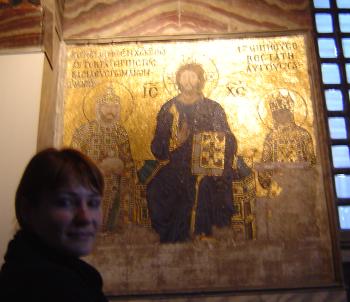
I did not expect Istanbul to remind me of all this. I came here from an entirely different direction – to find whatever traces of Constantinople still remain. Hagia Sofia was to be the highlight of my visit. As a child I remember leafing through my mother’s books on history of art and two pictures made a profound impression on me – Sainte-Chapelle and Hagia Sofia. I promised myself that one day I would see them, no matter what. This was no mean feat for a 10-year old living in deep communism, with not much hope of ever getting as far as the other side of the Danube to Austria. But one lives and dreams.
So when I was invited to speak at a conference in Istanbul, I accepted. Time to see Hagia Sofia, I thought. I was very much looking forward to it, expecting the Byzantine shine through the ages of the Islamic. The entrance was grandiose and reminded me of old cathedrals, with rough walls and majestic ceilings. Once I stepped inside the main nave, there was no magic for me. It was dark and gloomy but I usually do not mind that. It struck me as dilapidated and forgotten, the calligraphic roundels with Arabic script the victor’s graffiti stuck on to mark his prize winnings. There are still marks on the wall where the original crosses were ripped out.


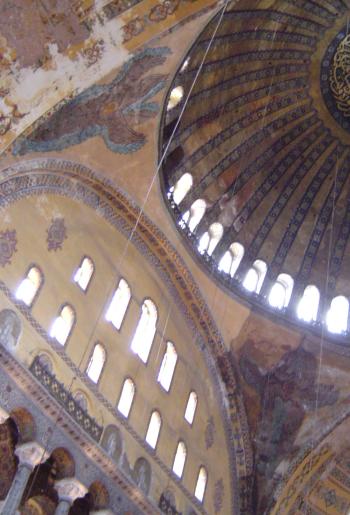
I wondered around for a while trying to unwrap the beauty of the place. I did find the magic in the end. The mosaics are exquisite and one has to gasp at the image of the entire church decorated with them. The great dome used to be covered in golden mosaic and the tinkling sound of pieces dropping to the ground was familiar to visitors until 19th century.
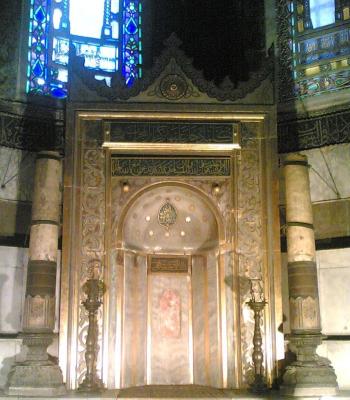
Above the mihrab, the niche indicating the direction of Mecca, is a striking mosaic of the Virgin with the infant and on its right, of Archangel Gabriel.
Mosaics of six-winged seraphim adorn four corners of the dome. They contrast strangely with minbar (imam’s pulpit) and other features added by Ottoman sultans after the conquest of Istanbul in 1453, when the church was converted into a mosque.
For various reasons I am reminded of a line from Kingdom of Heaven, although not the greatest film ever made, sums up the difference between Islam and Christianity – Mohammed says submit, Jesus says choose. And whether you are a believer or an atheist, there is no denying that this difference has affected the way the two cultures have gone.
The recent death of the footballer George Best has seen an outpouring of sentimental remembrance about the skill and talent of one of Britain’s greatest ever footballers. It has also seen a sober reflection of the darker side of Best’s life. As Sue Mott pointed out:
As a sportsman, he was ruinously worshipped as a god. As society’s golden boy, gloriously handsome, funny and highly intelligent, he enjoyed all life’s little luxuries in conveyor-belt quantities. He was a Hollywood film star from Belfast and while we may now lament the wine, women and song, if you had been there at the time, could you have been the one to say: ‘Shall we put the cork back in the champagne, George, I think we’ve had enough?”
It is a common theme of society that those who are blessed with extraordinary talents at one discipline are allowed special leeway in manners, morals and behaviour that are not bestowed upon lesser mortals. Had Best not been such a great footballer he would undoubtedly have been shunned by society as a drunk and a lecher. But because he was once a truly great footballer, he was treated as something different. People tolerated his drunkenness and women gave themselves to him sexually because he was genuinely seen as being cut from a higher cloth then other men. This may seem unfair, and in a way it is, but it was also the root of his downfall.
George Best, and footballers in general, though, are hardly the only sort of celebrity to take advantage of the special rules of society that are afforded to those touched by genius. And it has been going on for a long time.
Nearly 200 years ago, the poet Lord Byron made use of his fame as a poet to indulge himself in all manner of peccadillos, most of them sexual. That was perhaps not so uncommon for a Peer of the Realm back then, but it was mirrored by the behaviour of Percy Bysshe Shelley. A more dramatic example is in the personal life of Ludwig van Beethoven. Poor health, deafness, depression, loneliness and financial troubles made him a very difficult man to deal with, but he was indulged by many people precisely because he was obviously the greatest musical talent of his day.
Poets and classical composers do not have the influence on society in this day and age as they used to. The place of Byron and Beethoven has been taken by sports stars and actors and television celebrities. Some of these people, like Shane Warne are as gifted in his field as Byron was as a poet; and Warne has been noted for womanising on a considerable scale as well. Some are, in sober fact, non-entities, but we live in a vacuous time where everyone gets their ‘fifteen minutes of fame’.
Many not so talented people have also exploited their celebrity to get away with actions that would not be tolerated in others; Hollywood is of course notorious for this sort of thing, where actors and actresses have their notions of their own worth and talent over-inflated by agents, publicists, and the media. A similar fate has befallen many popular musicians over the last forty years. This sort of bad behaviour takes many forms, not just in terms of sexual self-indulgence, but substance abuse, or simply by being a difficult and unpleasant person to be around. The life and times of John Lennon reflect this- he confused his musical talent with wisdom, and spent his latter years pontificating about a society of which his understanding of seems have been very limited indeed. However, because he was such a fine musical talent, no one was willing to stand up to Lennon and tell him that he was talking nonsense.
Why? Why do we allow this select group of people, not all of whom are that talented, to get away with this sort of thing. Why can’t we “put the cork back in the champagne” as it were? There seems to be something innate to many people who must feel that they can reflect the glory of the star’s achievements by indulging them in their foibles. This can not be healthy for us any more then it is healthy for the stars. Just look at George Best now.
Poor old Harold Pinter gets a brutal ritualised kicking from the Samizdata commentariat here, and he’s not even a Muslim. This (and a dig from Perry) suggests I should amplify my comments on that article, which (as ever) have been willfully misunderstood.
I am with ‘Modesty Blaise’ in thinking Pinter overrated as a playwright, but can not help feeling that it is just a bit unreasonable to attack him for being Pinter even when what he says is pungently expressed fair comment. Fate has twisted the knife in the June 20th Group quite enough by landing them with Blair. Be careful what you wish for.
The occasion is this dictum in a letter of support for the anti-Bush group, The World Can’t Wait:
“The Bush administration is the most dangerous force that has ever existed. It is more dangerous than Nazi Germany because of the range and depth of its activities and intentions worldwide.”
He may be mad, but he is half right for half of the right reasons. It is just the reasons and conclusions don’t match up very much. He wants to hate Bush’s America by hook or crook. Rather as some of our commentariat want to love it and hate its opponents.
A pithy barb ought to make one think, not produce a spiteful reflex. American hegemony is not a bad thing in itself (pace Pinter). Capitalism is generally a force for good in human lives. But capitalism is full of discomforts (some of which Marxists hopefully identify as contradictions). And plenty of disastrous things have been done, and are being done, with American power in the world.
The Bush administration’s combination of complete lack of doubt in its righteousness and unrivalled global dominance does make it dangerous, in the sense of hazardous, whether or not this or that particular action is good-hearted or objectively a Good Thing. In that sense, it is much more dangerous than Nazism. Because it is powerful, and unrivalled, a determination to use that power unrestrained can dominate the world in a way that was impossible for the Nazis.
I am not equating Bushism with Nazism. I am saying that Bush has greater power for good or evil in its hands than Hitler ever had. There is nowhere to hide from evils promoted by America. A straightforward, and here uncontroversial, example is the War on Drugs. → Continue reading: ‘The Left’ are sometimes right
I know this post is not ‘on topic’ in these days of Islam casting its shadow over the Western society but it is tonight I am watching Doctor Zhivago.
I remember reading the book by Boris Pasternak in 1980s, as a teenager. I got only about 70% of it because I was too young. Despite the fact that I was living in deep communism. I guess that was the reason I understood even that much of the story, at the tender age of 14… Never mind the love story – it is the backdrop that interests me. The Russian Revolution of 1918.
The film shows the destraction of an individual, educated and sensitive, a doctor and a poet. Not a perfect human being by far, who loved his country and saw it and his life rent apart by a brutal change, his loved ones in danger and all he treasured destroyed.
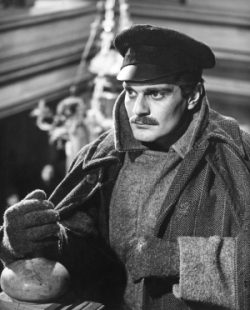
Let me relay some snippets that I found memorable.
Zhivago’s house in Moscow has been taken over by the local Soviet run by two sour-faced comrades. They tell him, reproachfully, that there is room for 13 families there. He says: In that case, this is a better arrangement. More just…
Doctor Yuri Zhivago was a member of the Russian intelligentsia and believed that there was a need for reform of the country. At the start, he saw the Communist Party as performing a deep operation cutting out a cancerous tumour. Today he probably would be reading the Guardian or the New York Times calling himself a progressive. A bleeding heart liberal, perhaps. But Pasternak puts the Zhivago character through the reality of a dystopia coming true.
There is a conversation between Doctor Zhivago and Strelnikov, a commander of the Red Guard of legendary reputation, the scourge of the country.
Strelnikov: Are you the poet? I used to admire poetry, it’s so personal, the flight of affections and humanity. Personal life is dead in Russia. I can see how you could hate me.
Zhivago: The fact I hate you, does not mean I want to kill you.
And later in the same conversation:
Zhivago: You burnt the wrong village.
Strelnikov [agitated]: A village is burnt, the point is made.
Yes, I remember the stern self-righteousness (or more accurately a psychotic moral high-ground), the fragile power that many experienced until they were the next batch to be devoured by the monstrous system. The glorious Party, the Workers, the Justice, Equality and the Better Tomorrow… airbrush the Gulags and you have the Guardianistas…
And then there is the nihilism of the ‘revolutionaries’.
Tonya’s (Zhivago’s wife) father: They shot the czar and all his family… [exclaims] What’s it for?
Zhivago: To show that there is no going back…
A young boy is found dying in the field after the attack of the partisans who kidnapped Zhivago for his medical expertise. The boy dies while Zhivago looks sadly on unable to save him. A partisan says:
It does not matter.
Zhivago: Did you ever have any children?
Partisan: I once had a wife and four children. None of this matters.
Zhivago: What matters, commander?
Partisan: Tell me, I have forgotten.
Towards the end of the film, Zhivago’s brother says of Lara, his lover:
She vanished and died somewhere in one of the labour camps. A nameless number on a list that was afterwards mislaid…
Watching the film reminds me of what an unqualified and unchecked evil the Soviet Revolution and communism was. Horrific in its suppression of the individual, ruthless in its ritual extinguishing of the human spirit and freedom, terrifying in its imposition of the most toxic variety of dystopia, arrogant in its denial of reality and brutal in the execution of those who dared even breathe against it. Evil, pure evil that will never be fully understood by those who have not experienced it.
Yeah, I should have gone out on Saturday night…
“From a certain point of view, the journalist, the politician, the police chief, and the terrorist can be seen as locked in a macabre waltz of the mind, no less distorting for being unconscious. We should not join that dance.”
– Matthew Parris in The Times
Indeed. What is it that causes skepticism here about the motives of the state and its agents to collapse as soon as Islamist violence is involved? I really want to know.
I was on my way to hear a talk by Tim Evans in Putney about his work as the boss of CNE. Presumably it was going to be similar to the talk flagged up here.
Anyway, I walked to St James’s Park tube station, which was open and functioning but with not many people using it. A train was standing at the platform and I ran down the steps in the hope of getting into it before the doors closed. I need not have bothered. It waited, and waited.
Until eventually, an announcement materialised saying: security alert at Victoria (the next station along the line). Damn. There I was, eager to do my bit to face down those moronofascist terrorists by going about my business as usual, as per the Spirit of the Blitz etc., which in my case meant a sweaty tube journey out to Putney to an evening meeting, but unable to make my journey. Very annoying. I would really have liked to have heard that talk of Tim’s, but there was now no way I was going to get to Putney in time.
All those Londoners who would have had to share my inconvenience had they got caught by the same delay, but who had instead decided to give their work a miss today, turned out to have made a wise decision.
I asked the bloke at the ticket barrier I went back through if I could get my money back. He pointed at the ticket window where I had bought my ticket, but said he did not fancy my chances, on account of my ticket being usable to get to my destination by other means, namely two interminable bus journeys or one bus journey and an annoyingly long walk. (Which, by the way, I was not sure about and would have to find out about. Ugh!) So when I nevertheless asked for my refund I emphasised that there was no other way I could get where I wanted to in time. And guess what, he gave me my money back. However, I got the definite impression from all of this that under normal circumstances – no bombs yesterday, the usual crazy rush hour crowds – I would not have been so lucky. They are not usually this reasonable. Has the word gone out to these guys to be nice to the passengers, until we return in sufficient numbers to clog everything up again, and they can resume their normal level of small-print-based nastiness, in circumstances like these?
I can find no reference on the internet to this particular little flap, as of 10pm, which is when I am writing this. The only relevant thing I could find was a reference to “Minor delays are occurring on the rest of the line”, i.e. the District Line, which is what it says around now at this Transport for London page.
My guess: jumpy people, chasing shadows, preferring the soft cushion of being safe to the faintest possibility of being sorry. Which is understandable. I am afraid London will be like this for quite a few more days yet.
The day has been long, too long.
When we were finally released from the offices in the City, we headed for a public house and a pint, a token of commemoration and resistance.
The best way to remember those who are not coming home tonight is to have a drink amongst friends.
“Cough, cough, cough,” I spluttered down the telephone in shock when told the price. Markets are, in general, excellent at making things cost less – so effective that we are sometimes encouraged by campaigners to pay extra. So what was it that made me aghast at its high price? It was something called an ISDN mixer.
A few days ago I was in a BBC studio late at night once again. I really like doing radio, but at the same time I would prefer to be doing evening and late-night radio from home with a mug of tea. The problem is that, understandably, the BBC does not like you doing interviews down an ordinary phone line because of the poor sound quality. So while at the BBC, I got a pen and jotted down the make of the ISDN mixer being used.
What’s with this ISDN mixer I am talking about? Apparently ISDN calls are not good quality on their own: I am told you need this ISDN mixer thing which has something called a “g722 audio codec”, and it is this codec which makes the call quality broadcast standard. And do you know how much one of these ISDN mixers cost? The make the Beeb uses is £1679 + VAT, excluding microphone and headphones, but I found another make (used by an impressive range of charities and trade unions) which costs a few hundred less. Still, it seems remarkably pricey for what is essentially a box with a few buttons and a printed circuit board.
I am writing this for two reasons. One, it is possible that an enlightened reader will post a comment explaining that what I need is called an XYZ and costs $79 at Wal-Mart. The second reason is to make the point that markets are a process, not an end state. The high price is not market failure (inasmuch as I do not think there is justification for the government to start making the things), but I do think lots of Chinese companies ought to enter the ISDN mixer market. Let’s hope.
The following meme has been bouncing around blogdom and what the heck, I’ll join in.
What are the five books that mean most to me?
- The Count of Monte Cristo, by Alexandre Dumas. This blockbuster of treachery, revenge and high excitement reads as fresh today as when I first came across the tale of Edmond Dantes’ imprisonment and dramatic escape. Some say it is the best thriller ever written, and I am not going to disagree.
- The Right Stuff, by Tom Wolfe (the movie is pretty good too). As an unashamed fan of aviation and Wolfe, I reckon this is his best non-fiction work. His description of Chuck Yeager’s record-breaking adventures and the early Mercury rocket series has not been bettered.
- The Happy Return. Never mind Patrick O’Brien, who was excellent, but C.S. Forester’s Hornblower novels are my favourite stories of life set in the age of Lord Nelson. You can smell the gunpowder and the salt air.
- Cryptonomicon. Neal Stephenson’s masterpiece, in my view. Complex and very moving at times.
- The Constitution of Liberty. Hayek lays out the case for classical liberalism and I pretty much agree with every word of what the great Austrian said.
Honourable mentions: Heinlein, Ayn Rand (of course!), John Varley, Vernor Vinge, Ian Fleming, Joseph Conrad, Victor Hugo, Evelyn Waugh and Wodehouse.
I have often lamented that with the collapse of the Soviet bloc, the forces of liberalism did not spend nearly enough time ruthlessly driving intellectual stakes through the hearts of all those who supported the ‘Evil Empire’ or preached appeasement or claimed that the Soviet system was ‘just another way of living’ rather than a mass murderous tyranny.
Well in this post-Cold War era in which the fight is now against militant Islam but the enemy within are in many cases the self same people who clearly thought the wrong side won the Cold War. This time we need to not just point out why these people are wrong, we need to grind their faces in their own words for all to see. It is imperative to show that there is often more than just mere ignorance or naivety at work when people choose to take an ‘even handed approach’ between Al Qaeda, the Taliban or the Ba’athists on one hand and the USA and UK on the other.
Now as I have said before on this blog, there are many people who opposed the war in Iraq for reasons that are clearly held in good conscience, fearing the cost to liberty in the West of such entanglements and I think it is important to differentiate between those people and others who oppose military action by the USA and UK for quite different reasons. Folks like Robert Fisk or John Pilger or Noam Chomsky are not neutral or ‘pro-peace’, they are actually on the other side because to them it is better to stand with people which makes women chattels, slaughters civilians intentionally, stones homosexuals to death and hangs female rape victims as well as the rapist, by simple virtue that anyone who is opposed to the liberal capitalist world is preferable to the United States. If the USA can be wounded, making the world safe for burquas and clitoridectomy is a small price to pay.
Well God bless the internet. By their own words they will be revealed. This is something that need to be an ongoing process, taking articles and ‘inviting’ the authors to confront their words and ask what they think now. Do not make the mistake of the 1990’s and be magnanimous in victory. No, before forgiveness must come repentance. If the other side wants to be treated kindly then let them put their hands up in surrender and admit they were wrong. Until then it is time to follow the example of Hussein Shirazi and put the boot in. Hard.
|
Who Are We? The Samizdata people are a bunch of sinister and heavily armed globalist illuminati who seek to infect the entire world with the values of personal liberty and several property. Amongst our many crimes is a sense of humour and the intermittent use of British spelling.
We are also a varied group made up of social individualists, classical liberals, whigs, libertarians, extropians, futurists, ‘Porcupines’, Karl Popper fetishists, recovering neo-conservatives, crazed Ayn Rand worshipers, over-caffeinated Virginia Postrel devotees, witty Frédéric Bastiat wannabes, cypherpunks, minarchists, kritarchists and wild-eyed anarcho-capitalists from Britain, North America, Australia and Europe.
|