Etiam pulvinar consectetur dolor sed malesuada. Ut convallis
euismod dolor nec pretium. Nunc ut tristique massa.
Nam sodales mi vitae dolor ullamcorper et vulputate enim accumsan.
Morbi orci magna, tincidunt vitae molestie nec, molestie at mi. Nulla nulla lorem,
suscipit in posuere in, interdum non magna.
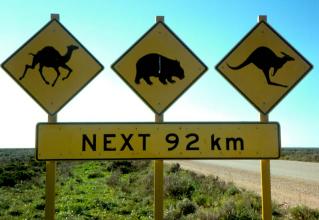


That’s a wombat.
Here where I live, they could add wild donkeys, pigs, crocodiles and buffalo to that lot…but won’t, since the locals are very aware of ’em and we don’t get tourists.
Mmmmm…wombat stew…
Don’t be so Hippo critical 🙂
If it is a hippo, one would not be concerned about the health of the hippo but hte health of one’s car.
km is soooo…”Olde Europe”
John: Indeed. Just like the kangaroos and wombats.
You have to love the exactitude of that sign. It causes one to wonder, however, what happens 92 km down that road that makes the danger cease to exist.
David: If you drive the 92 km, what you will find is another set of three signs identical to that one, with “next 110km” or something similar below them. The distance is not actually the distance for which there is a danger of animals, but the distance to the next set of warning signs. (No I don’t know why it is done like this either. Perhaps the highway agency thought that madness lies in warning people about camels for the next 1000km).
The signs are actually on the Eyre Highway, which follows the south coast of Australia along the bottom of the Nullarbor plane. At one point it is possible to drive 1200km along this highway without passing through a town. The road contains a 146.6km straight stretch, which is nothing compared to the railway a little further north, which contains a 478km straight stretch.
Perhaps there is a message here that we are missing. The kangaroos may be hopping away from the wombats, who are in turn being pursued hotly by the camels, in which case the discerning motorist should stay off this thoroughfare completely. This will minimize one’s chances of running into one of these caravans of pursued and pursuers.