A sample text widget
Etiam pulvinar consectetur dolor sed malesuada. Ut convallis
euismod dolor nec pretium. Nunc ut tristique massa.
Nam sodales mi vitae dolor ullamcorper et vulputate enim accumsan.
Morbi orci magna, tincidunt vitae molestie nec, molestie at mi. Nulla nulla lorem,
suscipit in posuere in, interdum non magna.
|
Telegraph reports that civil liberties campaigners accused the Government last night of compiling a national DNA database “by stealth” as police prepared to enter the two millionth profile into the system. Police powers to keep DNA samples have been strengthened considerably since 2001 when they were first allowed to keep the information indefinitely from suspects who were not convicted.
The new Criminal Justice Bill now before Parliament extends this rule to people who are arrested but never charged. David Blunkett, the Home Secretary, said the importance of DNA profiling to criminal detection outweighed the civil liberties objections.
The DNA and fingerprint databases have become vital weapons in law enforcement, making our communities safer by helping to put thousands of repeat criminals behind bars.
That would be fine, no one disputes the usefulness of advanced technology in crime detection. The problem is, as Gareth Crossman, a spokesman for Liberty, points out:
The Government is hell-bent on creating a national DNA database by stealth. It claims that only criminals will be listed, yet is passing legislation so DNA samples will be retained indefinitely for anyone who is ever arrested, whether guilty or innocent.
If you have any doubt about the government’s intention – the new Health Secretary, John Reid, plans to ask the genetics watchdog to consider the case for DNA screening of every newborn baby. All in the best possible taste, of course…

Simon Davies of Privacy International organised an event this evening here in London in order to honour George Orwell and hoist a drink or three to one of England’s greatest writers on the occasion of his birthday.

Now I know a lot of you have read Orwell’s sundry works… 1984… Animal Farm… etc… but how many of you have drunk a ‘Black and Tan’ at Orwell’s favorite pub, the Newman Arms on 23 Rathbone Street…
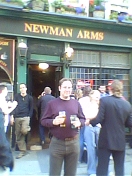
…followed by walk to the Elysee Restaurant, around the corner at 13 Percy Street, which was one of Orwell’s favorite eating places? The default dish here has to be Moussaka, as Orwell ate it on nearly every occasion that he visited this place.
A splendid evening was had by Gabriel Syme and myself (the wicked and iniquitous Johnathan Pearce was a no-show) amidst an impressive collection of privacy and civil liberties activists from across a .. ahem… wide range of the political spectrum.
Cross-posted from Samizdata.net
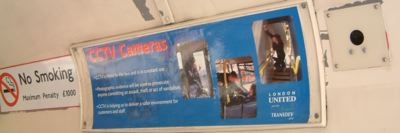
In a characteristic Samizdata posting, Perry de Havilland regrets the modern use of the phrase “Big Brother” to describe reality TV shows, and harks back to Orwell’s original coinage, with grim pictures of CCTV surveillance cameras outside primary schools, and of propaganda for CCTV cameras in the form of big posters in the London Underground.
All this anti-surveillance thinking over at Samizdata is connected to the recent launch of this new blog, which will be concerned with civil liberties and “intrusive state” issues. I’ve already done a couple of posts here, the most substantial of which concerned organ donorship, and I intend to contribute many more similar efforts. The boss of White Rose is one of my closest friends.
However, I have long been nursing heretical thoughts about this total surveillance stuff, which it makes sense to put on a “culture” blog rather than on a politics blog. Because what I think is at stake here is a sea change not just in state surveillance, but in the culture generally. What is more, it is a sea change which places programmes like Big Brother right at the centre of what is happening. → Continue reading: Reflections on “Big Brother”: the total surveillance society and the prescience of popular culture
The telescreen received and transmitted simultaneously. Any sound that Winston made, above the level of a very low whisper, would be picked up by it; moreover, so long as he remained within the field of vision which the metal plaque commanded, he could be seen as well as heard. There was of course no way of knowing whether you were being watched at any given moment. How often, or on what system, the Thought Police plugged in on any individual wire was guesswork. It was even conceivable that they watched everybody all the time. But at any rate they could plug in your wire whenever they wanted to. You had to live – did live, from habit that became instinct – in the assumption that every sound you made was overheard, and except in darkness, every movement scrutinised.
– George Orwell, from 1984
Today is George Orwell’s birthday. Happy birthday George, you were right… just a few years too early. And now we have thermal imagers which means even darkness is no shield from the Panopticon State.
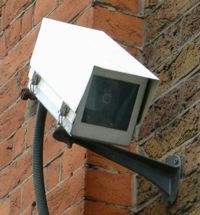
Nah! You must be paranoid! It’ll never happen here!
BBC reports that Home Secretary David Blunkett is to give details on how two million people are about to be listed on a national DNA crime database. The government originally said in 2000 that it wanted to have three million personal profiles on the system by 2004. This was thought to be the whole of the “criminal class”.
The arguments for such a national database are new figures that suggest it is increasingly obvious DNA evidence can be a potent weapon against all categories of crime. The last three years have seen a 50% increase in the crimes solved using DNA samples.
At the moment, only those charged with an offence have their samples taken, but the government’s Criminal Justice Bill plans to give police powers to take samples from anybody who has been arrested.
Both civil liberties campaigners and some scientists warn that with a potentially vast database, the possibility of somebody being wrongly linked to a crime would grow. DNA evidence is not infallible, with forensic experts evidence referring to the probability of match rather than a definite match.
All UK mobile phone operators now track the locations of cellphones, according to this BBC piece. The technology was built in order to provide mobile phone users with information about nearby services: dial a number and ask for the nearest Mexican restaurant, for example. But providers are beginning to offer reverse location lookups, so others can track the location of a particular phone, or send text messages to people in a particular area.
“All the big four operators now offer a commercial service so you can send them a telephone number and they will tell you where it is,” said Colin Bates, chief technology officer at location services company Mobile Commerce.
[…]
But location-based services are going to be much more common, now that locations can be requested for a few pence a time and firms such as Mobile Commerce and Verilocation are springing up to funnel location requests to the various networks.
The location system works best in urban areas covered by lots of base stations that have overlapping coverage. This lets operators give a location fix accurate to about 200 metres.
Providers are quick to point out that they won’t release information about a phone’s location without permission from the owner. Except if you’re a law enforcement officer, of course, or a corrupt employee, or a skilled social engineer, or the rules change..
Soon Verilocation plans to offer a service for families that lets worried parents find out where their offspring are. The service will cost a fixed amount every month and let family members check locations a few times per month.
Mr Overton said Data Protection legislation means that tracking cannot be done without consent of a handset owner.
– BBC, Being tracked down by your mobile.
Verilocation’s web page has some more information on how the process works, but there are no technical details.
The opportunity for abuse of such a capability is particularly alarming in a government-controlled monopoly such as telecommunications. The lengths to which network operators will go to please their state protectors was illustrated recently when it was revealed that UK government departments make 1 million requests for phone records each year. Service providers hand over as many as 100 million call records each year in order to maintain a good relationship with police and other investigatory agencies.
Cross-posted from Vigilant TV
When I was in Spain a couple of weeks ago, I paid for most things with cash, and I only used credit cards occasionally. The first time I did so was when I wished to buy a ticket for the Bilbao Guggenheim museum. Upon handing over my Visa card, I was asked for identification. I did what I usually do when I encounter a request of this nature that I am not used to. I smiled, complied with the request by getting out my driver’s licence and handing it over, and asking “Why?”.
The lady behind the counter looked briefly at me, and explained that things were done differently in different countries, and that in Spain they liked to check identification rather than a signature, because signatures are easy to forge and an identification cheque reduces fraud.
As far as it goes, this is probably true. It probably does reduce fraud. (On the other hand, a signature on a credit card slip is as much about making a contract legal as it is about identification. The reason we use such a flimsy means of identification is that the signature requirement wasn’t originally about identification). However, in this particular instance, an identity check was completely unnecessary. I do not expect that many people use stolen credit cards to buy tickets to art museums. However, the custom of asking for identification when credit cards are used in Spain is ingrained, so that it occurs even when it doesn’t make a great deal of logical sense. (I have occasionally been asked to produce identification in Australia and the UK when using credit cards to pay for expensive items of the sort that might be of value to thieves – for instance the laptop computer I am typing on now – but it only seems to happen when it does make some kind of logical sense).
A second thing that I observed in Spain was that a driver’s licence was not the sort of ID they really wanted to see. It was okay in the museum, but later on it became clear that what they meant by “ID” was my passport, although I could probably get away with a driver’s licence because I was a foreigner. In the case of Spanish people, what they wanted to see was a national ID card. Because everyone has to carry one of these around with them, the card’s use has expanded to the point that it is difficult to use a credit card without one. I don’t know precisely what the role of the compulsory ID card is under Spanish law, but Spanish people seem to need it to go about their day to day lives.
Of course, Spain actually was a fascist state until the mid 1970s, and quite probably the actual point of the card was that it would be needed for people to go about their day to day lives. I think the point may be that once such a card is in place and its use is part of everyday life, it is very hard to get rid of it. For that reason, introducing such a card is really not something to be done lightly.
To be honest I have never understood what the fascination people have with so-call ‘reality TV’ programmes like Big Brother. I have forced myself to watch a couple times and ended up despairing for the future of western civilization. Suddenly my taste for explosion filled action movies and lycra clad starlets with guns does not seem so low-brow after all.

Oooo! Very exciting!
No doubt some of our faithful commenters will put me right on this area of complete disconnection between me and this baffling area of popular culture.
But maybe this Disneyfication of the entirely unfunny term ‘Big Brother’ that George Orwell coined will soon be coming to an end.
Then maybe we can start getting more people frowning with concern rather than smiling vacuously at the sound of the words ‘Big Brother’. Why bother watching the TV to see a bunch of self-absorbed cretins in a room back-stabbing each other when you can be in your very own rolling endless episode of ‘Big Brother’ by just walking down almost any CCTV filled high street in Britain?
Here is some real reality TV, staring… you.
 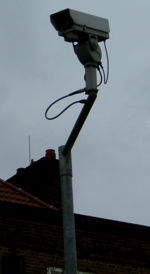

Cross posted from: Samizdata.net
A new speed camera installed at the urging of Robert Marshall, a Conservative on South Staffordshire district council has caught its first few victims, one of whom was… Robert Marshall.
The Tory speed demon was nailed doing a whopping 43mph in a 30mph limit.
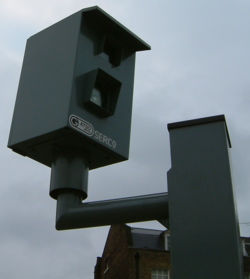
Gotcha, you Tory bastard!!!
Cross posted from: Samizdata.net
Since the atrocity of Sept. 11 some have argued that it is necessary to restrict freedom in order to protect ourselves from terrorism while others have argued that to give up freedom for security is to destroy the thing we are fighting to defend.
This is false dilemma. Individual liberty is not a threat to our security. It is or ought to be an integral part of our security system. To illustrate this point look at the bill of rights, the first ten amendments to the Constitution. The first amendment which protects free speech, freedom of the press and freedom of religion adds to our security in two ways.
First, it largely protects us from internal religious conflict. Because the state is forbidden to interfere in private religious matters, religious groups are not in constant conflict to impose their beliefs on each other. Thus we have been mostly spared from having home grown religious terrorists.
Second, by protecting freedom of the press the first amendment increases the probability that our nation will have a winning strategy in the war on terrorism. In any country the number of people in the defense and foreign policy bureaucracy is limited. Moreover many intelligent people interested in defense and foreign policy will not join the government agencies because of the bureaucratic regimentation. In the absence of freedom of the press, only the thinking of members of these bureaucracies could shape our foreign policy. With freedom of the press the ideas of thinkers outside the bureaucracies are available for consideration by the decision makers. Thus the total brain power brought to bare on security questions is vastly increased and the probability of our adopting a winning security strategy is increased. → Continue reading: Free society is secure society
A refreshingly straightforward opinion piece that I came across while searching the Telegraph’s site for their morsels on civil liberties and ID cards. It was written in December 2002 based on an interview with Matthias Kelly QC, new chairman of the Bar Council. It sounds as relevant now, if not more:
In David Blunkett, we have – in Mr Kelly’s words – a “profoundly illiberal” Home Secretary, but we also have a man who seems incapable of doing anything except talk tough. A good example of this is in the Government’s sudden adoption of the identity card, or “entitlement card” as it euphemistically calls the proposed £1.5 billion scheme.
Because this ministry would rather not reform or enforce the existing immigration laws, it has re-heated one of the worst ideas that was briefly considered and then abandoned by the Major government. Now the Home Office presents the discarded policy as an exciting “joined-up” piece of anti-crime thinking.
As we near the end of an unadvertised “consultation period”, the Government is hoping to spirit through an ID card scheme that will do almost nothing to help the police catch and convict criminals. The cards are an expensive stunt designed to give the impression that the Government is doing something to stop an Albanian jumping ahead of you in the queue for a hip operation.
As mentioned already, this was written in December 2002 and contains a reference to the end of an unadvertised consultation period. Is this the same one as the one that is nearing the end now? Is it another one in the spirit of we keep having ‘consultation periods’ until we get our way?
And the final words ring true to our finely tuned White Rose ears:
The ID card is practically undesirable, and as repugnant on civil liberty grounds as the assaults on jury trials and double jeopardy contained in the Criminal Justice Bill. Mr Kelly is to be congratulated for using his position at the Bar Council to sound the alarm about a government whose only toughness in the field of criminal justice is towards the presumption of innocence.
An observant reader told us of what he saw in Bristol when staying at a hotel there last weekend. A notice in the Travel Inn proclaims words to the following effect:
In order to comply with police requests and to improve security, all guests paying for their rooms in cash will be required to provide ID and proof of address.
Our gentle reader’s reaction?
You WHAT?!….So, if I refuse to provide you with information you have no right to, I don’t get my room. If I do, you… Do what with it, precisely? Pass it on to the police as a “potential terrorist”? Breach my personal privacy for your own amusement? Send me incessant advertising garbage? Store it in contravention with the Data Protection Act?
Can you tell he was not impressed?
This is a well spotted ‘minor’ occurrence. No police state can maintain its hold over society without its little helpers, who function, not exactly as the hand of the state, but certainly its ‘dainty’ prying and sticky fingers, deep in the everyday life of those around them. They exist in every society and although Britain is not a police state, I would not want to underestimate their reach, especially given the current government policies in the UK. Big Brother seems to have many cousins…
|
Commentary
Economics
Politics
Specialist
Tech
|

