Long-time Samizdata readers will know that one of my hobbies is to read The Times (of London) from a hundred years ago. It is often the case that the most interesting articles are also the shortest. Take this one for example:
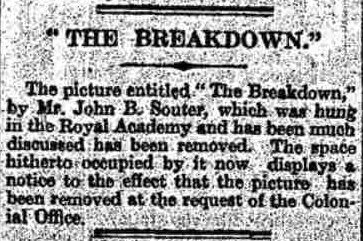
The brevity of the article may have something to do with the brevity of The Times. This article appeared in the 10 May 1926 edition i.e. in the middle of the General Strike.
I never cease to be surprised by the amount of censorship – formal and otherwise – that went on a hundred years ago. The era was not part of Keir Starmer’s “proud tradition of free speech.” Or maybe – come to think of what Starmer understood by “free speech” – it was. Anyway, I had to find out what all the fuss was about and if you click on “More” you can find out too.
WARNING: Not safe for work… or anywhere else for that matter.
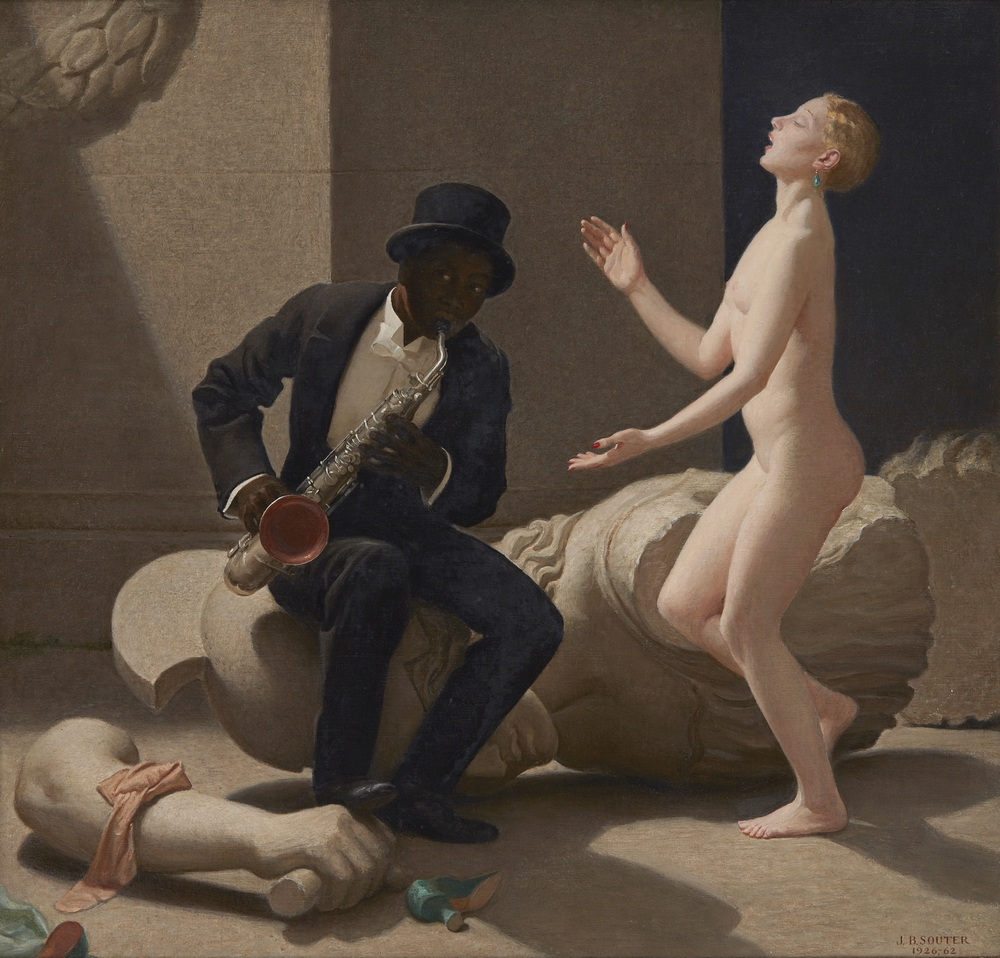
This is NOT the painting in question. Having withdrawn the original Souter destroyed it. What you see above is a recreation he painted in 1962.
I would comment but other than pointing out that it can be interpreted in more than one way, there’s not a lot to say.
It would appear that the ruined statue is of Minerva, Roman goddess of wisdom.


https://en.wikipedia.org/wiki/The_Breakdown
Melody Maker’s embrace of Punk fifty years later required a bit of a sea change.
Interesting how inarticulate the reasoning was, as though the work was so self-evidently‘obnoxious’ that no reason was needed.
I am struggling to see the connection with MM and this. Punk & Breakdown were both art and both controversial but beyond that…
My guess is that the Colonial Office was worried about civil unrest.
A hundred years ago people thought differently. What upset them (or the Establishment) reflexively was different.
Perhaps a naked short haired white woman dancing to a clothed black man, probably playing ‘black music’, challenged peoples’ expectations too much for the times.
I wonder what will challenge peoples’ expectations too much in 100 years time from now?
I have a feory (sic). It is that outrage is a conserved quantity. It is always there and in much the same quantity. All that varies is what triggers outrage. There have always pearl-clutchers. They are here now. They will be here a hundred years from now. What amuses me is that they don’t grok it that today’s they/them “gender warriors” have vastly more in common with Mary Whitehouse than they’d ever admit.
There is always a terrible need in some people to impose their morality upon others in order to affirm their own personal beliefs. What that belief is mutable but the root cause of this obsession is always the same – the desire to control others.
As to the picture in the OP… I can’t find anything to get het up about except it’s pretty mediocre and mediocrity never raised an army…
Does anyone remember the Beneton billboard ads? There was always some aspect of bad taste, although sometimes disturbing social commentary as I recall. The easily outraged would be outraged and Beneton got themselves a mountain of free publicity every single time, the outraged never learned their lesson from the previous time and would get outraged all over again.
Must admit I rather like it 😀
Formally speaking this was not censorship – the Colonial Office had no power to order the British Academy to remove the painting, it requested – and, I think WRONGLY, the British Academy agreed to remove it.
It was also a rather leftist (yes – leftist) move – the Scottish artist was warning of the destruction of wisdom and civilization, hence the smashed statue of Minerva, and, in his view, the degeneracy that was just starting to influence society – with women turning away (even a century ago) from their traditional role as wives and mothers – and turning away from their own people (their own culture and nation). Today we see mostly women waving “refugees are welcome here” banners – and denouncing anyone who does not go along with the destruction of historic nations.
Perhaps if a century ago, or even as late as the 1960s, the attitude of the establishment had NOT been “let us not talk about these things – and let us hide away, or destroy, images that warn us of the dangers” historic nations, including the United Kingdom, might have been saved.
One should also remember that perhaps the most important British artist of the early 20th century, Frank Salisbury (the portrait painter that people actually wanted to paint their portrait) was never allowed to be a member of the British Academy – and was excluded from most reference books on art, just as Sir Edwin Lutyens, the most popular British architect of the early 20th century, was excluded from many reference works. Why was Frank Salisbury excluded by the “educated” cultural “experts”? Because he was too “right wing” – that is why.
Even a century ago the “educated” elite were filled with hatred for their own civilization and its traditions. I suspect “it will cause tensions overseas” was just an excuse to get rid of a painting that parts (parts – not yet all of) the establishment (even then) disliked for the opposite reasons.
Still Patrick is correct – the tradition of Freedom of Speech here is limited, there was censorship of plays since the time of Sir Robert Walpole, and if the government (in the broad sense of the word “government”) did not want something in the newspapers – it did not appear in the British newspapers, even if it was in the American press.
Also, by the 1920s, there was, even a century ago, there was “gun control” in the United Kingdom – very mild by modern standards, hardly anyone was turned down for a firearm license – but it was present, indicating that the means of self defense, and the means to defend others, was NOT considered a right – even in the 1920s.
When P.E. Moore (the old tutor of T.S. Eliot) visited Britain in the 1930s – he was, at first, charmed by how polite and peaceful the country was – and how homogeneous the country was (truly a nation-state), but then he made disturbing discovery – there were no conservatives in politics, not really.
There was a large “Conservative Party” – but it was dominated by Social Reformers, by people whose instinct (and whose education) was to throw ever more money at benefits and public services and to impose regulations to, supposedly, help-the-people.
And, it should be noted, that Neville Chamberlain and Lord Halifax were MORE Social Reformers than Winston Churchill – they were MORE (not less) pro government benefits and public services than Churchill was.
In American terms – there-were-no-Conservatives in the British House of Commons – or in the universities.
No one was arguing for a smaller government – no one in politics – there was a few people outside formal politics – such as Sir Ernest Benn. And no one, again no-one in formal politics, was arguing that there were rights AGAINST the state – everyone seemed to see (in the style of Hobbes, Hume, Bentham and so on) rights as either nonexistent – or as nice things from the state, not limits upon the state.
In the United States such people were outnumbered in the Senate and the House of Representatives – but in the United Kingdom they were just not present in Parliament or the universities, at least P.E. Moore came to that conclusion – Patrick may be able to offer some comfort on this point.
There may have been political figures in Britain in the 1920s and 1930s who were different – who were against “Social Reform” (i.e. endlessly bigger government), P.E. Moore may just have not met them.
Did the average person seeing the painting (the original painting – which may have been rather better executed than the reconstruction) in 1926 see it is a warning – as the artist intended.
Or did they just see it as titillation – and a chance to laugh at stupid “modern women” (then a tiny minority of British women – most women were still traditional, right up to modern times) who had rejected civilization and were in a deluded trance?
I do not know.
I am not sure exactly how much i agree with the rest of Paul Marks’ comments. (Although it is a lot.)
However, wrt this particular paragraph, i wish to note that British women kept voting regularly for the Tories up to the time when Tony Blair was up for premiership.
It is rather more likely that his successful but undistinguished portraiture and paintings of cultural events seemed like thin cultural gruel in the age of Picasso and Matisse.
I believe Islam will defeat the west simply because Islam is reality based and the West is not. Islam does not allow women to do as they please, nor do muslims allow their enemies to live amongst them, or indeed live at all. You may find this abhorrent, but from the point of view of evolution it is a more successful strategy.
Marius – try not to be an ass. But then Frank Salisbury was just as rude about Picasso as you are about him – and Picasso could (unlike his modern followers) paint if he choose to do so – he made a conscious decision to turn away from tradition, it was not lack of skill (as it is with some artists now).
Roue le Jour – the point should be that women, and men, choose to do what is right – rather than being forced to do what is right, perhaps the real war is inside the mind (the soul) of each person. When most people in the West believed in Western principles – the West was strong and had no need to use violence against women, and nor should it. If we become like Islam in order to resist Islam – we have already lost.
Snorri Godhi – as I say in the later comment, the vast majority of British women remained traditional, in 1926 this was just a few lunatics.
The painting is called “Downfall”, there is a smashed statue of Minerva (Goddess of Wisdom), the naked women is in a trace – her mind subverted.
It would be hard for anyone to not see the message of the painting – the artist was not saying this is a good thing (as Picasso might have done), he was saying the opposite.
“Over civilization” – the obsession with the most “advanced” fashionable ideas – was leading to the danger of a collapse into barbarism.
The painting is a warning.
By the way – there were great artists in France, only a few years before this. For example William-Adolphe Bouguereau – who, with ordinary people, was far more popular than the artists who are praised by the reference works and the BBC documentaries. And the campaign against artists such as Bouguereau was only partly about art – it was far more about politics, the modernists pushed modern art for the express purpose of serving in their war against Western society – they were quite clear about this, they made no effort to hide it in their speeches and writings, they boasted about what they were doing.
Modernism, or Progressivism (or whatever name you want to use) in painting, sculpture, literature, music, architecture, and-so-on, does not undermine society by accident – it is very much by-design, that is what it is for.
“Politics is downstream from culture” (Andrew Breitbart) is something the left have always understood – subvert the culture and you subvert (undermine) everything.
Even some Soviet leaders had doubts about all this – because they wanted to rule over a functioning society, not preside over total collapse and chaos – which is what the Progressive movement (taken to its logical end point) leads to, the utter subversion of everything.
A single painting, which seems totally apolitical, can come-to carry a political message – even though when it was painted it did not.
For example, “Self Portrait In A Straw Hat”.
One can read, and should read, the books of William Doyle and others exposing the lies of the French Revolution (exposing centuries of pro Revolution propaganda) – but one can also look at this painting, and see that the society before 1789 was NOT evil, and that what happened to the friends of the artist (the lady herself escaped) was NOT justified.
As for a modern, not modernist, image of a women – by a local artist, see “The Vow” by local artist Thomas Cooper Gotch (the brother of the architect, and first Mayor of the Borough of Kettering – Alfred Gotch).
A person, man or women, looking at “The Vow” and “Breakdown” side by side -does not see a great beauty versus a ugly lady – the difference is not so much physical as mental and spiritual.
The women in “The Vow” is in control of herself – and committing herself to an honourable cause, the woman in “Breakdown” has collapsed – not physically, but mentally.
It seems that the Colonial Office did not suggest the removal of the picture because of it’s artistic qualities (or lack thereof).
On the other hand – seems the artist choose intentionally a sensational or controversial topic. (Controversial for his time).
Both, the communists and Ayn Rand, believed that art should serve a mission – should depict your ideals.
I, personally, am doubtful about artists with a mission (an ideological mission). Art should please one with it’s esthetics, not with it’s ideology.
As to the artist in this case – seems he achieved his aims – according to the saying attributed to Mae West: “there is no such thing as bad publicity”.
In the United States such people were outnumbered in the Senate and the House of Representatives – but in the United Kingdom they were just not present in Parliament or the universities, at least P.E. Moore came to that conclusion – Patrick may be able to offer some comfort on this point.
The best I can do is Sir Alfred Mond, later – I kid you not – the first Lord Melchett, who was the principal opponent of the Labour Party’s motion to Parliament condemning “capitalism” in 1923.
Speaking for myself, i do not see a great beauty vs an ugly lady, but a naked lady vs a clothed lady.
Speaking of which, my favorite Bouguereau is The Nymphaeum.
But for no politically-correct reasons.
Some of his other paintings are attractive for the same reasons.
PS: I don’t know much about art, but i know what i like.
@Jacob
I, personally, am doubtful about artists with a mission (an ideological mission). Art should please one with it’s esthetics, not with it’s ideology.
I mean I largely agree, but I suppose art should be whatever its creator and consumer want. But I am not a fan of this type of art, though this is a fairly moderate example. There is a certain elitist thinking in art which is along the lines of “On the surface this looks stupid, trivial or offensive, but that is because you don’t UNDERSTAND, you don’t GET IT, you are an ignorant plebian. We, who are in the know, understand what it REALLY means.” It is a “we are better than you because we are in the know”. This a theme in the human psyche, we love the idea that we are special because we are “in the know.” “Did you know that apple cider vinegar cures all your ills?”, “We Christians are special because we KNOW the one true God”, “Trump is running a secret pedophile ring and the press is covering it up”. “I can’t believe you actually BELIEVE we landed men on the moon”. We all just love secret knowledge, I think primarily because it makes us feel special.
And these art lovers who love a big red dot on a canvas for a million dollars or a banana taped to a wall are just part of that “I’m in the know” crowd, because “I’m in the know” means “I’m better than you”. I mean some of these artists must be laughing the asses off at the stupidity of it all, though no doubt a lot of them are caught up in the delusion themselves.
For sure, what does not define success in the art world is meritocracy. A lot of it is just utter crap. This was probably true in the time of Da Vinci, the difference is that they cared that the pictures required some skill in execution. It is why I am not AT ALL a fan of Picasso. I think his work is ugly and largely without merit. Guernica for example, one of his most famous and most lauded works, looks to me like something a bunch of kindergartners drew.
I mean hang whatever you like on your wall, if you enjoy it I’m glad for you. But don’t tell me the Emperor is wearing a very fine suit of clothes when he is obviously as naked as the day he was born.
Jacob – read the comments, we have discussed the politics of the painting.
As Fraser Orr points out – art expresses a view of life, even if there is no conscious political message (which there was with Picasso – he was political). For example, “Self Portrait in a Straw Hat” was not painted with any political agenda – yet it came to represent one. And the positive look (in the stance, in the eyes, and so on) is something that Ayn Rand would have loved.
Fraser Orr, as I have already pointed out – Picasso could paint – it is not lack of skill, his later work is a deliberate rejection of tradition and of beauty, part of a wider rejection of Western civilization – sadly he was far from alone, such people were Legion among the “educated classes”, the “cultural elite”. They promoted works that agreed with them – and attacked works (and artists) that did not agree with them – eventually forcing traditional artists (and composers, and architects, and so on) out of creative life – taking over everything, with the express purpose of undermining (subverting) everything.
Patrick – thank you Sir, I did not know about Sir Alfred Mond.
Snorri Godhi.
It is not the nudity – it is the mindlessness.
“Breakdown” represents “over civilized” toppling over into barbarism, “intellectualism” toppling over into the denial of the intellect – look at the eyes.
We should not need the artist to tell us this (although he did) – it is obvious in the painting, the smashed statue of Minerva (Goddess of Wisdom) and the mindless look in the eyes of the “modern” (really Modernist) woman.
It is lightyears from the Nymphaeum.
Where, as you know, the nude ladies are anything but mindless – they know exactly what they are doing. They are very much in control of themselves.
Patrick – according to Wikipedia (yes – sometimes not a very reliable source) Sir Alfred Mond was for (not against) the “New Liberalism” and “Social Reform” (i.e. bigger government).
Yes he broke with the David Lloyd-George – but only when the latter started flirting with the nationalization of farm land (even in the 19th century some “liberals” had gone down this path of insanity).
As for “Mondism” – it was not getting rid of “Collective Bargaining” by repealing the 1875 and 1906 Acts, it was, perhaps, making it worse – by institutionalizing it. Unions and Corporations getting together – not a good idea.
This was not someone who wanted to roll back the state.
No – the difference between “The Vow” and “Breakdown” is NOT that in one painting a women is clothed and in the other not clothed.
How can anyone look – but not see?
Here is Mond in the “Capitalism” debate of March 1923:
Paralysis seemed to seize everybody as soon as they began to work for the State or for a municipality. (Laughter.) That was because everybody had a “cushy” job, there was no profit and loss account, and it was supposed not to matter how the money was spent. On the other hand, the capitalist had a method by which inefficiency was wiped out and efficiency was rewarded. (Cheers.) Private employers who could not make a profit out of business had to go under and make way for people who could. (Cheers.)
[In response to a labour heckle] A cooperative society was one of the finest capitalist things in the world. (Ministerial cheers.) It was owned by a large number of small capitalists.
Paul:
I see your point (and i have taken into account the fallen statue); but still, one century later, i cannot help but laughing at the notion that jazz can brings young women to sexual ecstasy.
I am also reminded of Plato’s theory (in the Laws) that modern music brought decadence to Athens; which was even more amusing to me.
Ah, is THAT what that painting shows? That makes more sense now. I thought she was in some sort of physical distress.
@bobby b
Ah, is THAT what that painting shows? That makes more sense now. I thought she was in some sort of physical distress.
I assumed she had stubbed her toe on the big bit of rock. And really? Jazz brings a woman to ecstasy? All the work I have been doing all these years to achieve that same end and all I needed to do was fire up Spotify? There are no end of useful things you can find on Samizdata.
Snorri Godhi – it is not the jazz music, at least not mainly the music. It is the mentality that existed in her before she ever heard the music — the cynical dismissal of Western civilization which the “modern” were indulging in even then. The female character is very much part of that small minority of women in the 1920s who were very much Modernists – flippant, and fundamentally ignorant of what the dismissed. “Over civilized”.
By thinking herself above civilization – the woman (and men to) leaves herself open to falling below it.
As for Plato – he lacked self awareness, far from being the solution – he was part of the problem.
The farmers, craftsmen and traders who had built up Athens would not have thought highly of his ideas, government controlling everything, or his “lifestyle” as some people call it.
Ironically Aristotle, from a much smaller town (and who had to flee Athens when Alexander the Great died) was closer to both the ideas and to the life of traditional Athens than Plato was.
By the way – Cambridge went straight from Plato to Karl Marx, Cambridge in the sense of the “Apostles Club” and so on.
It was not really a big jump – both were Collectivist in their politics, and both rejected traditional society – although Plato, sometimes, pretended not to.
Pretty much the way i see it.
Maxim Gorky described a jazz band as “sexually wound-up madmen, conducted by a Stallion-like creature who is swinging his giant genitals.”