We are developing the social individualist meta-context for the future. From the very serious to the extremely frivolous... lets see what is on the mind of the Samizdata people.
Samizdata, derived from Samizdat /n. - a system of clandestine publication of banned literature in the USSR [Russ.,= self-publishing house]
|
Did you know that Boris doesn’t know who won the battle of Stalingrad? If you did not know this, please continue not to know it, because it is not in fact true. Should you encounter a reader of The Economist, however (one of life’s occasional joys of which I am now deprived by the lockdown), you may be told that Boris’ biography of Sir Winston Churchill reveals this and other remarkable lacunae in our current PM’s historical knowledge – told in a tone of great certainty and with the firmest assurance that any milder speculations you offer (for what Boris might have said to appear to mean such things) are not possible, so established are the facts.
I have never once in my entire life given money to The Economist in exchange for the doubtful privilege of reading it (and see very much less than no reason whatever to begin now), so I encounter copies but rarely in airplane lounges and on other people’s coffee tables. I therefore cannot tell you whether Economist readers believe this because an Economist writer once told them that or implied it, or merely because reading The Economist renders one credulous of such urban legends (insofar as the habit of reading The Economist does not reveal that one already is).
So astonished was I to be assured of this claim (by the undoubtedly educated and well-read) as a matter both unsurprising and beyond all doubt, that I have now once in my entire life given money to Boris (not to some cause he also espouses) in exchange for a copy of his Churchill biography – something I deduce Economist-readers are more loath to do even than I am to buy their rag. It struck me as a more primary source for verification than tracking down whatever years-old copy of The Economist had reviewed it or made a passing reference to it, or tracing the origin of its readers’ urban legends about it.
I was not surprised to learn that Boris knows what the gardener, the hairdresser and even the teenager all know – that Stalingrad did not end well for Adolf. I was not surprised to find I was correct in my pre-purchase guess that some throwaway one-liner about how far Adolf got despite Churchill (to suggest how dangerously further he might have got without Churchill) would be the sole basis for the bizarre claim that Boris didn’t. But after reading right through the book I am very surprised to discover just how vicious and/or deranged a reviewer would have to be to pretend and/or imagine that the text even remotely suggests such a thing (and likewise for the other claims).
That, however, is secondary. In her study of anti-semitism, Hannah Arendt explains that establishing the history of how ‘The Protocols of the Elders of Zion’ was forged is secondary. The historian’s primary subject is that the forgery is being believed. That someone – maybe originally some writer for The Economist but maybe, for all I know, originally just some reader of it holding forth to other readers in an upscale SW1 pub – claimed that Boris did not know a historical fact so famous that even an update of ‘1066 and all that’ might call it ‘memorable’, is secondary. The greater strangeness is that this claim is being believed – not by Jeremy two-Es Corbyn and his Momentum followers but by at least a few highly educated people who, in the late 1980s, were voting for Thatcher’s and Reagan’s economic policies even as they virtue-signalled disdain for their populism. What goes on in otherwise-intelligent minds to let a person move from that to this? How can their sense of reality be so deficient that they can be told Boris does not even know who won Stalingrad and still hear no alarm bell, no, “Maybe I should just check whether even Boris could really not know even that”?
The Economist was founded in 1843, not so long before Mill explained that democracy works best when:
“the sovereign Many have let themselves be guided (which in their best times they have always done) by the counsels and influence of a more highly gifted and instructed One or Few.” (‘On Liberty’, John Stewart Mill, 1859)
By this definition, The Economist has always been just what it claims to be: ultra-liberal. It is said that a senior editor once gave a junior colleague terse advice on how to write his first Economist leader article:
“Pretend you are God.”
The Economist has sometimes changed its mind in fact – it was rather late to abandon its Keynsianism for monetarism in the 1980s but it did. What never changes is the unapologetic arrogant smugness of a pretence that one suspects senior editors do not always recall is pretence. The Economist’s latest editor, a woman named Beddoes, is a Keynsian who thought Obama was wonderful. She belongs irredeemably to those whom Dominic Cummings described as:
always writing about how ‘shocking’ things are to them – things that never were as low probability events as they imagined
Brexit winning, Trump as president, Boris as PM – how shocking that the omniscience of pretend-God be challenged by such unforeseen events. Late last year, I was aware from my acquaintance how much Economist-readers loved Fintan O’Toole’s ‘explanation’ that Brexit arose from the idiocy of backward-looking British voters (Fintan O’Toole: ‘Heroic Failure: Brexit and the Politics of Pain’, published November 2019). Fintan laughed when Brexit-supporting reviewers warned him to worry instead about a real ugliness in his own Southern Irish electorate – until he was again shocked by an Éire election result that was (regrettably but foreseeably) never such a low-probability event as he and EU-negotiation-supporting taoiseach Varadkar imagined. (Corbyn’s success in 2017 is one on-balance-hopeful analogy to draw; there are others.)
It is said of communists that they think their party is God – a God sadly lacking the attributes of forgiveness and absolution. People who have the sense to know communism is stupid can still be very wilfully deluded about how much they themselves understand and how unshocking it should be to be proved not merely wrong but clueless.
So what is the UK equivalent of ‘NeverTrumper’? We all know what ‘Guardian-reader’ means. Is it time to be aware what ‘Economist-reader’ can mean?
I stopped reading after the first sentence:
“I grew up Asian American in North Dakota, South Dakota and Idaho, some of the whitest states in this country.”
My heuristic is that anyone using race as their frame of reference has got nothing to say that isn’t vile gibberish.
– Mike Fagan
Who would have thought that Sweden would end up being the last place in Europe where you could go for a beer?
writes an understandably surprised Swede (No lockdown please, we’re Swedish). In Sweden, the state tells people
how many slices of bread to eat per day … We still close liquor stores at 3 p.m. on a Saturday. The general idea is that if people were given the freedom and responsibility to figure out these things on their own, anarchy might follow.
And I can’t work out whether to call it ‘hardly less surprising’ or ‘barely more surprising’ that, at the other end of Europe, Portugal is (for now) following the same path. Instapunditer Sarah Hoyt was born and raised in Portugal but left because it lacked things like the first amendment, the second amendment and a lively SF culture.
The cynic in me is happy to suggest some less-than-libertarian explanations.
– Sarah Hoyt quotes the Portuguese Prime Minister explaining they avoided lockdown because the Portuguese are “more organized than other Europeans” – then adds
I have no idea what he’s smoking, or where he found it, but that’s potent stuff.
– Sweden has an unusually docile native population, an unusually different immigrant population and a political class that calls it bigotry for visible police actions to betray statistical differences between the two. Trying to enforce a lockdown is sure to offend many politically-correct regulations. Further, a society whose police seem already unable to control immigrant predilection for grenades and automatic weapons lacks the reserve of unused power needed to enforce a lockdown.
However the same attitudes that give me those thoughts also tell me that Swedish politicians will not only not speak them, even behind closed doors, they will have a hard time thinking them – which challenges my cynical explanation. Ordering the police and media not to mention the colour of suspects they seek lest the public see trends, yet thinking that
in a liberal democracy you have to convince and not command people
not to go to the pub, may seem absurd to logical libertarian and logical statist alike – but freedom owes much to the fact that humans are not logical. That Portugal may be too ill-organised to enforce statist solutions is another common way in which liberty survives its enemies, but at the moment it is not that they are trying and failing – they are actually not trying.
Thus we have our experimental controls – our null-hypothesis case studies. We’re doing a huge experiment to see how well locking down a nation can address a pandemic – an experiment whose costs’ ability to rise exponentially over time matches that of any disease graph. I don’t know how good or bad it will be for the Swedes and Portuguese, but it will be very good for the after-action report on this if a couple of moderately comparable nations stick with seeing what happens when you don’t lock everyone up.
Like it or not, every country is pursuing a herd immunity strategy, all they are doing is trying to manage the speed at which it happens.
– Perry de Havilland
True to its promise to leave no strategy untried that might help alleviate the coronavirus epidemic, Her Majesty’s Government, in accordance with the advice of the Lords Spiritual, has decreed that in penance for the sins that brought this plague upon us, all persons will now strictly observe the Lenten fast. Effective immediately, all confectionery, sweetmeats, and similar indulgent and luxurious foods will therefore be removed from sale in shops upon penalty of law. In particular the pagan custom of consumption of so-called “Easter eggs”, being a false admixture to the strictures of true religion, is henceforth prohibited.
It will be good for your souls.
OK, in case you were worried, what I just said was not true. Neither I nor the Bishops seek to use the law to deny the British public their choccy eggs. That’s the job of your local council.
Convenience stores are wrongly being told to limit the items they sell to just “essentials”, a trade body has warned.
Local newsagents, which are allowed to remain open under the Government’s guidelines, are facing interference from officials that are trying to restrict the range of goods they sell under lockdown measures.
Some shops have been told by police and local councils that Easter eggs are considered non-essential goods and must therefore be removed from shelves.
The Association of Convenience Stores (ACS) blamed “overzealous enforcement and a misreading of the rules”.
Ridiculous as it was, with the drone-assisted “lockdown shaming” of walkers in Derbyshire, I could at least see what the police thought they were trying to achieve. But I really can see no motive other than reflex puritanism for trying to prohibit the sale of “nonessential goods”, particularly as they were on the shelves anyway. What good would it do anyone to make the shopkeepers lose a packet by being forbidden to sell stock they had purchased in happier times? This isn’t World War II. Britain’s food is not coming in by convoys subject to torpedo attack. In fact, if you can afford luxury foods, should you not buy them in preference to plainer things in order to leave more staple foods available for those who cannot afford anything else?
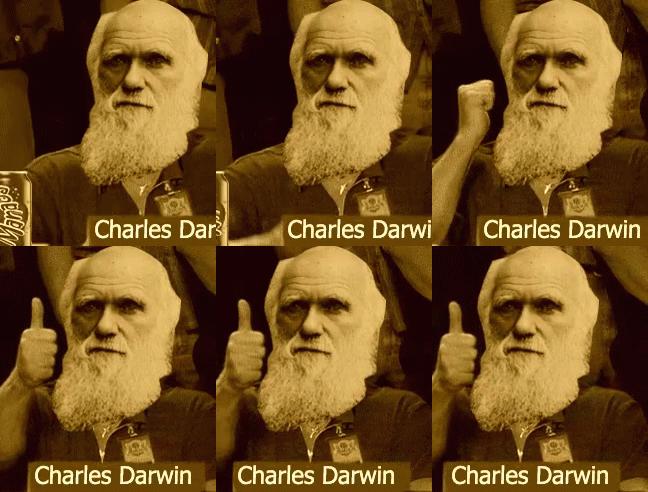
A vaccine would be great, a vaccine from ISRAEL would be awesome! Just imagine the lunatic conspiracy theories & of course, if the crazies refuse to use a ‘Jewish’ vaccine, that just means more for the rest of us! Take it away, Charles Darwin!
– Perry de Havilland
“There must logically be a point at which the cost of the containment measures, in terms of human welfare and even of fatalities, outweighs the cost of the virus.”
– Daniel Hannan.
|
Who Are We? The Samizdata people are a bunch of sinister and heavily armed globalist illuminati who seek to infect the entire world with the values of personal liberty and several property. Amongst our many crimes is a sense of humour and the intermittent use of British spelling.
We are also a varied group made up of social individualists, classical liberals, whigs, libertarians, extropians, futurists, ‘Porcupines’, Karl Popper fetishists, recovering neo-conservatives, crazed Ayn Rand worshipers, over-caffeinated Virginia Postrel devotees, witty Frédéric Bastiat wannabes, cypherpunks, minarchists, kritarchists and wild-eyed anarcho-capitalists from Britain, North America, Australia and Europe.
|




