A sample text widget
Etiam pulvinar consectetur dolor sed malesuada. Ut convallis
euismod dolor nec pretium. Nunc ut tristique massa.
Nam sodales mi vitae dolor ullamcorper et vulputate enim accumsan.
Morbi orci magna, tincidunt vitae molestie nec, molestie at mi. Nulla nulla lorem,
suscipit in posuere in, interdum non magna.
|
An opinion piece about the identity cards news in Telegraph is yet again explaining what is wrong with Blunkett’s argument. Basically, each of the claims made by the Home Secretary in support of his pet scheme is wrong.
- First, Mr Blunkett says that there is strong public support for the idea. In fact, the Home Office’s recent consultation exercise focused on the concept of an entitlement card, a very different prospect. (Also, according to this Out-law article, the goverment has admited that the public opposes the ID card scheme.)
- The Home Secretary goes on to argue ID cards will help fight crime. This is one of those assertions that is forever being made, but hardly ever substantiated… The public mood is said to have changed since September 11, 2001, but no one has explained – or even seriously tried to explain – how ID cards would have thwarted those bombers, many of whom died in possession of forged papers.
- Nor, by the way, are ID cards a solution to illegal immigration. The root of the asylum problem is not that we cannot find clandestine entrants, but that we never enforce their deportation.
- More faulty still is Mr Blunkett’s central proposition, as set out in a letter to his Cabinet colleagues: “The argument that identity cards will inhibit our freedom is wrong. We are strengthened in our liberty if our identity is protected from theft; if we are able to access the services we are entitled to; and if our community is better protected from terrorists.” In an appendix to Nineteen Eighty-Four, Orwell describes how a concept can be traduced if the words used to express it lose their meaning. The example he gives, uncannily, is the word “free”. Now here is Mr Blunkett using “freedom” to mean more state control.
- Any doubts as to the wisdom of the scheme must surely be removed by the Home Secretary’s final argument in its favour: that we are “out of kilter with Europe”. Indeed we are, thank heaven. Policemen in Britain are seen as citizens in uniform, not agents of the government.
The most worrying is Blunkett’s spin on the concept of freedom. In his view we are strengthened in our liberty if our identity is protected from theft; if we are able to access the services we are entitled to; and if our community is better protected from terrorists. This is vaguely based on the distinction between negative and positive liberty, which are not merely two distinct kinds of liberty; they can be seen as rival, incompatible interpretations of a single political ideal.
Negative liberty is the absence of obstacles, barriers or constraints. One has negative liberty to the extent that actions are available to one in this negative sense. Positive liberty is the possibility of acting – or the fact of acting – in such a way as to take control of one’s life and realize one’s fundamental purposes. While negative liberty is usually attributed to individual agents, positive liberty is sometimes attributed to collectivities, or to individuals considered primarily as members of given collectivities.
Blunkett and his New Labour chums are classic and rather unexceptional anti-liberals. I use the term liberal in its original meaning, based on negative definition of liberty and claiming that in order to protect individual liberty one should place strong limitations on the activities of the state. In Blunkett’s mind, the pursuit of liberty (whether of the individual or of the collectivity) requires state intervention, which, by definition, is not contradictory with limitations on personal freedom. As a result, the protests of civil liberties groups do not make sense to him.
The concept of freedom as being unprevented from doing whatever one might desire to do is alien to him. According to Isaiah Berlin the defender of positive freedom will take an additional step that consists in conceiving of the self as wider than the individual and as represented by an organic social whole – “a tribe, a race, a church, a state, the great society of the living and the dead and the yet unborn”. The true interests of the individual are to be identified with the interests of this whole, and individuals can and should be coerced into fulfilling these interests, for they would not resist coercion if they were as rational and wise as their coercers.
I will not grant Blunkett’s social and political philosophy such level of ‘sophistication’. I will say that his are the simple and toxic insticts of a collectivist and a statist and that those protesting policies based on them will have their words muffled by the Big Blunkett.
The Telegraph reports that a leaked memo revealed that David Blunkett is pushing the Cabinet to back national identity cards for everyone aged 16 and over. The Home Secretary insists in a memo to Cabinet colleagues that rather than limiting freedom, his plan for ID cards would reinforce people’s sense of liberty by making it easier for them to use services and protecting them from criminals and terrorists.
It is understood that he wants to introduce legislation in the autumn to allow cards to be brought in within the next few years. A full Cabinet discussion is expected within the next fortnight.
Privacy International, the civil rights watchdog, will mount a campaign against the plans this week. Simon Davies, its director, said:
This is without doubt the most threatening issue for civil rights and freedoms since the Second World War.
I just caught a snippet news item on the BBC about how magazines are complaining about people browsing through their mags in the shops, and photoing favourite pages with their camera-portable-phones and immediately phoning them to their friends. Information theft! Couldn’t find anything about this on the BBC website, but maybe someone else can.
I think this presages the moment when it won’t only be Big Brother who wields surveillance cameras in the street. Everybody will be able to! And they’ll be able to phone in the footage to – I don’t know – their personal websites or something. It’ll get even more fun, if that’s the word, when the cameras are in people’s buttons or glasses and you won’t even know that someone is doing it.
This kind of thing is probably happening already, on the quiet. The real excitement happens when doing it becomes a teen fad, and it starts being known about, and argued about by people saying they have a right to do it. Which maybe they do. After all, the government does it.
What happens then? What will White Rose make of that.
I’ve always been better at questions than at answers.
As British citizens we have very little actual power to influence government. One weapon we do have is words, that’s why we write blogs. However if we’re honest the impact is small. Only a tiny proportion of the population will ever read any blog at all. Most will read ones they agree with – we’re largely preaching to the converted.
What we need to do is take our words out on to the street – to get other people using them for us. We can do that not with lengthy arguments or rants but with simple phrases that encapsulate our position. Soundbites, memes, call them what you will. Politicians, advertisers and the media all know the power of a simple slogan: “Things can only get better”, “Beanz Meanz Heinz”, “the innocent have nothing to fear”…
The term I want to popularise is Big Blunkett. David Blunkett is an authoritarian Home Secretary who believes in monitoring innocent citizens. He is responsible for some of the worst threats to civil liberties this country has seen for many years. In particular he seems determined to introduce compulsory National Identity Cards – yet the average person on the street seems unaware of the threat he poses.
I’m not trying to offend or hurt David Blunkett personally. He might be a really nice man socially – but as a politician he is dangerous. The thought that he might become Prime Minister is frightening.
The expression “Big Blunkett” sums up the dangers simply and effectively, especially in the Orwell centenary year. When people hear the name David Blunkett they should automatically think “Big Brother”. The fact that Blunkett is blind simply adds irony and provides a talking point.
I want to get “Big Blunkett” into common usage and I want to do it fast – time is running out. Please help me. Use the term “Big Blunkett” at every opportunity. Use it with your mates down the pub, use it in your blogs, use it in letters/emails to the media. If you’re a journalist use it in your reports, even if only to the extent of saying “some people are calling him ‘Big Blunkett'”. I search Google daily for the phrase “Big Blunkett”, hopefully soon I’ll find 5000 entries instead of just 5.
Words can make a difference. Let’s use them.
I don’t want Big Blunkett watching me.
Cross-posted from An It Harm None and the brand new Big Blunkett blog.
The Sunday Times reports that in a leaked letter Home Secretary David Blunkett describes the case for Compulsory National Identity Cards as “overwhelming”.
Citizens would pay £39 for the privilege of carrying a card containing biometric information. It would not be compulsory to carry your card at all times however you would have to show it to the police within a few days of demand. So don’t forget to take it with you if you’re on holiday.
Blunkett adds that “a highly organised minority” would “campaign vocally” against the cards.
Too right we will. This plan is a serious threat to civil liberties in Britain and must be stopped.
Cross-posted from The Chestnut Tree Cafe
The article on the ST site appears unavailable just now, you can read the BBC summary.
This article is from nearly a week ago, but it is of interest still, I think:
Newspaper owners responsible for publishing racist or xenophobic articles in Britain are to be protected from being sent for trials abroad under government plans to soften the impact of the new Extradition Bill.
Ministers will introduce amendments today to tough European-wide laws that allow courts to extradite EU citizens accused of committing one of 32 generic criminal offences.
Concerns raised by the media that they could fall foul of the new law when it comes into force in January have prompted the Government to act to remove the threat of prosecution.
The Bill makes “xenophobia and racism” one of 32 crimes for which a British citizen can be sent for trial in another EU country – such as Germany or Austria, where it is illegal – although there is no such standalone offence in this country.
But because British newspapers are sold abroad and their articles are published on the internet, editors and their proprietors could face prosecution for racist offences committed in this country.
I can’t say I understand the full ramification of this, but my brain is abuzz with questions.
For instance. Will these amendments apply only to newspaper proprietors, or will, for example, the proprietors of group blogs be exempt also, in similar circumstances? If one of us junior contributors here did a White Rose posting that the government of Austria deemed to be xenophobic or racist, would Gabriel and Perry, the named organisers of White Rose, then still be in the firing line? Or do these amendments apply to them as well?
Looking at the larger picture here, the stink of this piece is that “Europe” is a place where what seems to matter is not what you have done but who you are.
What’s so special about these newspaper proprietors, other than that they have the power to affect the fortunes of major politicians? Are they like the drivers of fire engines needing to exceed the regular speed limits? I suppose they would argue that, metaphorically speaking, this is indeed what they are, sort of. They are our protectors, and therefore they themselves need special protection.
But one fears, on the contrary, that maybe these big media newspapers may ease off on their concern-raising about the other 31 of those 32 generic criminal offences – and about, you know, things in general – just so long as they themselves are not directly threatened by the new arrangements. One fears, in other words, that in exchange for their own protection, they’ll relax about protecting the rest of us.
Still, at least the Indy gave these other 31 criminal offences a passing mention. Can anyone say, or point to a place which does say, what they all are?
I’m afraid I don’t have a link for this – the FT’s web-site wouldn’t let me find the story. One of their columnists suggested a way to beat spam: this is roughly the gist:
Each ISP identifies mail addressed to more than, say, 100 receipients. An employee retained for the purpose glances at the mail, and accepts or rejects the mail. This should be relatively easy, as most spam is readily spotted, compared to mailing list entries, etc.
The employee reviews, say, 1 a minute, for 7 hours a day, stopping 60 * 7 * 100 = 42,000 pieces of spam a day. Over a 200 day working year, and at a salary of say £20,000, that works out at about a quarter of a penny per spam stopped.
The author went on to suggest given the global volume of spam, only a couple of people would be needed to stop it all. This seems fallacious, as EACH ISP would need to employee their own blockers.
I think most people reading this site would see the implications for privacy – ISPs would (perhaps be legally required to) read any mail sent to large numbers of individuals. This is not something I’d look forward to.
Hopefully, the idea will die the death of a thousand rapidly knocked up columns, but it’s worrying that privacy didn’t even strike the writer (or his editor) as an issue. Particularly as, once the proposal had been brought in, there would be a natural pressure to reduce the number of receipients that “triggered” checking. Spammers would drop the size of their mailings, and so the checkers would have to look at an ever higher proportion of mails to have any effect.
In a welcome turnabout for US citizens, MIT has launched the Government Information Awareness website.
The website developer Ryan McKinley explains
“Our goal is develop a technology which empowers citizens to form their own intelligence agency; to gather, sort and act on information they gather about the government,” said MIT graduate student Ryan McKinley, who developed GIA under the direction of Christopher Csikszentmihályi, an assistant professor at the MIT Media Lab’s Computing Culture group.
“Only by employing such technologies can we hope to have a government by the people and for the people,” McKinley said.
The method that McKinley uses is pilfered straight from the government itself.
GIA site users can submit information about public figures and government programs anonymously. In an attempt to ensure the accuracy of submitted data, the system automatically contacts the appropriate government officials and offers them an opportunity to confirm or deny submitted data.
But like an FBI file, information is not purged if the subject denies its veracity; the denial is simply added to the file. McKinley wryly added that those government officials who have nothing to hide have nothing to fear from GIA.
A nice touch!
The site itself is a bit limited; also, when I tried it out it was very slow. It might have underestimated the demand for it. This is a work in progress, but it’s a great start. This gives Big Brother a taste of his own medicine, and we need something like this in Australia.
Cross posted at The Eye of the Beholder
Having been published last month, this article, in blogosphere terms, is verging on the archaeological but it is well worth a delve into the archives for a sobering illustration of just how despotic and deranged our ruling classes have become.
Not content with having turned our justice system into a playground for victimologists, parasites and professional race-baiters, the Home Office is now preparing the ground for an arbitrary police-state:
The government’s war against men is now plumbing ever more astonishing depths. On Radio Four’s Today programme yesterday, the Home Secretary David Blunkett could scarcely wait to boast of new proposals to deal with domestic violence.
Anyone truly concerned with civil liberties could not fail to have been appalled by Mr Blunkett’s comments. The problem was, he enthusiastically explained, that at present ‘you have to get someone through court’ before a domestic violence suspect can be restrained.
So his solution is to restrain them before they even get to court. In other words, he wants action taken against a man on the basis of an unproven allegation by a woman– made under the protection of anonymity, to boot. So much for this Home Secretary’s understanding of the presumption of innocence, the meaning of justice and the necessity for a trial of the facts.
The article deserves to be read in it entirety in order to understand the extent to which the Home Office has deliberately ignored or manipulated statistical data in order to justify their insistence that male violence in the home is far worse and far more common than it actually is. Another case of tailoring the data to fit the political agenda.
These wicked and spiteful proposals are not on the books yet but they are clearly on the drawing board and, as per usual, it is only a matter of time before they are enacted thus ending the protection of the law for every man in this country.
The scope for abuse of powers like this is simply enormous and any case of abuse will lead to a man losing his home, access to his children and possibly even his livelihood all on the basis of an unproven and unanswerable allegation.
The damage this will cause to families and the fabric of society remains to be seen but, tragically, it will be seen thanks to a regime which is deeply in thrall to dangerously extremist femininst ideologues and which has now run out of easy targets.
Police yesterday released footage of the moment a 16-year-old girl was dragged into bushes as she walked home at 3am. A police officer driving home from work had spotted the girl walking on her own and had rung colleagues at the local police station, telling them to train the camera on her. Officers watching the CCTV footage saw the man carry her 20 yards into bushes.
An urgent message was sent over the police radio and several patrol cars raced to the scene. It is thought the man ran off when he either heard or saw the police cars in the distance. Det Con Mick Blunt, of Adwick CID, said last night:
The feeling among officers is that it could have been a lot worse. A man approached the girl from behind and had a brief conversation before picking her up and dragging her into adjacent bushes. The girl fought back, kicking and screaming, which resulted in her attacker releasing her.
This is good news – the girl was relatively unharmed, if traumatised, and it certainly appears that the CCTV camera was instrumental in saving her. Surveillance cameras are popular with the public precisely for this kind of assistance in crime prevention.
My opposition to surveillance is unabated though. It is based on two arguments. One is, installing a CCTV camera somewhere does not protect people in the area effectively. The effectiveness of such devices is determined by the way in which they are used. In this case, it was the police officer who spotted the girl and decided to instruct his colleagues to train the camera on her who made the difference.
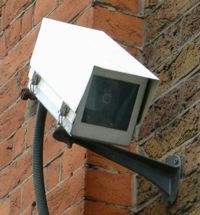
We live in a country with three million surveillance cameras. Why does a case of a surveillance camera being partially instrumental in preventing and potentially solving a crime make it to the headline news? In order to justify the instrusion into its citizens’ privacy, the state has not made a case strong enough for surveillance effectivness. I do not see any corresponding decrease in crime. The only practical use of surveillance camera footage is forensic, after the event. The lenient criminal justice system in the UK is making even that use insignificant.
The main reason of opposing surveillance cameras rather than putting up with a minor ‘inconvenience’ of being monitored in public places (after all, an honest citizen has nothing to hide, does he?) goes to the very nature of the state. Under the guise of public security, governments happily assume the role of the Big Watcher and lay down an infrustructure that give them greater control over the lives of individual citizens. And as Brian pointed out in his post on road pricing and total surveillance, it is impossible to pry it out of the state’s cold intrusive fingers…
Andy Duncan may take up smoking again…
The UK government’s chief medical officer, Sir Liam Donaldson, has claimed that outlawing smoking in bars, pubs, clubs, restaurants and at work would dramatically reduce levels of lung cancer, and other lung diseases, caused by passive smoking. It seems the push is on, by the UK do-gooding society, to follow the example recently set by Michael Bloomberg, in New York.
Significantly, Sir Liam cited a recent government report, which claimed that 88% of people were in favour of smoking restrictions in restaurants. He obviously knows where to hit a government hard, especially one with no other principles than those dictated to it by opinion poll.
No doubt the UK government’s response will be to say, at first, that it has no plans to impose a public area smoking ban. Then it will say if private businesses fail to co-operate with a ‘voluntary’ ban, it will be ‘forced’ to take the necessary action to impose one, and then eventually, it will ‘regretfully’ impose the ban, if the appropriate opinion polls tell it to.
I am non-smoker myself, having taken seven New Year Eves to finally give the filthy weed up, but I am with South Oxfordshire’s very own TV celebrity chef on this one; Antony Worrall Thompson said on Channel 4 News last night:
I believe in smoking and non-smoking areas. If you don’t like a place because people are smoking don’t go in.
No doubt one day smoking will be banned completely in the UK, if these do-gooders keep up their do-gooding work, even in the privacy of your own home. The fact that people have to die of something, eventually, seems to have fully escaped them.
On the day they do successfully get smoking fully banned, thereby creating an enormous black market and making it even more sexually attractive to teenagers causing them to start up in the first place, is the day I will light up again. I am not looking forward to smoking Golden Virginia roll-ups again, but if it is in the cause of freedom, and helps the US economy to boot, so be it!
Cross-posted from Samizdata.net
UK Chief Medical Officer Sir Liam Donaldson has called for smoking to be banned in public places including bars and restaurants. The Department of Health has said that there are no plans to implement this but are considering the proposal.
Smoking is unpleasant and dangerous, it is sensible to encourage people to give up. However the proposed ban goes too far. The individual should retain the right to choose.
It would be acceptable to ban smoking in genuinely public places such as railway waiting rooms. However bars, clubs and restaurants are simply private leisure businesses which the public can choose whether or not to enter. Many of these would undoubtedly gain customers through choosing to provide non-smoking areas or choosing to ban smoking on their premises whilst others allow it. That would provide customers with increased choice.
This proposal would set a dangerous precedent. In a free society the role of government should be education and regulation, not prohibition.
Cross-posted from The Chestnut Tree Cafe
|
Commentary
Economics
Politics
Specialist
Tech
|

