We are developing the social individualist meta-context for the future. From the very serious to the extremely frivolous... lets see what is on the mind of the Samizdata people.
Samizdata, derived from Samizdat /n. - a system of clandestine publication of banned literature in the USSR [Russ.,= self-publishing house]
|
I had thought that all decent people, whatever their politics or religion, accepted that each human being has the inalienable right to refuse to engage in sexual activity, and that for each person the decision as to what level of physical intimacy with any other person was acceptable to them was theirs and theirs alone.
I would never have guessed that was a case that still had to be argued. That would be like… having to go to court to argue all over again that prostitutes should have the right to refuse clients, or that marital rape should not be allowed. Or that forced concubinage should not be allowed, or any of the other forms of sexual slavery that stain the record of humanity.
Of course I knew that there were even now places in the world where people, usually women, still do not have the legal right to refuse sexual activity. Now that Daesh has been defeated, the first such place that comes to mind is the territory controlled by Boko Haram.
In British Columbia, the second most progressive province of Canada, they’re thinking about it.
I spent two summers speaking about the Modern Slavery Act to female factory workers in Sri Lanka’s free trade zones, which are industrial areas with a number of garment factories that supply many foreign companies. I found there is intense pressure on local managers to clean up their assembly lines in such a way that the western companies which hire them could not be accused of modern slavery. The pressure to appear “clean” results in an unhealthy working environment.
It also limits women’s freedom in a number of ways. For instance, a number of women I spoke to engaged in part-time sex work to make extra money outside of their factory jobs. This work was of their own choosing – and very different to the sexual trafficking or exploitation that the Modern Slavery Act is also designed to stop. But local managers feared it would be seen by Western auditors as exploitation and threaten their contracts. As one factory manager told me: “If we do not fire part-time sex workers, our factories can get blacklisted, and our orders will be cancelled.”
– Sandya Hewamanne
I thought about putting this in The Great Realignment, but the link to politics is slight. This is more about fantasy fulfilment. Have you ever dreamed of telling a bad boss what you think of him? Have you ever dreamed of telling the world what you think of your bad boss, shortly before making him your ex-boss? Meet Gareth Arnold, who until today seems to have handled the Twitter account for Jared O’Mara MP, regarded by all sides as the most useless MP in Parliament today. Actually as of now (20:36 BST) Mr Arnold still is handling Mr O’Mara’s account but Mr O’Mara may not be entirely happy with that.
The first indication that something was up came at 8:03. A tweet allegedly from Mr O’Mara said,
Jared O’Mara
@jaredomaramp
Comms Team signing off… forever: Jared, you are the most disgustingly morally bankrupt person I have ever had the displeasure of working with. You do not care about your constituents. You do not care about anyone but yourself.
Thick and fast they followed:
I cannot and will not defend you and your vile, inexcusable contempt for the people who voted you in. You selfish, degenerate prick.
*
My fear is that now (as I quit) the rest of the staff will leave and once again you will close your office and stop helping anyone but still take your wages until you have the decency to call a byelection.
*
Leaving constituents desperate for representation again. No matter if they are having their homes taken away, their liberaties disgraced or being deported because of your inaction.
*
Sheffield Hallam deserves so much better than you. You have wasted opportunities which people dare not to even dream of.
*
Consider this my resignation.
Thanks
Gareth Arnold
– @garetharnolduk
“GnasherJew” has archived the thread to keep it for posterity.
P.S. In other news, Boris Johnson will be made PM tomorrow.
There’s sufficient evidence that Stanley Kubrick directed the fake moon landing film, but being a perfectionist he did it on location.
– Runcie Balspune
…America faked the first moon landing.
And I say: well done them. That can’t have been easy. What other country has faked a moon landing, eh? Take that Russia! And what about the Chinese? They can fake anything but not putting a man on the moon. Only America can do that. And not once either but, er, several times. Including one moonshot that “didn’t get there”. Now that’s attention to verisimilitude.
But seriously, consider what an impossibly complicated and expensive exercise faking the moon landing was. You need a big fucking rocket. And it’s got to go up. Quite a long way in fact. And in a straight line. And not blow up.
And then you’ve got to get people to talk about all the little details: command module, lunar module, re-entry, space suits.
Oh, and spare a thought for Hollywood’s contribution. People in space. People bouncing around on the “moon”. All done in an age before CGI. And making the Earth round just to keep the Spherical Earth lobby happy. And note how they got all the radio delays right. And they even mangled Armstrong’s “one small step” speech just so that 30 years later they could claim that transmissions were subject to “interference”.
But what’s really impressive is how they kept everybody quiet. 1969 America was a place where you couldn’t even drive off a bridge and kill your secretary without it being front page news. Home of the brave? Home of the blabbermouth more like. But they kept the faked moon landing hushed up. Neil Armstrong kept the secret to his grave. And the other astronauts, and the people at Mission Control, and the gazillions of engineers who “worked” on the rocket, the life-support systems, the navigation, the computers, the software. The material scientists. To buy all these people’s silence? Now, that must have cost a fortune.
Sometimes I think it would have been cheaper to have done it for real. 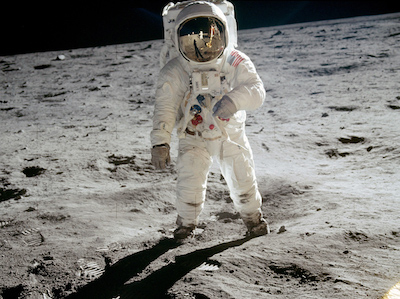 On a sound stage no one can hear you taking a dump
Self-determination
Ulster is British because that is what the majority of her citizens want. This has been shown time and time again in elections, referendums and opinion polls. [Although last time I looked it was getting pretty close in elections.]
In the most recent general election, in 1992, unionists of various descriptions won 13 of Ulster’s 17 seats and 64.7% of the vote. In 1973 the government held a referendum on Ulster’s future. 98.9% of those who voted voted for the continuance of the union. Much was made of the boycott of the poll by nationalists and the consequent low turnout of only 58.7%. As Morrison points out, the highest ever turnout in a Northern Ireland general election was 72%, so even if all those between 58.7% and 72% had voted for a united Ireland it would still have only represented about 14% of the total vote.
[That would be John Morrison who wrote “The Ulster Cover-up”.
I am not sure about the maths here.
There are all sorts of reasons to think that the turnout would be higher in a referendum where every vote counts. After all, there is less point in voting Conservative in a safe Labour seat than a marginal. Fortunately, we have the example of the 1998 Good Friday Agreement Referendum where the turnout was 81%.
So let us assume that without a boycott the Border poll would also have had an 81% turnout. Let us also assume that all the “extra” voters would have voted leave. Those who voted remain represent .989 x .587 or 58.1% of the electorate. 58.1% of 81% is 71.7%. So the maximum leave vote would have been 28.3%. I think.]
Commentators often look at the [changing] ratio of Catholics to Protestants and draw the conclusion that Catholics will eventually outnumber Protestants and that therefore they will vote Northern Ireland into a united Ireland. This ignores two essential points. Firstly, projecting the past into the future is a dangerous business. Secondly, an individual’s choice between being a unionist or a nationalist is not determined solely by his religion. The nationalist vote is soft. In 1964, for instance, after 40 years of peace, prosperity and progress, the Northern Ireland Labour Party, which supported the Union, succeeded in pushing nationalists into third place in the general election of that year.
[So the NILP got all its support from Nationalists, eh? Not true. By the way, that is the Northern Ireland Labour Party and not the Labour Party which refused and continues to refuse to organise in the province.]
Opinion polls also show little evidence of a desire for a united Ireland. In January 1996, in a survey carried out for the Belfast Telegraph only 17% of those interviewed chose a united Ireland as their preferred outcome.
[Very similar to recent polls I have seen although it does beg the question why nationalists get 40-45% of the vote in elections.]
A Unionist politician once had an illuminating discussion with a Catholic Unionist voter. The voter explained that most of his Catholic colleagues agreed that they did not want a united Ireland but that despite this they continued to vote for nationalist candidates. It seemed that they voted the way they did for reasons of communal solidarity.
[Question answered.]
→ Continue reading: Ulster for Beginners – Part V
In many cases rent control appears to be the most efficient technique presently known to destroy a city – except for bombing.
– Economist Assar Lindbeck, which seems a timely reminder in view of this absurdity. Some actually take the view it is worse than bombing.
The UK is following the USA in adopting conviction-free, hell, trial-free presumption of guilt. It starts with ‘obvious’ bad guys but as USA’s example with asset forfeiture shows, it doesn’t stop there.
– Perry de Havilland, discussing this.
In terms of the massively deluded concerning economics as we all know John McDonnell is one of life’s winners. Anyone who can possibly observe the past 40 years and decide that capitalism as failed is clearly, obviously, either nuts or ignorant. True, he saw through the Senior Lecturer but still. He is though insisting that a Labour victory, with those associated policies of uncompensated nationalisation, yet more of the country’s investment running through government, will raise the value of sterling.
This might, you know, not happen.
– Tim Worstall
“What has been will be again,” as it says in Ecclesiastes, “what has been done will be done again; there is nothing new under the sun.”
Yesterday – to my shame I did not spot it until today – the Times reprinted a letter to the editor that was a century old to the day. I wish I could say that it was merely of historical interest.
From The Times July 15, 1919
To the Editor of The Times
Sir, Will you permit an elderly man, who is not a politician nor a public character, but merely an individual among millions of honest, sober persons whose liberty is attacked by a moral tyranny, to state an opinion with regard to the crusade against moderate drinkers? It is not needed even in the cause of morality. When I was a child excess in drinking was patent in every class of society. Now, in my wide circle, I do not know of one man or woman who is ever seen “under the influence of liquor”. Why not leave the process of moderation, so marked within 60 years, to pursue its normal course? It is untrue to say that a reasonable use of alcohol is injurious to mind, body or morality. My father, whose life was one of intense intellectual application, and who died from an accident in his 79th year, was the most rigidly conscientious evangelical I have ever known. He would have been astonished to learn that his claret and water at his midday meal, and his glass of Constantia at bedtime, were either sinful in themselves or provocative to sin in others.
There is no blessing upon those who invent offences for the pleasure of giving pain and who lay burdens on the liberty of others. We have seen attempts by the fantastically righteous to condemn those who eat meat, who go to see plays, who take walks on Sundays. The campaign against the sober use of wine and beer is on a footing with these efforts, and should be treated as they have been. Already tobacco is being forbidden to the clergy! The fact that Americans are leading the campaign should be regarded with alarm. We do not express an opinion, much less organize propaganda, against “dryness” in the United States. It is not for us to interfere in their domestic business. If Englishmen went round America urging Americans to defy their own laws and revolt against their customs, we should be very properly indignant. Let crusading Americans be taught the same reticence.
The propagandist teetotaler is active and unscrupulous. He fights with all weapons, whether they are clean or no. We must resist, without fear of consequences, the cruel and ignorant fanaticism of these apostles.
I am, Sir, your obedient servant,
EDMUND GOSSE
The BBC is breathlessly reporting cases of parents whose bank accounts have been cleared out by their children playing games with in-game purchases.
We are technically savvy but didn’t think to put a password on and my son, who was 12, ended up spending around £700.
It was on his own phone and he managed to download Clash of Clans through a Google Play account, enter his own children’s bank card details and buy lots of in-game items.
It is possible to prevent this. My own children often ask to buy in-game items, which tells me I have somewhat succeeded in training them to ask first. Steam has a PIN code that only I know. The iPad requires my fingerprint before it will take money. And Google Play is set up to require a password. So far, so good.
I installed Mini Golf King on my phone for my son who is five. He knows he’s not allowed to spend money in games, yet this game successfully tricked him into spending £300 on in-app purchases.
[…]
People will say “well, you should be supervising him”. I was! I was in the room.
But the game is a children’s game, rated PEGI 3 [suitable for players aged three and above].
I would allow him to watch a U-rated film and I assumed PEGI 3 games were safe to play with casual supervision.
Now things are getting tricky: user interfaces are hard to get right even when you are trying not to confuse people. I can remember a handful of occasions where I have done something daft with a computer, have been met with no sympathy at all from support staff, but objected that the problem is that the user interface was misleading. There are worthy complaints here.
Now politicians are taking an interest. There is always this instinctive call: The Government should Do Something! I do not see the need. Complain instead to marketplace. Google Play, the Apple App Store and Steam are in a position to enforce user interface standards and they can probably do better with default settings, spending limits, and better-designed family accounts.
|
Who Are We? The Samizdata people are a bunch of sinister and heavily armed globalist illuminati who seek to infect the entire world with the values of personal liberty and several property. Amongst our many crimes is a sense of humour and the intermittent use of British spelling.
We are also a varied group made up of social individualists, classical liberals, whigs, libertarians, extropians, futurists, ‘Porcupines’, Karl Popper fetishists, recovering neo-conservatives, crazed Ayn Rand worshipers, over-caffeinated Virginia Postrel devotees, witty Frédéric Bastiat wannabes, cypherpunks, minarchists, kritarchists and wild-eyed anarcho-capitalists from Britain, North America, Australia and Europe.
|





Recent Comments