We are developing the social individualist meta-context for the future. From the very serious to the extremely frivolous... lets see what is on the mind of the Samizdata people.
Samizdata, derived from Samizdat /n. - a system of clandestine publication of banned literature in the USSR [Russ.,= self-publishing house]
|
One trend that has been a big push in recent weeks is – for obvious reasons – homeschooling. And those who run the education system in North America (and I presume, in other places) are worried that if youngsters learn at home, they’ll be less prone to teachers’ ministrations. Kids will start to think for themselves. This must be resisted because it undermines civic spirit, apparently, according to this Harvard Review article:
She views the absence of regulations ensuring that homeschooled children receive a meaningful education equivalent to that required in public schools as a threat to U.S. democracy. “From the beginning of compulsory education in this country, we have thought of the government as having some right to educate children so that they become active, productive participants in the larger society,” she says. This involves in part giving children the knowledge to eventually get jobs and support themselves. “But it’s also important that children grow up exposed to community values, social values, democratic values, ideas about nondiscrimination and tolerance of other people’s viewpoints,” she says, noting that European countries such as Germany ban homeschooling entirely and that countries such as France require home visits and annual tests.
Here’s another gem:
She concedes that in some situations, homeschooling may be justified and effective. “No doubt there are some parents who are motivated and capable of giving an education that’s of a higher quality and as broad in scope as what’s happening in the public school,” she says. But Bartholet believes that if parents want permission to opt out of schools, the burden of proving that their case is justified should fall on parents.
The problem with this article is that the author of the piece appears oblivious to parents’ worries about the poor quality of much public schooling in the US. There is also the default assumption that the State is entitled to impose a certain view and set of aptitudes and attitudes on children and that the burden of proof is on those who want the family, not the State, to be the primary decision-taker on education. An article in Reason magazine last year also directly challenged the idea that homeschooled kids are less likely to be well-adjusted adults. (Like with all these issues, there are clear exceptions, such as with children who are maltreated by parents, etc).
I will be interested to see if any of you fine Samizdata commenters have been schooled at home for any part of your time, and what your experience has been.
In times of crisis, certain viewpoints are challenged. Now is such a time.
I expect ability to procure was some way down the list of attributes they were expected to demonstrate at the interview, coming behind devotion to the cult of the NHS, commitment to diversity, and being utterly subservient to upper management and bureaucracy.
– Tim Newman responding to reports of NHS procurement ineptitude.
Via Ed Driscoll of Instapundit, I found this admirably thorough story by Mollie Hemingway in The Federalist. Here, she said, are some of CNN’s reports about Christine Blasey Ford’s accusations against Brett Kavanaugh:
Read the letter Christine Blasey Ford sent accusing Brett Kavanaugh of sexual misconduct,
Post reporter says Kavanaugh accuser was ‘terrified about going public’,
Republican senators weigh in on delaying Kavanaugh vote,
Echoes of Anita Hill in allegations against Kavanaugh,
Dems call for delay of Kavanaugh vote after accuser comes forward, Listen to letter from Kavanaugh’s accuser, and
Washington Post: Kavanaugh accuser comes forward.
These senators could make or break Kavanaugh’s nomination,
The Kavanaugh controversy is a watershed moment for GOP,
Trump stands by Kavanaugh, supports ‘a full process’,
Why the Kavanaugh allegations come at the worst possible time for Republicans,
an interview with the reporter who broke the Post story,
Kellyanne Conway says Kavanaugh’s accuser ‘should not be ignored or insulted’,
a page devoted to a video of Kellyanne Conway’s statement,
Kavanaugh allegations lead to White House scramble,
Lawyer: Kavanaugh accuser willing to testify publicly,
State of play of the Kavanaugh nomination on Capitol Hill,
Joe Biden reacts to Kavanaugh allegation, reviving memories of Anita Hill hearing,
Why sexual assault survivors often don’t come forward,
Why Dianne Feinstein waited to take the Brett Kavanaugh allegations to the FBI,
White House plan to defend Kavanaugh relies heavily on women,
Brett Kavanaugh, Christine Blasey Ford to testify on assault allegations in public Monday,
Anita Hill’s accusations did not hurt public support for Clarence Thomas in ’91,
Republicans and Democrats grapple with Kavanaugh political fallout 7 weeks from midterms,
The power of a named accuser: Kavanaugh’s future now hangs in the balance,
Mark Judge, Kavanaugh’s high school classmate, details high school parties in past writings, and many others.
By September 18, CNN’s participation in the anti-Kavanaugh campaign was even more intense:
Why Kavanaugh should make men question ‘himpathy’,
Dianne Feinstein, elected in the ‘Year of the Woman,’ navigates the politics of #MeToo,
Julia Louis-Dreyfus lends support to Brett Kavanaugh accuser,
Anita Hill: Senate should ‘do better’ than it did in 1991,
Doug Jones: Senate should compel Kavanaugh’s friend to testify,
Kavanaugh nomination descends into chaos,
What happens if Christine Blasey Ford doesn’t testify?,
With Kavanaugh, McConnell’s throne is on the line,
Christine Blasey Ford is risking it all to speak out,
Kavanaugh decision moment: A horrendous act or a monstrous lie,
Emmy attendee shows up with ‘Stop Kavanaugh’ written on her arm,
What The Wall Street Journal gets dead wrong about Christine Blasey Ford and Brett Kavanaugh,
Women hold the key to Kavanaugh — and maybe control of Congress,
Trump on Kavanaugh: ‘This is not a man who deserves this’,
Former classmate of Kavanaugh’s denies being at party in sexual assault allegation,
Kavanaugh accuser wants FBI investigation before testifying,
Sen. Hirono’s message to men: ‘Just shut up and step up. Do the right thing.’,
5 big questions about the Kavanaugh hearing,
Kavanaugh hearing uncertain for Monday as accuser wants FBI to investigate before hearing,
George W. Bush defends Kavanaugh as ‘a fine husband, father, and friend’,
Accuser’s friend: She is nothing but honest,
Reliable Sources: Kavanaugh questions; left and right reactions,
Mark Judge tells Senate he ‘has no memory of alleged’ incident with Kavanaugh,
Read: Christine Blasey Ford’s attorneys’ letter requesting FBI investigation, and many others.
Trump calls Kavanaugh ‘an extraordinary man’,
Kavanaugh’s accuser made her move — now Republicans have to choose,
Mazie Hirono: Kavanaugh accuser is hesitating to testify because she’s afraid of a GOP ‘railroad job’,
Trump says he wants to see Kavanaugh’s accuser testify,
6 possible Kavanaugh scenarios, including a Supreme Court vacancy until 2021,
Anita Hill: FBI should investigate Ford’s claim,
Kavanaugh’s accuser says he was drunk at the time. What studies say about alcohol and memory loss,
Kavanaugh accuser’s lawyer: ‘Rush to a hearing is unnecessary’,
Friend of Kavanaugh’s accuser speaks out,
Toobin: If she won’t testify, he gets confirmed,
Reliable Sources: The Supreme Court clock is ticking,
Republicans just made a giant gamble on Brett Kavanaugh,
Collins says ‘it’s not fair’ for Kavanaugh accuser not to testify,
Did Donald Trump just hedge on Brett Kavanaugh’s future?,
McCaskill’s voting against Kavanaugh – and it has nothing to do with the accusations,
Grassley sets Friday deadline to hear back from Kavanaugh accuser,
Garamendi: This is a defining Me Too moment,
Accuser’s lawyer: Rush to hearing unnecessary,
Gillibrand: GOP approach amounts to ‘sham hearing’ on Kavanaugh allegations,
Begala: Hypocrisy, thy name is GOP,
GoFundMe raises more than $100K to help Kavanaugh accuser with security expenses,
Graham wants Kavanaugh vote before midterms
In Hemingway’s report, every one of these is a link. Click ’em and see. There were more, I just got bored of copying them.
And here is all the reporting CNN had done of the very similar allegation against Joe Biden by Tara Reade until yesterday:
“China knows it is in a strategic battle with the West; it is time we realised this basic fact, too. Using their comparative advantage of getting through the virus first, Beijing is pursuing its geostrategic interests via ‘mask diplomacy’, soft power, trying to change the basic narrative by offering hard-hit countries medical supplies, both as a showy humanitarian gesture and as a sign of their system’s supposed superiority. Leaving aside that these supplies must be paid for and some are defective, the whole exercise feels like an arsonist expecting gratitude for providing their victim with a watering can.”
– John C Hulsman
Governments anxious to be seen to “do something” (the curse of democratic politicians everywhere) made grand dramatic gestures – building hospitals in days that would normally have taken years. To hell with whether they were needed or not (the much bruited London Nightingale reportedly has just 19 patients) Look! We are doing stuff. Stuff you could never do yourselves!! The State and its hordes are heroes.
– ‘Tom Paine’
Samizdata no longer needs me. Soon it will no longer need you. I took the text from the sidebar:
The Samizdata people are a bunch of sinister and heavily armed globalist illuminati who seek to infect the entire world with the values of personal liberty and several property.
and copied it into Talk To Transformer.
The Samizdata people are a bunch of sinister and heavily armed globalist illuminati who seek to infect the entire world with the values of personal liberty and several property. Most of them are rich white males who are probably atheists, but many are probably questioning the existence of a god as they revel in their limitless wealth. They believe that anyone who is unprotesting of their cause is a threat to their cause and a threat to their own existence. They don’t care if you are a child and a physician or an Arab and a journalist. You must conform and accept their conspiracies. This is the true face of
Comments are, as ever, welcome. Even from humans.
“The coronavirus outbreak gives us a neat experiment in what happens when humans suddenly dramatically reduce both production and consumption. And, to put it mildly, most of us are not enjoying it one bit. That suggests that instead of the hair shirtery favoured by the Gretas of this world, our best solution is creating the technologies that allow us to keep consuming while also keeping the planet cool with our doing so.”
– Tim Worstall.
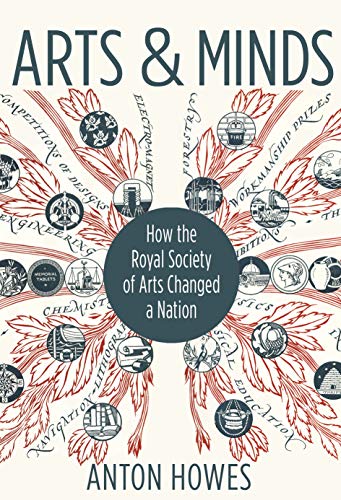
Yes, I learn from a tweet by Anton Howes, a young academic whom I greatly admire, that his first book, entitled Arts & Minds: How The Royal Society of Arts Changed a Nation will be out on May 12th. It is already available on Kindle.
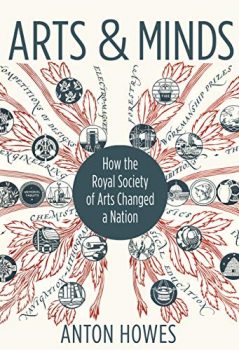
I will start reading this book with the prejudice in my head that the Industrial Revolution was not only “industrial”; it also resembled what we more usually mean by a “revolution”, in the sense that it was also an ideological event. People didn’t just do this, for their own private and selfish reasons. They believed in doing it. They told each other, and anyone else who would listen, that what they were doing would do good, on a huge scale.
But unlike with almost all other “revolutions”, the ideologists of the Industrial Revolution were completely and triumphantly right. This triumphant rightness has been such an elephantine presence in the room of history, and is so very counter-intuitive (“Ideologists are all nutters!”), that the ideological nature of this revolution has now become nearly invisible.
The concluding paragraph of the Amazon blurb …:
Informative and entertaining, Arts and Minds reveals how a society of public-spirited individuals tried to make their country a better place, and draws vital lessons from their triumphs and failures for all would-be reformers today.
… together with the title of the book, arts and minds, suggest to me that the above prejudices will be confirmed and strengthened.
If there is a disaster, would you like people for hundreds of miles around to drop everything and make herculean efforts to get those worst affected exactly the sort of help they need most – even when the helpers have no personal connection with the victims? Would you like factories worldwide to rush to switch production to making whatever they are short of in the disaster zone?
You would? Then let people make money by doing it. You can either rely on the small subset of people who will seriously disrupt their lives to help strangers out of pure charity, or you can also get help from the much larger pool of people who who are pushed from vague thoughts of benevolence into action by the prospect of profit. Let them sell goods of which there is a shortage at a higher price and soon there won’t be a shortage any more.
– something sorta like this was said by someone, whom I would gladly credit if I could remember who they were.
My post was prompted by this story by Edward Thicknesse in City A.M.: Coronavirus: Calls for price controls dismissed as ‘economically illiterate’.
Coronavirus is dominating all our lives just now, but I have little to say about it other than that I, like almost everyone else, wish it all to stop, both the virus itself and the measures now believed necessary to combat it. Whether these measures have been and are insufficient or wise or excessive, I look forward to reading about in the months and years ahead, but do not now have much of an opinion about.
Instead, I would like to ask some questions about the political beliefs that most of us here share. What are the best arguments you know of in favour of libertarianism? I define “libertarianism” loosely, as a general inclination towards liberty, towards property as the way to solve the problems of contending liberties, general lifestyle freedom, and (very) little in the way of governmental power, either financial or regulatory.
Insofar as I can remember how I first thought about such things (during the 1960s and early 1970s), what made me a libertarian was that the world’s most free countries seemed also to be the nicest countries, while the least free countries were definitely the nastiest ones. This contrast was especially clear when you looked at single countries which had been divided into two countries, unfree and much freer, such as Korea and Germany.
What pushed me away from the majority “centrist” notion of how things should be (quite a lot of liberty but also a lot of government), was the thought that if extreme liberty worked amazingly well (Hong Kong seemed to me to illustrate that) and extreme lack of liberty definitely worked extremely badly, why would you want to have a “balanced” mixture of these two contending processes, one very good but the other extremely bad? There was a widespread view, then as now, that “business” needed to be quite free, but that things like healthcare, education, and (a particular interest of mine) architecture, could not or should not be treated only as businesses, as the mere outcomes of free and individual decisions, like the washing machine business or the hi-fi business. I thought: Why not? Surely this notion should be given a serious go, in at least some countries. I further thought that if it was given a serious go it would work out very well, and that it consequently would, or at least should, spread very widely and preferably to nearly everywhere.
I further believed that “lifestyle” freedom and commercial freedom went well together, each reinforcing the other, despite the loudly expressed opinion from many of my contemporaries, who also favoured lifestyle freedom but who believed that only government power applied to the advantage of hitherto disadvantaged minorities could set them free.
So, those were my answers to my above questions, and such thinking continues to make me call myself a libertarian. But are mine the sort of arguments that will best persuade others to arrive at similar conclusions?
What I’m hoping for from commenters is not so much minute dissection of only a very few arguments, but rather quantity of arguments, each quickly and perhaps rather roughly described, together with expressed preferences for this sort argument over that, in terms of persuasiveness. Thanks in advance for as many answers to these questions as commenters are kind enough to supply.
Concerning quantity of arguments in particular, different people respond to different arguments, depending on how they already think, and therefore maybe quantity is the key to successful libertarian persuasion. We need lots of arguments, including many that we have either not yet thought of, or made much use of, or which we ourselves do not now consider very persuasive. Perhaps the title of this posting should be: What are all the arguments for libertarianism?
By the way, you don’t have to be a libertarian to contribute to this discussion. Quite the contrary. Every argument against libertarianism calls for a response, which it may get, or may not get but should.
Links have been lacking in this so far, so here is one to end with, although not a proper one because it is to a video recording of a talk that I myself gave in 2012, to the now alas dormant Libertarian Home. This talk was entitled Libertarianism Is Simple To Describe But Not Simple To Argue For. Partly because of what it said, this talk started well but became less coherent as it went on. But I’m still quite proud of it, because despite its meandering nature, it does refer to many different sorts of arguments for and against libertarianism, of the sort I seek to learn more about now.
I’ve just been reading the twitter feed of a senior journalist and also of a well-known philosopher. They seem to me to be preposterous figures. One of the extraordinary effects of digital is that it reveals the hollowness and mediocrity of those we’d once have lauded.
– Douglas Carswell
“NHS phone app holds key to lifting UK’s coronavirus lockdown”, the Times reports.
Ministers have ordered the creation of an NHS mobile phone app the government hopes will help end the coronavirus lockdown.
The app would allow mobile phones to trace users who have come into contact with infected people, alerting them to get tested.
This would make it possible to start lifting the most stringent social-distancing measures from late next month, ministers hope.
Senior sources say NHSX, the health service’s technology arm, has been working on the app with Google and Apple at “breakneck speed”. The system will use Bluetooth technology to alert those who download the app if they have been in close proximity with someone who has tested positive for Covid-19.
Combined with a vast expansion in testing, which ministers claim will hit 100,000 a day by the end of the month, the app is a central plank in the government’s push to lift the lockdown. “We believe this could be important in helping the country return to normality,” a Whitehall source said.
Matt Hancock, the health secretary, is considering how to incentivise people to install the app. Experts say the “track and trace” concept only works effectively if 60% of people adopt it.
One idea under consideration would mean people being told they could resume normal work and home life if they installed it on their phones.
As I said in the title, the worst of it is that this might be the way to control the epidemic, an outcome greatly to be desired. And then it might be the way to control us.
|
Who Are We? The Samizdata people are a bunch of sinister and heavily armed globalist illuminati who seek to infect the entire world with the values of personal liberty and several property. Amongst our many crimes is a sense of humour and the intermittent use of British spelling.
We are also a varied group made up of social individualists, classical liberals, whigs, libertarians, extropians, futurists, ‘Porcupines’, Karl Popper fetishists, recovering neo-conservatives, crazed Ayn Rand worshipers, over-caffeinated Virginia Postrel devotees, witty Frédéric Bastiat wannabes, cypherpunks, minarchists, kritarchists and wild-eyed anarcho-capitalists from Britain, North America, Australia and Europe.
|





Recent Comments