We are developing the social individualist meta-context for the future. From the very serious to the extremely frivolous... lets see what is on the mind of the Samizdata people.
Samizdata, derived from Samizdat /n. - a system of clandestine publication of banned literature in the USSR [Russ.,= self-publishing house]
|
No country has ever improved the health of its population by making itself poorer.
– Dr John Lee.
England may soon have new road signs for pedestrians. We have some new signs coming out, to remind us about ‘social distancing’. Here are the samples taken from the .gov.uk website.
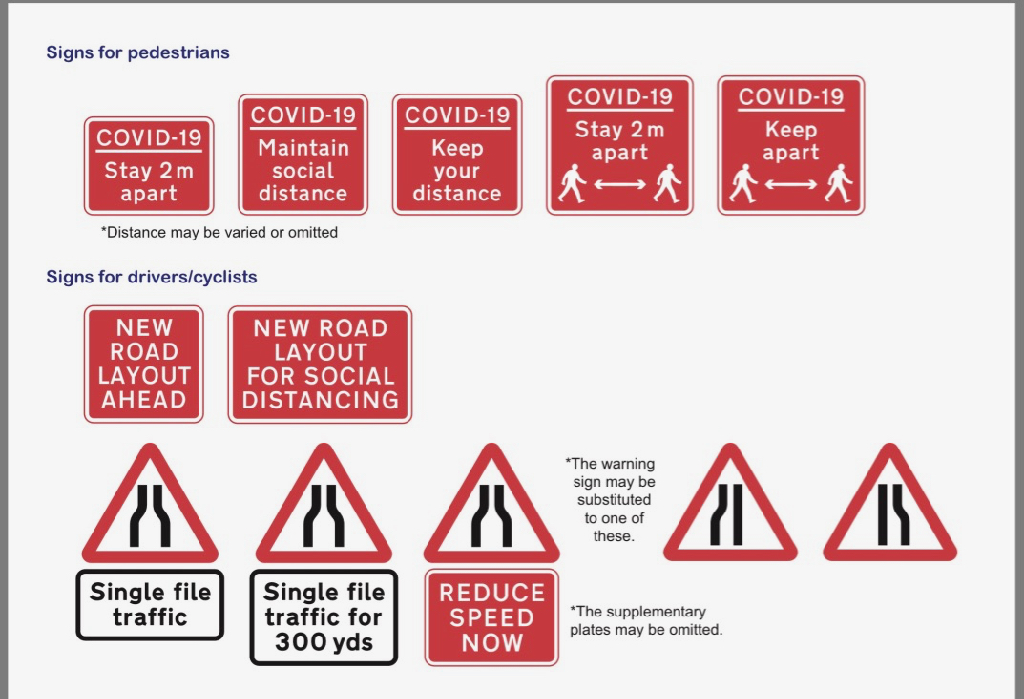
What are these signs for? The UK government’s Department of Transport is clearly playing the long game in short order in the war on freedom and against the private motor vehicle, er.., Covid-19 in England. On Saturday 9th May 2020, guidance came out for local councils (who manage most of the road space) to make changes to road use to facilitate the use of ‘roadspace’ by cyclists and pedestrians. This has been done by providing new ‘guidance’ to local councils on under The Traffic Management Act 2004. So the response to this epidemic is clearly going to be rather more ‘permanent’ than temporary, the government is engaged in not just a reaction to widespread respiratory tract infections and the inability of the NHS to provide health care. Take a look at some of the wording:
“The government therefore expects local authorities to make significant changes to their road layouts to give more space to cyclists and pedestrians. Such changes will help embed altered behaviours and demonstrate the positive effects of active travel.”
“When the country gets back to work, we need them to carry on cycling, and to be joined by millions more. With public transport capacity reduced, the roads in our largest cities, in particular, may not be able to cope without it. We also know that in the new world, pedestrians will need more space. Indications are that there is a significant link between COVID-19 recovery and fitness. Active travel can help us become more resilient.”
A new world, are we on Mars? It goes on:
“We recognise this moment for what it is: a once in a generation opportunity to deliver a lasting transformative change in how we make short journeys in our towns and cities. According to the National Travel Survey, in 2017-18 over 40% of urban journeys were under 2 miles – perfectly suited to walking and cycling.”
Never let a crisis go to waste.
“Active travel is affordable, delivers significant health benefits, has been shown to improve wellbeing, mitigates congestion, improves air quality and has no carbon emissions at the point of use. Towns and cities based around active travel will have happier and healthier citizens as well as lasting local economic benefits.”
Will those citizens be happier and healthier cycling to work in the cold November rain? Sorry, I assumed that there will be any meaningful jobs left by then. Why haven’t they been cycling already? ‘…no carbon emissions at the point of use…’, really? I think it means ‘carbon dioxide’ of course. But if anyone rides a pushbike and doesn’t emit carbon dioxide, whether immediately or via lactic acid metabolism, they will be dead.‘…lasting local economic benefits…’: Never mind the bigger picture. The bull is big on this and they know it and don’t care.
So all this is what the Secretary of State for Transport, Mr Grant Shapps, a sort of Bruce Foxton lookalike, has in mind. He seems to be there to make the rest of the Cabinet look good, and who has a very trustworthy past.
Is, in this ‘new world’, (their words) HS2 going to be viable as this virus will still be deemed a threat in 2030 or whenever it is ready, and the train will be ‘socially-distanced’? Don’t hold your breath, unless you want to reduce carbon emissions.
Whatever the UK Prime Minister says tonight, the UK government is clearly using this situation as an opportunity to regulate ever more closely every aspect of our lives. This is Mr Johnson’s green agenda bursting out into the open, the Khmer Vert with Covid-1984.
Good quality housing only seems less available now to people who pretend the housing stock is the same and household size is the same.
Fifty years ago large families crammed into small leaky houses. Nowadays half as many live in the renovated versions of those houses. With decent plumbing etc.
We frequently blow up fifty year old tower blocks because they are considered sub-standard.
– the delightfully named Chester Draws
“Science is the belief in the ignorance of experts.” (Richard Feynman)
Over a decade ago, climategate confirmed that Jones, Mann and Briffa knew exactly what they were doing when they scaled the hockystick to hide the decline while having not a clue about what the decline meant. However it incidentally revealed the, uh, ‘quality’ of their code.
Neil Ferguson’s extra-lockdown/marital escapade says much about his elite opinion of us common people (and of the lockdown), but meanwhile someone has taken a look at the, uh, ‘quality’ of his code.
Conclusions. All papers based on this code should be retracted immediately. Imperial’s modelling efforts should be reset with a new team that isn’t under Professor Ferguson, and which has a commitment to replicable results with published code from day one.
On a personal level, I’d go further and suggest that all academic epidemiology be defunded. This sort of work is best done by the insurance sector.
Read the review to see what leads to these conclusions. You have to laugh (in order not to cry 🙂 ).
Homeschooling is in the news a lot these day, for reasons that you already know all about. So, it makes sense to give a plug here to a video interview that Amy Willis of econlin.org did recently with Bryan Caplan, which I just listened to. I got to know Caplan a bit better than before when I attended a lecture he gave last December in London about Poverty and about who’s to blame for it.
This homeschooling conversation, which lasts just under forty minutes, is very commonsensical, I think. Caplan is no zealot for snatching his kids out of school. His one big doctrinal disagreement with regular schooling of the sort his kids were getting is that he reckons maths is more important than schools generally, and his kids’ school in particular, tend to assume.
For Caplan, homeschooling began when his two older sons, twins and introverts, declared themselves to be unhappy with the school they were at. Caplan reckoned he might be able to do better, so they gave it a shot. And it would appear to have worked out well.
His younger and only daughter seems now to be happier going to school, because she likes meeting up with her friends, and because the arts-skewed curriculum appeals to her a lot more than it did to her brothers. She must be suffering a bit now. His younger son, on the other hand, is liking the new stay-at-home regime.
That being a particular thing I take from this conversation: how female-friendly and male-hostile regular schooling of the sort Caplan is talking about seems to have become. Is there a bias in homeschooling numbers between boys and girls being homeschooled? I don’t know, but I bet Caplan does.
Towards the end of their conversation, Willis and Caplan talk about Caplan’s book on education, which is entitled The Case against Education: Why the Education System Is a Waste of Time and Money. I guess the guy’s somewhat more doctrinal than he had earlier seemed.
On the other hand, both those twins want to be college professors, and Caplan doesn’t seem to be doing anything to try to stop them.
“Yeah, the reason the speaker can’t come here is because he promotes violence – by us, his enemies.”
– Robert Murphy
Quoted by David Thompson.
My mother was in her early teens in World War II. I once asked her what it was like not to know who would win. Alas, I cannot remember in detail how she answered, but among the things she said was that she did not speculate about it much because any such discussion would have been instantly quashed by her father, a former soldier, with some words along the lines of “There will be no defeatist talk in this family, young lady!”
Yet this atmosphere of stern patriotism did not stop her openly reading a translation of Hitler’s Mein Kampf on the principle of “Know thy enemy”.
“Owning a book isn’t a declaration of belief,” writes Janice Turner in the Times.
Journalists own a lot of odd books. Some are sent to us unsolicited, others we buy to illuminate a news story. That Michael Gove, a former Times columnist, has The War Path by Holocaust-denying historian David Irving nestling among Alastair Campbell diaries and Stalin biographies does not alarm me. But the online outrage at a photograph showing this book on Gove’s shelves does.
Because if I’d covered, say, the 1996 libel case brought by Irving I’d have bought his work, too. Why? Curiosity; the desire to quote from original sources; to hear Irving’s authorial voice; to understand how he magicked away mass murder. Later, my piece written, I’d have squeezed it in my unruly shelves with Mike Tyson’s Undisputed Truth and Naomi Wolf’s Vagina.
At this point I feel I ought to mention that the original Times article has that last word in italics.
Yet owning Irving’s book was to activist-journalist Owen Jones a window into Gove’s dark soul. On Twitter, people questioned why you’d read Irving rather than his many critics, as if they couldn’t trust their own minds not to be swayed. Gove was accused of “proudly displayed” antisemitism in his home. But books are not posters or cushions, mere expressions of personal taste.
What is the correct thing to do when you’ve read this book, in case some visiting fool concludes you’re a Nazi? Donating it to a charity shop risks further dissemination of evil. Well, you could burn it. That always goes well.
Here is Owen Jones’s tweet in all its glory.
Which of the books on your shelves would make you wish you had enabled the “blur background” function before turning on Zoom?
Apart from the obvious – a copy of Chavs by Owen Jones – I have three coffee-table books of reproductions of selected articles from the English language edition of Signal magazine, issued by the Wehrmachtpropaganda from 1940-1945. (It continued to publish an English language edition even after the US entered the war, ostensibly for the benefit of the Channel Islanders.)
How about you? Confess all and the tribunal will be merciful.
Here is a link to yesterday’s article by Kieren McCarthy in the Register:
UK finds itself almost alone with centralized virus contact-tracing app that probably won’t work well, asks for your location, may be illegal
Is he right?
Update: Guido Fawkes is also on the case. He is engaged in a vigorous and very public debate with the government, specifically the Department of Health. Earlier he sent this missive their way: 10 Problems With the NHS’s New Coronavirus App. Fair play to them, they did respond, and he has now issued this: NHS App: Rebuttal and Response. (Hat tip to Niall Kilmartin, who independently mentioned this link in the comments.)
Back when I was clever, I went to Oxford. My time there was not wasted. I learned that the best place to get stationery was the OUSU* shop in Little Clarendon Street, or Little Trendy Street as it is properly known. There you could get jolly nice ring binders with the university crest on them for £3.50, I think it was, and, if memory does not fail me, bottles of Tippex for 70p. Proper Tippex with a cute little brush, not a silly foam applicator. Also available were bottles of Tippex thinner. Change and decay all around I see: apparently Tippex thinner is no longer a thing.
Buuut…
The Oxford University Student Union voted for a policy that transgender, working-class and female students needed more protection and urged the university to give faculties guidance and make more use of trigger warnings.
The motion, proposed by Alex Illsley, co-chairman of Oxford’s LGBTQ+ campaign, stated that there were multiple examples of “ableist, transphobic, classist and misogynistic content” on reading lists. He cited an article advocating that it should be a moral duty not to have disabled children, which was included on a medical law and ethics reading list, and one “advocating for the murder of disabled children after they have been born”.
Perhaps not all change is decay. In a departure from its usual policy of dignified pusillanimity, the University grew a pair:
The university issued a statement saying there would be no changes as a result of the motion. “[There are] no plans to censor reading materials assigned by our academics,” it said. It referred to its policy on free speech, adding: “Free speech is the lifeblood of a university. It enables the pursuit of knowledge. It helps us approach truth. Recognising the vital importance of free expression for the life of the mind, a university may make rules concerning the conduct of debate but should never prevent speech that is lawful. Inevitably, this will mean that members of the university are confronted with views that some find unsettling, extreme or offensive.”
Cambridge, take note.
*Back in those days OUSU stood for something. Though it always seemed a little odd that “The one that isn’t the Oxford Union” didn’t start with a T.
Volume 9 of of the collected works of Kim Il Sung is now out, and Mick Hartley is having a hard job containing his excitement:
Let’s hope the book maintains the powerful tradition in Korean revolutionary literature of keeping sentences long, with plenty of clauses which further elaborate on the idea first mentioned in the opening clause, thereby ensuring that the original idea becomes ever more entrenched within the consciousness of the reader as the theme is expanded upon and elaborated, very much in the way that a piece of music takes an original theme which is then embellished and repeated in different formats and combinations, which serves to increase the power of the music and can similarly be a powerful device to increase the power of a revolutionary thought or indeed instruction from a Great or Dear Leader, even if there is a risk, among those perhaps insufficiently devoted to the drive towards a successful and dynamic socialist country, that the original thought that started the sentence may have been forgotten by the time the reader comes in, panting but nevertheless certainly wiser and also older, to the end of the sentence.
Hartley has also been very good on the lockdown.
So you don’t read people you disagree with? Do you at least read the CliffsNotes version to know if you actually disagree with them?
To be fair, not uncommon, which is why my party trick of attributing Mussolini quotes to Marx to see what someone really thinks works so well.
– Perry de Havilland
A guest post from Sandy Wallace
No-one from a nation that has never endured occupation should ever presume to sit in judgement on how vigorously those who have been occupied should have resisted occupation. I now realise that I too would have at best acquiesced to the occupation. Had I been in power, with my salary and pension dependent on my decision, I might have collaborated.
When Rishi Sunak announced his first great rescue package including the guarantee of 80% salary to anyone furloughed due to CoViD19, I took to my bed for six hours. I had only just got up after 8 hours sleep. When I returned to my computer I faced a wall of approval, from writers and commentators I considered to be to my right politically. He had just privatised the British state, without recourse to Parliament and he was the hero of the hour. I looked to see who would argue against the trashing of the economy for a generation. Douglas Carswell seemed to be my De Gaulle, but in truth he did little more than murmur doubts. There were many more Petains. At my minor level, I examined my position. As a Councillor elected as a Conservative who had resigned from the party at the height of May’s Brexit betrayal, leaving a pro-Remain and pro-Big Government Scottish Conservative Party, whose ruling Council administration group preferred if at all possible to give all power to our minority LibDem partners, I had been close to presenting a rival council budget proposal, a shadow quasi Conservative budget full of cuts to front line services to permit investment in capital projects. I had dropped my plans as CoViD now made my grandstanding seem self-indulgent rather than politically provocative. I sighed with relief at my near miss. I had misjudged the mood. Nobody cared about the principles of living within your means, of planning for the future. All that mattered was getting through the day.
Then my own daily travails interrupted. My two day a week sojourn at B&Q would be paid at 80% while I sat at home and got on with my hobby degree. As a school run taxi driver, I had asked to take three months off to focus on that degree. Now I would be paid 80% of what I would have earned based on what I earned last year. My degree funding was not only secure, the nod and wink indicated that even if I submitted no work I would still get nodded through to second year. My pay as a Councillor is unaffected. My wife, a senior nurse, and younger daughter, a junior nurse, were looking at unlimited overtime and public adulation. My elder daughter, a student, was now assured passage into third year. It dawned on me that with no travel costs and no eating out the future looked rosy. I took up camp with my elder daughter in her flat in a lovely village with pleasant country walks and a well-stocked Co_op.
I looked again at the decisions of the Johnson government. Should they have followed my instincts? No lockdown. Shield the elderly and the vulnerable, like my elder daughters immuno-deficient boyfriend, but let all normal life continue. Let the virus rip. Let the football league play out its conclusion and more to the point let out beloved Dundee Stars Elite Ice Hockey Club break our hearts and miss the playoffs. Such a government would probably have fallen within days, battered by the broadcast media, backbench rebellion and a nation that preferred to be kept safe from the unknown that they feared. Had they survived the month, then the elderly who by choice refused to be shielded would have pitched up in their thousands at A&E, to be faced with experienced nurses like my wife who triaged them on the doorstep and sent many of them home to die, to preserve the ICU beds for those who could be saved. Instead of admitting them so that they could die with every bit as much certainty. Had he survived the first month, Johnson would have fallen regardless and nation would be traumatised by the memory of grandparents sent home to die
Had I been in his shoes, I too would have sued for peace. My nation demanded it of me. I would have convinced myself it was the right thing and when the chest pain and cough arrived, I would have felt relief that I had made the correct call. I would have looked at the Malice of Piers Morgan and convinced myself that I was still moderate. I would have dismissed the feeble objections of lunatic libertarians.
When it’s over we can shave the heads of a few easy victims and vilify a few who enjoyed it too much. But I collaborated too.
|
Who Are We? The Samizdata people are a bunch of sinister and heavily armed globalist illuminati who seek to infect the entire world with the values of personal liberty and several property. Amongst our many crimes is a sense of humour and the intermittent use of British spelling.
We are also a varied group made up of social individualists, classical liberals, whigs, libertarians, extropians, futurists, ‘Porcupines’, Karl Popper fetishists, recovering neo-conservatives, crazed Ayn Rand worshipers, over-caffeinated Virginia Postrel devotees, witty Frédéric Bastiat wannabes, cypherpunks, minarchists, kritarchists and wild-eyed anarcho-capitalists from Britain, North America, Australia and Europe.
|





Recent Comments