We are developing the social individualist meta-context for the future. From the very serious to the extremely frivolous... lets see what is on the mind of the Samizdata people.
Samizdata, derived from Samizdat /n. - a system of clandestine publication of banned literature in the USSR [Russ.,= self-publishing house]
|
As a side-issue to the recent decision by London’s TFL [Transport for London] to stiff Uber for alleged safety concerns (please try not to laugh at the back), it occurs to me that there are various reasons why people across the spectrum, including Tories, seem quite fine with the ban (it may be that Uber will do some sort of deal and get back into business in London, mind). One seems to be a sort of fogeyish dislike of Uber (it’s American, which is vulgar, and relies on newfangled tech that some people don’t understand, such as apps, and satellites, etc); another seems to be “fuck-the-consumer-why-can’t-they-use-the-night bus?” level of grumpy nastiness, and another is a sort of feigned, or maybe real, worry about the loss of a set of skills (learning the streets of London by heart). I regard the first two reasons as so fatuous as to not be worth responding to. The latter, however, does interest me.
Consider, a standard Marxist argument, and indeed one not just associated with Marx but even early classical economics (the Labour Theory of Value) It holds that the value which a provider of a service/product should receive is linked to his labour, his effort and skill (learned via effort), not simply the interplay of demand and supply. There are, of course, all manner of problems with it: you cannot simply work out whether a skilled worker is worth X or Y times more than an unskilled one – there is no formula to do this. Second, resource allocation is impossible if the amount paid for Y or X is based not on the relative differences in wants and scarcities of something, but labour, instead. The marginalist revolution in economics, which broke in the 19th Century and which seems to have passed Marxists by, points out that the subtle differences in the subjective preferences of people for this or that are what drive economic exchange. Prices are signals; a labour theory of value leaves out the vital signalling function of prices, which is why an economy driven by such a theory breaks down, with shortages of much-wanted goods over here, and a glut of not-wanted stuff over there (evidence: socialist countries throughout history).
It may be a bummer for the taxi drivers of black cabs who have spent ages learning the streets of London by heart – getting “the knowledge” – to find that satnav and apps have driven a stake into their business model and potential sources of earnings, and be forced to get all those newfangled gizmos and compete with a chap from Hounslow who is second-generation Indian and who cannot name the first-11 team sheet of your favourite soccer team. But in a free market, technology and innovation means the customer isn’t paying for the effort to acquire a skill, but the outcome of it. And that seems a tough argument to sell, but it is nevertheless correct.
On a related note, this essay by Jeff Tucker of FEE about marginal utility and human happiness is brilliant. I shared it on social media and people who might not normally give a crap about such ideas said how much they liked it. Economic wisdom can spread in mysterious ways!
The Foundation for Economic Education website is really rather good. Following links from Perry’s SQOTD about Venezuela, I hit upon an article questioning the idea that an education should be well-rounded. I have been skeptical of this idea since being forced to study things in secondary school that seemed like a waste of time.
…we need to get rid of the idea that all kids need to learn the same stuff in schools. I think a corollary is getting rid of the idea that kids need to be well-rounded, which is one of the reasons why we have so much standardized curriculum.
This is an attractive idea. Specialising is more productive. People who are not good at mathematics get can get by, especially now that there are tools and information online. The same goes for other areas of knowledge.
This concept of “agility” seems to be a good description of how people function in the real world:
Well-roundedness means being prepared for anything by knowing a diverse array of stuff; whatever the situation, there is a chance the person will know something about it. Agility is the ability to adapt to change, not because one knows diverse stuff, but because one knows how to learn what one needs in any situation. The well-rounded person isn’t stymied by math because they know a little math. The agile person isn’t stymied by math because when they confront a math challenge, they use whatever tools they can to figure out a workaround.
There are some things the article misses. Perhaps learning about a diverse array of things when young, thereby learning how to tackle diverse problems, is a good way to become “agile”. Perhaps sampling a diverse array of things when young is also a good way to figure out what it is you would like to specialise in. Perhaps the author has unduly conflated standardised curricula with learning diverse topics.
One of the problems with my state secondary school education was the rapid time division multiplexing of topics. I would have preferred to focus on one thing at a time. Not everyone is like this*, and supply of different types of education for different people (perhaps via some kind of “market”, who knows?) might be of value, and is separate from the idea of education on specialised topics.
(*) — Incidentally, many parents seem to worry about their children obsessing over one particular thing and not being “well-balanced”. But multiplexing of diverse interests can be done over a scale of months rather than hours. I think such obsessions usually turn out to be temporary and are best left to run their course, or else they will be long-lasting and productive. I hope so: my own children are currently specialising in computer game testing.
Here’s where we get to the economics lesson. When producers aren’t allowed to profit, they don’t produce.
– Daniel Mitchell
Now this might seem screamingly obvious, yet even the UK is full of people who are either utterly oblivious to this self-evident and often demonstrated fact, or simply do not care, as equality via privation-for-all is actually their objective, with Venezuela’s example on that score being much admired.
The satire writes itself these days. For the past 16 months, ever since voters said No to the EU, the supposed liberal set has been signalling its virtue over migrant workers. These Remainer types have filled newspaper columns and dinner-party chatter with sad talk about foreigners losing the right to travel to and work in Britain. Yet now these same people have chortled as London mayor Sadiq Khan and his pen-pushers at Transport for London (TfL) have refused to renew Uber’s licence in the capital. Which means 30,000 people will lose work. Many of them migrants. They cry over migrant workers one day, and laugh as they lose their livelihoods the next.
– Brendan O’Neill
Not paying corporation tax is an advantage to those who don’t pay it as against those who do. Which is what we’ve been saying about corporate and capital taxation all along. If you tax corporations then there will be less investment in them in your economy. This makes everyone poorer – the deadweight costs are high. This is indeed exactly the same reasoning which leads us to insisting, as a result of optimal tax theory, that we shouldn’t be taxing the corporations at all.
Which is interesting, even amusing, don’t you think? The EU’s justification for why they just must tax companies is the very reason basic theory says we shouldn’t be taxing corporations at all.
– Tim Worstall
The #SaveYourUber petition has, as of 10:45 pm in London, attracted 600,000+ names, and one of them is mine.
Of course the best way to save Uber is to get rid of Sadiq Khan and make the issue politically radioactive.
This may seem a rather strange proposition, but in terms of ‘housekeeping’, there are various aspects to running a ‘household’, and I am comparing the financial discipline and general acumen of the First Lord of the Treasury (aka Mrs May) making the analogy to running the national ‘house’ to the practical but non-monetary skills of a badger, or rather, some badgers local to me.
The other day I found a badgers’ latrine on my morning walk, it was rather obvious, a ‘not-quite steaming’ pile and I immediately thought of the Prime Minister. I was struck by how careful the badger is to look after his household (or rather, his sett) and not to dump in it, instead using a carefully-dug latrine. This one was unusual in that it was very close to the roadside and highly visible.

Whereas it seems that the Prime Minister is quite happy to dump on the country a €20,000,000,000 bill for the privilege of leaving the EU and letting the UK run a trade deficit with them, and also dump a load of regulations on the UK. If you are going to make a payment, at the bloody least make it in Sterling, so the Bank of England can QE the money out of thin air (if this has to be done at all, which it doesn’t) and they can spend their nice pounds rather than HMG buy Euros. The good folk at Lawyers for Britain have debunked the case for any payment to be made for leaving. How about telling the EU that if your income falls, you cut costs, so that there are fewer than 10,000 in the EU earning more than the UK’s Prime Minister (which ought not to be an ‘office of profit’ under the Crown anyway).
The plan to graft into UK law all EU Regulations has at least the attraction of providing certainty, but why not plan a bonfire ‘On Day 1‘ to quote the Donald (yeah, it still hasn’t happened).
So if I have to choose between the two?
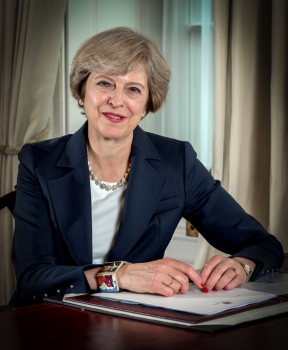 or or 
Having had to negotiate with a badger at 3 am one winter morning to get him to leave my garden, in my pyjamas and armed with only a garden fork for self-defence (this is England), I can testify that they do not give up a position easily, but my bluff worked.
To be fair to Mrs May, the badger seems to know instinctively not to foul its home, however, this is a skill that some of our politicians have yet to learn, and they are so very busy doing the opposite, it may take some time for them to lose their habits, but why?
Photo credits: Per Wikipedia, The Rt. Hon. T May MP, per Controller of HMSO – Own work, CC BY-SA 3.0, Badgerhero.
Patrick Crozier has written his own thoughts on this just now, but I have some thoughts of my own. I cannot remember being so angry about a decision out of London for some time.
Brian Micklethwait and others on this blog have written in the past about why Uber is such a big deal in how the case for capitalism and the free market can be made. And I have already seen evidence from people who are on the Left side of the spectrum that they are angry about this ban, in ways that are not always intellectually consistent, but also useful in showing how this could be a teachable moment about free enterprise. Consider that tens of thousands of Uber drivers will no longer be able to earn a living in this way; sure, some of them will work for other taxi firms as they try to fill the gap that is left, but that will take a certain amount of time. Established taxi firms such as Addison Lee are no doubt delighted. Car leasing firms will see drivers sell up, causing goodness-knows what troubles. Besides the drivers, there are also all those software and support service people who will be made redundant. Many of them are young and may not be all that political; some may even be quite leftist. What will they think of Labour now, I wonder? All those bearded hipsters dreaming of creating clever businesses have been told, in essence, to fuck off unless you do something that doesn’t challenge anyone too much. Great.
For all that Mr Khan likes to strike poses as being more supposedly electable than Jeremy Corbyn, he shows that under all the different images, he is an advocate of rent-seeking socialism, happy to play to whatever unionised groups are around. He talks endlessly about the need for “more resources”, and has been remarkably useless as far as I can see in terms of making London safer overall. In fact, one safety casualty of banning Uber and similar entities is that it will once again be quite difficult at times for people to get a taxi, such as late at night and in bad weather, increasing the risks to people in certain situations. The Law of Unintended Consequences.
Another effect of this ban is the message it broadcasts to the wider world and those of business: make sure you pay politicians lots of money and creep up to them, otherwise we could find fault and ban you. If you disrupt unionised, regulated business models you are unwelcome, and will be punished. And the kicker is that the current mayor is a Remainer, a man who has, fatuously, claimed that our exit from the Single Market is a disaster because of the loss of trading opportunities. Well, it appears that his enthusiasm for such things is limited when practical, actual cases of competition arise.
Anyway, here is a press statement from the Institute of Economic Affairs, which neatly summarises the issues. It comes from Mark Littlewood, Director General at the IEA:
“Transport for London’s decision to not renew Uber’s license strikes a huge blow to competition and innovation within London’s transport market. If this ruling is upheld, it will ruin flexible working opportunities for the 40,000 city drivers who use the app – many for their livelihood, and many to top-up low wages.
“The ruling also inconveniences the 3.5 million Londoners who regularly use the service, and reasserts the dominance of the city’s taxi cartel, which only the wealthiest residents can afford to use with any sense of frequency.
“Apps like Uber have a large role to play in our increasingly dynamic economy, and it is a mistake to cling onto out-dated views of working arrangements. Uber is not an ’employer’ – it is simply a platform that allows drivers and customers to meet and trade under a specific set of rules.
“Banning Uber, and clamping down on the Gig Economy more generally, is a restriction upon freedom of choice, both for Uber’s drivers and passengers. In doing so, Transport for London has privileged the views of a powerful minority who wish to restrict consumer choice over the will of millions of ordinary Londoners.”
“Today’s decision is an assault on drivers and customers alike, and a victory for protectionism.”
In 8 days time.
Fuckers.
Lots of people – including some Uber supporters – saying stupid things.
Talking of which, I see Sargon of Akkad – he of This Week in Stupid – has been “unpublished” on Facebook.
What a shit day.
There is an important law of which government bureaucracies would take cognisance if good government were their aim: that once a method of measurement is used to set a target, it becomes so corrupted that what it measures bears no relation to what it is supposed to measure.
[…]
A further force for corruption is the accelerating overproduction of people with higher degrees compared with the number of opportunities there are to employ them in their field. This increases yet further the pressure to publish, the majority of what is published consequently being of doubtful quality.
– Theodore Dalrymple
The joint Chinese-Russian naval exercises presently going on in the northern Pacific are presented as normal “we do this every year” – but they are clearly an anti American move, threatening Japan and in support of North Korea. Although perhaps not the present dictator of North Korea – the Chinese-Russian alliance may have someone else in mind for this role.
From Europe (the Baltic States, and the Ukraine, and everywhere else), to the Middle East (the joint Chinese-Russian alliance with the Islamic Republic of Iran and associated irregular forces such as the “Party of God” in Lebanon and Syria), to the Far East and the Pacific, the alliance of the People’s Republic of China and Mr Putin’s Russia is a Clear and Present Danger to the West.
And everyone, apart from powerless people, is ignoring this danger. Mr Putin is not going anywhere – and he was trained, over many years, to hate the West – not for ideological reasons (he is not a Marxist), but simply as an opponent who-must-be-defeated (the endless agitprop attacks from “RT” against the West show the obsession of Mr Putin). And the regime in China is thought of as a wonderful business opportunity, in spite of the fact that this mercantalist regime has run up massive trade surpluses for many years now – crippling the West with debt which the West has used to finance CONSUMPTION not productive investment. The People’s Republic of China’s true nature as an extremely aggressive nationalistic (Han Chinese ethnic supremacist) dictatorship bent on military modernisation and endless expansion taking-over-ever-more-lands-and-seas, is still not really understood. The PRC is not a big version of Taiwan – it is a ruthless dictatorship, bent upon expansion.
Of course the rising power of China is not in the long term interests of Russia – but Mr Putin is myopic, his training has given him the view that the West is the great enemy of Russia. He is focused on this mythical threat – and ignores the real long term threat, the People’s Republic of China. Indeed he is locked in an alliance with the PRC against the West.
|
Who Are We? The Samizdata people are a bunch of sinister and heavily armed globalist illuminati who seek to infect the entire world with the values of personal liberty and several property. Amongst our many crimes is a sense of humour and the intermittent use of British spelling.
We are also a varied group made up of social individualists, classical liberals, whigs, libertarians, extropians, futurists, ‘Porcupines’, Karl Popper fetishists, recovering neo-conservatives, crazed Ayn Rand worshipers, over-caffeinated Virginia Postrel devotees, witty Frédéric Bastiat wannabes, cypherpunks, minarchists, kritarchists and wild-eyed anarcho-capitalists from Britain, North America, Australia and Europe.
|






Recent Comments