In North Korea they jail entire families because of one person’s alleged crime. Outside of North Korea we simply mob people with problematic parents on social media and get them fired.
|
|||||
As the Wall Street Journal (paywall) editors said:
And the national security argument trotted out to support such tariffs is given suitably short shrift by the WSJ:
On just about all conceivable grounds, the tariffs are stupid. Last year, reflecting on a few of Trump’s acts, such as deregulation moves, the tax cuts, Supreme Court picks, crushing of the Paris AGW accord and the Jerusalem embassy decision, I felt that, while Trump had said a lot of foolish things, maybe he was turning out to be a pretty good POTUS after all. The protectionism, however, remains a major blot on his record. Ross Clark at the UK’s Spectator, meanwhile, makes an interesting observation of how all this plays to the case for Brexit. March 2nd, 2018 | 52 comments - (Comments are closed)
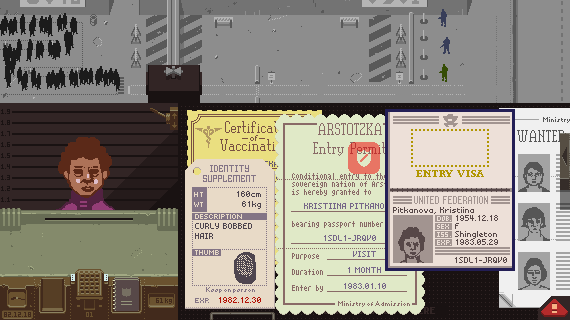
 I recently played the computer game, Papers, Please. It is set in a fictional dictatorship that looks like the USSR. You play a man who is assigned by lottery the job of border agent.
At the start of each work day you are shown newpaper headlines which affect the border rules. A shortage of jobs might lead to a requirement for foreigners traveling for work to have a work permit, for example. There is a long queue and travelers come to your desk one by one. There is some dialog ranging from “hello” to an elaborate sob story. You look at the papers presented and make sure all the rules are followed, then decide whether to stamp then entry visa with “APPROVED” or “DENIED”. You get paid according to the number of people you check through the border in a limited amount of time and you can get fined if you fail to follow the rules properly. At the end of each work day you are presented with bills and must check off which ones to pay. You must always pay rent, but must choose whether to buy heat, food or medicine. You are also shown whether your wife, son, uncle and mother-in-law are cold, hungry or ill. You might decide, for example, to buy medicine for your son instead of food for your mother-in-law. All this is presented in a point-and-click, drag-and-drop, retro-style indie-game interface with a distinctly Soviet look and sound design. Tension comes from trying to work quickly without making any mistakes. It’s easy enough to check that the passport has not expired and the work visa is valid, but not notice that the name on the work visa does not match the name on the passport. Rules get increasingly more complicated as the game progresses with more documentation being required and more information to check. The game also gives you some moral agency. One man with valid papers says his wife is in the queue, but there is a minor discrepancy with her papers. Do you separate the couple, or take pity on them? Another woman says she will be killed if she is sent back home. Another begs you not to allow a certain man through as he is planning to sell her into prostitution. You can break the rules about twice per day and get away with it, but any more and you will get fined. Breaking the rules on purpose increases the risk of being fined for making a mistake. All this means that while you might start with good intentions, before long you are weighing the lives of your family against the plight of the travelers. On my first play-through I sent various travelers to their doom to save my ill son, but ended up in jail when I decided to deny access to the pimp whose papers were valid, got fined, and could not afford the rent. It’s a fun game and has an interesting lesson about how people are compromised by inhumane systems. See also: Papers, Please cosplay and the short film. March 2nd, 2018 | 20 comments - (Comments are closed)
The real shock today would be if Meghan Markle came out and said she wasn’t a feminist. There were some slight rumblings when the royal-to-be announced she was swapping her acting career for marriage. But this pales into insignificance in comparison to the ugly insults and criticisms levelled at Katie Roiphe, Germaine Greer, Catherine Deneuve and other women who have criticised #MeToo. No, today it seems as if royalty and feminism are perfectly suited to each other: both are posh, prissy and condescending. Personally I think Meghan Markle would be a catastrophic addition to The Firm if she does not understand why it is a terrible idea for the Royals to get political. Do that and they stop being symbols (essentially endearing living flags whose job is to wave strangely and act as a navigational datum for flypasts) and become legitimate political targets. There is no surer route to a republic and I would regret that (as I do not share Spiked’s democracy fetish) but not necessarily oppose it if the House of Windsor does indeed go full retard. March 1st, 2018 | 26 comments - (Comments are closed)
As I have said before, I retain a belief in CAGW two-and-a-half letters to the left of most commenters on this blog. But Bob Ward – Policy and Communications Director at the Grantham Research Institute on Climate Change and the Environment at the London School of Economics – is not the first believer in the imminent peril of climate change to have a damn good go at pushing my scepticism-marker to the right. On the LSE British Politics and Policy blog, he writes:
Betteridge’s Law of Headlines applies for a reason. If someone knows a thing for sure, they don’t ask the air. They state it, good and hard.
Get-out clause.
The standard of what he thinks is evidence is what prompted me to write this post.
So 8 out of the 65 were not. That is 12.3%. According to a Guardian article asking how well women are represented in UK science in the light of the forced resignation of Tim Hunt (an affair which itself demonstrated the incompatibility of modern feminism with science), women make up just 12.8% of the STEM workforce. So the GWPF’s pamphlet output is, as we scientists say, only short by a whisker. Yeah, that 12.8% is a factoid I plucked out of the air of questionable relevance to anything, but so is Bob Ward’s figure of 57/65 GWPF pamphlets not having a woman’s name at the end. Incidentally I am shocked that the Guardian, unlike Mr Ward, ignores scientists of non-binary gender. No, wait! I have suddenly seen that Mr Ward’s rather strange phrasing “written by men only” might not after all be a progressive acknowledgement that some authors presenting as male or female might actually consider themselves as part of the Two Spirit community. It could just be about papers with more than one author. Oh, poot. That’s a paragraph of snark wasted. Not to worry, though. All I have to do is put a question mark at the end and I can use it after all: Does Bob Ward have a problem with the Two Spirit Community?
Those square quotes are men. I can tell by the way they are so aggressive and in yer face. Female punctuation marks are much nicer.
So that’s the Global Warming Policy Foundation shown to be almost as sexist as liberal Hollywood luvvies or Oxfam directors. Are we going to reach the bit where we prove – or even attempt to prove – the sexism of climate sceptics in general rather than this one think-tank soon?
Huh? I can vaguely see how he gets from “does not disclose any details about the identities of its members” to “appearing to operate as an old boys’ club”, but where did the bit about prostate cancer come from? The term “old boys’ club” or “old boy network” is usually taken to mean a group that operates by the principle of “it’s not what you know but who you know”. But the mention of “boys” is a historical hangover from the days when the days when practically all professionals were male. There was never any suggestion that old boys’ clubs became more acceptable if they dealt with old boys’ issues.
Good to see the Charity Commission staying within its legal remit. Gambling Commission, please note.
Science of the sort that Bob Ward approves of is also disproportionately old and male. Old because it takes time to learn this stuff, male because… well, that is not a question into which modern science cares to delve.
The fact that Mr Ward put in this nugget that undermines the rest of his article made me think a lot better of him. But it still undermines the rest of his article.
As above.
Anyone who has engaged with ‘human beings’ will have learned that it is the men who are most vocal about their views.
The degree of male chauvinism in that is close to zero. I am female but if I do not think too highly of a person I might easily refer to them as “this X Y man” if they happen to be male and “this A B woman” if they happen to be female. To omit her professional title does fall short of the highest standards of courtesy but before we specifically condemn Nigel Lawson for sexism perhaps we ought to establish that he is more insulting to women than to men. Paradoxically he could defend himself from the charge by pointing to his frequent waspishness to his male political allies, his male political enemies, and to the male chat show host Clive Anderson. I am sure Lord Lawson would not have dreamed of making disparaging reference to the appearance of a lady.
What an adorably old-fashioned chappie Delingpole is. As indeed is Mr Ward. A chick can go Oxford and have a science degree and still be pretty damn foxy, you know. This is a point upon which I feel strongly.
No, it is not clear. Insufficient evidence has been provided to support the assertion. Edit: Oh, and one further thing. A point so fundamental that I didn’t think of putting it in until later, like the Zeroth Law. Lord Lawson, James Delingpole, the entire complement of the Global Warming Policy Foundation irrespective of gender, and every climate sceptic on the planet could all be misogynist space Nazis who wear Free Cuckistan socks in bed and it still would not make their opinions on climate change wrong. March 1st, 2018 | 21 comments - (Comments are closed)
Grim news from South Africa. Just in case anyone thought that the departure of President Zuma, a corrupt man who has stripped his country (South Africa faces severe water shortages brought on by neglect of infrastructure) might lead to better things will be disappointed. The new regime has signed off on a land-grab policy of confiscating white-owned land without compensation. (About 70 per cent of South African farmland is owned by whites.) The claim made is that any white person who owns land in the country must, by definition, have stolen it. (The idea that such ownership might have come into being without theft just does not cross certain persons’ minds. That fact is simply undiscussible.) As we have found in the seizure/collectivisation of farms in the former Soviet Union, in China, and in Zimbabwe more recently, such moves herald mass poverty and violence. South Africa has ironically seen an influx of poor Zimbabweans since the vile Mugabe regime started to attack white farmers and seize land; the country has suffered a catastrophic decline in its farmland output, which may never recover. South Africa seems keen to follow suit; it has a range of largely self-inflicted woes: the current government is deeply corrupt. The country needs inward investment – seizing white-owned property hardly encourages any investor, of any racial background. As a matter of simple common sense, taking land by brute force, without compensation, from owners and giving it to those who are political cronies and hangers-on will inevitably reduce output and wealth, not the other way round. The unfolding of South Africa’s history is a tragedy, and it is easy to see why there is an element of “score-settling” at work here. Apartheid, let it not be forgotten, was introduced in the late 1940s at the behest to some degree of the white trade union movement, keen to bolster its bargaining power. Even if you were a private entrepreneur who wanted to hire non-whites for certain jobs, for example, you couldn’t. (Minimum wage laws operated in ways that hurt, not helped, non-whites.) The system was as absurd and vile as the Jim Crow laws of the US, or other examples of serfdom and oppression down the ages. It had to go; for anyone who supports a free market economy, apartheid and its cousins are absurd as well as wrong. But the solution of seizing white-owned land, regardless of the honesty or provenance of it, and giving it to people via a political carve-up, turns the injustices inherited from the old regime on their head, creating a new form of racism. Two wrongs do not make a right. And further, one suspects that the land seizures are an attempt to deflect attention from the failings of the existing regime. Compare and contrast how, for example, the “Asian tigers” threw off their old colonial masters and focused on getting seriously rich, not least by respecting property rights. And wherever one looks, there does seem a pretty tight correlation between respect for property rights – indeed their very existence – with prosperity and happiness more broadly. Hernando de Soto has made something of a career pushing the point that the world needs more property rights, spread among more people. (Check out this recent lecture by Niall Ferguson on the same sort of issue.) As an aside, it also seems to be a pretty solid marker of respect for property rights to have a large and growing middle class. I suspect that one of the underlying problems in South Africa is that among the non-white population, persons who can be so described aren’t a big portion of the total. Lest anyone pounces on the notion that what has happened proves that certain racial groups are incapable of building a civilized political order, bear in mind that here in the UK, the oh-so-white Caucasian leadership of Her Majesty’s Opposition, Jeremy Corbyn, and his colleagues, want to do to the owners of privately-owned industries such as electricity, gas, and the rest what the new leadership in South Africa wants to do to white farmers. The defence of settled property rights remains a vital cause for anyone interested not just in prosperity, but liberty. As of this week, that cause took a turn for the worse in South Africa. February 28th, 2018 | 89 comments - (Comments are closed)
What’s interesting about this Florida school shooting is that events are revealing themselves in such a way that not even the most statist of gun controlling media types are able to spin the narrative to their ends. The old adage that “when seconds count, the police are only minutes away”… well, that’s a pithy line, and it hits home. It also assumes that the police are minutes away. Not in this case. In fact, the police were seconds away, yet they didn’t intervene. In Parkland, it wasn’t that the state couldn’t protect you – no, it could have. Actually, the state wouldn’t protect you. You were on your own. What message should the ordinary citizen take away from this? That it is clear and painfully obvious they need to protect themselves. Best justification for the 2nd Amendment in my lifetime at least. February 28th, 2018 | 26 comments - (Comments are closed)
A senior English police officer has called for children of extremists to be taken away from them.
Meanwhile, far away in Argentina, the Grim Reaper has finally called for one of the old ‘Dirty War’ Generals, Luciano Benjamín Menéndez (cousin of the clown who was ‘Gauleiter’ of the Falklands in 1982 until some Paras, Guards, Marines and Gurkhas et. al. turned up).
The Montoneros were a murderous bunch for sure. But why does a senior English police officer think it is appropriate to imitate a South American Junta? February 28th, 2018 | 26 comments - (Comments are closed)
Like Matt Walsh, I remain baffled at why the slaughter of concert-goers in Las Vegas a few months ago, and the almost total lack of evidence or data on the killer’s motives and actions, haven’t caused much in the way of a media/political firestorm, contrasting with events of recent days:
From my vantage point, it seems that fairly early on, the media seemed to give up a hunt for explanations and for holding various people to account. Consider this point: Vegas hotels are famously packed with CCTV to foil thieves and crooks of various descriptions. And yet a man was able to get a large cache of weapons into a room and do what he did. The trouble with even writing about this topic now is that I feel that I sound like a conspiracy nut, which I am emphatically not. All very odd. February 27th, 2018 | 48 comments - (Comments are closed)
I remember the moment when I had to get plugged into email, some time in the mid-to-late 1990s. I was on the phone and he asked me: What’s your email? I had no answer. He said: oh. It was the way he said it. I knew I had to get an email address sorted immediately. With social media it was much more gradual. For about a decade, the social media were sold to me as mechanisms for me to influence the world. But during that same decade my desire to influence the world slackened, and a rule of mine is: do not unleash solutions upon circumstances which are not a problem. So, no social media. But as time passed, I realised that I wasn’t just not changing the world, I was ceasing to understand it. The more I read things, the more I heard echoes of social media conversations and dramas of which I had no direct knowledge, which had been going on for a fortnight or more before I even heard rather confusing reports about whatever it was. I was losing touch. (In particular I failed to understand the last two US Presidential elections.) So it was that, finally, years after most others of my acquaintance, I have now plugged myself into Facebook and into Twitter. Not that this was easy, mind you. They kept asking me to type in bits of code which I had just asked them to send to me and which they claimed that they had just sent to me but which they never did send to me. But, with help, I eventually got it all sorted. Having waited a decade, the further wait wasn’t a problem. First impression: I greatly prefer Twitter to Facebook. Indeed “greatly” doesn’t communicate the gulf. Twitter is, for me, now, very useful. Facebook is, for me, not useful, at all, not yet and maybe not ever. The basic reason for this disparity of usefulness is that whereas I think I am pretty sure that I understand what Twitter means by the word “follower”, I have no clear idea at all of what Facebook means by the word “friend”. As soon as I got connected to Facebook, a hoard of total strangers sent me emails (or Facebook sent me emails about them) referring to “notifications”, which said something along the lines of: let’s be friends. Who were these people? They didn’t seem like “friends”. More like email spammers. And what would it mean for me to be a “friend” of them? If I shared a home with a Facebook veteran all this would no doubt have been explained to me in about half a minute. But, I do not. Some of the names involved in these Facebook “notifications” I recognised. These were the names of actual friends. I now have three Facebook “friends” who are also real life friends. But frankly, I am learning a lot less about these Facebook-and-real-life friends than I thought I would. I do, after all, possess and make use of: a telephone. And given how little I have learned about these genuine friends from their Facebook postings, I am not inclined to venture further into the great, for me, confusion that is Facebook. It is always pleasing to see one’s immediate personal reactions seeming to be echoed by others, and I am pleased to note that Facebook is being criticised by others who know much more about it than I do. In particular, it is being accused of deranging rather than enhancing people’s social lives, crucially their friendships, and even, to some extent, driving them a bit mad. Perhaps this is just the usual moaning whenever you get a new technique of communication springing upon the world, but I’d be interested to hear what others say about these sorts of complaints. Twitter, on the other hand, is a new friend. “Follower” is a concept that made and makes, to me, immediate sense. No doubt the way that Twitter defines “follower” has ramifications and subtleties of which I am unaware, but the basic idea coincides with reality in a way that Facebook’s notion of “friend”, to me, absolutely does not. My arrival on Twitter coincided almost exactly with the explosion into something resembling mass celebrity of Jordan Peterson, author of the current best seller 12 Rules For Life. This is a man whom I had already noticed, but whom a whole new slice of humanity is now noticing. And I too am now “following” Jordan Peterson. But there is no suggestion, from Twitter or from anyone else, that Jordan Peterson is “following” me, and certainly not that he and I are in any sense “friends”. To Jordan Peterson, I am but one tiny blip in a cacophony of new-found celebrity. The concept of me being Jordan Peterson’s “follower”, in other words, precisely describes what is going on and, equally importantly, what is not going on. I am following him. He has no idea of my existence. Twitter, in other words, makes sense to me because it separates two utterly distinct concepts: me paying attention to you, and you paying attention to me. Twitter also makes sense because attention is just that and only that, attention. It is the lowest form of human relationship, and anyone can start doing it, to anyone they learn about, whenever they please. There are many more things to be said about Twitter and Facebook, and perhaps commenters on this will say some of these things. (I’m thinking of such matters as the ongoing debate about how and how much Twitter and Facebook are politically biased, and how much that matters.) But for now, instead of speculating about things that others know a lot more about than I do, I will instead turn my attention to concocting further Samizdata postings concerning the things which Twitter has told me about. And which Facebook has not. One final point. Some of my favourite Tweets have come to me courtesy of this excellent man. No pressure was put upon me to say that, but say it I do. This elephant doing some tidying up, which this man retweeted a few days ago, is particularly wonderful. Jordan Peterson would surely approve. February 26th, 2018 | 33 comments - (Comments are closed)
The Sage of Kettering and I have been on another trip, not to some distant, warm, European setting, but a distinctly chilly Suffolk on a bright early Spring day. Here is my account of our trip to an oft-overlooked corner of England and a dip into the past, focusing on the damage done by the iconoclasts. I am indebted beyond measure to the wonderful Suffolk churches site for inspiration on what to see, and links to pictures. The first stop was a quick look at a proper windmill, unfortunately under repair, the Post Mill at Saxtead. So much more attractive than the hideous electric-powered windmills that clutter the landscape, sucking up subsidies and slowing down the wind.
The walls of the castle are impressively high, with an excellent ditch.
Around the towers, there are Tudor chimneys, allowing some local heating.
The castle does not have a keep inside it, it is just a wall with a series of towers. The space inside was used to build a poorhouse. And in the Poorhouse is a local museum, with a fine collection of curious, including this tribute to General Pershing and his Crusaders. The Sage decided to try out the headgear, it might be useful with canvassing with local elections coming up. February 25th, 2018 | 29 comments - (Comments are closed)
The old argument about the science of socialism was that it would be more efficient than capitalism and markets. Eliminate all that waste of competition and plan what is to be produced, by whom, where, and we’ll all have more stuff. We’ll be richer in short. Then we went and tested the contention to destruction and 1989 showed that it was incorrect. Oh well, not the first nor the last scientific or political proposition shown to be wrong. What’s much more interesting is that the justification for the same policies has changed in this modern age. For all too many people still insist we should be doing those same things, they just trot out different reasons as to why we should. Some that it would be fairer that way, others even going so far as to insist that we shouldn’t have economic growth therefore planning and socialism. February 24th, 2018 | 44 comments - (Comments are closed)
|
   |
||||

All content on this website (including text, photographs, audio files, and any other original works), unless otherwise noted, is licensed under a Creative Commons License. |
|||||








Recent Comments