We are developing the social individualist meta-context for the future. From the very serious to the extremely frivolous... lets see what is on the mind of the Samizdata people.
Samizdata, derived from Samizdat /n. - a system of clandestine publication of banned literature in the USSR [Russ.,= self-publishing house]
|
Thou shalt rise up before the hoary head, and honour the face of the old man, says the Book of Leviticus, alongside other injunctions about such matters as how to sprinkle of the blood of the sin offering upon the side of the altar that even Leave voters might concede do not go so well on an inspirational poster.
For a while after the EU referendum result was announced there was a trend among some particularly enraged Remain voters to be about as willing to honour the face of one of those senile, bigoted, gammony, UKIP-voting coffin-dodgers as to bring a young bullock without blemish to the door of the tabernacle and kill it before the LORD. I lost count of the number of times I read young activists claiming that “their future had been stolen from them” and arguing that since the old had fewer years of life left their votes should not count.
This trend has now receded, either because it finally dawned on them that in the coming Brexitocalypse we will all be counted old at thirty or because the United Nations Independent Expert told them to can it.
That must have hurt. The United Nations telling them, who had thought themselves free from blemish, that though they wist it not, yet are they ist. Yeah verily, they are guilty of an ism, and shall bear their iniquity.
And now everyone’s at it. Out: “We should ban old people from voting”. In: “Age is a protected characteristic”.
The UK is “completely and institutionally ageist”, according to the chief executive of Care England, the largest representative body for independent social care services in the UK.
Prof Martin Green, also the chair of the International Longevity Centre, said ageism in the UK was “a national scandal” that should be challenged in the courts.
The Equality and Human Rights Commission (EHRC) should, he added, “hang their heads in shame” over its failure to pursue as many ageism cases through the courts as other protected characteristics, such as racism or homophobia.
The people of the past thought that the old should be treated with respect because they could be presumed to have gained wisdom through experience. The only lens strong enough to let modern Britain see the elderly as worth being treated with respect is that “old age” has joined the official list of “protected characteristics”. Better than nothing, I suppose, but the image of how to treat old people as seen through the “anti-discrimination” lens is one that most of the old people I know would say is distorted. For instance Professor Green indignantly writes,
If you just flip the categories, you see how unacceptable ageism is. You hear those in the NHS say: ‘That person is too old for an operation’ but they’d never say they are ‘too black’ or ‘too gay’ for treatment.”
I have known many people who have had lifesaving operations in old age. Though I do not share in the national worship of the NHS, I am grateful that the skill of its doctors and surgeons has allowed friends and family of mine to enjoy more good years of life. But if you are going to have a taxpayer-funded health service, then, yes, at some point the NHS must say, as it does say, “That person is too old for an operation”. Eventually the law of diminishing returns cuts in. The amount that could conceivably be spent on medical treatment to give a very old person a few more months of life is almost infinite. Fine if they are paying from their own purse – though even then a time comes when a honest doctor would advise against further treatment – but not if they are competing for NHS resources against a three year old child needing an urgent operation.
Yes, a rather belated Merry Christmas to all my fellow Samizdatistas, and similar wishes and thanks to all who read us and comment on us and on each other.
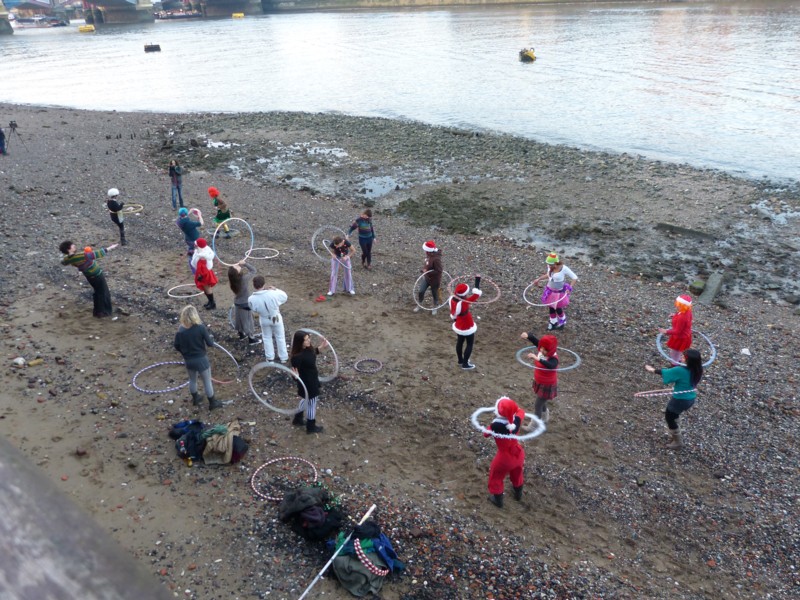
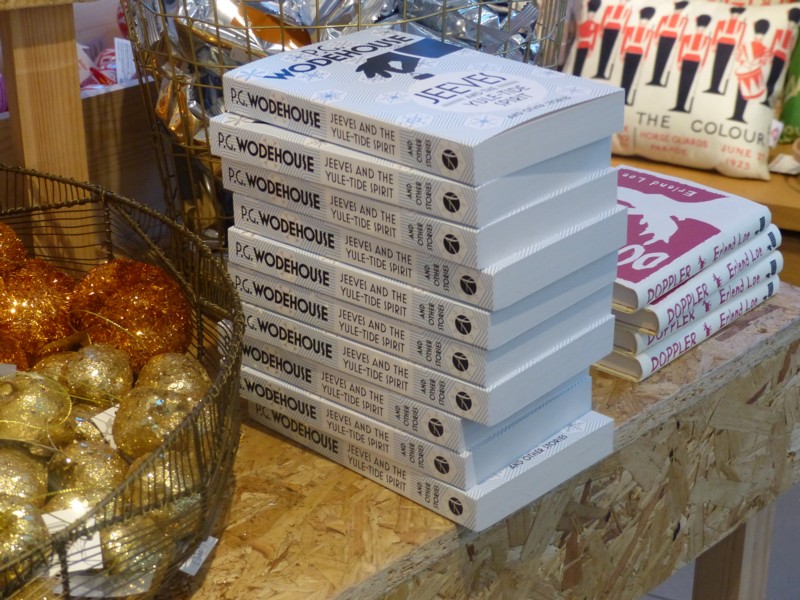
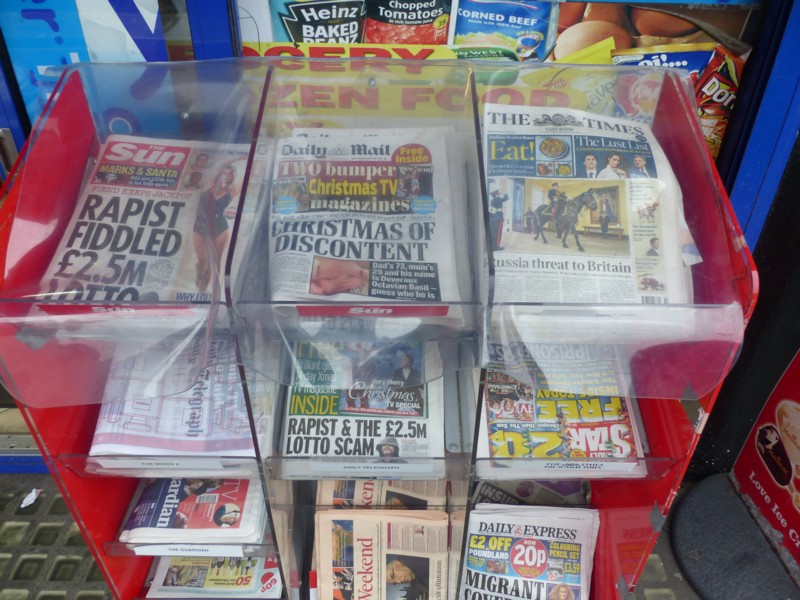
I’ve been trawling through my photo-archives for Christmas-related imagery, and here are half a dozen photos that I liked, and which I hope you will like also.
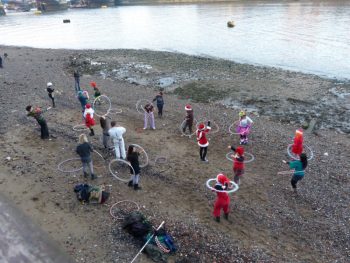
I photoed these people, many of whom were seasonally attired, in December 2012, as they disported themselves down by the riverside here in London, at low tide:
Next up, something topical, which Maplins in Tottenham Court Road was trying to sell as a Christmas present in December 2014:

Sadly, Maplins is now bust, and Tottenham Court Road’s electrical business is now in steady retreat, in the face of advances by clothes and furniture stores.
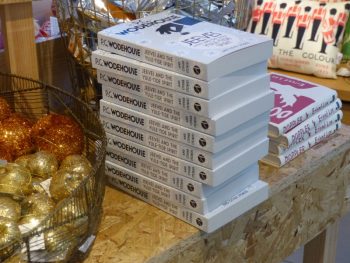
Next, taken exactly two years to the day after that drone photo, some literature. In Foyles, under the Royal Festival Hall:
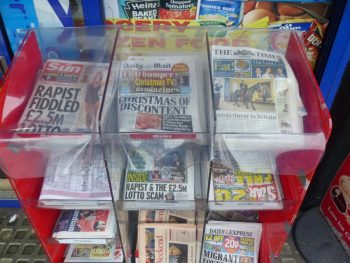
Next up, a typically discontented crop of Newapapers, again, December 2016:
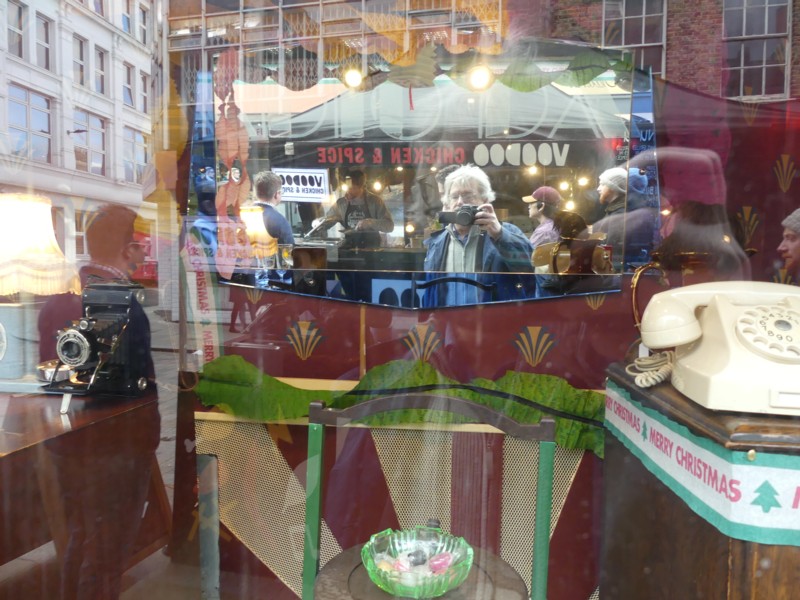
And finally, a couple of snaps taken in January of this year, in Lower Marsh, which is one of my favourite London haunts, or it was, until Gramex closed its doors. Sign that you’re getting old: your favourite shops keep closing. Lower Marsh is the kind of place where the effort they put into their Christmas windows tends to linger on into mid-January.
First of these last two, a selfie in a shop window, a favourite photo-genre of mine, featuring some satisfyingly ancient technology in the foreground:
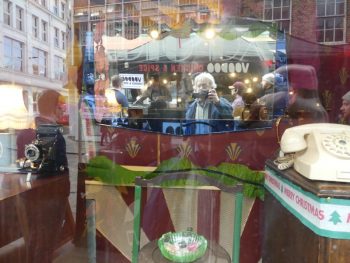
I never could be doing with photography until the digital version of it arrived just before this century did, but I still use a phone like that one.
Finally, this, taken minutes later:

I don’t know what that creature is. His expression suggests that something just went wrong with his Christmas cooking.
Here’s hoping nothing goes wrong with your Christmas or with your Christmas cooking, or for that matter with mine.
Suzanne Moore on Twitter, on Twitter:
One thing twitter has ruined for ever is the fantasy that left-wing people are nice. What a bunch of bastards. Spewing out nastiness. I am on the left myself but very rarely pure enough to be as shitty as these true believers.
People complain about how Twitter and the rest of social media, and the internet generally, have enabled nasty and anti-social people to set aside their inhibitions and to be honestly nasty in what they say and how they say it. But this is a feature as well as a bug. I rejoice that the current state of communications technology has caused, in particular, many leftists to rip off their masks of virtue, and to reveal the sheer savagery and malevolence that used to be hid behind those polite masks.
This is one of the many arguments in favour of free and unfettered expression. We get to learn who civilisation’s enemies are. The nasty leftists whom Suzanne Moore refers to do not “mean well”, and now, thanks to social media especially, both she and the rest of us can all see this.
See also: Islam. By any sane definition, the Quran contains a great deal of “hate speech”. But that is a big reason why we all – Muslims and infidels alike – should continue to be allowed to read it, and to see – in the case of “moderate” Muslims, to face – what it truly says.
Before solving a problem, it is necessary to identify it. Few political leaders or journalists or other public figures are willing to state the obvious fact that the main source of anti-Semitism in Europe today is not among the usual suspects on the far right but the red-green alliance, where the primeval Jew hatred of Muslim immigrants is excused away by the anti-Zionist cosmopolitanism of the secular left.
– From a piece by James Kirchick, in the Tablet, entitled What the EU Survey Reveals about European Anti-Semitism.
With thanks to the relentlessly anti-anti-Semitic Mick Hartley.
Although, “cosmopolitanism” is hardly the right word to describe the left these days.
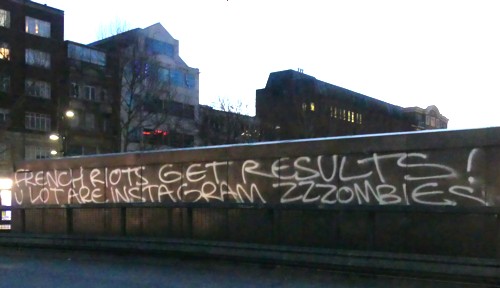
Yesterday, as daylight was ending, I encountered this item of graffiti:
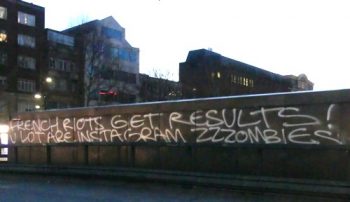
In case – what with the rather unhelpful lighting and this blog’s preference for making photos smaller – you can’t read that, it says:
FRENCH RIOTS GET RESULTS! U LOT ARE INSTAGRAM ZZZOMBIES.
The above transcript has the added advantage that if anyone sees this same proclamation and types the words of it into the www, there’s a good chance they’ll get sent here.
This message is (or perhaps now: was) to be seen on the bridge where the top end of Tottenham Court Road goes north over Euston Road and turns itself into Hampstead Road.
I’m not sure what to make of it. He (it probably is a he) has a point, I suppose, if by results you include the riot police getting a pay rise. Riots do sometimes get results, but only in rather particular circumstances, I think. Things like a very weak and unpopular government, and preferably also a dithery and indecisive one; and like: a symbolic issue of great potency, and like: the absence of any other means to express discontent.
But, my prejudice is that the sprayer of the above message is a hell of a lot more interested in rioting, for the sheer hell of it, than he is in what the results of any particular riot might be. “I riot therefore I am” is what this says to me. Or, to adapt that old Marlon Brando line: “What are you rioting against?” “Whaddaya got?”
Personally, I prefer taking photos.
Whenever I learn of a book about the history of the English language, then provided the price is not too steep, I tend to buy it. Only this month, I bought another such book. Although short, as promised, this one looks like being very good.
You may recall learning about how some Normans conquered the English speaking rulers of England in the eleventh century. 1066 and all that. You may even know something of the bit of the story of English that most fascinates me, which is when, in the late fourteenth century, English, in England, conquered Norman French as the language of those ruling England.
That I like wallowing in this story is why, when I was today looking for something to read while answering nature’s call, I noticed in and picked out from my large and disorganised book collection The Adventure of English by Melvyn Bragg, to rediscover what he had said about this particular moment in the history of English.
→ Continue reading: Melvyn Bragg on England’s verbal twins
Sarah Phelps is the writer of The ABC Murders. This TV drama starring John Malkovitch is the BBC’s newest interpretation of the character Hercule Poirot, the Belgian detective created by Agatha Christie. Here she is – Ms Phelps, not Mrs Christie – talking about her creation:
“For a long time Britain was caught up in the wave of righteous sentimentality and sympathy for poor little plucky Belgium. Then the times start to pinch. It’s the Thirties. There’s less to go around. People start to be cruel. They want someone to blame and it’s really easy to blame the people who arrived. So he’s being scrutinised now. People are asking questions. ‘You make us look like halfwits and you’ve got a foreign accent.’ English police for English crimes.”
Are there parallels with Brexit Britain? Of course there are.
“I really wanted to think about who we were in that decade and who we are right now. How have we gone from the optimism, the look-at-us-we’re-brilliant spirit of 2012, from celebrating this glorious, inclusive, generous country, to suddenly this place? How quickly something toxic can take hold! When we talk of the nationalism roaring across Europe in the Thirties, we forgive ourselves and think, ‘Well, that never happened here.’ It did, and the language was very much the same as the language that has been developing in our politics over the last four or five years.”
It will indeed be a Poirot for the second half of 2018 and the first three months of 2019.
Pro-tip: Don’t hold your hands behind your back when you’re taking a photo with a group of coppers.
– PC Dave Wise
According to the BBC, ‘persons of interest’ have been identified as responsible for flying the drone or drones that shut down Gatwick airport. As it gradually became clear that this was going on too long to be the work of careless hobbyists or malicious pranksters, the profile of the crime (it disrupted air travel but did not kill anyone) made me think that “climate justice” activists might be responsible. The BBC article says that is indeed one of the lines of enquiry being pursued. Still, let us be no more hasty to jump to conclusions or to blame every environmentalist in existence for the possible crimes of one of their number than we would like them to be next time someone loosely describable as “on our side” commits a crime.
The more urgent problem is that now whoever it was has demonstrated the method, anyone can copy it.
Technically and legally what can be done to stop a repetition? What should be done? What should not be? If you are one of those who have enjoyed flying drones in a responsible manner, or who is developing ways to use drones for emergency or commercial use, start work on your arguments now, because, trust me, the calls to BAN ALL DRONES NOW are going to be loud.
Matt Ridley:
Has the percentage of the world population that lives in extreme poverty almost doubled, almost halved or stayed the same over the past 20 years? When the Swedish statistician and public health expert Hans Rosling began asking people that question in 2013, he was astounded by their responses. Only 5% of 1,005 Americans got the right answer: Extreme poverty has been cut almost in half. A chimpanzee would do much better, he pointed out mischievously, by picking an answer at random. So people are worse than ignorant: They believe they know many dire things about the world that are, in fact, untrue.
Before his untimely death last year, Rosling (with his son and daughter-in-law as co-authors) published a magnificent book arguing against such reflexive pessimism. Its title says it all: “Factfulness: Ten Reasons We’re Wrong About the World — and Why Things Are Better Than You Think.” As the author of a book called “The Rational Optimist,” I’m happy to include myself in their platoon, which also includes writers such as Steven Pinker, Bjorn Lomborg, Michael Shermer and Gregg Easterbrook.
For us New Optimists, however, it’s an uphill battle. No matter how persuasive our evidence, we routinely encounter disbelief and even hostility, as if accentuating the positive was callous. People cling to pessimism about the state of the world. John Stuart Mill neatly summarized this tendency as far back as 1828: “I have observed that not the man who hopes when others despair, but the man who despairs when others hope, is admired by a large class of persons as a sage.” It’s cool to be gloomy.
Studies consistently find that people in developed societies tend to be pessimistic about their country and the world but optimistic about their own lives. They expect to earn more and to stay married longer than they generally do. The Eurobarometer survey finds that Europeans are almost twice as likely to expect their own economic prospects to get better in the coming year as to get worse, while at the same time being more likely to expect their countries’ prospects to get worse than to improve. The psychologist Martin Seligman of the University of Pennsylvania suggests a reason for this: We think we are in control of our own fortunes but not those of the wider society.
There are certainly many causes for concern in the world today, from terrorism to obesity to environmental problems, but the persistence of pessimism about the planet requires some explanation beyond the facts themselves. …
One reason why people are so gloomy about the state of the world might simply be that most of us are genetically programmed to look more keenly for badness than for goodness, because badness, if ignored, might kill us. Impending disaster requires us to take action, by, say, getting out of its way. All that impending wonderfulness demands of us is … well, not much at all. As evolutionary scientists constantly remind us, what matters is individual and group survival and procreation, not the mere truth of things. If being unrealistically gloomy about the future of mankind makes us more likely to perpetuate our DNA, perhaps by making us believe that life has to be more of a struggle than it really does have to be, then maybe such pessimism is an attitude that has consequently become part of that DNA, in defiance of the mere truth.
But what do I know? Personally, I’ve always been an almost pathological optimist, about the world if not so much about my own prospects in that world. That being all part of why I have read so much of what Ridley says on these matters.
I encountered this photo, of a brand new building in Belgium, at the Twitter feed of something called Architectural Revival.

Right now this photo has pride of place there, but just to be sure, this is the Tweet in question. There are several more photos to be seen there of similarly brand-new-but-looking-old buildings, also in Belgium.
So, let all of us who are that way inclined have a comment bunfight about what architecture is the best, ancient, or modern, or fake-ancient.
Personally I favour all three styles, and like it when they are in close proximity to one another. Modernity, unrelieved by either genuine or fake antiquity can get very dreary. But genuine antiquity everywhere can feel rather dispiriting too, because it can feel like you are living or working in a gigantic museum rather than in a place with a future, as well as a mere past. Paris sometimes feels a bit like this to me, especially compared to London which absolutely does not.
To be a bit more precise, I like skyscrapers, whether fake-antique (as they originally were in Chicago and New York) or modern, as in the City of London and nearby spots now. But nearer to the ground I like antiquity to remain, and I would favour more fake-antiquity, especially for many smaller buildings that don’t reach for the sky, than is the case in London now.
Above and beyond my mere tastes, or yours, I favour freedom of choice, in architecture as in all such lifestyle decisions. If you want to build a pretend Scottish Baronial Castle on your plot of land, good luck to you. I think if that was the rule rather than merely something that used to happen if you were rich a hundred and fifty years ago, architecture would be much more fun to look at, and in general, much better.
For more concerning such arguments, see this recent piece by Roger Scruton.
It turns out that one of Germany’s best-regarded reporters, Claas Relotius, has been doing for Der Spiegel what Jayson Blair did for the New York Times.
I have given this post the tag “Deleted by the PC Media”. That’s because we don’t have a tag called “Invented by the PC Media”. Like Blair before him, if Mr Relotius could not find the right juicy detail to enliven a story his custom was to make one up. He was at it for years. This article about the Relotius case in Der Spiegel by Ullrich Fichtner has not yet appeared in English, but the miracle of Google Translate allows me to make a guess as to how Relotius got away with it so long:
In his story about Fergus Falls, Relotius, in a hurtingly haughty way, is styling contemporary history. To have a hearty prelude, he tells us that at the entrance to the village right next to the welcome sign, a second sign was set up, “half as high, but hard to miss … On this sign, driven from thick wood into the frozen ground, stands in large, painted letters: ‘Mexicans Keep Out’ – Mexican, stay away. ”
The shield, which gives the whole story the keynote, never existed, it was only in the imagination of the author. Nevertheless, he passed the invention on as a matter of fact to hundreds of thousands of readers, just like that. And he insulted the inhabitants of Fergus Falls. It seems so, in the overall view, that people who are no longer children tell him nothing. There are exceptions, but Relotius gives the inhabitants of Fergus Falls false biographies that fit him as if he were a puppeteer. He also goes along with grotesque lies, such as that the children of the John F. Kennedy High School painted their models for the American Dream as follows: “They painted,” writes Relotius, “not a single picture of a woman. One class painted Barack Obama, two painted John D. Rockefeller.
Schoolchildren in 2018 are so enchanted by the example of John D Rockerfeller that they choose him to represent the American Dream? It seems unlikely that they would even have heard of this capitalist except as a bogeyman. But evidently it did not seem an unlikely thing to happen in Trump’s America to Der Spiegel‘s readers. Relotius told them what they wanted to hear.
Update: In the comments Rob Fisher pointed out this “Fisking” of Relotius’s article by two residents of Fergus Falls:
There are so many lies here, that my friend Jake and I had to narrow them down to top 11 most absurd lies (we couldn’t do just 10) for the purpose of this article. We’ve been working on it since the article came out in spring of 2017, but had to set it aside to attend to our lives (raising a family, managing a nonprofit organization, etc.) before coming back to it this fall, and finally wrapped things up a few weeks ago, just in time to hear today that Relotius was fired when he was exposed for fabricating many of his articles.
|
Who Are We? The Samizdata people are a bunch of sinister and heavily armed globalist illuminati who seek to infect the entire world with the values of personal liberty and several property. Amongst our many crimes is a sense of humour and the intermittent use of British spelling.
We are also a varied group made up of social individualists, classical liberals, whigs, libertarians, extropians, futurists, ‘Porcupines’, Karl Popper fetishists, recovering neo-conservatives, crazed Ayn Rand worshipers, over-caffeinated Virginia Postrel devotees, witty Frédéric Bastiat wannabes, cypherpunks, minarchists, kritarchists and wild-eyed anarcho-capitalists from Britain, North America, Australia and Europe.
|








Recent Comments