We are developing the social individualist meta-context for the future. From the very serious to the extremely frivolous... lets see what is on the mind of the Samizdata people.
Samizdata, derived from Samizdat /n. - a system of clandestine publication of banned literature in the USSR [Russ.,= self-publishing house]
|
Well, the memo was released. You can read it in full here, and I recommend you do so because, on the evidence of much of Friday’s TV and radio coverage, most commentators only want to talk about it in the most shallow political terms. Whereas the questions it raises about state corruption in an age of round-the-clock technological surveillance are far more profound.
– Mark Steyn
Read the memo.
Holy.Fucking.Shit.
Under Ian Smith (remember him?), only 5% of the population of Zimbabwe (then Rhodesia) had votes that counted (and all but one in twenty of them were white) but the other 95% of the population did eat: Mugabe inherited a country where their prosperity was rising. By 2016, only Mugabe and a few cronies had votes that counted, and Zimbabwe produced not the 300,000+ tons of grain per year that it once did, but 20,000 tons. Or, as the poet did not quite put it,
My other enemy is such
As you too should abhor:
Who justly hates white racists much,
Hates socialists yet more.
It seems so superflous to add that non-white racism (between the Shona and Ndebele tribes) was also a feature of Mugabe’s rule; he was a Shona as well as a socialist.
He doesn’t mean to be a monster and I don’t want to see him as one, but in his presence my blood ran cold. I was afraid of him. I was even more afraid of the way the earnest folk in the room laughed as he joked about the unintended consequences of various programmes to clean up the act of the idiotic, self-destructive great unwashed, I realised that I might be the only one there who included himself in the category of “the people” to be shaped as opposed to the smug elite doing the shaping.
No one seemed remotely concerned for the freedoms of those on the receiving end of Dr Chadwick’s mind bending, “nudging” and manipulation — the benighted mugs who ultimately pay to have such well-shod professionals sneer about them behind their backs.
– Tom Paine writing an article titled ‘An unexpected encounter with a monster‘
Oh boy, do I feel Tom’s Pain (sorry).
It reminds me of the following remarks I made when speaking to a rather earnest employee of Her Majesty’s government. It was at a PPE dinner at an Oxford college, filled to the rafters with pretty much the same people who filled the room where Tom Paine’s blood ran cold. As I was clearly very off-message, she had just told me that “You’re the sort of person we need to convince”:
“Don’t waste your time trying to convince me its all for my own good, because the objective isn’t my good, its making sure the people in this room have power. If you keep nudging people, and you just won’t stop, eventually they’ll punch you in the face. But we both know the reason that doesn’t happen to you is because Mao’s dictum is entirely correct. Your presumed right to do what you do to the hoi polloi is embedded at an axiomatic level, you don’t have any coherent moral argument to back it up, and why should you? The only reason you can do what you do is because you keep the police force funded, which is why you don’t need to convince me of anything.”
For some reason I don’t get taken to those kind of dinners any more 😆
But Justice Gorsuch took not an “expectation of privacy” approach to the question but a property rights approach. Under common law, he said, “possession is good title against everybody except for people with superior title.” Absent probable cause, a trespass action would be available against anyone searching the car. Thus, “by virtue of his possession,” Byrd would have a right to resist a carjacker or throw out an overstaying hitchhiker. “So why not the government?”
– Roger Pilon
Tim Worstall says that Hayek’s much-derided argument that government health care would make us serfs of the state is supported by an astonishing piece by Nick Cohen which appears to argue that so it would, and so it must. Part of me hopes that Cohen, who has often been one of the more principled voices on the British Left, is writing tongue in cheek or trying to provoke a reaction. But the commenters nearly all seem to take it quite seriously and only berate him for not going far enough.
Here’s the piece from Cohen: “Saving the NHS means forcing us to change the way we lead our lives”.
If you imagine a healthy future for Britain, or any other country that has put the hunger of millennia behind it, you see a kind of dictatorship. Not a tyranny, but a society that ruthlessly restricts free choice. It is a future that views the mass of people as base creatures jerked around by desires they cannot control. Expert authority must engineer their lives from above for their own good and the common good.
Speaking as a base creature myself, I do not believe it would be a healthy future at all to be ruled by people with such contempt for me.
Here’s my partial sketch of how Britain would have to change to limit the costs to the NHS that stunted lives and avoidable pain will bring. Pedestrians and cyclists would have priority on the roads. If the roads are too narrow to take cars, cycle lanes and a pavement wide enough to allow pedestrians to walk or run in comfort, then cars will have to go. School runs will become history as heads refuse to admit any able-bodied child who arrives at school in a car.
It will not necessarily be illegal to drive in towns and cities, just pointless. Motorists would inch along because cycle and bus lanes would take up road space and pelican crossings would be reset so pedestrians never had to wait more than a minute to cross a road. Even when they reached their destinations, drivers would search forever for a space because car parks would have been demolished and replaced with public parks.
No fast-food outlet would be allowed within a one-mile radius of a school. Agricultural subsidies for fat and sugar would be abolished. Rapeseed oil and sugar beet cultivation would stop as new subsidies for public transport began. Meanwhile, the manufacturers of processed food high in sugar, salt and fat would face advertising bans and punitive taxes. (If food manufacturers want to dump prematurely sick patients on the NHS, we will say, they can damn well pay for the privilege.)
A commenter called “erikus” put their finger on what all this was reminding me of:
Stardate 21327.5. Captain Picard & the crew of the Enterprise arrive at a world where the local inhabitants are suffering the apocalyptic consequences that fell upon them after they tried to re-engineer themselves in order to meet the expectations they believe are placed upon them by the institutions that were created by their ancestors and which they’ve come to regard as sacred & inviolate.
Picard’s final speech: ‘They killed themselves for this. They died because they believed that they had to sacrifice themselves in order to preserve in perfect form the institutions left to them by their ancestors: Institutions that were themselves originally created with one simple purpose: To preserve their lives:
We must remember that the institutions that we create exist for our well-being & that once we begin to worship them & think their well-being transcends that of our own, they lose their reason for existence.’
I just wanted to share this chance-found five year old Observer editorial because it is so gloriously apocalyptic: “If Britain leaves Europe, we will become a renegade without economic power”
Conservative Eurosceptics will be delighted. For them, membership of the EU has contributed to Britain’s protracted depression. Echoing the defeated Tea Party in the United States, they offer Britain a prospectus of becoming like Hong Kong. Minimal protections in the workplace; the chance to develop ourselves as a tax haven;
Sounds great! Alas, not all my countrymen share this inspiring vision of our post-Brexit future, but at least we’re out.
to become Europe’s economic and political renegade, imagining that the EU will be perfectly happy to accept unfair and unregulated competition. To believe this as the route to economic salvation is fanciful indeed.
Instead, it will be a disaster at every level. Britain’s mass car industry will head to low-cost countries that have remained in the EU. Much other manufacturing will follow; Airbus production will migrate to Germany and France. Already, there is massive damage. It was partly because Germany now anticipates Britain leaving the EU that Berlin vetoed BAe’s deal with the defence giant EADS. It did not want Europe’s defence industry to be concentrated in a non-EU member. The financial services industry will be regulated on terms set in Brussels and be powerless to resist. British farmers, who have prospered under the Common Agricultural Policy, will find they become dependent on whatever mean-spirited British system of farm support that replaces it. Farms will survive by industrial farming, devastating the beloved English countryside.
Tax avoidance and evasion will reach crippling levels as our economy becomes increasingly wholly owned by foreign multinationals that make tax avoidance in Britain central to their business strategy. No Eurosceptic ever complains about the selling of Britain to foreigners, a much greater constraint on our sovereignty than Brussels. Our fiscal and monetary policy will shadow that of the European authorities for fear of an attack on sterling if we do not.
We will be become subcontractor to the world with zero economic sovereignty, a bits-and-pieces economy offering low-paid, transient work to a public unprotected by any kind of social contract because of the disappearance of our tax base.
The best in Britain know this – most in the leadership teams of our main political parties including the Tory party, directors in our top companies, our cultural leaders, our trade union leaders, our universities and some of our public intellectuals. Yet collectively they are silent, bullied and cowed by the overwhelming media might of the Eurosceptics and losing heart because of the single currency crisis. Yet the EU is putting in place mechanisms for the euro’s survival and even its prospering – a rescue and bail-out mechanism, a banking union, closer fiscal co-ordination and more political collaboration. The EU, the euro and the single currency will be here in a decade’s time – our continent’s instruments for managing globalisation and the challenges of the 21st century. We can be the renegade at the margins or playing our part in one of the great projects of our time. Those who believe in Europe need to start speaking out – and urgently.
Last Wednesday, I attended a meeting at the Frontline Club, which is near Paddington Station in west London. The meeting was devoted to the memory of the great Romanian businessman and freedom-championing newspaper owner Dan Adamescu, and the danger now facing Dan’s son Alexander Adamescu. Some friends of mine are also Friends of Alexander Adamescu, and this is me trying to help them.
Encouraged by the organisers, I took photos at that meeting, photos of very variable quality, because of my woeful inexperience in what for me were very imperfect lighting conditions. But, I hope that the best of them may be of some use to the cause, and assist Alexander Adamescu’s friends in stirring up more media attention.
The cause being that Dan Adamescu was, just over one year ago, imprisoned to death, so to speak, by the government of Romania, and that the government of Romania has for some time now been trying to do something similar to Dan’s son Alexander, after he complained what was being done to his father.
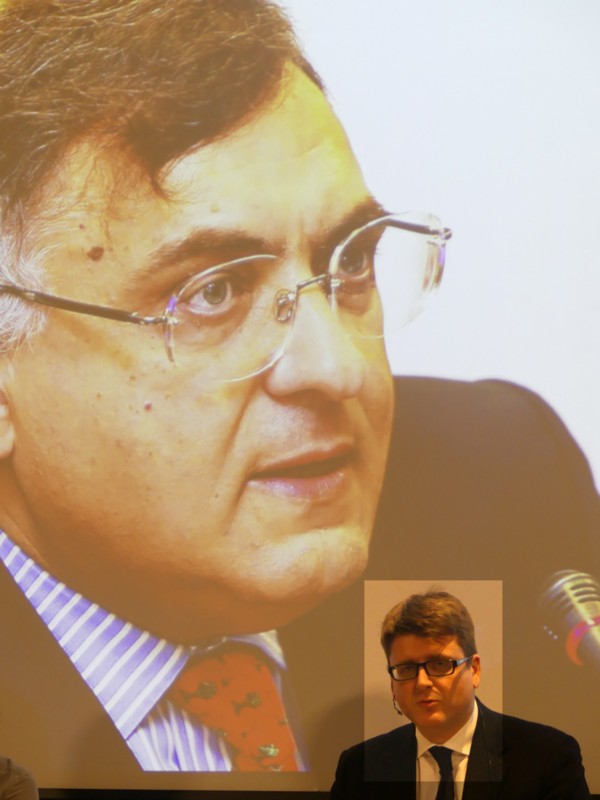
Here is a picture of the big picture of the late Dan Adamescu that presided over the meeting, beneath which sat Alexander Adamescu, who spoke at the meeting:
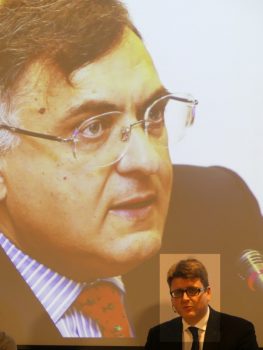
As you can see, I did a bit of photomanipulation there, to make it clearer what Alexander Adamescu looks like.
Alexander Adamescu now lives in London with his wife (who also spoke most eloquently about Dan Adamescu) and young family. But the government of Romania wants the British government to hand Alexander over to them, so that they can inflict upon him the same sort of parody of justice that they inflicted upon his father. Their instrument of choice to accomplish this is the European Arrest Warrant.
→ Continue reading: The government of Romania versus the Adamescu family
In recent weeks, Labour could not make a simple statement in support of those protesting for freedom in Iran. It couldn’t give a straightforward condemnation of a regime that stones people to death for adultery, publicly hangs gay people, and forces women by threat of criminal punishment to wear headscarves in public. The hard left’s virulent anti-Americanism renders it ‘just not that simple’. No, with the influence and influx of ‘Stop The War’ ideologies, Labour has been dragged so deeply down the rabbit hole of anti-imperialist theories that they cannot condemn dictatorial, theocratic, repressive Iran in case it somehow strengthens, or implies support for, democratic, secular and free America. My Labour would see America is a necessary bulwark against Iran, yet the Labour we have sees Iran as a necessary bulwark against America. I cannot in all good conscience tell a single person to vote for that.
– Nora Mulready, writing an article titled “Today I resigned from the Labour Party”
As I am some manner of wild-eyed libertarian/classical liberal, I suspect Ms. Mulready and I might not see eye to eye on certain issues, yet I have to respect someone who has the emotional maturity and intellectual integrity to transcend the tribal impulses we are all prone to, to detach themselves from an institution they were once deeply invested in.
IKEA founder Ingvar Kamprad has has died. Evidence suggests that in his youth, Mr Kamprad was a Nazi. I don’t mean this in any metaphorical sense. He appears to have been an actual Nazi.
Mr Kamprad then went on to conquer the world through selling people flat pack furniture. Rather than the other way.
The unhinged Nazi talk discourages reasoned analysis in favour of chasing the cheap thrill of yelling “fascist!” at someone you don’t like. It is profoundly anti-intellectual. But it does something worse than muddy the present and harm rational debate about politics today; it also ravages the past; it relativizes the Nazi experience and, unwittingly no doubt, dilutes the savagery of the Holocaust through comparing that immense crime with what is simply an elected American administration many people don’t like.
This might not be Holocaust denial, but it is certainly Holocaust dilution. It is Holocaust relativism. And as some historians have been pointing out since the 1970s, Holocaust relativism, the treatment of the Nazi era as just a wicked brand of politics that crops up every now and then, including now, is the foundation stone of the vile prejudices that underpin actual Holocaust denial.
– Brendan O’Neill discussing the toxic absurdity of the ‘Trump is a Nazi’ notion.
This story is not alone. Elsewhere it was reported this week that ‘one in eight Swedish women will be raped in their lifetimes’. Never mind the dubious use of the future tense in this headline, when it comes to stories about rape in Sweden, beware ‘fake truths’. Sweden already has the second highest incidence of rape in the world – another actual fact – but this is because it has one of the broadest definitions of rape and most meticulous method of investigating it and correlating related statistics. Sweden has consequently one of the lowest conviction rates of rape in Europe – another fact thrown about with much alarm by people such as Naomi Klein – but this isn’t something we should be unduly concerned about. It’s a reflection, paradoxically, of just how seriously Sweden takes the crime of rape.
– Patrick West
Your group identity is not your cardinal feature. That’s the great discovery of the west. That’s why the west is right. And I mean that unconditionally. The west is the only place in the world that has ever figured out that the individual is sovereign. And that’s an impossible thing to figure out. It’s amazing that we managed it. And it’s the key to everything that we’ve ever done right
– Jordan Peterson
|
Who Are We? The Samizdata people are a bunch of sinister and heavily armed globalist illuminati who seek to infect the entire world with the values of personal liberty and several property. Amongst our many crimes is a sense of humour and the intermittent use of British spelling.
We are also a varied group made up of social individualists, classical liberals, whigs, libertarians, extropians, futurists, ‘Porcupines’, Karl Popper fetishists, recovering neo-conservatives, crazed Ayn Rand worshipers, over-caffeinated Virginia Postrel devotees, witty Frédéric Bastiat wannabes, cypherpunks, minarchists, kritarchists and wild-eyed anarcho-capitalists from Britain, North America, Australia and Europe.
|





Recent Comments