We are developing the social individualist meta-context for the future. From the very serious to the extremely frivolous... lets see what is on the mind of the Samizdata people.
Samizdata, derived from Samizdat /n. - a system of clandestine publication of banned literature in the USSR [Russ.,= self-publishing house]
|
Festive photos to add to that photo of meat, from Christmas Eve, meat which I was lucky enough to share.
That evening we all did much toasting, and one of us photoed all our glasses while we were doing this. Many get angry about the modern habit of photoing food and drink just before it is consumed, but I say: Why not? Where’s the harm?
On Christmas Eve I was too busy holding up my own glass and joining in the fun to be photoing it. But, I did take a photo of a very similar event back on December 18th, on Primrose Hill, just to the north of Regents Park:

Christmas, or in this case the run up to Christmas, is a time to renew old acquaintances. I don’t know who these people were and how they were connected, and in this time of computerised face recognition, I have deliberately made this difficult with my photo. Friends? Relatives? What I do know is that they were greatly enjoying each other’s company, just as Perry and I and his other guests did on Dec 24th.
Later on Christmas Eve I did get my camera out, and I got this shot of our Dear Leader, enjoying a present that one of us had given him, of one of his favourite chocolate treats:

On a more serious note, I have been reading Deidre McCloskey’s book, The Bourgeois Virtues. At the beginning of her chapter entitled: The Very Word “Virtue”, McCloskey offers a number of quotes from bygone years, including this one from Benjamin Constant, who until now has been only a name to me. Apparently, in the year 1814, Constant said, in celebration of the greatly increased opportunities for human enjoyment that commerce was at that time beginning to make available to the generality of people, this:
The progress of civilization, the commercial tendency of the age, the communication among the peoples, have infinitely multiplied and varied the means of individual happiness. To be happy, men need only to be left in perfect independence in all that concerns their occupations, their undertakings, their sphere of activity, their fantasies.
Plus, a bit of spare cash and the chance to spend it on luxuries, like high quality meat (as Perry put it: “Duck with skin turned to quackling, stuffed with pheasant & wood pigeon”), and amusingly packaged chocolate. Here’s another toast, to: stuff. The stuff that has, since Benjamin Constant’s time, so greatly increased, by means of exactly the processes he refers to.
Concerning who and what Benjamin Constant was, I have yet to read this. Tomorrow, I intend to. Happy Christmas everyone, what’s left of it.
This was a real threat to the press, and our #FreeThePress campaign urged citizens to say No to both prospects. Section 40 would mean strong-arming newspapers into signing up to a press-backed regulator – ending centuries of a (relatively) free press. What’s more, the only press regulator that has been approved by the Leveson-created Press Recognition Panel is Impress, which is staffed by snobbish ‘hackademics’ and funded by tabloid-loathing millionaire Max Mosley.
– Naomi Firsht
Wishing our readers a splendid Christmas…
 Duck with skin turned to quackling, stuffed with pheasant & wood pigeon. Beware of shot. Crispy roast potatoes coated with polenta. More off-camera!
I have a dim memory of a TV news report on how the 1973 oil crisis was affecting Holland. I can’t remember the specifics but it was something along the lines that the crisis was much worse in Holland than elsewhere. At some later date I got the idea that the Dutch had been selling arms to the Israelis and the Arab oil embargo introduced after the Yom Kippur War was much more strictly enforced on Holland than elsewhere.
As I got older (I was very young in 1973) this made less and less sense. How, I thought, do you control what happens to oil you’ve sold once it has been put on a ship?
For some reason this week I was reminded of this dim and distant memory and decided to do some duckduckgoing. I discovered that someone has written a book on the subject. This is what the rubric says:
The Netherlands played a remarkable role during the October War and the oil crisis of 1973. In secret, the Dutch government sent a substantial amount of ammunition and spare parts to Israel. The Dutch supported Israel also politically. Within the EC they vetoed a more pro-Arab policy. The Arab oil producing countries punished The Netherlands by imposing an oil embargo. The embargo against the Netherlands was intimidating. The Netherlands was dependent on Arab oil. The embargo seemed to threaten the Dutch position in the international oil sector. The government introduced several measures to reduce oil consumption. However, within two months it became clear that oil continued to arrive in Rotterdam. There was in fact no oil shortage in the Netherlands.
Oh. 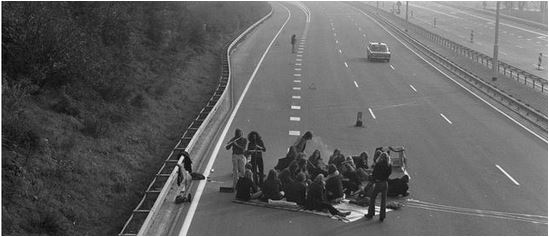 Some hippies on a road on a “car-free” Sunday in Holland, made “car-free” because the government was worried about oil supplies.
But the problem is worse. For in our taxation of the richer among us we’re pretty much at that Laffer Curve point. Sure, we can argue about whether the income tax take peaks at 40%, 43%, 47% and so on but all the experience (our own experience with the 50% rate, academic research by Diamond and Saez and so on) tells us that when we look at taxes upon income (so, adding NI and so on) then we are at least around about that peak.
Which means that if we’re to increase the tax take as a percentage of the economy, the thing being demanded, then we’re going to have to tax the poorer among us. The very people who don’t have much to start with and who are really going to miss that marginal income.
– Tim Worstall
Matthew Parris recently, in the Times (registration required):
The media and political world is in a lather about whether the (now) de facto deputy prime minister once accessed pornography in his office. Here I am, fretting — some will say nitpicking — about whether it was appropriate for a now-retired Metropolitan Police officer (1) to have gathered and kept what he claims to be the evidence for these allegations, though there is no suggestion the law was broken; (2) to have disobeyed orders by keeping the evidence; and (3) nine years later to have put the allegations into the public domain.
My acquaintance with Damian Green is slight. He strikes me as one of those necessary second-rank men (in a world of third and fourth-rank men) who combine a useful level-headedness with a dispiriting blandness: podgy and unflappable, with the advantage at least — a quality in a Tory MP to be fallen on with relief — of not being mad. So my strong sense of injustice in this case has little to do with the merits of Mr Green and everything to do with what looks like a co-ordinated police vendetta against a politician they’ve clashed with.
He concludes:
When it comes to issues of rumour and reputation I’m no dry rationalist. Every journalist knows that the appearance of things does matter, and that stern logic cannot always rescue a wounded public figure. We know too that “process” stories often fail to hold public attention, and this column’s complaint about the abuse of police powers is essentially a process story.
But behind process may lie principle. What Damian Green was alleged to have watched might be thought disgusting, but what two former Met officers have been up to is little short of sinister. Disgust can rule the headlines and may win the day, but former police officers are trying to destroy a senior minister with whom they have clashed. This is London, not Chicago. Parliamentarians, in retreat for a decade now, should unite to push back.
I hold no particular brief for Mr Green; I disagree with him on Brexit. It actually worries me that some Brexiters I know are almost gloating that a pro-Remain senior Tory has had to resign after giving, it is said, less-than-truthful answers about the matter of his computer, but the fact remains that, as Parris says, evidence gathered in a decade-ago investigation, and not remotely connected to it, was brought up for no other reason than I can think of to embarrass and damage an elected politician. The ex-copper in question, who appears to nurse a grudge, seems, as Parris says, to be arguing not that what Green did was illegal, but improper. So we are getting into the murky territory of police officers taking moral stands, they claim, about what a democratically elected political figure does. (See here, for a version of events in the Guardian.)
I remember in the early days of this blog that we sometimes used to refer to the UK police as the “paramilitary wing of the Guardian newspaper”, more concerned about enforcing PC doctrines, or chasing after real or alleged bogeymen of the Right, such as those saying mean things about homosexuals, Muslims, etc, than catching crooks. The recent period post the Jimmy Savile fiasco (a paedophile who preyed on people for decades) seems to have seen the police morph, perhaps out of guilt about failing to nail the old BBC presenter, into a hyperactive pursuer of alleged perverts, with due process of law taking a back seat. The recent shabby treatment of Sir Cliff Richard, the entertainer, is an example of where this sort of zeal leads.
As an aside, it appears that the Tory Party, in its enfeebled parliamentary state, is or has been unwilling to clamp down on the police, to insist on reforms and push back against the assault on Common Law principles of fairness and due process. The Met are not necessarily part of any sort of Deep State (conspiracy theory alert!) taking root but they are certainly showing a level of presumption that is dangerous in a liberal order. The police are, in some respects, out of control, and need to be reined in. Just imagine the damage that can be done if police are emboldened to chase after enemies if or when Mr Corbyn and his re-heated Marxist allies take office. Something to think about for 2018.
Signs perhaps of MPs waking up to the problem.
From Forbes magazine’s website:
Wells Fargo and Apple both made substantial moves within London since the Brexit vote. Wells Fargo spent $400 million to buy a new European headquarters in London’s financial district. Apple announced plans to open a new London campus in 2021 that covers nearly 500,000 square feet of space. Facebook is also in the market for 700,000 square feet to accommodate 9,000 employees.
The whole article is worth a read. And it reminded me that there are now dozens of stories, tracked by the likes of Guido Fawkes, going on about how This or That splendid thing has taken place “despite Brexit”. The joke here, of course, is that the Remain-leaning folks who write for the likes of the Financial Times and others have a hardwired assumption that Brexit is bad, will damage the UK economy, and that anything that appears to be positive is therefore in some sort of defiance of said presumption, to be dismissed, or cast aside. (This is not all one way, of course, there can be over-inflation of optimism about what the UK departure will mean, but my impression is that the volume of “despite Brexit” stories and the bias they reveal is much greater than the other sort.)
The point is soon being reached when an entire volume of news stories could be gathered into one place and the title of the book could be called “Despite Brexit”. Maybe those folk at Guido Fawkes or the Spectator, etc might bring out one in time for next year’s Christmas. I suspect the book will run to several hundred pages. (OK, I demand copyright on the idea, now!)
Sorry for the unoriginal choice of title. This is about the fourth Samizdata post with a title related to that slogan, and the umpteenth to mention it. Don’t blame us. If the authorities would stop repeatedly proving that slogan to be a cruel travesty, we would be happy to stop going on about it.
Until that day arrives, the Guardian has a good report on the latest example of what innocent people have to fear:
Police made ‘appalling’ errors in using internet data to target suspects
Police have made serious errors getting search warrants for suspected sex offenders, leading to the targeting of innocent people and children being wrongly separated from their parents, an official report has revealed.
The errors – highlighted by the interception of communications commissioner, Sir Stanley Burnton, in his annual report to the prime minister – had “appalling” consequences and related to some of the most intrusive powers the state can use against its citizens.
In one example, two children were separated from their parents for a weekend while the parents were questioned as suspects in a child sexual exploitation case. It later emerged that police had raided the wrong address due to an error on the documentation and the parents were innocent.
Digital devices belonging to innocent people were also forensically examined by police, Burnton said.
The errors identified were mainly because details were wrongly entered into software that helps police work out the location where a specific IP (internet protocol) address has been used.
But IP addresses are routinely reassigned by internet providers. Burnton warned investigators not to rely on them when trying to work out who is hiding behind the anonymity of the internet to commit crimes.
He wrote: “These [errors] are far more common than is acceptable, especially in cases relating to child sex exploitation. The impact on some victims of these errors has been appalling.”
The BBC were interviewing an ex police officer today who was complaining that it wasn’t their fault because of “cuts” and they couldn’t resource their investigations properly. This is nonsense. The cases were assigned an investigation officer. He – or she – failed to do their job properly. They also don’t need “resources” to forward all of the evidence to the defence team. They fucked up. This has much to do with politicising the police and the culture in which they now operate. They have gone from not believing the “victim” to believing them unconditionally. Somewhere along the way, they lost the ability to conduct an impartial investigation of all of the relevant evidence. To do this they need to take a neutral stance of neither believing nor not believing until the evidence determines whether there is a case to answer. Then and only then, seek to charge.
– Longrider
We are in the midst of a revolution in our understanding of sexual harassment and assault. We’re told, as we are often told in the midst of media-driven manias, that everything has really changed this time. As satisfying as this narrative might be for feminists on the warpath against “toxic masculinity” and conservatives who revile the sexual libertinism of the past half-century in America, it isn’t true. As long as men and women are thrown together in the workplace—and are placed in competition with each other—sex will, in part, be a means to achieve power, a weapon wielded by both men and women. The question is what we can do to mitigate the damage. The record so far—and by so far, I mean over the past four decades—is not encouraging.
– Christine Rosen, Commentary Magazine.
Some years back, I decided I had to quit the teaching profession to which I had dedicated half my life. The modern academy, I felt, was so far gone that restoration was no longer possible. Indeed, I now believe that complete collapse is the only hope for the future, but as Woody Allen said about death, I’d rather not be there when it happens.
– David Solway
Of all the crimes against humanity that one can imagine, it may seem hard (or perhaps all to easy) for the visitors to this parish to imagine that, if you are an employer, offering your employees a pay rise can be regarded as legally actionable under principles of Human Rights law, and give rise to a claim for compensation. But such is the law in the United Kingdom, in defined circumstances. Those circumstances being where an employer’s principal or only motive for making an offer (regardless of it being accepted) is to get 2 or more employees to forego their rights to collective bargaining.
The situation was recently highlighted in a case involving a UK branch of a German engineering company, Kostal UK Ltd.
The employer had a ‘recognition agreement’ for a group of its workers with Unite (the UK’s largest Trade Union). This agreement is described as ‘binding in honour only’, and under it, the employer agreed to negotiate terms of employment for those covered by the agreement with the Union, rather than with the employees directly. it was not, by itself, legally enforceable. However, despite this ‘agreement’ being unenforceable as such, the Union’s ‘right’ to negotiate on behalf of its members is protected by a specific piece of legislation which prevents employers from making offers of different (including better) terms to two or more of its employees if they are (or are proposing to be) covered by a (non-binding) collective agreement between the employer and a Trade Union, if the employer’s motive is to go over the heads of the Union to reach an agreement with the employees represented by the Union.
Under this law, it is, of course, for the employer to prove what its motive was for making any offers to its employees in these circumstances, and if the motive (or main motive) is benign, there is no liability. And the risk? An award of £3,907 per employee for every offer that is made. In the Kostal case, it came out at around £422,000 per some reports, as the employer made two offers to around 57 employees. For some bizarre reason, apparently to do with its German parent company, its first offer, made in December, included a Christmas bonus, but its second offer, made in January did not, so two offers were made and two lots of compensation (at the time £3,800 per offer) was due, twice penalising what was essentially a single course of conduct.
Why is this ‘law’ in force, you may ask. The answer is that it is to protect the Human Rights of the workers, as, if an employer gets fed up dealing with a Union on pay negotiations, and tries to bypass it, so that the terms of employment of two or more employees covered by a collective agreement are no longer decided in line with that agreement, this is, according to the European Court of Human Rights, a violation of the right of freedom of association.
As the judgment in this case puts it:
…under Article 11 of the Convention, which provides:
“1. Everyone has the right to freedom of peaceful assembly and to freedom of association with others, including the right to form and to join trade unions for the protection of his interests.
2. No restrictions shall be placed on the exercise of these rights other than such as are prescribed by law and are necessary to a democratic society in the interests of national security or public safety, for the prevention of disorder or crime, for the protection of health or morals or for the protection of the rights and freedoms of others…”
The judgment goes on to explain the ‘reasoning’ of the European Court of Human Rights (the Strasbourg Court):
“In other words, the Strasbourg Court held that states have positive obligations to secure effective enjoyment of Article 11 rights; and if direct offers outside the collective bargaining process can be made and would lead to less favourable treatment of workers who do not accept, that acts as a disincentive to the exercise of Article 11 rights and allows employers to undermine or frustrate a trade union’s ability to strive for protection of its members.
So, lest an employer find a Union is asking for Mars and it can only offer the Moon, and it offers the Moon to Alphie and Bill, Charlie’s right to claim Mars is protected by making the employer pay compensation to Alphie and Bill for having the temerity of trying to cut them a deal, or even if the deal for Alphie and Bill is Venus plus Mars. And, lest you ask, if Alphie and Bill accept the offer, it is still enforceable against the employer.
Having met someone who went through the gates of Belsen at its liberation, it is hard not to think that Human Rights law is a sick mockery of the dead.
I am not saying that this judgment is outwith legal principles, it is starkly in keeping with them as they stand. With this as ‘law’, the UK has a long journey back to a Common Law that can be deduced from reason.
|
Who Are We? The Samizdata people are a bunch of sinister and heavily armed globalist illuminati who seek to infect the entire world with the values of personal liberty and several property. Amongst our many crimes is a sense of humour and the intermittent use of British spelling.
We are also a varied group made up of social individualists, classical liberals, whigs, libertarians, extropians, futurists, ‘Porcupines’, Karl Popper fetishists, recovering neo-conservatives, crazed Ayn Rand worshipers, over-caffeinated Virginia Postrel devotees, witty Frédéric Bastiat wannabes, cypherpunks, minarchists, kritarchists and wild-eyed anarcho-capitalists from Britain, North America, Australia and Europe.
|








Recent Comments