We are developing the social individualist meta-context for the future. From the very serious to the extremely frivolous... lets see what is on the mind of the Samizdata people.
Samizdata, derived from Samizdat /n. - a system of clandestine publication of banned literature in the USSR [Russ.,= self-publishing house]
|
If only the people writing the newspapers knew things, eh?
– Tim Worstall
“I found their disrespect for women very disheartening, perhaps because their overall behavior seems so similar to our own, yet no amount of telling them I’m a professional, responsible, independent adult would change their views.”
What, might you ask, has troubled this person? Let me adumbrate that the writer is (afaik) a woman, remarking on a lack of respect for women, which is not shown to men.
But do not be too concerned, it is not a lack of respect for the particular woman’s professional abilities that drives this, the writer goes on, I parse, for what will be obvious reasons.
…But when the one father in our group approached, they would slink away without putting up a fight. Every time he sat down, they would come bounding back…
So clearly there is sexism going on here. So why isn’t reason working? I have some bad ‘news’ for this disheartened professional.
The disrespectful ones are, it turns out, not going to listen to reason, as they are… baboons (4th answer).
Which gives me an wonderful opportunity to stretch the evolutionary tree and crowbar in Jordan Peterson and Lobsters, watch and treasure, standing up straight with your shoulders back.
As those regimes demonstrated, Peterson’s claim that identity politics is “genocidal in its ultimate expression” is no exaggeration. Hitler’s military invasions and death camps were the ultimate expression of the racialist and nationalist identity politics that spiritually drove Nazism. And Stalin’s weaponized famines and “gulag archipelago” were the ultimate expression of the class warfare identity politics that spiritually drove Soviet communism.
– Dan Sanchez, discussing Jordan Peterson
There’s a problem Theresa May has, which may be fatal (politically fatal, that is.) The problem is this.
She comes across as a Thatcherite to people who don’t like Thatcher. So they will never vote for her, even though she’s much closer to them politically than they realise.
But she doesn’t come across as a Thatcherite to people who do like Thatcher. She comes across as a pathetic Euro-elite wet. So they’re reluctant to support her. A lot of them voted for her grudgingly in the last election, but only because the Conservatives were supporting Brexit. They’re even less keen on her now.
– Hector Drummond
Oxfam have, again, come up with a gross misrepresentation of world poverty which fails to line up with everything else we know about human advancement and income improvements. Demonising capitalism may be fashionable in the affluent Western world but it ignores the millions of people who have risen out of poverty as a result of free markets.
– Mark Littlewood, summing up why I would never give a toxic outfit like Oxfam a penny. Oxfam is part of the problem, not part of the solution.
One of the great tragedies of the NHS is that it has unnecessarily turned health into a Zero Sum Game. Because it has a limited budget, money spent on one treatment means that it cannot be spent on others. It therefore has to make life and death decisions based on what those running it perceive to be its priorities.
– Madsen Pirie
Early in 1918 the Earl of Derby, War Minister, bet David Lloyd George, Prime Minister, 100 cigars to 100 cigarettes that the war would be over within the year. Lloyd George eagerly accepted.
He had good reason to. The Allies’ prospects did not look good. Russia was in chaos. Italy had suffered defeat at Caporetto. France had only just recovered from the Nivelle Offensive and the subsequent mutinies. America appeared to be doing little. Only Britain had an effective army in the field and while it had prevented the Germans from launching an all-out attack on the weakened French there was no decisive or significant victory it could point to.
Initially, with the combination of a predicted barrage and tanks Cambrai had looked like a stunning success. But when the Germans counter-attacked the Allies ended up with less territory than they had started with. It looked like a stalemate.
At home, although the U-boat campaign had failed to bring Britain to her knees its impact was being felt. While only sugar was rationed, there was a whole panoply of other restrictions such as price controls, bans on hoarding, standard loaves and standard meals. There were sporadic shortages of such essentials as potatoes and matches.
About the only bright spot was the Middle East where both Jerusalem and Baghdad were in British hands.
As if things weren’t bad enough already, Lloyd George made his own, unique contribution. Convinced that the Western Front was a stalemate he kept troops back at home. He then agreed that the British army should take over more of the line from the French. So, the British army was being asked to do more with less at a time when the enemy was being re-inforced with divisions from the East.
And yet, Lloyd George would still lose his bet. Spanish influenza might have had something to do with it.
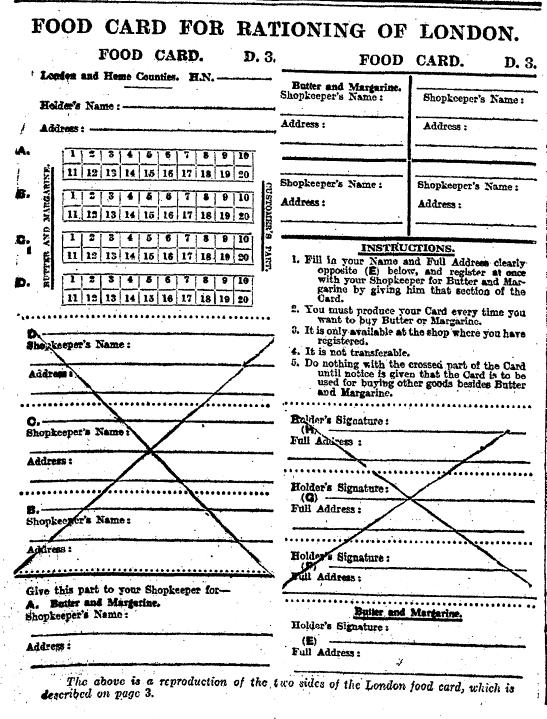
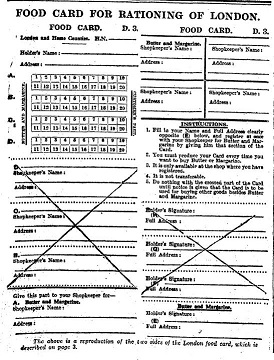 The Times 17 January 1918 p6. Notice that bearers had to register with a retailer. Why? one wonders.
A defendant who makes the wrong choice will wind up in jail; a prosecutor who charges improperly will suffer little, if any, adverse consequence beyond a poor win/loss record. Prosecutors are even absolutely immune from lawsuits over misconduct in their prosecutorial capacity.
So I think we should give prosecutors some skin in the game. Let juries be informed that they may refuse to convict if they think a conviction is unjust — and, if that happens, let the defendants’ attorney fees and other costs be billed to the government. Also, let juries be informed that, if they believe the prosecution itself was malicious or unfair, they can make that finding — in which case the defendants’ costs should come out of the prosecutor’s budget. (If you want to get even tougher, you could provide that the prosecutors involved should be disqualified from law practice for a year or stripped of their immunity from civil suit. But I’m not sure we need to go that far).
– Glenn Reynolds
Last night I went with the Sage of Kettering to see Darkest Hour, based on the events around Churchill becoming Prime Minister as Germany destroys Western Europe. Overall, I would say that it is an excellent film, but with a certain flaw, perhaps a sacrifice to dramatic licence. The actor playing Churchill has done a good job of conveying the man and his quirks.
The film starts with an obviously ill Chamberlain yielding power, in the face of challenges from Attlee, the Labour Leader of the Opposition. The film seems to try to cast Lord Halifax, till then Chamberlain’s ‘sidekick’ as a villain scheming for power. Whilst any politician may well in his heart lust for power, and obviously deny any overt ambitions, Halifax does come across as a bit of a ‘villain’, who is manoeuvring for Churchill’s fall. It may be that he was simply terrified of another war (having been through the Great War and seen action) and lacked the stomach for another, i.e. he had the UK’s best interests at heart in his wrongful head. However, Churchill kisses hands with George VI, a frosty relationship going back to issues over Gallipoli and the Abdication crisis, with Halifax a personal friend of the King. The Conservative Party loath Churchill, Labour and the Liberals support him (perhaps looking forward to taking over the government in a National Coalition, and getting if not always their people, their policies in place for what turns out to be at least the next 80 years).
The situation in Europe deteriorates, and Churchill tries to make rally the French, as he grapples with the demands of office and others try to get used to his chaotic working style. Churchill is alarmed to find that the French have no ‘plan B’ should they fail to contain the Wehrmacht to their North West regions, and the situation worsens. Along with the disasters in France, Churchill’s situation weakens as those seeking a negotiated peace urge their case, with Halifax and Chamberlain (now revealed to have terminal cancer) planning to resign. Overtures are made by Halifax to Italy for Mussolini to help with some form of negotiated peace, but this comes to naught. The King goes to see Churchill, after considering leaving for Canada, and the two become mutually-supportive.
The film gives Churchill a chance to point out that Gallipoli might have worked but for delay in its implementation (he blames the Admirals only, not the Generals as well), and Roosevelt and Churchill have a chat, Churchill in an artfully concealed phone box. The gist of it is that the UK is on its own (at this point) the Neutrality Act ties Roosevelt’s hands, but by a ruse some fighters that Britain has paid for can be got to Canada.
The film takes a bit of a liberty with Churchill suddenly taking the Underground train in a surprisingly long one-stop journey and meeting ordinary people (with a bit of inclusive casting, which shows the common heritage amongst the English-speaking peoples). He finds the ordinary people are willing to fight, and this fortifies him to carry on and abandon defeatist thoughts. This almost breaks the Fourth Wall and I found it spoils the film a bit, it could have been done better. Also, there is no indication of the Communist sabotage of the Allied war effort either in France or in the UK.
Churchill goes to the full Cabinet and rallies support for resistance, the gist of his speech being that a noble end is better than surrender, and the consensus is that any peace would be under Mosleyites.
Matters come to a head with the encirclement of British and French forces around Dunkirk, with a smaller force in Calais sacrificed to buy time for Operation Dynamo, the evacuation. Brigadier Nicholson and his unit in Calais are shown, been told by telegram that they are to stand to the last, a heroic footnote that the film rightly notes. With Dynamo underway, Churchill rallies the House of Commons with another speech, and Chamberlain signals his support (as Leader of the Conservative Party), cementing Churchill’s position, Halifax looks on from the gallery in despair.
The film is not without humour. It rehashes a few of Churchill’s old jokes, and his constant drinking is a running theme, with booze at breakfast. Asked by the King how he manages to drink throughout the day, Churchill replies ‘Practice!‘. The end notes also apologise for depicting smoking, necessary for accuracy, but it grossly under-depicits the extent of smoking.
Having seen the film Dunkirk last year, I would say that this is a far better film, it tells the story of the wider context, it does not have a jarring switch in narrative and has hardly any CGI, which is only used to show the streams of refugees and the odd aerial attack.
It was noteworthy that a couple of Lefties were in our viewing, and at the end they moaned loudly about the film being patriotic (can there be higher praise with faint damnation?), and made parallels about Brexit. It is hard not to see the parallels with the Mrs May’s lamentable efforts at ‘negotiation’, but remember that Halifax today would not be a Remoaner, but a cautious Leaver. The Remoaners would be the Mosleyites, whose only changes have been in label and a different emphasis on race in politics eager for the UK to be subordinate to a foreign power hostile to our laws and customs, with some form of economic dirigisme in place.
And it still strikes me as remarkable that the Queen’s first Britannic Prime Minister was Churchill, and look at her last 5.
UPDATE:
I have found the Sage’s commentary on Lord Halifax in this very parish, from 2003. Halifax, the Holy Fool.
Rather than having a “Minister for Loneliness“, how about not having one? How about the state just maintains basic order, fills in a few street potholes & then minds its own frigging business? The state is not your friend
– Perry de Havilland
In the NHS, unforeseen demand simply results in more queuing and rationing. Given that budgets are largely fixed by the political process, and resources are allocated to different parts of the service based on highly speculative demand estimates, deviations in demand can lead to acute shortages.
Of course, on the margin, having more resources can help. An NHS awash with cash would no doubt be under less pressure than it is today. But no reasonable amount of funding would solve these structural economic realities entirely.
There is a reason the NHS has these winter crises regularly, and other countries do not
– Ryan Bourne
Mercantilists literally believe (even when they deny the belief) that money is wealth – that to accumulate money is to accumulate wealth and that to spend money is to become less wealthy. This mercantilist “reasoning” is why, for example, mercantilists applaud exports (because exports are sold for money) and lament imports (because imports are paid for with money). Thus the mercantilist obsession with the balance of payments.
Economists counter this mercantilist belief by pointing out that money is valuable only because it can be exchanged for real goods and services. Ultimately, wealth is not money and money is not wealth; ultimately wealth is the use of real goods and services. People who envy Jeff Bezos or Bill Gates or Dave the hedge-fund manager across town don’t really envy Jeff’s, Bill’s, or Dave’s possession of billions of Federal Reserve Notes (or of pieces of paper or streams of electronic bits that are easily convertible into dollars or some other currency). What the envious envy is Jeff’s, Bill’s, and Dave’s luxurious homes, luxury automobiles, private jets, top-rate medical care, and regular consumption of other real goods and services that are not affordable in the same quantities by less-wealthy people.
– Don Boudreaux
|
Who Are We? The Samizdata people are a bunch of sinister and heavily armed globalist illuminati who seek to infect the entire world with the values of personal liberty and several property. Amongst our many crimes is a sense of humour and the intermittent use of British spelling.
We are also a varied group made up of social individualists, classical liberals, whigs, libertarians, extropians, futurists, ‘Porcupines’, Karl Popper fetishists, recovering neo-conservatives, crazed Ayn Rand worshipers, over-caffeinated Virginia Postrel devotees, witty Frédéric Bastiat wannabes, cypherpunks, minarchists, kritarchists and wild-eyed anarcho-capitalists from Britain, North America, Australia and Europe.
|





Recent Comments