We are developing the social individualist meta-context for the future. From the very serious to the extremely frivolous... lets see what is on the mind of the Samizdata people.
Samizdata, derived from Samizdat /n. - a system of clandestine publication of banned literature in the USSR [Russ.,= self-publishing house]
|
In an earlier post I said that things were looking good for the Allies in late 1916. In essence, they were getting stronger and their enemies were getting weaker. In early 1917, things got even better. America joined the war while Russia became a republic with a democratic constitution. What could possibly go wrong?
Well, as we know, lots did. First, while America may have been a rich country with a large population it suffered from exactly the same problems as Britain did in 1914. Its army was small and not prepared for war against similarly-armed opponents. It would take time to become effective and it’s debatable whether it ever really did.
Second, the French launched the ill-fated Nivelle Offensive. Although it was far from a total failure, Nivelle had made extraordinary claims for it. When the hopes founded on these claims were dashed French morale collapsed. What happened to the French army at this time is still shrouded in mystery. The rumour is that far more French soldiers ended up getting shot for mutiny than was admitted at the time or even subsequently. It’s possible we’ll get to find out a little more this year when a few more of the archives are opened.
One of the odd things was how this affected Haig’s standing. In February, there had been an attempt to subordinate him to the French High Command. By May, the French government was asking his opinion on who should head that High Command. He didn’t give it.
Third, the February Revolution failed to stick. The Russian army had ceased to be an effective fighting force well before the Bolshevik take over in November.
So by late summer 1917 Britain’s only effective ally was Italy. While I am tempted to crack jokes Italian “effectiveness” the truth is that I don’t know enough about Italy’s contribution in the war to comment with any great authority. And, anyway, after the defeat at Caporetto, in November, they were in much the same position as the French.
Worse still, in February, the Germans launched unrestricted submarine warfare. This sent shock waves through the British high command. At one point, Jellicoe, the First Sea Lord, claimed that Britain had only a matter of months left before its food supplies ran out. The only thing that could save it was the British army capturing the Channel ports where most submarines were based.
This is the context in which Passchendaele – or the Third Battle of Ypres as it was officially known – was fought.
When dealing with complex political issues I often find it useful to ask myself what would happen in the absence of the state. This is not because I think that the glorious libertarian revolution is just around the corner but because such an exercise can at least give us some clues as to what the state should be doing in the here and now.
So, what do I mean by private roads?
Roads where the owners may decide who uses them, under what circumstances and have the means to enforce their decisions. The type of ownership could include purely commercial enterprises – out for a profit, individually-owned roads and – what I think will be the most common form – club-owned roads.
A lot would depend on people’s propensity to tolerate acts of terrorism. My guess is that this would be pretty low but I could be wrong. But that’s the great thing about the free market: it is a wonderful way of finding out what people really want. If the propensity is high then I would guess the outcome would be very similar to what we have now. Terrorism would simply be something that people would have to get used to. But let’s assume that the propensity is low. A commercial road owner would therefore have a very strong incentive to prevent terrorism.
Why?
Because, if a competitor was better at preventing terrorism then more people will want to use his roads.
But what of a road owned by a club?
This is an important example if I am right that most private roads would be in this form. The governance rules might be in the form of one frontage one vote. But it may be that the number of votes is proportional to the fees charged.
Now a road club will not have the same incentives as a commercial road – they would not exist to make money. But they would have incentives enough. The principal one would be that their members would want to preserve the value of their properties and one factor in that would be how likely it was that their properties became subject to terrorism.
Individual road owners, we can assume, would be in much the same position as clubs.
So, assuming there are strong incentives to prevent terrorism how would road owners go about it?
Obviously they would want to stop the terrorists. But they would also want to make it as easy as possible for non-terrorists to go about their business. And they would want to keep the costs down.
A key moment is what happens when someone enters the road – or road network – from one of the inevitably large number of frontages. You could have a guard on every frontage searching every person entering the road. However, this would be expensive. Not only that but it would be unlikely to be effective. Guards would get bored and become inattentive and would themselves become likely targets.
Another approach might be to deny access to anyone suspected of being an active terrorist. But this is fraught with difficulty. How would you know who is who?
Far simpler and more effective would be to ban anyone harbouring any terrorist sympathies whatsoever. Effective terrorist campaigns can always rely on a sea of sympathisers who are not themselves terrorists to aid and abet those who are. These sympathisers are usually easy to identify. Exceptions might be granted for children and members of the older generation. Or maybe there would be a system of vouching for people, guarantees of good behaviour or even the taking of hostages. The chances are that if private roads came about tomorrow terrorist sympathisers would wake up to find their properties surrounded by barbed wire.
The next issue would be those seeking entry from another road i.e. a road owned by another entity. What you would probably see is a system of guarantees. One road owner would guarantee the non-terrorist nature of their road users to other road owners. Obviously, there would be some fairly hefty compensation should one road owner’s users engage in acts of terrorism on another road owner’s territory. That would mean that road owners would be very careful who they let out.
There is a precedent for this – sort of. Those familiar with the movie The Day of the Jackal will recall that the idea that they might be letting a terrorist loose on foreign soil scared the living daylights out of the British government.
So, what would happen to the terrorist sympathisers?
It is difficult to see how terrorist sympathisers would be allowed to use non-terrorist-sympathiser roads. They would therefore only be allowed to use terrorist-sympathiser roads. As terrorist sympathisers tend to be poor and geographically concentrated, they would have an immediate problem over what to do for an income especially in the absence of a welfare state. Faced with poverty some would choose to leave for terrorist-sympathiser majority countries while others would choose to change their beliefs. Of course, there is the issue as to whether such conversions would be genuine. I have no answer to this.
But what if the terrorists engaged in acts of terrorism from their own roads?
They could for instance mortar bomb non-terrorist-sympathiser roads. My guess is that they would get mortar-bombed back. Just to greater effect.
And then Bond just skis off the edge and as he drops down through the sky he kicks loose his skis and pulls the cord and his parachute opens – a massive Union Jack chute, which is a bit of a giveaway for a secret agent in deep cover but, as Christopher Wood noted with pride, elicited huge cheers from audiences in the decrepit strike-ridden hellhole of pre-Thatcher Britain.
– Mark Steyn on the late Roger Moore.
Stefan Molyneux on the Manchester bombing.
In case you didn’t already know The Prisoner is a TV series starring Patrick McGoohan, originally broadcast in 1967. Lots of libertarians get very excited about it. It was recently re-shown on True Entertainment. [Indeed the very first episode is being re-shown this very afternoon.]
1. The set-up is superb. The numbers, the clothing, “Be seeing you”, Portmeirion, the upbeat public address messages, the font, Number Two, Mini Mokes, Rover, the surveillance. Superficial pleasantness and concealed malice. Brilliant.
2. Many of the episodes hinge on the idea that medical science can manipulate and control the human mind. This is very Sixties but oddly enough doesn’t seem all that dated.
3. Number 6 is very grumpy. Yes, I suppose being kidnapped and imprisoned might get on anyone’s goat but does he have to be quite so testy when dealing with his fellow inmates?
4. Taken as a whole it is a mess. It can’t make up it’s mind whether it is spy drama (Arrival), microcosm (Free for All) or allegory (Living in Harmony). Some episodes e.g. Dance of the Dead seem beyond characterisation.
5. Although as a whole it is a mess, the individual episodes all stand up. Writing, acting, direction. All good. In this regard it rather put me in mind of Antonioni’s “Blow Up”. That has a succession of brilliant scenes that in my estimation don’t add up to a row of beans. It was released a year before The Prisoner. Coincidence? I think not.
6. Did I say all the episodes? It’s time to talk about Fall Out, the finale. When it was first broadcast viewers jammed the broadcaster’s switchboard with their complaints. And it is not difficult to see why. They were promised a logical, rational spy mystery in which the clues would lead to a solution and they were given a clunky allegory with lots of people behaving very oddly. If there is a moral to The Prisoner it is to know how the story is going to end before you start writing it.
7. When I first watched it my interpretation of Six being One was that we are our own jailers. McGoohan himself argued that One is the evil side of all of us that we have to keep in control. This would appear to imply that to be good you have to be grumpy. Hmm.
8. How libertarian is it? The late Chris Tame thought “very”. I am not so sure. Sure there’s a great speech at the beginning about not being “filed, indexed, numbered. I am a free man…” etc. But other than that the only episode where individualism is really present is Change of Mind. This is the episode which introduced us to the word “unmutual”. Even so Number Six only survives because he is too valuable to be lobotomised, can spot when he is being drugged and knows how to hypnotise people. It is not so much the individual against the state as the exceptional individual against the state. And by the way, Number Six does get filed, indexed and numbered.
9. I am far from the first Samizdatista/Libertarian Ally to have written on the subject. See here, here, here and here.
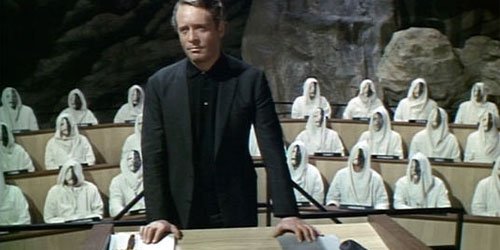 The masks conceal the lack of a proper resolution. From here
He [Trump] appears to be entertaining the horrible idea that the people who buy cars ought to be free to decide for themselves how much fuel economy matters to them – since they will be the ones paying for both the car and the gas. And – oh my god! – that this is really none of the business of the “concerned” scientists and other professional busybodies who regard their opinions and preferences as holy writ enforceable at gunpoint.
– Eric Peters
A Russian politician has proposed turning football hooliganism into a sport…
Such a sport already exists. It’s called “rugby”.
He published the proposal on his party’s website, stating: “Russia would be a pioneer in a new sport. Fans arrive, for example, and start picking fights. And they get the answer – challenge accepted. A meeting in a stadium at a set time.
Still rugby.
Following clashes between his country’s fans and England supporters at Euro 2016, Lebedev said he “did not see anything terrible about fans fighting”.
And to be honest I don’t see anything terrible about rugby fans fighting either.
Igor Lebedev has drawn up rules…
Rules? Rules? Ok, that’s not rugby.
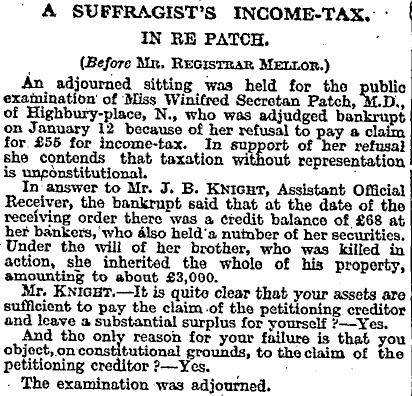 The Times 28 February 1917 p4 And no representation without (net) taxation one might add.
I did some searching to see what happened in this case but to no avail. I presume the state got its money in the end. As to the good lady herself there seems to be some sort of medical prize in her name.
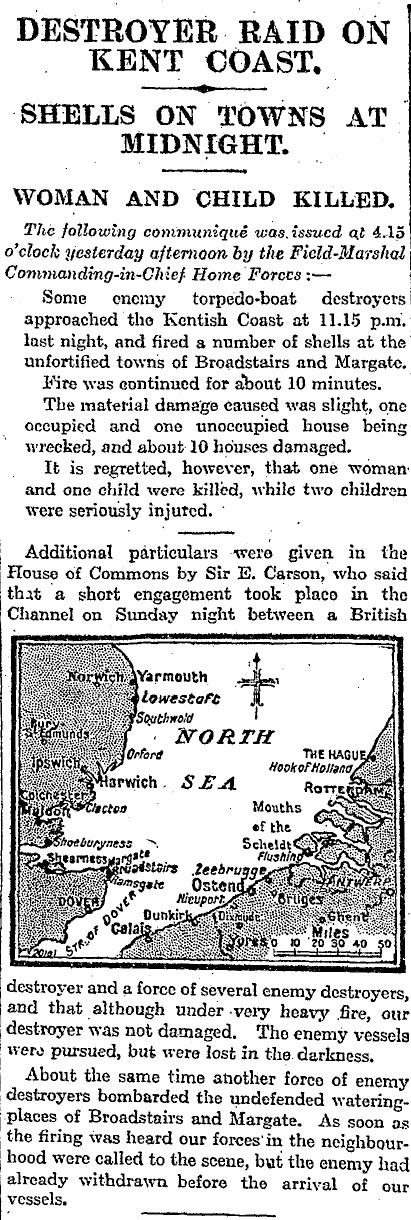
In 1917, as this cutting shows, the German navy shelled Margate and Broadstairs. Nothing strange in that, you might think, they had done much worse to Scarborough and Great Yarmouth.
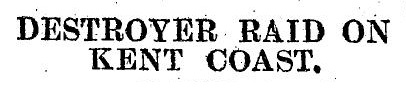 The Times 27 February 1917 p6. Right click for the whole article. However, this raid was a bit different. Far from causing general mayhem and tweaking the tail of the Royal Navy, on this occasion the target was one man: Lord Northcliffe, proprietor of The Times, The Daily Mail and – I kid you not – The Daily Mirror. Not that you would know it from this heavily censored report.
Northcliffe had attracted the ire of the German government by – apparently, I get little impression of this from The Times itself – being the main cheerleader of anti-German and pro-War sentiment in Britain. In 1918, doubtless aided by the Kaiser’s ringing, if unintentional, endorsement, Northcliffe became Britain’s Director of Propaganda.
I appreciate that in writing this article I may be giving the God-Emperor some ideas. So, Donald, if you’re reading, just remember: sailing a battleship up the Hudson, shelling the New York Times building and turning it into a smoking pile of rubble just so you can wipe the smile off the faces of a bunch of smug, arrogant, conceited, snobbish, self-satisfied, aloof, out-of-touch, blockheaded, group-thinking, bubble-dwelling, histrionic, paranoid, lying, devious, dissembling, childish, cry-baby, bitter, vindictive, divisive, conspiratorial, freedom-hating, progress-denying communists… is not nice.
It may even be wrong.
Milo Yiannopolous seems to have got himself into a spot of bother over remarks about homosexual sex with teenagers. The gist of it – especially if you read his clarification – seems to be that he was ready to take it up the bum at 13 and if it was OK for him then it would probably be OK for others. I suspect – given the little I know about him – that Milo at that age would have been capable of weighing up the pros and cons of such a decision. But not many others.
Milo raises – albeit indirectly – an important question: when does a child become an adult? As it happens, I drafted an attempt at an answer to this some time ago but lacked the guts to publish it. It’s time I did:
As the law stands if a man has sex with a female of 15 years and 364 days he is a scoundrel who should be imprisoned for a very long time. However, if he has sex with a female of 16 years and 0 days that’s just fine and dandy.
Or to put it another way, in the opinion of the law all women undergo the transition from young, innocent child to responsible, rational adult in a split second at exactly the same age.
That’s absurd; but, for the law, hardly uncommon. Similar rules apply to all sorts of aspects of growing up: when you can drive a car, enter into contracts, vote, marry, drink alcohol, leave school, get a job etc. And in each case the state’s answer is some arbitrary, one-size-fits-all number. And often it is a different number: 17 for driving (I am referring to English law here), 18 for drinking, 16 for sex. That can’t be right.
Could there perhaps, be a solution that is – to paraphrase H. L. Mencken – simple, neat and not wrong? The argument for numbers is that you have to draw the line somewhere, meaning: the law has to draw the line somewhere. But why should it be the law drawing the line? Why can’t it be the child? What if when the child comes to the decision that he is old enough to take on the rights and responsibilities of adulthood he just does? Obviously, he would have to tell people but that implies some sort of arrangement not unlike marriage with documents, ceremonies and cooling-off periods. Hardly beyond the wit of man.
I’ve been trying to think up some drawbacks. One might be that a girl’s declaration of adulthood might look awfully like a declaration that she wanted to have sex. And women are a bit coy about that sort of thing. Another might be that some children would decide to become adults at an absurdly young age and then proceed to ruin their lives, perhaps by driving the car into a bunch of passers-by. Or drinking themselves to death. But how likely is that? My personal experience of childhood is that I was perfectly well aware of my unpreparedness for taking on the responsiblities of adulthood. Perhaps we should be more worried about the other end of the age scale. Would some people choose to extend their childhood into their 20s and beyond?
Perhaps one way to look at this is to consider when we might ourselves have felt ready for the transition. In my case I think it was about 14-15. The only issue for me at that age would have been the predatory homosexuals who made up the school’s English Department.
That’s a line that the Rod Steiger character uses in the the 1970 film Waterloo. And it’s a line I have been repeating to myself again and again over the last few months.
My enemies in the Establishment, whether it be the media, communists, social justice warriors or the last-ditch Remainers have been obligingly making error after error. I could point out their mistakes and laugh but there is that danger – however remote – that they might listen and learn. You see, I don’t want them to learn. What I want them to do is to keep the gas pedal pressed down hard as they can as they drive the juggernaut of bad ideas over the cliff and into oblivion. In such circumstances it is best to keep ones counsel.
Even so, when Prince Charles co-authors a Ladybird book on climate change I feel obliged to comment. You see, I am rather fond of our vestigial monarchy. Don’t ask me why, I just am. But for the heir apparent to involve himself in a political argument at a time when his side is losing is madness.
Prince Charles hopes the new Ladybird book, which will be available from Thursday, will act as a simple guide to the topic and win over climate change sceptics.
It’s a Ladybird book. It’s aimed at children. That makes it indoctrination.
I loved this from one of his co-authors:
I don’t think there has ever been a Ladybird book before in the history of ladybird books to have been subject to multiple rounds of peer review…
Keeping the pedal to the metal and beyond.
There are times when I think that Brenda’s main motivation in staying alive is to prevent her son doing irreparable damage to the monarchy.
If you are a fan of Watford, Aston Villa or Lincoln City or just football in general you will be shocked and saddened by the news of the death of Graham Taylor at the age of 72.
He was a remarkable manager. He took Lincoln City from the Fourth to the Third Division. He took Aston Villa from the Second Division to runners-up in the First. He took England to the 1992 European Championships and successfully kept them out of the 1994 World Cup.
But it was with Watford he had his greatest success. Teaming up with Elton John in 1977 he quickly won promotion to the Third Division. Shortly afterwards he gave a talk at my old school. In the Q&A one of the cheekier boys asked him when we would be in the First Division. How we laughed. It was unthinkable. Not going to happen. Taylor replied that if you aim for the ceiling your feet won’t get off the ground but if you aim for the sky then you may hit the ceiling. Four years later having smashed through the ceiling, roof and lower troposphere we were indeed in the First Division making monkeys out of the likes of Manchester United and Liverpool. [What’s changed? I hear you ask.] In 1983 Watford were the second-best team in the entire country. In 1984 they got to the final of the FA Cup.
For the benefit of North American readers unused to the joys of promotion and relegation the equivalent of all this might be the Montreal Expos winning the World Series or a Canadian team winning the Stanley Cup. Or, if you’re not interested in sport, somebody without political experience, a coherent philosophy, tact, media savvy or plausible hair becoming President of the United States. As I said: not going to happen.
Taylor even returned to Watford in the 1990s once again taking them from the Third to the First Division (or Premier League as it was by then known).
There were a number of secrets to his success. One was fitness: it was essential that his teams could keep going for the full 90 minutes. Another was the employment of the sublimely-talented John Barnes and the sublimely-passionate Luther Blissett at a time when many of the big teams were reluctant to field black players. Another was going back to the stats and working out that the traditional English long-ball game was by far the most effective. This was indeed fortunate as to attempt to pass the ball on the notoriously glutinous Vicarage Road pitch of the 1980s was to engage in cruelty to spherical objects.
On Saturday, Watford are playing at home. The club and fans will attempt to honour Taylor’s memory – many already have via the #thankyougt hashtag. But it will be difficult. Graham Taylor was a remarkable manager – and by all accounts – a true gentleman. Watford owes him a huge debt.
|
Who Are We? The Samizdata people are a bunch of sinister and heavily armed globalist illuminati who seek to infect the entire world with the values of personal liberty and several property. Amongst our many crimes is a sense of humour and the intermittent use of British spelling.
We are also a varied group made up of social individualists, classical liberals, whigs, libertarians, extropians, futurists, ‘Porcupines’, Karl Popper fetishists, recovering neo-conservatives, crazed Ayn Rand worshipers, over-caffeinated Virginia Postrel devotees, witty Frédéric Bastiat wannabes, cypherpunks, minarchists, kritarchists and wild-eyed anarcho-capitalists from Britain, North America, Australia and Europe.
|





Recent Comments