We are developing the social individualist meta-context for the future. From the very serious to the extremely frivolous... lets see what is on the mind of the Samizdata people.
Samizdata, derived from Samizdat /n. - a system of clandestine publication of banned literature in the USSR [Russ.,= self-publishing house]
|
From Instapundit (my emboldenings):
The miniature Perdex drones, different from larger, more common remotely piloted vehicles (RPVs) like the well-known Reaper and Predator, operate with a high degree of collective autonomy and reduced dependency on remote flight crews to control them. The large group of more autonomous Perdex drones creates a “swarm” of miniature drones. The swarm shares information across data links during operation, and can make mission-adaptive decisions faster than RPV’s controlled in the more conventional manner.
In a statement released by the U.S. Department of Defense, Strategic Capabilities Office Director William Roper said, “Due to the complex nature of combat, Perdix are not pre-programmed synchronized individuals, they are a collective organism, sharing one distributed brain for decision-making and adapting to each other like swarms in nature,” Director Roper went on to say, “Because every Perdix communicates and collaborates with every other Perdix, the swarm has no leader and can gracefully adapt to drones entering or exiting the team.”
Doctor Who fans will know exactly where this sort of thing leads:
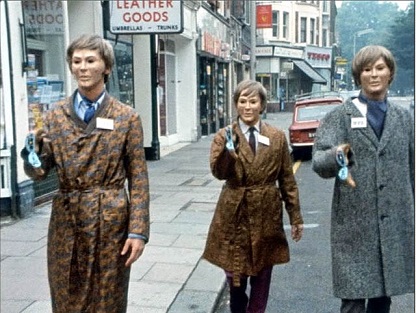
You have been warned.
Patsy Cornwallis-West was at one time mistress to the Prince of Wales, the future Edward VII. By the First World War she was a woman in her fifties married to a highly respectable retired colonel in his late seventies.
Her son, George, married one Jennie Jerome, mother of one Winston Churchill before marrying one Mrs Patrick Campbell. But that’s another story.
It would appear that Mrs Cornwallis-West was not entirely satisfied with her septugenarian husband and developed a “more than ordinary interest” in a young officer recently promoted from the ranks and recently wounded. When the young officer failed to reciprocate she started to pull strings. One of these strings was attached to the Quartermaster General.
Soon afterwards, the officer found that he had been transferred to another battalion. This may not sound like a big deal to you or me but it was clearly a huge deal to everyone involved at the time. My guess is that soldiers are deeply attached to their battalions especially when there’s a war on.
This was not the end of the matter. Questions were asked in Parliament and – I kid you not – a special Act – the Army (Courts of Inquiry) Act – was passed to create a committee to look into this one case (well, two actually, but the other one doesn’t concern us). The upshot was that the junior officer was exonerated, his commanding officer fired, Cornwallis-West censured and the Quartermaster General, ahem, informed of the “displeasure of the government”.
That such an effort could be made to secure justice in the middle of a war for a single subaltern who for all I know got killed anyway and may well not even have had the vote is staggering. And magnificent.
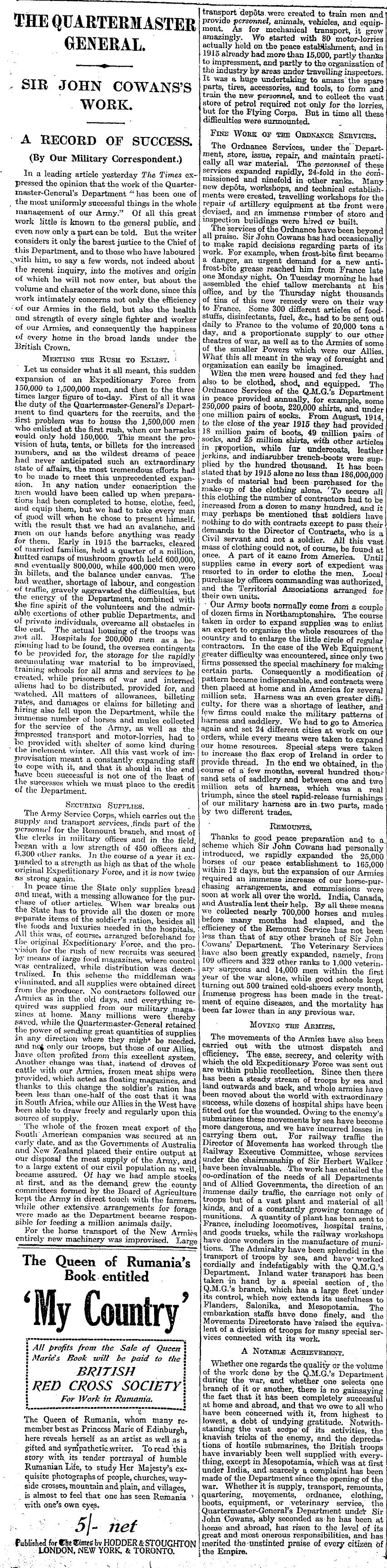
Which brings us on to the linked article. The Quartermaster General concerned was a chap called Sir John Cowans. The job he had in supplying the biggest army in British history was immense. And it would appear that he was very good at it. Clearly, scandal or no scandal, a lot of people wanted to keep him in his post. Hence (probably) this article from the Times Military Correspondent singing his praises.
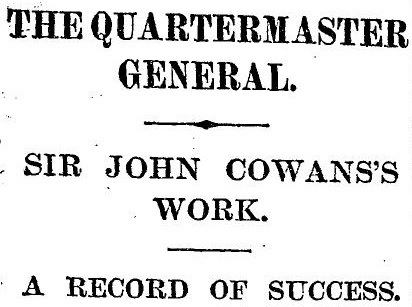 The Times 5 January 1917 p3 I particularly liked this bit:
For example, when the frost-bite first became a danger, an urgent demand for a new anti-frost-bite grease reached him from France late one Monday night. On Tuesday morning he had assembled the chief tallow merchants at his office, and by the Thursday night thousands of tins of this new remedy were on their way to France.
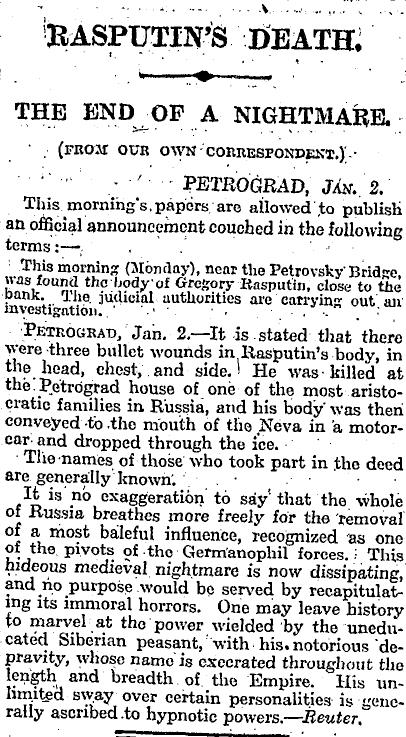
Justice was one thing but the heavens falling was another.
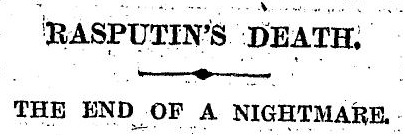 The Times 4 January 1917 p7
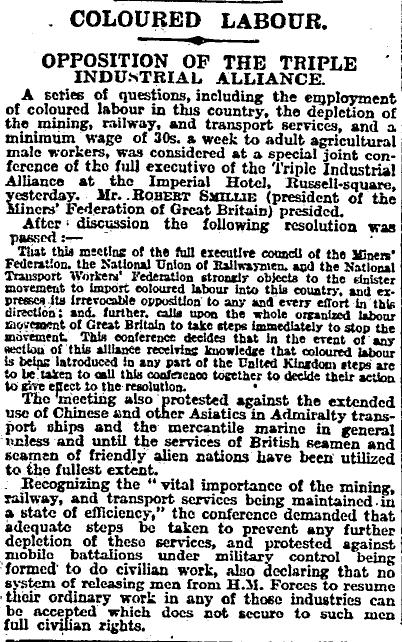 The Time 22 December 1916
Things were looking good for the Allies at the close of 1916. The French had pushed back the Germans at Verdun. The British were consistently doing much the same on the Somme. The Russians had made huge gains at the expense of the Austrians during the Brusilov Offensive. The Italians were continuing to attack and it appeared that it was finally all systems go on the Salonika Front. The only real fly in the ointment was Romania which was being invaded.
Away from the frontlines there was also plenty of scope for optimism. The British were at last getting guns and shells in sufficient quantities. The Irish rebellion had been crushed. The U-boat campaign was quiescent. Conscription seemed to be working. Even the Russians seemed to have turned the corner when it came to their supply problems.
Most importantly, the Western Allies – and particularly the French under a dashing young commander – appeared to have found the formula for winning battles on the Western Front.
Meanwhile the Germans were slowly and literally being starved by a combination of the Blockade and their own economic incompetence. Splits were beginning to appear with the communist, Karl Liebnecht demanding an end to the war. At the same time they were having to prop up their increasingly helpless allies. In Austria, the death of Emperor Franz Josef followed on the heels of the assassination of the Prime Minister by another communist in protest at the continuing refusal to recall parliament.
It must have looked like victory was just around the corner. In such situations you often find that unscrupulous politicians like to jockey for position in order to be able to take the credit. Not that such things would ever happen in Britain.
On 6 December, having out-manoeuvred his predecessor, David Lloyd George became Prime Minister.
Oh and the name of that dashing French commander – he of the formula? Nivelle. Robert Nivelle.
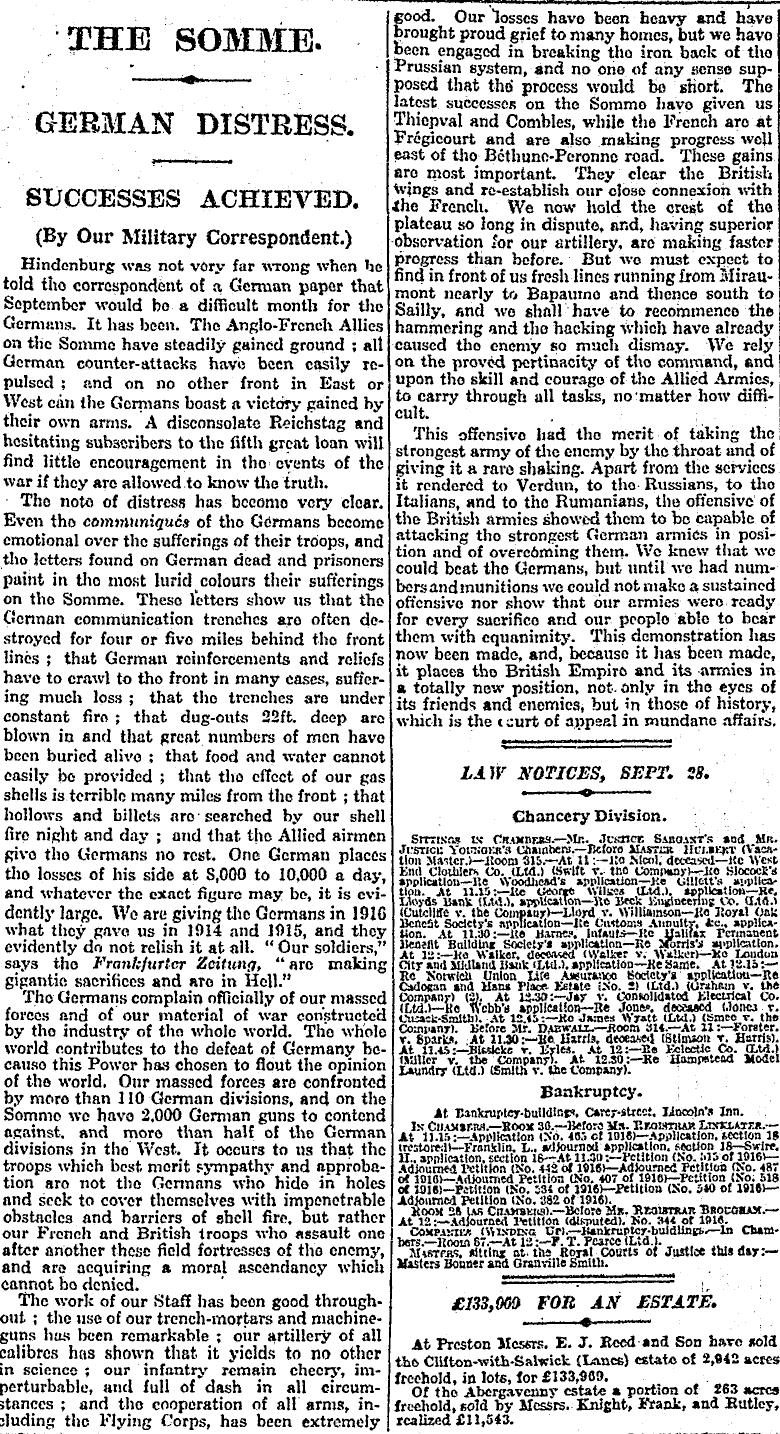
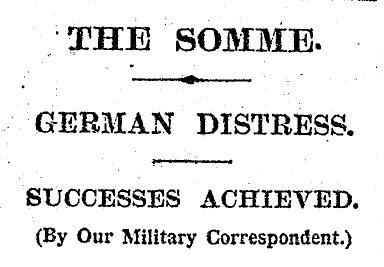 The Times 28 September 1916
A chap called Ricky Vaughn posted this to Gab:
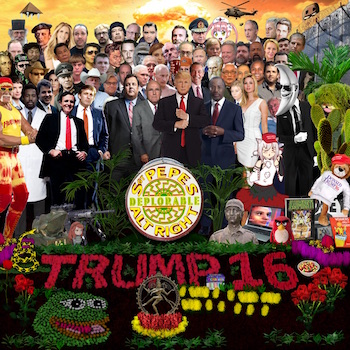 No Reagan or Thatcher. No Paul Joseph Watson or Stefan Molyneux either.
“Ah, it’s a homage to The Beatles’ Sergeant Pepper’s Lonely Hearts Club Band album cover. How clever.” I thought.
“Let’s see who’s here.”
“Well there’s Nige, Ron Paul, Pepe (of course), Ann Coulter, Milo, Harambe (heh!), Joseph McCarthy, Scott Adams. All good or good-ish stuff. Well maybe not Pepe. Or Harambe.”
“Who’s that skulking in the shadows?”
“Oh shit, it’s that Norwegian mass murderer!”
“And hang about that’s Gaddafi!”
“And that’s…”
By my count it’s 4 tyrants, 1 fascist leader, 2 mass murderers and 1 serial killer. And that’s the ones I recognise.
The disturbing thing is that this image may well be accurate. These people represent the intellectual (stop sniggering. Seriously, stop sniggering) underpinnings of the Trump presidency. Obviously, there are serious differences which will probably lead to serious subsidence.
But there are things that unite them. With the exception of Farage, I cannot think of any who would have been on the right side of history in 1939. Which is remarkable. Even Neville Chamberlain got that one right.
They are also united by a loathing of the establishment. Which I loathe too. The UN, the EU, the welfare state, crony capitalism, fiat money, political correctness, climate alarmism, regulation after regulation after regulation: they’ve all got to go. But in all of that happening all sorts of other things may happen. One can only hope those things are nearer the Farage than Mosley end of the spectrum.
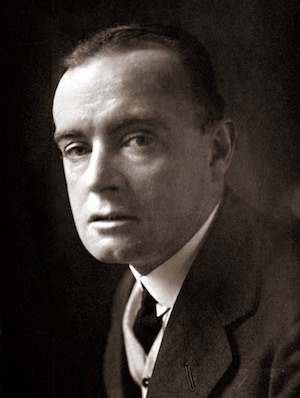
H H Monro – who wrote under the pen name Saki – was a writer of mainly short stories. In most of them the innocent and gullible find themselves in an unequal struggle with the sly and devious.
In his novel When William Came he wrote about what would happen in the event of a German invasion. It is not a particularly good novel but it does describe the process by which die-hard patriots find themselves ever more isolated as more and more of the smart set – desperate to carry on as before – adapt themselves to occupation
When war came, Monro was a man in his 40s and as such could have stood aside. Instead he joined up. He was killed on the Somme a hundred years ago yesterday.
One our regular-ish commenters posts under the same name as one of Saki’s recurring characters so it will be interesting to hear Clovis Sangrail’s take.
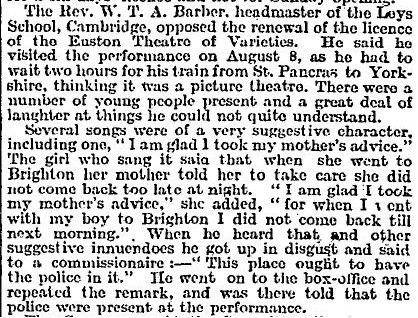 The Times 3 November 1916 p6
…it is a symbol that the bearer has made a donation to the Royal British Legion’s Haig Fund.
I thought it might be worth pointing that out bearing in mind recent kerfuffles.
After a gazillion years of proposals, enquiries and delayed decisions the Government has finally given the go-ahead for the building of a new runway at Heathrow. Apparently this will be the first runway built in the South East of England in 50 years.
The MP for Richmond – just across the river from me – Zac Goldsmith immediately resigned his seat and announced his intention to stand as an independent in the resulting by-election. His former party, the Conservative Party, the governing party, won’t even be putting up a candidate. It’s not just Goldsmith. Extraordinarily, cabinet ministers who represent constituencies under the flightpath have been given permission to speak against the decision.
So what is the kerfuffle all about? I have been living under the flightpath for 15 years now. I live to the east when most of the action is east-west, so I don’t get the worst of it. But I do live where most of the people who would be affected live. For the most part I am barely aware that there’s an airport in the vicinity at all. About one or month or so, planes are moving west-east and every couple of minutes I won’t be able to hear the telly. In such cases I have to take the drastic action of pushing the pause button on my remote control. Heathrow has never deprived me of any sleep and things would have to get a lot worse before it bothered me. Or the Fonz for that matter:
Indeed, things are a lot better than they were in the days of Concorde. The racket that thing used to make was astonishing. And wonderful. So what if I couldn’t hear a damn thing for 30 seconds? That was a deafness induced by the finest British engineering, a richer deafness. A better deafness.
Now I accept I (and the Fonz) are not everybody. Maybe, others are more affected. If so one wonders why they choose to live in Richmond. OK, it’s possible that there some who are not affected now but will be in the future. In that case they would probably be best off leaving and moving somewhere quieter. Now, as a libertarian, I think that people should be compensated for such losses. Except I very much doubt there will be any need. I suspect that any loss people might suffer in terms of the cost of moving will easily be matched in terms of the rise in house prices due to the fact that their homes are so near to an expanding airport.
I just can’t see the problem.
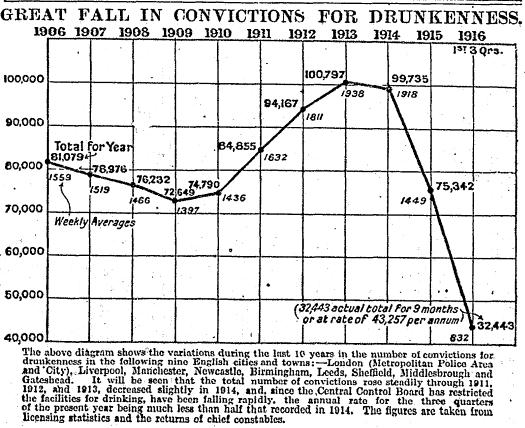 The Times 28 October 1916 p5 In case there should be any doubt: I do not like the implication that state violence can make the world a better place. I suspect there are all sorts of reasons why the graph might not be accurate and if it is accurate for doubting that it tells the full story. For instance, a lot of the men who would have got drunk are by this stage in the army and serving in France.
Even so, what if it’s true? What if restrictions on alcohol helped to increase munition production and helped to win the war?
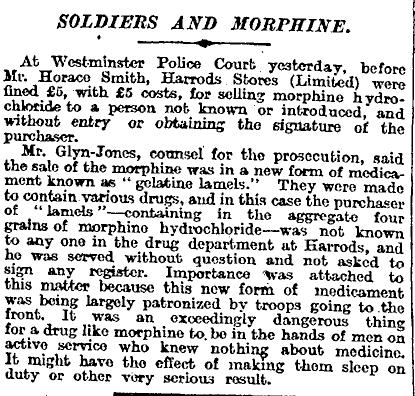
Like now, the war against alcohol was very much a feature of the time. Earlier on in the year, along with other restrictions, the “round” had been banned. Just this week (a hundred years ago) a full-page advertisement had appeared in The Times calling for prohibition until the end of the war. The 1,000 signatories included such luminaries as H.G. Wells, John Masefield, Thomas Hardy, Robert Baden-Powell, Ernest Rutherford, Elizabeth Garrett Anderson and General Smith-Dorrien.
For example:
 The Times 5 February 1916 p3
|
Who Are We? The Samizdata people are a bunch of sinister and heavily armed globalist illuminati who seek to infect the entire world with the values of personal liberty and several property. Amongst our many crimes is a sense of humour and the intermittent use of British spelling.
We are also a varied group made up of social individualists, classical liberals, whigs, libertarians, extropians, futurists, ‘Porcupines’, Karl Popper fetishists, recovering neo-conservatives, crazed Ayn Rand worshipers, over-caffeinated Virginia Postrel devotees, witty Frédéric Bastiat wannabes, cypherpunks, minarchists, kritarchists and wild-eyed anarcho-capitalists from Britain, North America, Australia and Europe.
|






Recent Comments