We are developing the social individualist meta-context for the future. From the very serious to the extremely frivolous... lets see what is on the mind of the Samizdata people.
Samizdata, derived from Samizdat /n. - a system of clandestine publication of banned literature in the USSR [Russ.,= self-publishing house]
|
This quotation comes from an article entitled “Russia To-day”; not words one normally associates with accuracy:
Perhaps the advent of Bolshevik Government is a necessary evil. It may be an indipensable ordeal through which Russia must pass before the bulk of the people realize the fact that the Bolsheviks are the real counter-revolutionaries, who are doing their best utterly to ruin the country, and are working hand-in-glove with the enemies of Russia and the secret agents of the old regime. But we know enough about the Bolsheviks to realise that methods of peaceful suasion will never rid the country of ther evil sway. There is only one remedy against them. M. Kerensky indicated it when he asked General Korniloff to send a cavalry division to Petrograd “to subdue the Maximalists.” The proverbial “whiff of grape-shot” is the only medicine, and until it is administered in the proper dose the present situation will continue.
But of course it wasn’t.
There is a lot to get ones teeth into here. I mean there’s the obvious point that the Bolsheviks really did “ruin the country”. So, there’s at least one person out there in 1917 who could see the dangers of communism.
And then there’s Korniloff. At school I was taught that he was attempting a coup and that he had the “brains of a sheep”. I am beginning to think that in reality he was one of the good guys – or at least one of the less bad guys.
The Korniloff affair remains murky – see the Wikipedia page – but the consequence was clear enough: the army was no longer willing – and probably not able – to support the Provisional government. The correspondent here gets this.
I am not an expert on the ins and outs of the Russian Revolution. So whether the Bolsheviks and Okhrana were working hand-in-hand I have no idea.
I wonder what the “M” in “M. Kerensky” stands for?
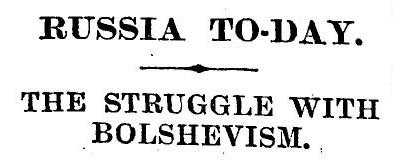 The Times 28 September 1917
By “we” I mean the American government of course.
Let’s try some Q and A:
Does North Korea currently possess the means to destroy cities in South Korea, Japan and even the United States?
I’m guessing that’s a “no”. My understanding is that building a missile is one thing, building an atomic bomb another thing and combining the two really difficult.
If not, are they likely to acquire those means any time soon?
Well, they seem to have spent a hell of a long time just getting to this stage. So, it could be a while yet.
Were they to acquire them how likely would they be to use them?
I suppose the question here is whether or not the threat of instant nuclear annihilation would deter them. The point is that the Norks are atheists. They do not have a heaven to go to. They want to receive their rewards in this world. There is no upside to being nuked. So, they can be deterred.
Of course, I say they are atheists but their system of government is clearly a hereditary monarchy. Monarchies tend to have gods attached. But as yet (to the best of my knowledge) the Norks haven’t come up with a heaven. But when they do… watch out.
So, the best approach is probably to do nothing and let deterrence do its thing?
Probably. Of course, it doesn’t have to be the US doing the deterring. Japan and South Korea could do much the same, after they had developed nuclear weapons of course.
Getting back to this god stuff, the Iranians aren’t atheists are they?
No they’re not. And they believe in heaven. And they believe they would go to heaven if they nuked Israel. And rumour has it that the Norks are helping them with the tech. But my guess is that the Israelis have the means to deal with this threat before it becomes serious.
So, what you’re saying is that the US’s best approach is to do nothing?
Yes, I guess I am.
I would just add that it is remarkable how difficult smaller tyrannies find it to replicate 60-year old technology.
In 8 days time.
Fuckers.
Lots of people – including some Uber supporters – saying stupid things.
Talking of which, I see Sargon of Akkad – he of This Week in Stupid – has been “unpublished” on Facebook.
What a shit day.
Bear with me on this.
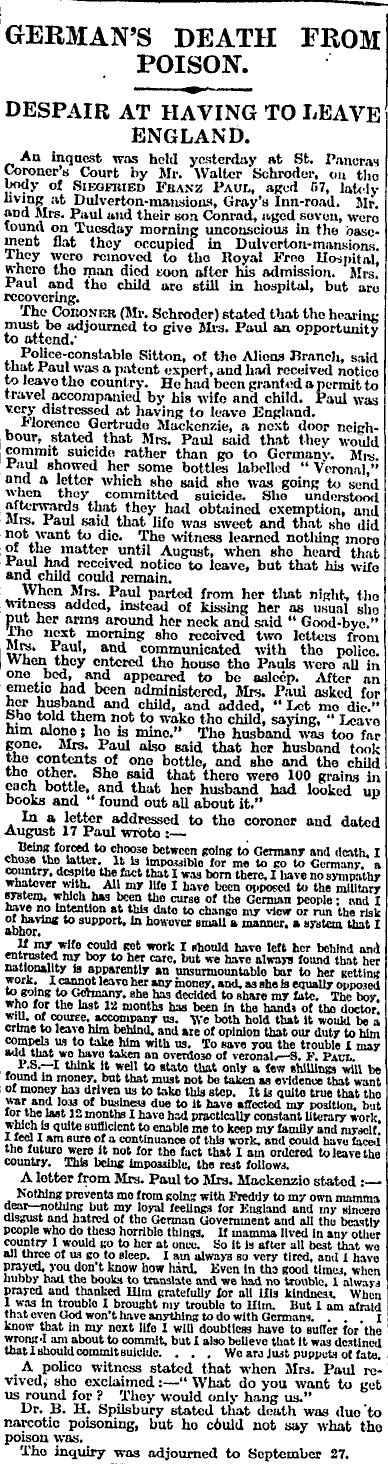
I give you two examples from 1917.
Exhibit A hoarding:
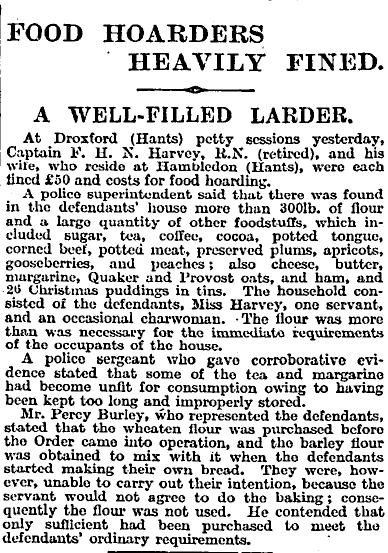 The Times, 1 September 1917 p3
And now for the grim tale of Exhibit B (from The Times 8 September 1917 p3). To cut a long story short: a German gets served with a deportation order, doesn’t want to go and commits suicide instead. Oh, and he tries and fails to take his family with him. The suicide note is heartbreaking.
In the First World War, the British state started off weak and only acquired greater powers on a case by case basis.
In the Second World War, the British state was much more comprehensive and consistent. As a consequence neither of these two outrages would have happened. There would have been no hoarding because the ration system would have made it more or less impossible and there was no deportation because all German citizens were interned.
I would much rather this wasn’t the case.
On the idle hill of summer,
Sleepy with the flow of streams,
Far I hear the steady drummer
Drumming like a noise in dreams
A. E. Housman
Now, in 1917 you might not be able to hear the drums but you might – depending on the proximity between your ear and the ground – be able to hear the drumfire:
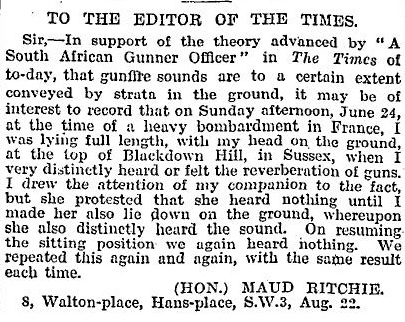 The Times 24 August 1917 p9. Right click for full article. Just in case you were wondering 24 June was in the “lull” between the Battle of Messines and the Third Battle of Ypres or Passchendaele as it is better known.
Things I know about Mother’s Day: correctly Mothering Sunday, early in the year, ancient celebration, all about being nice to mothers and appreciating their efforts.
Wrong.
Mother’s Day is not Mothering Sunday. Mothering Sunday is ancient. Mother’s Day is modern. And American. Mothering Sunday has nothing to do with mothers. Mother’s Day does. Mother’s Day only really came to be accepted (in Britain) in the 1950s when it got commercialised. Confusingly, the British have chosen to hold both celebrations on the same day.
The first modern (British) Mother’s Day was held on 8 August 1917.
I always had my doubts.
This kind of clotted nonsense could only be generally circulated and generally believed in England, where newspapers claiming to be conservative and reliable are the most utterly untrustworthy of any on earth. In apology for these newspapers it may be said that their untrustworthiness is not always due to intention, but more frequently to ignorance and prejudice.
– W. R. Hearst in a telegram to The Times printed on 2 November 1907. In it he denies ever using the words: “You provide the pictures and I will provide the war,”. Hat-tip W. Joseph Campbell Getting it wrong: ten of the greatest misreported stories in American journalism.
Yesterday I said the British police had hit rock bottom and started to drill. Last night they shipped in some dynamite:
– Tim Newman
The ADC is a fire-eater and longs for the fray.
– Douglas Haig, Diary entry for 20 July 1917 commenting on a meeting with American Commander-in-Chief Pershing and other members of his staff.
And the name of this fire-eating ADC?
George S. Patton.
Those with French-sounding first names:
Marcel Kittel
André Greipel
Simon Geschke
Emanuel Buchmann
Marcel Sieburg
Those with first names that could be either French or German:
Paul Martens
Christian Knees
Robert Wagner
Marcus Burghardt
Those with British-sounding first names:
Tony Martin
John Degenkolb
Rick Zabel
Those that don’t seem to fall into any of the above:
Nikias Arndt
Nils Politt
Jasha Sütterlin
Those with out-and-out, no-question-about-it, traditionally German first names:
Rüdiger Selig
Update: As of this afternoon both the Marcels are out. There is a lesson in there somewhere.
Finally, on both sides of the Atlantic our citizens are confronted by yet another danger; one firmly within our control. This danger is invisible to some but familiar to the Poles: the steady creep of government bureaucracy that drains the vitality and wealth of the people. The West became great not because of paperwork and regulations but because people were allowed to chase their dreams and pursue their destinies.
– Donald Trump speaking in Warsaw today.
Someone close to me died recently. Here are a few of the things I learnt:
-
Diagnosis is far worse than death.
-
Sort out your will. Also: sort out a lasting power of attorney, a potted biography, who is going to do the eulogy and what music, hymns and readings you want at your funeral.
-
Dying people like visitors.
-
You can’t be sad all the time.
-
Not everyone wants to die at home.
-
While this is not the occasion to indulge in NHS bashing, let us say it did not exactly cover itself in glory. Honourable exception: district nurses.
-
Downturns can happen very quickly.
-
It sounds obvious, but medical professionals have to be, well, professional. They cannot afford to get emotionally involved. This means that sometimes you don’t pick up on the gravity of the situation.
-
Pain control is not as simple as you might think.
-
Brace yourself when you hear the word “Midazolam”.
-
Most people don’t get a chance to utter dying words. And they’re probably not that profound anyway.
-
If death is swift, if there is time to talk, if caring is not a burden, if there was nothing anyone could have done, then you are lucky. You won’t think it of course.
-
A lot of the stress and exhaustion comes from not knowing what you’re doing. Give yourself a break. You’re probably doing much better than you think.
-
The dead look quite different from the living and the change takes place instantaneously.
-
If you can, try to close their eyes and mouth.
-
Some of you may be thinking that if someone is dying it would be a hoot to borrow their car and drive like a loon safe in the knowledge that the points would end up on their licence. This would be illegal. And very, very naughty.
-
When someone dies there is so much to do you don’t have time to grieve.
-
Everyone wants a death certificate. Everyone.
-
You can talk to the grieving but steer clear of jokes or flippancy.
-
Undertakers are useful. There is a lot that goes into a funeral.
-
I am glad I went to the Chapel of Rest. I have no idea why.
-
Pallbearers can be hard to find in England.
-
It’s the day after the funeral that really hurts.
-
Most of the deceased’s things will end up in the bin.
|
Who Are We? The Samizdata people are a bunch of sinister and heavily armed globalist illuminati who seek to infect the entire world with the values of personal liberty and several property. Amongst our many crimes is a sense of humour and the intermittent use of British spelling.
We are also a varied group made up of social individualists, classical liberals, whigs, libertarians, extropians, futurists, ‘Porcupines’, Karl Popper fetishists, recovering neo-conservatives, crazed Ayn Rand worshipers, over-caffeinated Virginia Postrel devotees, witty Frédéric Bastiat wannabes, cypherpunks, minarchists, kritarchists and wild-eyed anarcho-capitalists from Britain, North America, Australia and Europe.
|






Recent Comments