We are developing the social individualist meta-context for the future. From the very serious to the extremely frivolous... lets see what is on the mind of the Samizdata people.
Samizdata, derived from Samizdat /n. - a system of clandestine publication of banned literature in the USSR [Russ.,= self-publishing house]
|
Paypal stops handling payments for Tommy Robinson, reports the BBC.
As usual, I will defend the right of Paypal to exclude whomsoever it wishes. But I find something ominous about the fact that the company refuses to say exactly what Mr Robinson has done to violate its terms of use, and also about the fact that it seems likely that it has taken this step because a lot of people signed a petition telling it to:
Paypal has told former English Defence League leader Tommy Robinson it will no longer process payments on his behalf, the BBC understands.
The payments network is believed to have told Mr Robinson he had violated its terms and conditions.
It said Paypal could not be used to promote hate, violence or discrimination.
Online petitions calling on finance firms to sever links with him have gained thousands of signatures.
In a statement, Paypal said it could not comment on individual customers but added that it regularly reviewed accounts to ensure their use aligned with its acceptable use policy.
“PayPal connects buyers and sellers.” When it so chooses.
Which is as it should be. But if it makes enough choices like this one I can see the day coming when I might choose another payments provider.
It is traditional at this time of year to burn Guy Fawkes in effigy. My Catholic family never had a problem with doing that. Fawkes was a terrorist before the name was invented. But for variety’s sake, effigies of many public figures other than Fawkes have been put on the bonfire over the years. The town of Lewes is particularly known for its vigorous celebrations:
In 2001 effigies of Osama bin Laden were burned by the Cliffe, Commercial Square and Lewes Borough bonfire societies, causing the Lewes Bonfire to receive more press attention than usual, being featured on the front page of some national newspapers, as did the Firle Bonfire Society’s 2003 choice of a gypsy caravan. In 2014 police investigated complaints about plans to burn two effigies of Alex Salmond, the First Minister of Scotland, and one model was subsequently withdrawn from the event. In 2015 effigies of David Cameron with a pig, Jeremy Clarkson and Sepp Blatter were burned.
I don’t have much of a problem with that, either. All those mentioned chose to be public figures, apart from the pig.
However I do have a problem with the nasty jerks (nothing to do with Lewes) who made a cardboard model of Grenfell Tower, the building that burned down in June 2017, killing 72 people, and put that on their bonfire. To laugh and joke about innocent people dying in agony is despicable. The proper response is scorn.
The actual response in the UK of 2018 was to send Plod round to scoop up a load of “gaffer tape and white tags” in a clear plastic bag and carry it away for detailed forensic analysis. Given that the six “suspects” voluntarily handed themselves in, why it is deemed necessary to search for their fingerprints on discarded pieces of cardboard is not clear, unless it is intended to feature in the first episode of the long-promised CSI South Norwood.
“Grenfell fire: When does causing offence become a crime?” asks the BBC.
I don’t know, when does it? It wasn’t a crime when I was growing up. How odd to think in Lewes and elsewhere a tradition of burning public figures in effigy grew up and persisted in the centuries since 1605, despite rulers who were quite happy to chop off an ear or two as a punishment for seditious libel. Now we have the Human Rights Act and everything, but jerks get arrested for burning a cardboard model.
My guess is that the police know perfectly well that even in these days of declining freedom, this example of causing offence still does not qualify as a crime. The performance of evidence bags solemnly being carried away in front of the TV cameras as if they had discovered the lair of a serial killer was not as pointless as it might seem at first. The process was the punishment.
The first one is straightforward. The internet threw me a talk by the computer scientist and businessman Stephen Wolfram today. It lasts three minutes 21 seconds and is called “How humans can communicate with aliens”.The subject is one that has so often been used as the basis for fiction that we sometimes forget that when you look up at night, what you see is real. There is a whole universe out there. It might have intelligences in it. Mr Wolfram contends that we might have been seeing evidence of intelligences all the time without realising it.
Do you think he is right? And assuming we can talk to them, should we?
Alien contact sounds wonderful at first but then becomes terrifying as you think more deeply. The second topic for discussion I want to put forward sounds terrifying at first but then becomes –
Well, you tell me what it becomes. There is a very strange final paragraph to Mr Wolfram’s Wikipedia page:
Personal analytics
The significance data has on the products Wolfram creates transfers into his own life. He has an extensive log of personal analytics, including emails received and sent, keystrokes made, meetings and events attended, phone calls, even physical movement dating back to the 1980s. He has stated “[personal analytics] can give us a whole new dimension to experiencing our lives”.
One of my recurring nightmares is that as spy devices get smaller and the computational power available to analyse what they learn gets bigger, someone – or lots of someones – will be able to analyse my life in that sort of detail, down to every keystroke I make. It had never occurred to me to think of it as something I might like to do to myself.
Does anyone reading this do anything similar? Would you like to?
On November 2nd 2001, we started scribbling random thoughts on this blog. My goodness, how much the world has change since then, and us along with it.
The Remain die-hards are much excited by the news that the Leave donor Arron Banks faces a criminal inquiry over his financial support for the Brexit campaign. “MPs call for Brexit process to be paused as NCA investigates £2.9m spent by leave campaign”, says the strapline to that Guardian article, as if David Lammy calling for the Brexit process to be paused were a new development and not something he has been doing since 25 June 2016.
I do not always agree with Peter J North, but when that one was bowled in his direction he batted it away for six:
Remain cheated for decades
Arron Banks has been referred to the National Crime Agency in respect of his alleged dodgy financial dealings. I don’t care. I have never met the man, and exchanged few words, most of them derogatory. My decision to vote to leave the EU is based on a long standing democratic principle and I was never going to vote any other way.
This evening I tweeted “I think I speak for virtually all leavers when I say Tony Blair and John Major did a million times more to influence my #Brexit vote than Arron Banks or Vote Leave”. It has some 1200 likes so I think I am in the right ballpark here. Most had never heard of Arron Banks until the referendum. I certainly hadn’t and my perceptions of the EU have been forged over two decades.
and
From the outset the leave movement was up against the entirety of the establishment be it academic, industry bosses, the legal profession, the state broadcaster and the Westminster machine – all of whom have been plied with junkets, goodies and treasure over a number of decades to buy their loyalty to the EU. It has made many sectors of civil society hopelessly dependent on it and if we are talking about foreign interference in UK democracy then the EU of itself is a culprit and we don’t hear similar wailing about one George Soros who has almost single handedly bankrolled the legacy remain campaign.
It is actually painful to have to select paragraphs to quote, because I want them all. One more:
As much as Brexit is about ending the rule of Brussels it is as much a yank ion the leash of our politicians to remind them who is boss. We have corrected their mistake. They now warn us that if there is no deal then we see a cascade of failure and the termination of all of our foreign relations. This is because they and they alone put all of our external relations and regulatory constructs into a single treaty framework and handed over the keys to Brussels. They are the ones who created that vulnerability in the belief that it would be irreversible just so long as they continued to deny us a say.
Madeline Grant of the Institute of Economic Affairs has a guest spot in the Times. Presumably when they invited her they had an inkling of what sort of guest she would be. You really ought to buy a copy of the Times or electronic equivalent to read the whole article, but I hope that the following excerpts will give the general picture. She is metaphorically sitting with her boots on the coffee table, fag in one hand, her host’s vintage port in the other, keeping the party both appalled and entertained:
Let’s stop kidding ourselves about the NHS
… our public services are on track to become a Leviathan health provider, with only a few other minor functions attached. You might argue that this cycle of increased spending simply reflects Britain’s ageing population, but it hides some growing dangers.
Voltaire quipped in the 18th century that “where some states possess an army, the Prussian Army possesses a state”. Like Prussian military might, the NHS has embedded itself in our national psyche, consistently topping opinion polls of Britain’s best-loved institutions. Its cult status is spread on social media by people sharing personal tales and using hashtags such as #TheNHSsavedmylife, as if a publicly-funded service doing its job was somehow remarkable. Then there was the bizarre worship of the NHS at the 2012 London Olympics opening ceremony. Foreign visitors here, often with far superior health systems at home, regard our NHS mania with bemusement.
…
We could learn a lot from other countries. Australia offers free health cover for everyone but encourages citizens to top up these costs wherever possible. Most Australians are covered for all in-patient care and about three-quarters of GP care. The majority buy “top-up” insurance to meet the shortfall, while the state subsidises insurance premiums. Though public spending on health accounts for 9.3 per cent of Australian GDP compared to Britain’s 9.8 per cent, it outperforms us on almost every measure, including, most importantly, patient outcomes.
Sadly, given our worship of the NHS, it will be politically difficult to incorporate cost-sharing elements. But let’s at least admit that our centralised model is an international outlier and not, as is often claimed, the “envy of the world”. Even in Sweden, which the left regards as a socialist Valhalla, personal spending accounts for 16 per cent of total health expenditure, compared with 9 per cent in Britain.
Increased funding for the NHS must go hand in hand with reform of a system which favours bureaucrats over frontline staff. Despite a growing shortage of nurses, the number of managers on the payroll had risen by almost a quarter in four years. Our health service lags behind others in the uptake of new technologies — a report last year revealed it was “the world’s largest purchaser of fax machines”.
There are facts and figures a-plenty in the article, but long after they are forgotten I will remember that line about the fax machines. Sometimes a single dramatic example that encapsulates an issue can do more to change opinion than a page of statistics.
Niels Högel: German ex-nurse admits killing 100 patients
A hundred victims, and it is not even the BBC’s top story.
Towards the end of the last century I visited a very nice elderly couple, the husband of whom was a retired doctor. I noticed a flyer or newsletter sitting on their kitchen table with a heading something like “Doctors against gun violence”. At that time Dr Harold Shipman had fairly recently been arrested and the sheer number of his victims – more than two hundred – was beginning to emerge. I could not help thinking that, given that the number of people Shipman had killed by medical means exceeded by a great margin the death toll of the two largest shooting mass murders that had then occurred in the UK, Dunblane and Hungerford, maybe there was scope for a rival pamphlet called “Gun owners against medical violence”. The thought remained unspoken, of course, and a good thing too. I was not usually so flippant about mass murder even in thought: after the Dunblane massacre of primary schoolchildren I had thought about Thomas Hamilton’s victims almost every day for two years or more. Shipman’s victims did not haunt me to nearly the same extent. The same seems true of the general public. No doubt much of that was because Shipman killed the old not the young. It is not that people do not care about elderly victims, but the instinct to protect children and thus to consider the murder of a child the worst of crimes is bred in the bone. But that does not entirely explain it. Another British medical serial killer, the nurse Beverley Allitt, did target babies and children, by giving them overdoses of insulin and potassium. She murdered four children between the ages of seven weeks and eleven years and attempted to murder several others. One of those she failed to kill, Katie Phillips, was left permanently brain damaged by her attentions. This was after Katie’s twin sister Becky had already been murdered by Allitt. Yet her deeds seem almost forgotten now.
Maybe it is time for that long unspoken thought to get an airing, and for better reasons than to keep score in competitive shroud-waving. I have come away from Wikipedia shocked at how many such“angels of death” there have been, how long they have got away with it, and how high their number of victims has been. Almost more chilling than the death counts is their uncertainty: Donald Harvey, United States, 57-87. Arnfinn Nesset, Norway, 27-138+. Charles Cullen, United States 35-400+. There are plenty more on that list. And it can be practically certain that there are yet more who appear on no list, because they are still killing now.
The football commenter and distinguished former player and manager Glenn Hoddle suffered a heart attack two days ago while at a London TV studio. His life was saved by a sound engineer who knew how to use a defibrillator, though he remains in a serious condition. I wish him well.
I do not follow football, but those who do might enjoy the appreciation of Hoddle’s career written for the Times by its sports writer Matthew Syed, “Glenn Hoddle a visionary whose face did not fit in muscular English game”:
Ray Clemence, the goalkeeper, would pass out to Steve Perryman, who would feed Hoddle. A glance up, and then the ball was off, curving into the path of the wide players, the move already in full swing. As Hoddle advanced up the pitch, he was like a grandmaster in lilywhite, seeing four moves ahead, making passes into space, and daring his team-mates to think differently.
Hoddle’s different way of thinking extended to matters other than football. Syed relates,
His managerial career for England ended in acrimony after he expressed controversial religious views. I felt then, and still feel, that he was treated abominably.
…
Hoddle’s reported view that disabled people are paying the price for sins in a previous life struck me as no less ridiculous or offensive than the theology I had been surrounded by as a youngster at church. The difference was that his views were unconventionally whacky, which is why he was not granted the latitude that would undoubtedly have been offered a Christian or Muslim. Tony Blair, whose religious views are as off the wall as anybody’s, called for him to resign. Hoddle said that his beliefs had been misrepresented, but by that stage, it hardly mattered. By the time he was sacked, it had become a witch-hunt.
Mr Syed’s views about religion are not mine, but when it comes to the unfairness of a man being hounded out of his job for religious beliefs unrelated to that job, and the double unfairness of the Prime Minister joining the mob, we are at one. (Blair’s bad example was followed by Cameron who also disgraced his office by denouncing a private citizen who had broken no law.) The links are all dead in the blogpost I wrote in 2004 in response to an article by Simon Barnes that placed Hoddle in the same bracket as the then head coach of the Spanish football team who had made racist remarks, but my opinion has not changed:
But there was one part of his [Simon Barnes’s] article that I thought was unfair. I quote:
“Glenn Hoddle was dismissed as England coach because he said things about the disabled that provoked a heart-felt reaction across the country. The head of the England football team just can’t go around saying things like that.”
No, he can’t. And that has the unfortunate consequence, particularly for those who oppose racism as Simon Barnes does, that until things change we can never have a Hindu coach for our football team. Hoddle’s belief in reincarnation and that misfortune in this life is the result of bad behaviour in past lives may be unusual for a white Briton but is orthodox for thousands of Britons of the Hindu religion. I have no doubt that Hoddle’s sacking had a chilling effect on Hindus striving for public eminence in all sorts of fields, not limited to sport.
and
I wish more prominent British Hindus had spoken out about this at the time of Hoddle’s exit – but I find it hard to blame them for their silence, given that it had just been demonstrated that people with their beliefs could be sacked for them to popular acclaim.
A week or so ago I went to see The First Man at the cinema. At first it seemed to do a good job of turning historical figures into real people. The domestic lives of the astronauts contrasted with the bravery of their test flights. There were lots of scenes of worried housewives which seemed believable enough. Armstrong is portrayed as a serious engineer with good attention to detail. He makes some mistakes which his bosses put down to being distracted by his daughter’s ill health. After she dies, Armstrong is understandably never truly happy. He does not express his emotions, and tells one friend who tries to talk to him, “if I wanted to talk to someone, do you think I would be standing out here [away from everyone]?” I like that line: I have felt like that at times.
When the Gemini 8 flight has problems, his wife hears about it and she goes to complain that her audio feed has been switched off to protect her from hearing about what is going on. Don’t worry, she is told, we have everything under control. No you don’t, she retorts, “you’re a bunch of boys playing with balsa wood models.” There is a certain truth to that line which I enjoyed: it is hard to have complete understanding of a complex enough system, and there is a certain playfulness to engineering.
There is a montage about protestors complaining about the cost of the Apollo program and listing better ways of spending tax dollars such as by helping poor people. We see Gil Scott-Heron on stage reading his poem Whitey On The Moon. It made sense to portray these things in the movie.
A lot of Armstrong’s colleagues are killed. The Apollo 1 cockpit testing scene is hard to watch if you know what is coming. A lot of the movie is spent with Armstrong taking the deaths hard. There are a lot of funeral scenes. There is a scene where Armstrong’s wife makes him explain to his kids that he might not survive Apollo 13.
They fly to the moon. I have a big criticism of the cinematography: I am sure spacecraft do not vibrate that much. There must be other ways to portray speed and acceleration. They fly home. Once home, Armstrong’s wife visits him in quarantine. He seems sullen. She seems sullen. The End.
And then it hit me: no-one is happy about going to the moon. There is no pride, no sense of achievement, no celebration of the accomplishment whatever. All we learn is that we are doing it to beat the Soviets, it costs a lot of money, there is a huge human cost, people worry and suffer, relationships are strained. This is a joyless movie. It portrays no up-side. The closest we get to any kind of positive commentary on the Apollo project is when Armstrong first applies for the job. The superiors ask why he wants to go to the moon and he answers with a speech about mankind’s need to explore. The superiors seem skeptical, but pleased: the message is that this guy can be trusted to say the right things. Being happy about going to the moon is for the stupid masses.
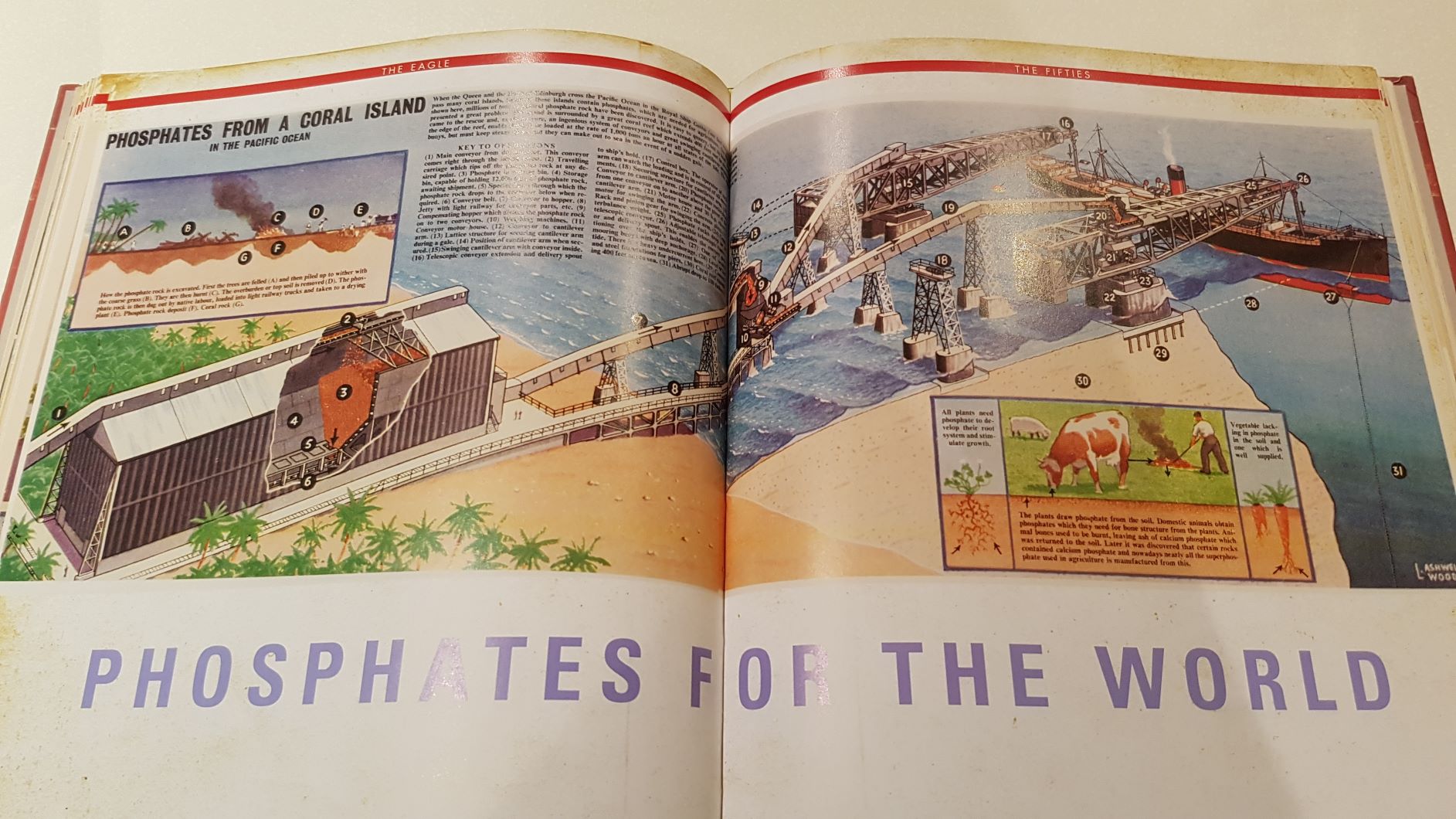
On my bookshelf I have a couple of anthologies of the Eagle comic from the 50s and 60s.
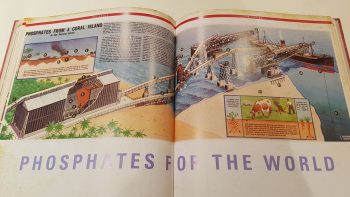 Phosphates for The World They feature cutaway drawings explaining wonders of technology, present and future, all of it wonderfully unapologetic. We are doing awesome things and we will do even more awesome things soon, kids are told. Today’s teenagers are bombarded with worry and pessimism. BBC Focus magazine is a science magazine that seems to be aimed at young audience and it features an article about climate change and how having children is bad. The Week Junior seems to be full of articles about endangered animals and banning plastic. If I did not know that most of the terrible problems are not terrible problems and that the world is in general getting better, I might be a bit despondent about all that. If I was an impressionable youth I might rebel against it; I hope they do.
Guido Fawkes reports:
ECHR: Defaming Muhammad beyond “Permissible limits” of “objective debate”
and comments,
The Austrian court found that “by making the statements the applicant had suggested that Muhammad was not a worthy subject of worship”. The ECHR has now agreed that this is a crime which trumps a person’s right to free speech. On the same day that Ireland is finally voting to take blasphemy laws out of its constitution, the ECHR seems determined to put them back in…
Calling all Samizdata-reading lawyers! Is this as bad for free speech as it sounds, or are there complicating factors? How specific to Austria is it?
Note that the ECHR (European Court of Human Rights) is not the “supreme court of the EU”, that would be the European Court of Justice (ECJ). We will probably stay in the ECHR when we leave the EU.
Finally, what’s with “… he was not a worthy subject of worship”? Muslims strenuously deny that they worship Muhammad; worship is for God alone. At first I thought this might be a sloppy paraphrase by Guido, but those very words do appear several times in the original judgement.
Twitter urged to bring in ‘Verified Scottish’ status
A Scottish member of the European parliament has warned that fake Scots are taking to twitter and spreading fake news.
It is unclear what led natz MEP Alyn Smith to this appalling discovery. Some suggest he first became suspicious when he realised that tweets from an Aberdeenshire businessman named Donald were in fact coming from an IP address in Washington D.C. Others speculate that his scepticism was naturally aroused when an allegedly-Scottish comic expressed more liking for the English than for the natz, which Alyn found neither Scottish nor comical. Surely it cannot be that the very disciplined natz party suspects its former leader of having too close an association with a source of twitter bots?
Whatever it was alerted him to the problem, he knows the solution:
Alyn Smith urges Twitter to bring in ‘Verified Scottish’ status.
I hate to break it to my fellow Scot, but I’m not sure Jack Dorsey is going to be too interested in this. I’m also not sure how Jack would decide who is Scottish and who is not. Scots have a great love of their country from a distance: by one definition, there are said to be 5 or 6 times as many Scots around the world as there are in Scotland. Conversely, there are English people in Scotland, some of whom immigrated from south of the Tweed quite recently. Other recent immigrants come from a greater distance – the middle east, for example. Might Twitter think it wrong to withhold Scottishness from any who claim it? And how would they assess Alyn himself, who often tweets from Strasburg or Brussels?
I suppose Twitter could always apply the reasoning they appear to use in the US, but Mr Smith had better hope it gets adapted for the Scottish domain. The algorithm “Tweet account likes English – treat it as a bot” would no doubt suit him, but an automated “Tweet account likes ‘Donald’ – treat it as a bot” might rate some of his natz colleagues as ‘fake’ – and be all the more accurate for it. 🙂
(A description of the No True Scotsman fallacy is here.)
From Don Boudreaux on his blog Cafe Hayek:
A protectionist is someone who believes that we humans reside in near-paradise.
As the protectionist views reality – and assuming that he believes all that he says and understands its implications – the only thing that is scarce in this near-paradise of ours are opportunities to toil and struggle. Everything else – each and every good and service that is and could ever possibly be desired by humans – is so abundant that our only challenge is to find work.
For the protectionist, complete and unalloyed paradise is Robinson Crusoe being stranded alone on a desert island with virtually no material possessions. If the protectionist were consistent, he would voluntarily strand himself in such utter isolation not only from his fellow human beings but from any goods and services other than those that he himself produces with his own hands.
The protectionist cannot understand why Robinson Crusoe might have wanted to be rescued from his desert island.
|
Who Are We? The Samizdata people are a bunch of sinister and heavily armed globalist illuminati who seek to infect the entire world with the values of personal liberty and several property. Amongst our many crimes is a sense of humour and the intermittent use of British spelling.
We are also a varied group made up of social individualists, classical liberals, whigs, libertarians, extropians, futurists, ‘Porcupines’, Karl Popper fetishists, recovering neo-conservatives, crazed Ayn Rand worshipers, over-caffeinated Virginia Postrel devotees, witty Frédéric Bastiat wannabes, cypherpunks, minarchists, kritarchists and wild-eyed anarcho-capitalists from Britain, North America, Australia and Europe.
|





Recent Comments