We are developing the social individualist meta-context for the future. From the very serious to the extremely frivolous... lets see what is on the mind of the Samizdata people.
Samizdata, derived from Samizdat /n. - a system of clandestine publication of banned literature in the USSR [Russ.,= self-publishing house]
Labour is now described as having an antisemitism problem. But those who talk like this are neglecting the fact that for many Corbynites antisemitism accomplishes something very important. It helps to drive out of the Labour Party all of those Labour supporters who think that the badness of antisemitism ought to be publicly talked about, instead of these Labourites silently or vocally caving in, for now, to the Corbynite project. And that, as far as the Corbynites are concerned, is a feature rather than a bug.
We can see this process described in this piece, by “New Labour” (i.e. the kind of Labour that the Corbynites are determined utterly to destroy) Prime Minister Tony Blair’s senior shouter-down-the-phone, Alastair Campbell:
In a speech to centre-left campaign group Progress, Mr Campbell said: “All my life I have been tribally Labour. But my Labour tribalism is being pushed to the limit – by the return of Militant style nastiness in local politics; by my revulsion that any anti-Semitism has been allowed to fester; by the feeling that some in the leadership, and their supporters, feel much greater animus against other Labour supporters than against Tories.”
Campbell is right. The Corbynites do indeed hate Campbell and his ilk far more than they hate the Conservatives. The Conservatives, by allowing themselves to be lead by people like Theresa May, are bringing the day of glorious socialist triumph ever closer. Campbell and his sort are a far more immediate threat to Corbynism. So if antisemitism serves to cure Alastair Campbell of his tribal love of Labour, … good for antisemitism.
As of now, the Corbynites are far more interested in establishing themselves in unchallengeable command of the Labour Party than they are in merely winning elections. Their thinking is that, sooner or later, capitalism will be hit by another crisis, and that at that point they’ll win a general election, and then the question will be: will there be any New Labour Alastair Campbell type bastards around to prevent them from turning Britain into Venezuela or worse? Meanwhile, they can agitate, do local activism, recruit the right sort of unswervingly loyal cadres, on the internet and in real life, and generally speed up the arrival of that crisis of capitalism and be ready for it. Having helped to bring about their crisis of capitalism, they can then blame capitalism for it and sweep to power.
At some point during all this, Corbyn will step aside and be replaced by a younger, better dressed and better shaved personage, more emollient, more “centrist” in tone, in appearance more like Alastair Campbell. Britain as a whole will be fooled. That “crisis” general election will be duly won, and then the “project” can really begin. And an essential part of that process is clearing out backsliding scum like Alastair Campbell, who, if they hang about and continue to attend Labour events, might blow the gaff in time to stop all this. At the very least such persons will be an unwanted nuisance.
Personally, I think that this is all a very long shot. But I wish it was a whole lot longer than it is.
The other thing to be said about antisemitism is that eradicating it from the Corbynite clan will be impossible. The Corbynites may, any year now, once all the Blairites are flushed out or permanently silenced, tone it down in public, once that besuited and beshaven person steps forward. But they will still all be antisemites.
Peers’ Section 40 amendments to the bill, which would see publishers pay both sides’ legal costs in data protection disputes, win or lose, have been slammed by many publishers as “anti-press”.
Guardian News and Media has said it has written to all MPs making clear that it disagrees with “attempts to impose a selective sanction on the media” ahead of a Commons vote later today.
MPs will vote on an amendment, tabled by deputy Labour leader Tom Watson, this afternoon.
As it stands, news organisations signed up to a state-sponsored regulator – currently only Impress – would avoid the cost penalties.
You did read that right. Tom Watson’s amendment to Section 40 would have meant that newspapers refusing to join Max Moseley’s pet* regulator Impress would have been liable for costs when sued for libel even if they won the case. In recent years the Guardian has not often lived up to its name. But I am glad to note that even they balked at such blatant perversion of the justice system.
In the event Watson declined to put his amendment to a vote, and Ed Miliband’s less shameless but still repressive amendment regarding a second Leveson enquiry into press regulation was defeated.
Perhaps that’s the end of it, perhaps not. This monster has been apparently killed before but did not stay dead. I do not know what stage of the horror movie we are at.
I saw a fascinating letter in the Continental Telegraph to Agatha Antigone asking for advice. There is something about it that makes me strongly suspect I know who the man of wealth and taste seeking wise counsel is… any ideas? 🤣😂😜
No, no, not eating Irish children, this is 2018 (not that I have anything against grass-fed Irish children), but rather a modest proposal to ensure national unity:
As the Guardian says, we really should change Bank Holidays – Crecy, Agincourt, Trafalgar?
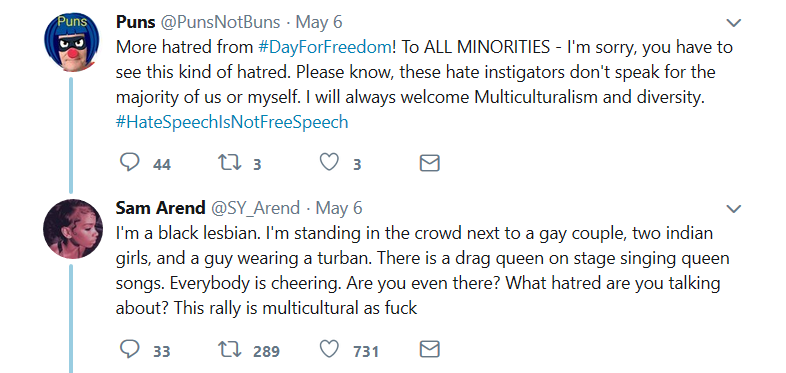
I found this interesting, just a mere twitter exchange relating to the Day of Freedom rally that you will never see the BBC say much (or indeed anything I suspect) about.
I am increasingly willing to accept almost anyone on the correct side of this as an ally, and if the Guardian wants to tar anyone who supports free speech as ‘far right’, well who cares? It turns out that support for free speech is in fact ‘multicultural as fuck’.
I wanted to support the Daniel Hannan classical liberal faction within the Party as it (I hoped) took control.
I have been disappointed so far. The nature of the beast is still just as I remembered it and Teresa May – possessor of a second-rate mind untroubled by principle – is its archetype. I was a Conservative Party counting agent at my local authority elections this week and spent a few hours in the dejected company of candidates and volunteers in a solidly Labour London Borough. My impression was of a Party that sees Labour as the engine and itself as the brakes. Or perhaps more kindly Labour as the arsonists and itself as the Fire Brigade. No Marxist ever subscribed so thoroughly to his doctrine of “historical inevitability” as these people. A consumer regulator might usefully force both parties to change their names to the “Let’s Fuck it Up” and the “Let’s Fuck it Up More Slowly” Parties. The only encouragement I took from the evening was when I wandered off and mooched around the Labourites. My God, what an unappealing bunch they are, at least in London.
There has been, as we know, much fuss over how Russian Twitter ‘bots backed both Brexit and Donald Trump. This is an interference with our democracy which just cannot be lived with, something must be done. You know, regulate Twitter so that nothing so appalling as anyone ever using it to support non-progressive causes can ever happen again. That not being quite how free speech nor freedom of the press is supposed to work of course.
Expect some of this to die down a little now that we know that those same Twitter ‘bots – from Russia, you know – backed Jeremy Corbyn at the last General Election.
A retired GP accused by a “serial fantastist” of being part of a paedophile ring was told yesterday he would not be reimbursed for £94,000 in legal costs he incurred before the case collapsed.
Stephen Glascoe, from Cardiff, spent most of his savings preparing his defence. The woman who made unproven allegations against him and others has won £22,000 in “criminal injuries” compensation and has asked for more.
Several cases have collapsed in recent months after the Crown Prosecution Service ordered a review of evidence in all serious sexual offence allegations.
Charges against Dr Glascoe and four other men were dropped in January, two weeks before their trial was due to start, after concerns about the alleged victim’s evidence and her relationship with her therapist and the police officer who had led the investigation.
Dr Glascoe, 67, who was not entitled to legal aid because of his savings, spent more than £100,000 on lawyers and expert witnesses. He will receive only £7,280 from the Legal Aid Board and no contribution to the cost of his barrister.
The complainant received £22,000 from the Criminal Injuries Compensation Authority after contacting South Wales police in 2012 but later refused to co-operate with the investigation.
She spoke to police again in 2016 with more allegations about being abused at parties between the ages of three and 15. She said she had a pregnancy forcibly aborted and had been made to take part in torturing other children. She has applied for more compensation.
Christopher Clee, QC, applied at Cardiff crown court yesterday for Dr Glascoe to have all his costs reimbursed on the ground that the charges were the result of an “improper act or omission” by the prosecution. The prosecution should have been alerted, he said, to the poor credibility of the alleged victim by notes from 229 counselling sessions, which included “regression work”, and her improperly close relationship with the investigating detective.
Mr Clee said the notes made clear that the therapist “had exceeded any professional boundaries” and given the woman the idea that she had been raped by five men. Prosecutors had demanded to see the therapy notes before deciding whether to charge, but a senior police officer urged them to take a “victim-centric position”, he said.
Catherine Richards, for the prosecution, said the case was dropped over “considerable concern” about the detective, and because a jury might consider that there had been a “mirror of the undue influence” by the alleged victim on the officer and her therapist.
Judge Thomas Crowther attributed the collapse of the case to “dynamite” evidence that the complainant had lied about an Amazon package she claimed had been ordered by her abusers.
The judge dismissed the application for Dr Glascoe’s costs, saying he would have to prove that no reasonable prosecutor could have decided to bring charges. The decision had been “in line with enlightened modern practice”, he said.
It was certainly in line with modern justice as practised by the Enlightened.
A woman has told how she shot at a machete-wielding intruder with a CROSSBOW when a gang burst into her home and attacked her family.
Anji Rhys, 49, said she sprang into action when masked raiders kicked down her door in Dunstable, Bedfordshire, after apparently mistaking it for a drugs den.
Ex-Thai boxer Anji, who is reportedly a grandmother, grabbed her crossbow, which she dubs Manstopper, and shot one thug during the horrifying ordeal.
Anji keeps the bow on a wall inside the house to protect her family which include her partner Rebecca, son Dillon and elderly mum Lilian.
The so-called survivalist, who possesses an arsenal of weapons inside her home, was reportedly watching TV when the yobs entered her home and pinned down her son.
Don’t get me wrong, I am happy to read that this lady was able to protect herself and her family. But I am mystified by the supportive tone of the Mirror reporter, and of most of the comments, when exactly the same sequence of events but involving a gun-wielding grandma in the US instead of a crossbow-wielding one in the UK would have been dismissed as NRA propaganda and further evidence of the lunacy and barbarism of Americans in their “love affair with the gun”.
And if you like the idea that a comedian convicted a making a joke in bad taste and fined £800 by a Scottish court could end up making a tidy profit, you might want to drop your mouse on this link and send him some money. I did 😀
Help Markus stop a truly terrible precedent being set and help fund the appeal. If there is any money left over, he promises to invade the Sudetenland.
A teenager who posted rap lyrics which included racist language on Instagram has been found guilty of sending a grossly offensive message.
Chelsea Russell, 19, from Liverpool posted the lyric from Snap Dogg’s I’m Trippin’ to pay tribute to a boy who died in a road crash, a court heard.
Russell argued it was not offensive, but was handed a community order.
Prosecutors said her sentence was increased from a fine to a community order “as it was a hate crime”.
She was charged after Merseyside Police were anonymously sent a screenshot of her update.
Liverpool Justice Centre, sitting at Sefton Magistrates’ Court, heard Russell posted the lyrics to her account after the death of a 13-year-old in a road accident in 2017, the Crown Prosecution Service said.
The words Russell used on her account contained a racial label which some people find extremely offensive.
The screenshot was passed to hate crime unit PC Dominique Walker, who told the court the term was “grossly offensive” to her as a black woman and to the general community.
As in the Count Dankula case, all it takes is one member of the approved victim class to turn up in court and say they were offended. The fact that in this case the approved victim is also an approved witchfinder makes everything more convenient.
The Liverpool Echo reported that Russell’s defence had argued the usage of the word had changed over time and it had been used by superstar rapper Jay-Z “in front of thousands of people at the Glastonbury Festival”.
Prosecutor Angela Conlan said Russell’s defence also argued her profile “wasn’t public”, but it had been proved in court that anyone could access it and “see the offensive language”.
She said prosecutors also “sourced case law that showed that posting the profile on her account constituted sending it and making it public”.
Russell was found guilty of sending a grossly offensive message by a public communication.
She was given an eight-week community order, placed on an eight-week curfew and told to pay costs of £500 and an £85 victim surcharge.
Well, yesterday’s actually. Or the last century’s, or maybe the century before that. Meh, who cares; with these guys everything old is new again but not in a good way. Here is your helping of reheated Grauniad porridge from someone called Rhik Samadder:
The Samizdata people are a bunch of sinister and heavily armed globalist illuminati who seek to infect the entire world with the values of personal liberty and several property. Amongst our many crimes is a sense of humour and the intermittent use of British spelling.
We are also a varied group made up of social individualists, classical liberals, whigs, libertarians, extropians, futurists, ‘Porcupines’, Karl Popper fetishists, recovering neo-conservatives, crazed Ayn Rand worshipers, over-caffeinated Virginia Postrel devotees, witty Frédéric Bastiat wannabes, cypherpunks, minarchists, kritarchists and wild-eyed anarcho-capitalists from Britain, North America, Australia and Europe.
All content on this website (including text, photographs, audio files, and any other original works), unless otherwise noted, is licensed under a Creative Commons License. Powered by WordPress & Atahualpa





Recent Comments