Brian Micklethwait departed this world earlier today, leaving the samizdatistas poorer for his absence but richer for his lifetime dedication to the cause of liberty.
|
|||||
October 2nd, 2021 | 33 comments - (Comments are closed)
 “China is serious about building a cleaner, fairer, and sustainable society.” As you know, I get press releases, and this one, from the Swiss private bank and investment manager, Vontobel, was too good not to let go without sharing. Further comment from me is superfluous. Reading that comment, considering how the CCP operates and what it does, has left me dumbstruck. September 27th, 2021 | 15 comments - (Comments are closed)
Michael Rectenwald has written a very interesting essay Living in the Age of Covid: “The Power of the Powerless” that raises many very alarming parallels, musing on the original essay by Václav Havel The Power of the Powerless.
Read the whole thing. August 21st, 2021 | 38 comments - (Comments are closed)
I didn’t look too closely when in 2015 a Conservative administration proposed changing the law on gender recognition. A few trans people want more easily to get official confirmation for the new gender they have become? Well, I thought, that’s probably OK. No skin off any part of me. Then the issue appeared to morph into a different kind of conflict. It had clearly somewhere along the line become impermissible for those who thought that there was something ineluctable about biological sex to say so. It wasn’t whether they were correct or mistaken on the subject that was in question, but their right even to express their view. A recognisably totalitarian declension seemed to be being imposed: if you said biological sex was real then you argued with the ability of someone who felt they should be the other sex to simply assert that uncontested. That meant you were denying their “existence” as the new sex. Which was tantamount to denying their existence as a human being. Which was close to saying you wanted them and everyone like them dead. Which is the kind of thing the Nazis did. So you’re a Nazi. And we can’t let Nazis publish Nazi thoughts in books. Or speak at universities, or sully our public spaces with their terrible prejudice. Here I drew the line. I saw people I knew being bullied and harassed for having an opinion on biological sex (actually the majority opinion on biological sex), and even if I didn’t know whether I agreed with them, I knew that was wrong. … – David Aaronovitch in the Times (£), writing about this book by Helen Joyce, quoted by and commented upon by Mick Hartley (not £). July 17th, 2021 | 14 comments - (Comments are closed)
“The cliche goes that the UK is a former empire in search of a role. That is not strictly true. The NHS has become Britain’s all-consuming project, the millstone around its neck and the cloying source of confected national pride. Its hold over the country is so powerful that even a libertarian Conservative PM decided this week to risk sacrificing our ordinary freedom rather than dare to reform it.” – Sherelle Jacobs, Daily Telegraph, 13 July (£) My only quibble is the appellation “libertarian”, in this case. Mr Johnson’s libertarian views increasingly resemble entities of myth and legend, such as the Loch Ness Monster, Atlantis, or the 1966 English World Cup winning football team. July 13th, 2021 | 18 comments - (Comments are closed)
The future of the flying car is finally arriving, a flying car, the AirCar, has completed a test flight between two airports in Slovakia, reports the BBC. This wonderful development brought to us by Professor Stefan Klein (the article has a short video showing the car flying etc.) is not yet licensed to fly, and given the caution around aviation, such approval may be a long way off, but it is technically possible now, almost a century after the English Electric Wren which was seen as a rival to the emergent motor car. To think that within around 31 years, English Electric would build the Lightning is simply mind-boggling. However, this fantastic development runs on a petrol engine, has an airborne range of c. 1,000 km (625 miles) and can cruise at 170km/h (c.106 mph), at 8,200 feet (pressurisation not an option at the moment it seems). Imagine the liberty of flight, in your garage, the horror of unrestricted travel, no speed cameras, the Left’s (and the State’s) hatred of mobility and autonomy will shine like the fiery pits of Hell. Two passengers, provided that they don’t weigh more than 31 stone. Let physics limit your weight, not the government.
but there is obviously a cautionary note:
With a 600 mile range, a self-fly/drive break on the Continent would be a breeze. Short-haul aviation is pointless in such a world, as are inflexible trains (HS2 etc.), even car hire. Bring it on. June 30th, 2021 | 47 comments - (Comments are closed)
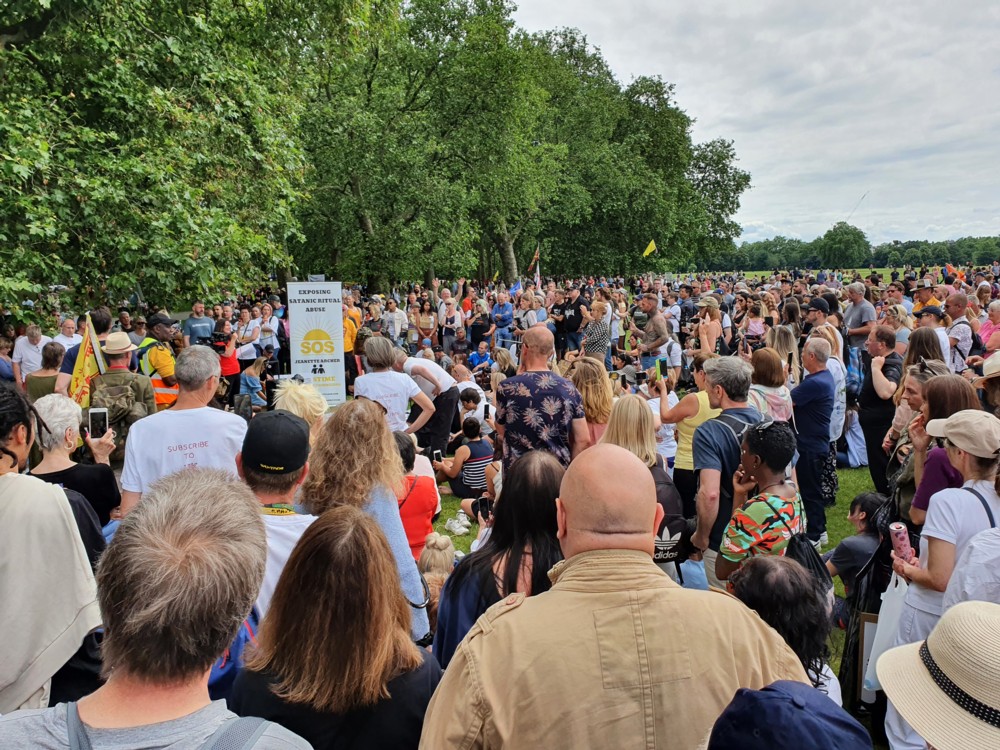
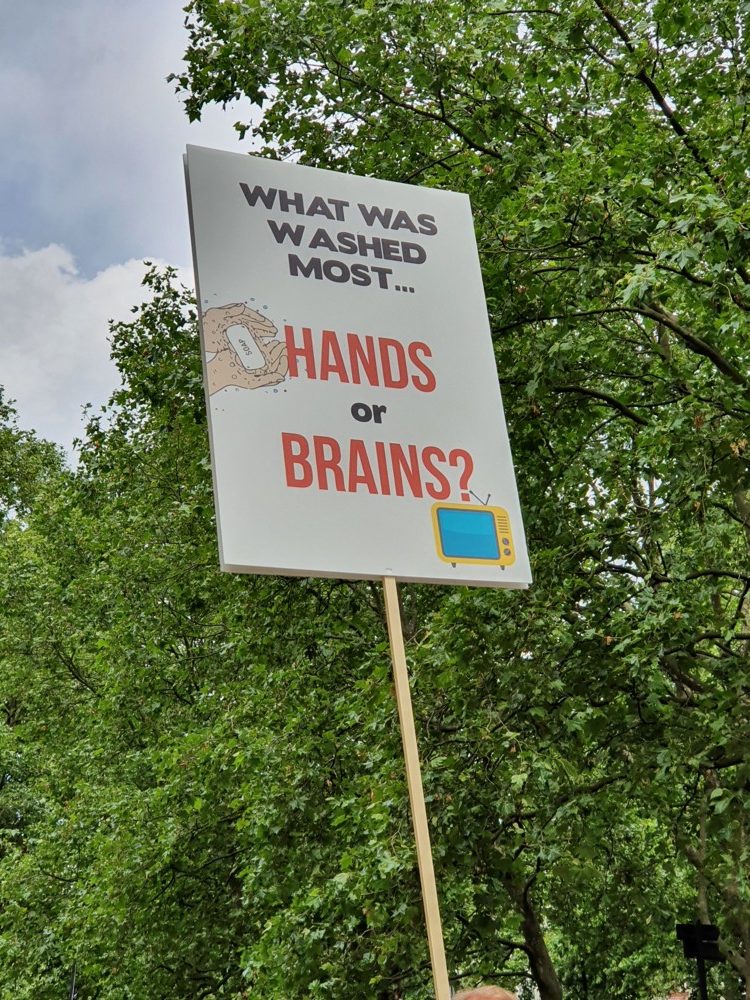
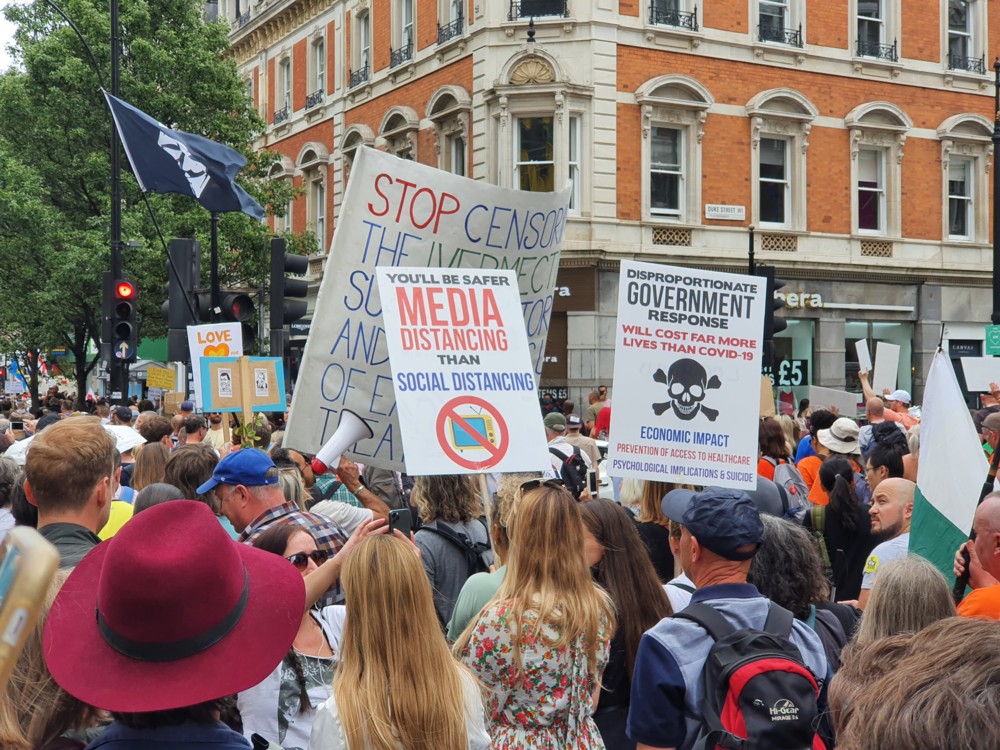
Last Saturday a mate of mine dropped by to see me, having just been at the Covid demo But look at these, and you’ll get the picture:
I have very mixed feelings about demos. When they work is when people generally are surprised by the demo, either because they didn’t know about the issue in question until now, or because they had no idea people felt so strongly about it, or because they didn’t think enough people had the guts to complain about it in public. None of this applied to this demo. There’s been a Lockdown, which many consider to have been pointless, a cure worse than the disease, and even if it did once serve a purpose it should end now. And, here are some of those grumblers, gathering in a crowd in London, with signs. I can see why some genuinely don’t think this is big news. Although, despite gloomy prophecies of a news black-out, it was small news. Another problem is that demos are awfully liable to put out mixed messages. It only needs a few off-message demonstrators to get in on the act, and the whole thing can be sabotaged. In this case, I recall some of the news coverage I caught saying that this was a demonstration against vaccines. Vaccines have been mostly very popular, are much touted now as one of the government’s few definite successes, and are in many anti-Lockdowner opinions a big reason why Lockdown should now stop, rather than part of it. There are no anti-vaccine signs to be seen in any of my mate’s photos, but a news team only needs one such to be bending the whole reporting of the event completely out of shape. Where demos, even of the most un-newsworthy sort, do have an impact is that those who attend them get to know each other and exchange ideas. I remember watching some Remain demos, long after Brexit had won the referendum, and even I think, after the voters had voted “Get Brexit Done” at the last general election, and thinking that this couldn’t change the decision, and I was right. These Remainers, only then, I now realise, were realising what they were about to lose. Until they finally lost, they thought they’d win. But these too-much-too-late demonstrators would, as I realised at the time, at least be influencing each other, forming networks and spreading ideas, and this might have consequences down the line. Perhaps one consequence will be a slight strengthening of any campaign in the future for Britain to rejoin the EU. I can’t see such a campaign succeeding, but if it gets its fangs into any major political party, it will surely damage that party, in the eyes of all those who voted Leave, and many more besides. “Move on.” “Get over it.” You can just hear the young besuited types trying to stop such talk, because they will surely know how it will damage the new arrangements that they are now busily contriving. In the case of this London demo last Saturday, there is surely at least the possibility that libertarian ideas may spread amongst the demonstrators, from all those who already think this way, to all those who didn’t, but may now be starting to. I, of course, want to believe this. I also wonder what other consequence this demo, and all the others like it up and down the country, may have. June 29th, 2021 | 17 comments - (Comments are closed)
In Britain there is overwhelming popular support for the legalisation of cannabis, yet because recreational drugs are illegal, our cities are being ravaged by criminal turf wars over drug distribution. Taking the products out of the hands of criminals and into regulated markets would not only end the bloodshed, it would end the unnecessary criminalisation of thousands of young people. Drug addiction would be treated as a medical, not judicial problem. The war on drugs has failed and will always fail because humans like to alter their mental state. Voters should be allowed to enjoy drugs safely … Ever since I attended Essex University in the early 1970s I have been of the the opinion that cannabis can have a very bad effect on some people. I watched it turn a few relatively normal people into excessively placid and “pacific” people who, if you then verbally pressurised them even quite mildly, but in a way they couldn’t handle, were liable to turn on you like cornered rats, in ways that were wildly excessive compared to any rudeness you had subjected them to. In short, cannabis drove them mad. In particular, paranoid. All sense of proportionality in how they defended themselves in a vigorous but basically friendly conversation went out the window. That’s what I think I then saw. And ever since then, I’ve heard further anecdotage that confirms that prejudice. Which does not mean that I favour cannabis being illegal, any more than I favour it being illegal to smoke, or to drink alcohol, or to borrow money unwisely, or to gamble, or to climb mountains, or to parachute out of airplanes, or to do anything dangerous merely because it is dangerous. Guido frames this as an argument about the right to do drugs safely. I prefer to think of it as the right to do unsafe things, to decide what risks you will take with your life, to make your own judgements about how to balance pleasure against danger. Insofar as Guido merely implies that dangerous things which you can only get from criminals are a hell of a lot more dangerous than if they are legal, I wholly agree. April 21st, 2021 | 45 comments - (Comments are closed)
It’s not just virtue that needs courage. Jokes can need a little courage too. On one of Prince Philip’s visits to Australia, a virtue-signalling politico decided he would be asked the same questions as any immigrant.
Witty remarks need wit – and timing (the worthlessness of ‘l’esprit d’escalier’ – that clever retort you think of whle descending the starcase after the party – has been proverbial for centuries). Humour cannot survive a too-timid inner censor (“Can I really say that? Dare I really say that?”) stealing the moment. I’m not just talking about the overt courage some jokes need. That can be very real of course. Christabel Bielenberg fell in love with a German in 1932 and married him in 1934.
In the very last days of WWII in Europe, she walked into the mayor’s office in the German community where she lived and noticed that the picture of Adolf Hitler was missing from the wall. Seeing her glance, the mayor explained he had put it in the fire the day before. Christabel thought of a joke about Adolf and his picture, automatically reminded herself not to say it out loud – and then realised with delight that for the first time in many years she could say it out loud, she no longer had to think first whether everyone present was ‘safe’. In the joke, Adolf muses to his picture, “I wonder what will happen to us after the war?” The picture replies, “I don’t wonder – I know: you’ll be hung and I’ll be unhung.” The mayor, like the vast majority of Germans, had never heard it – and till the day before would not have dared laugh at it. He spent the rest of the aftenoon suddenly guffawing and murmering, “hung – unhung”. Despite everything, the new freedom to laugh seems to have been a relief to him too. He – unlike Christabel but like too many Germans – had not had the courage to remain aware of his inner censor during the Nazi years; it had become part of him. It’s not just the comedian who needs a little courage. The audience can also use a little of it. Prince Philip once joked to a British student in China that if he stayed there too long he might acquire ‘slitty eyes’. Thinking people (people not too scared to think) know that a joke does not mean what it literally says (and that Prince Philip did not imagine that the facial features of other nationalities could be caught through proximity, like a disease). Imagine that, back in 1937, visiting a family funeral in Germany, he had told a British student there to beware staying too long lest his head become squarer. The alleged ‘squareheads’ of native Germans in the first half of the 20th century betokened the too ordered, too obedient, too constrained thoughts within them, as the alleged ‘slitty eyes’ of native Chinese in the second half betokened the deceitful propaganda of the CCP. It should not be hard to get the joke’s point – unless of course, the very idea of thinking about an ethnic slur before condemning it is too terrifying to contemplate. “Do not trust China. China is asshole.” as a chinaman in Hong Kong more recently put it. Orwell explained that putting the mind in a politically-correct box kills a writer’s creativity. Such cowardly conformity also hurts the sense of humour – the sense of humour. The courage to joke also helps if your position tends to make others nervous:
And facing your death with courage will often mean facing it with humour. When the brilliant Oxford mathematician Sir Michael Atiyah (not so long before his own death) told Prince Philip how sorry he was to hear he was standing down from official duties in late 2017, Prince Philip replied:
The freedom to make a joke. The freedom to take a joke. Freedoms worth tending in the garden of your mind. April 11th, 2021 | 29 comments - (Comments are closed)
On the evening of the 22nd March, visitors to the main UK politics subreddit, /r/ukpolitics found a mysterious message saying that the subreddit, which has nearly 400,000 members, had been set to “private” by its own volunteer moderators. It was the beginning of a cascade. The lights are going off all over Reddit! Subreddit after subreddit was set to private in sympathy with /r/ukpolitics. Most of them dealt with topics unrelated to politics. At its peak the wave of protest closures affected subreddits collectively having tens of millions of members all over the world. To understand why this protest against Reddit by its own users gained such traction, we need to go back to the 8th of March when the Spectator published an article by its unlikeliest new writer, the radical left wing “gender critical” feminist Julie Bindel, called “The Green party’s woman problem”. It contained the lines,
That brief reference to “the Aimee Challenor case” was to have dramatic consequences. A hyperlink on the word “case” linked in turn to this Independent article dated 13 January 2019: Having parted ways with the Greens, Aimee Challenor joined the Liberal Democrats. Once again her association with the party ended as a result of child safeguarding issues related to someone with whom she lived. This time it was her fiancé Nathaniel Knight. He claims his twitter account was hacked. A point to note: these events were widely reported. Given a prompt about a person who had left both the Greens and the Lib Dems under a cloud, anyone who follows UK political news would probably be able to dig up her name in half a dozen keystrokes. Getting back to the main story, at about quarter to eleven on the morning of the 23rd, the ukpolitics subreddit reappeared. It now carried the following announcement: March 26th, 2021 | 15 comments - (Comments are closed)
The converting-Libertarian-Alliance-pamphlets-to-HTML phase of the Brian Micklethwait Archive project continues. When I add something new, I also add a news update post about it. These usually briefly describe what the update is with, perhaps, a quote. Today’s update about How to Win the Libertarian Argument contains some of Brian’s most important and useful wisdom: how to spread libertarianism by arguing (and not necessarily by winning arguments). I could not choose which quote to use, so there are a lot of them. I’ll repost them here.
The article covers the importance of politeness:
…
And it covers how to sell your ideas:
It offers the sort of wisdom that people on Twitter could do with hearing:
…
And there are descriptions of the ways in which people change their minds.
…
Do keep an eye on the updates, or follow the Twitter feed if you are so minded. I have been managing about two per week so far. March 18th, 2021 | 10 comments - (Comments are closed)
|
|||||

All content on this website (including text, photographs, audio files, and any other original works), unless otherwise noted, is licensed under a Creative Commons License. |
|||||