We are developing the social individualist meta-context for the future. From the very serious to the extremely frivolous... lets see what is on the mind of the Samizdata people.
Samizdata, derived from Samizdat /n. - a system of clandestine publication of banned literature in the USSR [Russ.,= self-publishing house]
|
Thomas Piketty and a bunch of other Europeans have published “Our manifesto to save Europe from itself”.
Our proposals are based on the creation of a budget for democratisation that would be debated and voted on by a new, sovereign European assembly. This will at last enable Europe to equip itself with a public institution capable of dealing with crises in Europe immediately and of producing a set of fundamental public goods and services in the framework of a lasting and solidarity-based economy. The promise made at the treaty of Rome of “harmonisation of living and working conditions” will finally become meaningful.
Are you inspired yet?
“The U.K. is a European country, and always will be. Trade and contacts among the nations of Europe can and should continue much as before. And I have no doubt they will do so. But the political nature of the EU has changed since monetary union. The EU failed to recognize that the euro would demand fiscal and political integration if it was to succeed, and that countries outside the euro area would require a different kind of EU membership. It was inevitable, therefore, that, sooner or later, Britain would decide to withdraw from a political project in which it had little interest apart from the shared desire for free trade.”
– Mervyn King, former governor of the Bank of England. If you read his comments carefully, his displeasure at how the institution he led has become a plaything of Remainer propoganda is plain. His book, The End of Alchemy, contains a devastating take-down of the euro and is an explanation of why the UK had little alternative in the end but to leave. King was never quite of the full “establishment” – too much of the West Midlands grammar school boy to really be at ease in the EU corridors of power. Good.
The Guardian‘s Matthew d’Ancona is at least honest about his opinion of Brexit voters:
“Let’s be honest about what’s really driving Brexit: bigotry”.
“One of the main targets of (Bishop of Lincoln) Robert Grosseteste‘s (c. 1175 – 9 October 1253) criticism was the Papacy, which he believed was levying over-harsh taxation in England and appointing inappropriate men to benefices in the Church.”
Another quote:
“Those rascal Romans….. he hated like the poison of a serpent. He was wont to say that if he should commit the charge of souls to them, he should be acting like Satan. Wherefore he often threw down with contempt the letters sealed with the papal bulls and openly refused to listen to such commands.”
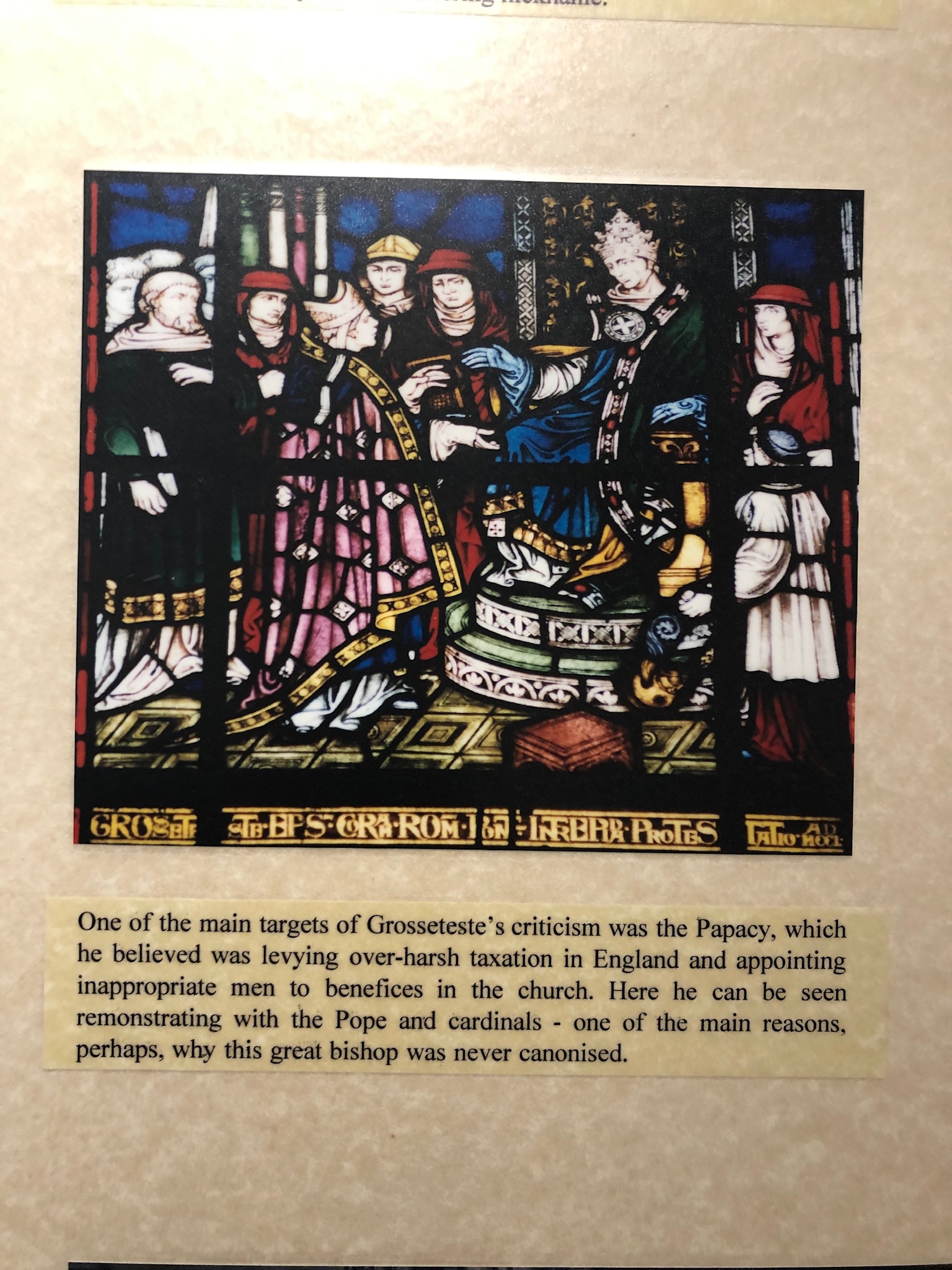
Thus say English Heritage of Bishop Grossteste (Big Head) of Lincoln, in a display in the former Bishop’s Palace in Lincoln. The Bishop was never canonised, perhaps because he was too holy. He was no fan of Rome, as English Heritage note, in their exhibition in his former palace.
A Protestant before the term was coined, and surely a model for our current political class in the light of current ‘difficulties’ from over the water.
“The idea that it is not possible to leave the EU seems to be the most dangerous affront to democracy. They are saying not only that it was wrong for the public to vote to leave, but also that it cannot be done and therefore the democratic vote was meaningless.”
– Richard Tombs, historian, University of Cambridge.
“The unwarranted gloom about the UK and the exaggerated respect for the EU are not new. Many of those who now say that Britain must stay as closely aligned to the EU as possible predicted disaster when the pound left the exchange rate mechanism in 1992; prophesied a decade later that Britain would rue the day that Gordon Brown gave the single currency a wide berth; and said with the utmost confidence in 2016 that a vote for Brexit would lead to an immediate and deep recession and a massive increase in unemployment. None of these things happened.”
– Larry Elliott, writing in – yes – the Guardian. Even if you don’t share his left-leaning, Keynesian economics, much of what he says he about the EU debate is spot-on. He is right, for example, to remind folk of just how lousy the forecasts of various EU pushers down the years have been, and continue to be. The shamelessness is, well, shameful.
Author’s note: I gave a talk at one of Brian Micklethwait’s end-of-month Fridays on the Brexit process and why and how libertarians should think about it. This is a sort of distillation of my views, with added material from events of this week. Thanks again to Brian for giving me a chance to hash this out in a congenial atmosphere, along with the likes of Patrick Crozier, also of this parish.)
I haven’t anything particularly original to add to the immediate furore about Mrs May’s plan but thought I would set out a few thoughts here, particularly as people on the pro-liberty side of the fence are often divided on the Brexit question. (Yes, there are libertarian Remainers, and may the Lord have mercy on their souls.)
Mrs May’s “deal” is awful, in my view, and my former editor, Allister Heath, says what needed to be said yesterday in a typically trenchant Daily Telegraph column. To paraphrase (the DT is behind a paywall), he notes that, for example, members of NATO are free to leave without having to get permission from the others first, whereas under this “deal”, the UK would have to ask Brussels’ permission to leave the Customs Union. (In the 1960s, De Gaulle took France out of NATO in certain respects at the height of the Cold War, let it be noted.)
In all walks of life, people can and do end agreements – they get divorced, change jobs, leave membership organisations of all kinds. I even cancelled a gym membership once – I don’t recall asking any civil servant’s consent. And the world continues to turn. Only the EU, it seems, wants to lock the UK into an indefinite arrangement, like a form of involuntary servitude. The only way that such a deal would ever be overturned is by extra-legal means (yes, and that might even include military action). The fact that the EU demands such terms from a country that is making very few other changes to its post-EU situation and paying £39 billion for the privilege, is so evidently unjust that one wonders if there is a secret agenda for the UK to crash out. (I sometimes wonder if this is what is going on, but then remember the more obvious reason which is that Mrs May, who supported Remain, does not and did not want Brexit to happen, other than superficially, such as getting blue passports and being meaner to immigrants, as part of her generally authortarian mindset.)
The oddity about our situation is that while the EU moves on towards becoming ever more centralised – assuming the euro-zone doesn’t crack up under its contradictions – the new technologies and ideas shaking up business and creating our future are going to come from free, open economies, where the State is relatively small, taxes are low and flat, regulations are strict but not wide, and where entrepreneurship and grit are prized qualities. The EU, by contrast, trundles on, poisoning national politics, stirring up ugly populism, and lining the pockets of a group of people who are so convinced of their own virtue that they express open contempt for democracy. We forget, for instance, how the EU recently helped to stamp out seccession of Catalonia from the rest of Spain. The Scottish independence folk who think Brussels is their friend should take note.
My dislike of these forms of bullying and obduracy are in general the reasons I voted for Brexit over two years ago. This was never going to be a clean or easy process – there’s too much invested psychologically in this project of an EU state for its architects to give up easily. For some on the Remain side, this goes deeper than “market access” or the ability to hire a Polish cleaner without fuss. It’s about virtue, modernity, of being part of the progressive side of history.
For those on the Brexit side like me who hew to classical liberal ideas on society, in the tradition ranging from John Locke all the way through to Ayn Rand and Milton Friedman, it is also important to acknowledge that some on the Brexit side are as collectivist, and fans of Big Government, as some Remainers appear to be, while some on the Remain side hold broadly liberal views and genuinely worry that Brexit will mean the return of socialism and protectionism. Those worries should be taken seriously.
Brexit does not have to involve any diminution of a drive towards a freer society – ultimately, what will make the difference are the values of the people who make up a political construct. To those libertarian Remainers who – rightly – object to the idiocies that we Brits are capable of inflicting on ourselves (and the list is long) I make this point: it is a damn sight easier to chuck out a national government than it is to chuck out a whole political class from 28 separate countries, with different languages and political traditions. And that, for me, is the most important argument of all.
Things are lively in Westminster tonight. According to the Guardian Theresa May has secured the backing of the Cabinet for a Brexit deal. And according to Guido Fawkes, Jacob Rees-Mogg has finally made his move against Theresa May. After saying that he had initially supported Mrs May’s efforts to negotiate Brexit, the Mogster now takes a different view:
Unfortunately the proposals for a UK/EU agreement released today do not match up to those early expectations. For four key reasons.
1. The proposed agreement will see the UK hand over £39 billion to the EU for little or nothing in return. The prospect of an agreed free trade agreement is as far away today as it always has been. The 15 page political declaration is neither binding nor clear in its intentions. If it aims to put in place the Chequers proposal it is neither workable nor respectful of the referendum result.
Next comes some side-of-the-bus stuff about nurses, just to remind us that JRM is only the “Member for the Eighteenth Century” in his manners. He is thoroughly twentieth century when it comes to Our NHS. The letter continues,
2. The proposed agreement would treat Northern Ireland differently than the rest of the UK. This is unacceptable to Unionists particularly in Northern Ireland, and Scotland where the SNP will seek to demand similar internal UK borders to weaken the Union.
A funny way of putting it, but presumably he means that Scotland would seek to be more deeply in the EU.
3. This agreement will lock us into an EU customs union and EU laws. This will prevent us pursuing a UK trade policy based around our priorities and economy. Without the ability to regulate
That word again
our own economy and form our own trade agreements we will lose out on the opportunities that Brexit affords us.
That was a key point.
4. Agreeing to be subject to the rules of an EU Customs Union, in contravention of the 2017 Conservative manifesto, without any votes or influence is profoundly undemocratic. This is compounded by the lack of any ability for the UK to unilaterally escape, making the UK a permanent rule taker.
Personally, though I do object to being subject to the rules of an EU Customs Union, I do not object because of a lack of democracy. However he has a good point about being locked in.
Cutting to the chase,
For these reasons I can not support the proposed agreement in Parliament and would hope that Conservative MPs would do likewise.
Yours
Jacob Rees-Mogg MP.
Whaddya think?
“…my own view is that signing up to this backstop with this review mechanism would be mad, simply mad….”
So writes Martin Howe QC, of Lawyers for Britain (sounding for all the World like a certain denizen of this parish) in a message to supporters, summarising his advice. He is referring to the proposed deal that the UK Cabinet is being asked by the FFC to agree to:
This is the advice I would give the Cabinet about the Irish border “backstop” arrangement.
First, the existing confusing December 2017 text about the “backstop” is not legally binding. We still have a brief, golden opportunity to walk away from this mess. The UK is free under international law to walk away. By contrast, if we sign a treaty text embodying a backstop arrangement, it would become legally binding. It is not realistic to say (as some have) that it is just a treaty and we can either change it in future or just break or leave it. We cannot do this unless its terms allow us to.
But it gets worse:
Trade treaties normally contain clauses which allow either party to withdraw on notice. I can’t think of a single existing trade treaty which does not contain such a notice clause. So what the EU is currently asking for – a clause which would allow the UK to terminate the backstop only if it is replaced by a subsequent agreement with the EU – is wholly exceptional in international treaty practice. This would lock the UK into a relationship with the EU which the UK could not escape except with the EU’s permission.
Instead of pressing for a simple clause which gives the UK the right to withdraw from the backstop on notice, the government is contemplating a clause under which the UK’s right to withdraw is dependent upon satisfying a ‘joint review mechanism’ or arbitral body.
It is virtually unheard of in international treaty relations for states to agree to be bound by decisions of tribunals which are not strictly neutral. Typically, an international arbitration panel will consist of an arbitrator appointed by each party and a neutral chairman. However, the Chequers White Paper has proposed an arbitration process modelled on Ukraine’s humiliating deal with the EU under which the arbitration panel is obliged to refer issues of EU law to the ECJ and is bound by its decision.
The legal black hole of the proposed treaty.
So my advice to the Cabinet is that agreeing to a backstop which the UK can only leave if we satisfy a review mechanism risks dropping the UK into a legal black hole for probably a number of years and quite possibly for longer .
While in that black hole, we would be subject to EU control of our tariffs and external trade policy and of wide areas of our internal laws, without having any vote on the rules which bind us, and we would be unable to negotiate trade agreements with non-EU countries.
We know have a clear legal right to terminate the application of EU laws to ourselves by giving two years notice under Article 50. We would have swapped that to a situation where our right to escape from EU laws would be not under our control, and in the worst case might lock the UK into the backstop permanently.
So it’s really a Brezhnev Doctrine for the EU, the acquis communautaire, with the UK conveniently deprived of voting rights, like a caterpillar injected with a wasp’s egg that slowly consumes the poor beast from within, when it thought it was going to pupate and become a butterfly.However, it’s not clear to me how the sovereignty of the UK Parliament could be subordinated (or suborned) to a treaty, presumably there will be some ‘supremacy clause’ seeking to establish Parliament’s subordination, it may be the Lawyers for Britain have the answer here, subordination to the ECJ.
The Remain die-hards are much excited by the news that the Leave donor Arron Banks faces a criminal inquiry over his financial support for the Brexit campaign. “MPs call for Brexit process to be paused as NCA investigates £2.9m spent by leave campaign”, says the strapline to that Guardian article, as if David Lammy calling for the Brexit process to be paused were a new development and not something he has been doing since 25 June 2016.
I do not always agree with Peter J North, but when that one was bowled in his direction he batted it away for six:
Remain cheated for decades
Arron Banks has been referred to the National Crime Agency in respect of his alleged dodgy financial dealings. I don’t care. I have never met the man, and exchanged few words, most of them derogatory. My decision to vote to leave the EU is based on a long standing democratic principle and I was never going to vote any other way.
This evening I tweeted “I think I speak for virtually all leavers when I say Tony Blair and John Major did a million times more to influence my #Brexit vote than Arron Banks or Vote Leave”. It has some 1200 likes so I think I am in the right ballpark here. Most had never heard of Arron Banks until the referendum. I certainly hadn’t and my perceptions of the EU have been forged over two decades.
and
From the outset the leave movement was up against the entirety of the establishment be it academic, industry bosses, the legal profession, the state broadcaster and the Westminster machine – all of whom have been plied with junkets, goodies and treasure over a number of decades to buy their loyalty to the EU. It has made many sectors of civil society hopelessly dependent on it and if we are talking about foreign interference in UK democracy then the EU of itself is a culprit and we don’t hear similar wailing about one George Soros who has almost single handedly bankrolled the legacy remain campaign.
It is actually painful to have to select paragraphs to quote, because I want them all. One more:
As much as Brexit is about ending the rule of Brussels it is as much a yank ion the leash of our politicians to remind them who is boss. We have corrected their mistake. They now warn us that if there is no deal then we see a cascade of failure and the termination of all of our foreign relations. This is because they and they alone put all of our external relations and regulatory constructs into a single treaty framework and handed over the keys to Brussels. They are the ones who created that vulnerability in the belief that it would be irreversible just so long as they continued to deny us a say.
Guido Fawkes reports:
ECHR: Defaming Muhammad beyond “Permissible limits” of “objective debate”
and comments,
The Austrian court found that “by making the statements the applicant had suggested that Muhammad was not a worthy subject of worship”. The ECHR has now agreed that this is a crime which trumps a person’s right to free speech. On the same day that Ireland is finally voting to take blasphemy laws out of its constitution, the ECHR seems determined to put them back in…
Calling all Samizdata-reading lawyers! Is this as bad for free speech as it sounds, or are there complicating factors? How specific to Austria is it?
Note that the ECHR (European Court of Human Rights) is not the “supreme court of the EU”, that would be the European Court of Justice (ECJ). We will probably stay in the ECHR when we leave the EU.
Finally, what’s with “… he was not a worthy subject of worship”? Muslims strenuously deny that they worship Muhammad; worship is for God alone. At first I thought this might be a sloppy paraphrase by Guido, but those very words do appear several times in the original judgement.
While we follow the soap operas at Westminster, Brussels and Washington other things happen in the world. Some of them will have effects that may still reverberate when the names “May” or “Merkel” or “Trump” have become no more than answers to pub quiz questions. Harry Phibbs, writing in CapX, has depressing news:
Anti-scientific EU rules are hindering work to save millions of lives
Let us consider another EU imposition. It is a rule that inhibits our contribution to the fight against malaria. According to UNICEF this disease is “the largest killer of children” on the planet. That agency estimates that malaria kills one child every 30 seconds, about a million a year. Most of those children are under five years of age, with 90 per cent of cases occurring in sub-Saharan Africa. Research suggests that while the number of deaths has fallen since 2010, in the last couple of years progress has stalled.
The good news is that a gene editing application has been developed which could eradicate malaria. It is called CRISPR — Clustered Regularly Interspaced Short Palindromic Repeats — and is considered “cheaper, faster, and less error-prone than any gene editing technology that came before it”. It could help preserve endangered species, improve welfare for farm animals — and save the lives of millions of children. The idea is to make mosquitoes immune to the disease.
But
In July, the BBC reported that the “European Court of Justice ruled that altering living things using the relatively new technique of genome editing counts as genetic engineering.” It added that “scientists who work in the areas of gene editing and genetic modification warned that the ruling would hold back cutting-edge research and innovation.”
Denis Murphy, professor of biotechnology at the University of South Wales, said the EU rules would “potentially impose highly onerous burdens on the use of genome editing both in agriculture and even in medicine, where the method has recently shown great promise for improving human health and well being.”
I must be honest here. As I read that article, mixed in with the genuine sadness and anger I felt about the way the EU’s restrictions look likely to hinder the development of a technique that could have alleviated large amounts of human suffering, I also felt a certain ignoble exhilaration. The European Union is being as bad as I always said it was. I had found a devastating answer to “Name me one bad thing the EU does, then!” It is possible that partisan passion is blinding me to the good reasons the ECJ might have had for caution. Ecosystems are complicated. Messing about with them has a habit of going wrong. Think of the introduction of rabbits to Australia or Mao’s attempt to eradicate sparrows from China.
One of the skipped-over paragraphs from Mr Phibbs’ article that I covered with the word “But” is this one:
“The team began with just two edited males, designated mosquitoes 10.1 and 10.2, into which the drive was inserted. After two generations of cross-breeding with hundreds of wild-type mosquitoes — and in mosquitoes, two generations can pass in less than a month — they produced 3,894 third-generation mosquitoes, of which 3,869 (99.5 percent) had the resistance gene. Just two mosquitoes were able to spread the trait to thousands of progeny — and malaria resistance along with it.”
The speed of that geometric progression scares me. Once started, the spread of these gene-edited mosquitoes could not be easily reversed.
But maybe it does not scare you, and you know more of genome editing than I do. My knowledge of biology is that of an attentive reader of pop science. Can any of you tell me more about this subject? Is the EU being as bad as I always said it was?
|
Who Are We? The Samizdata people are a bunch of sinister and heavily armed globalist illuminati who seek to infect the entire world with the values of personal liberty and several property. Amongst our many crimes is a sense of humour and the intermittent use of British spelling.
We are also a varied group made up of social individualists, classical liberals, whigs, libertarians, extropians, futurists, ‘Porcupines’, Karl Popper fetishists, recovering neo-conservatives, crazed Ayn Rand worshipers, over-caffeinated Virginia Postrel devotees, witty Frédéric Bastiat wannabes, cypherpunks, minarchists, kritarchists and wild-eyed anarcho-capitalists from Britain, North America, Australia and Europe.
|

