This is just too good not to share:


In Meme War terms, this is like taking two torpedoes amidships 😆
(Hat tip to Ignacio Wenley Palacios)
|
|||||
|
This is just too good not to share:
In Meme War terms, this is like taking two torpedoes amidships 😆 (Hat tip to Ignacio Wenley Palacios) August 12th, 2017 | 39 comments - (Comments are closed)
 Recently dismissed Google employee James Damore posted a document on an internal Google mailing list entitled Google’s Ideological Echo Chamber about Google’s diversity policy and the difficulty of criticising it. It was originally reported by Motherboard (labelled an anti-diversity manifesto) and later by Gizmodo (labelled an anti-diversity screed). Here are some quotations from the document:
Meanwhile the very headlines of the article call this an anti-diversity document, establishing a narrative. Here is a reaction from Laura Shortridge, a prominent commentator on Twitter:
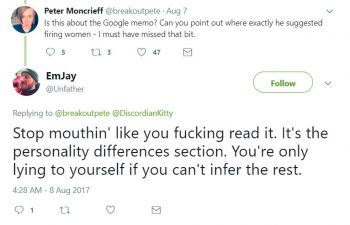
Many users responded that he had not called for anyone to be fired. A response to this objection may hint at where differences in opnion about the document originate:
The personality differences section talks about such things as “openness directed towards feelings and aesthetics rather than ideas”. It also contains more controversial-sounding statements such as “Women on average are more prone to anxiety”. It cites a section of a wikipedia article about sex differences in psychology, though this may not have been known by commentators external to Google as the version of the document containing hyperlinks has only become available more recently. The Wikipedia page says, ” Females were on average higher than males in extraversion, anxiety, trust, and, especially, tender-mindedness (e.g., nurturance).” It cites “Gender differences in personality: a meta-analysis” by Feingold, A. (1994-11-01). The section is in the context of coming up with suggestions to improve the work environment for women without resorting to discriminatory practices such as training courses only available to women. The Guardian columnist Owen Jones says:
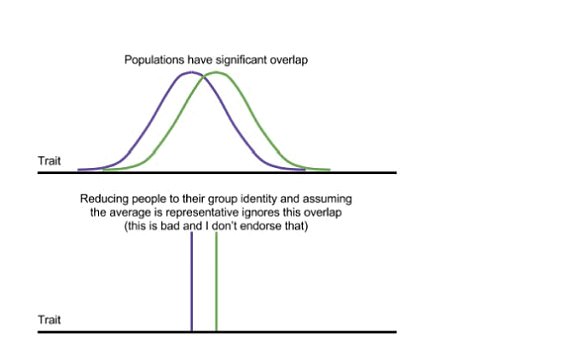
On the general subject of differences between men and women, Scott Alexander has an interesting article comparing meta-studies on the subject and statistical approaches which lead to different results. He finds that:
In his document, Damore explains that he is talking about small differences between men and women across a large population, and not making generalisations.
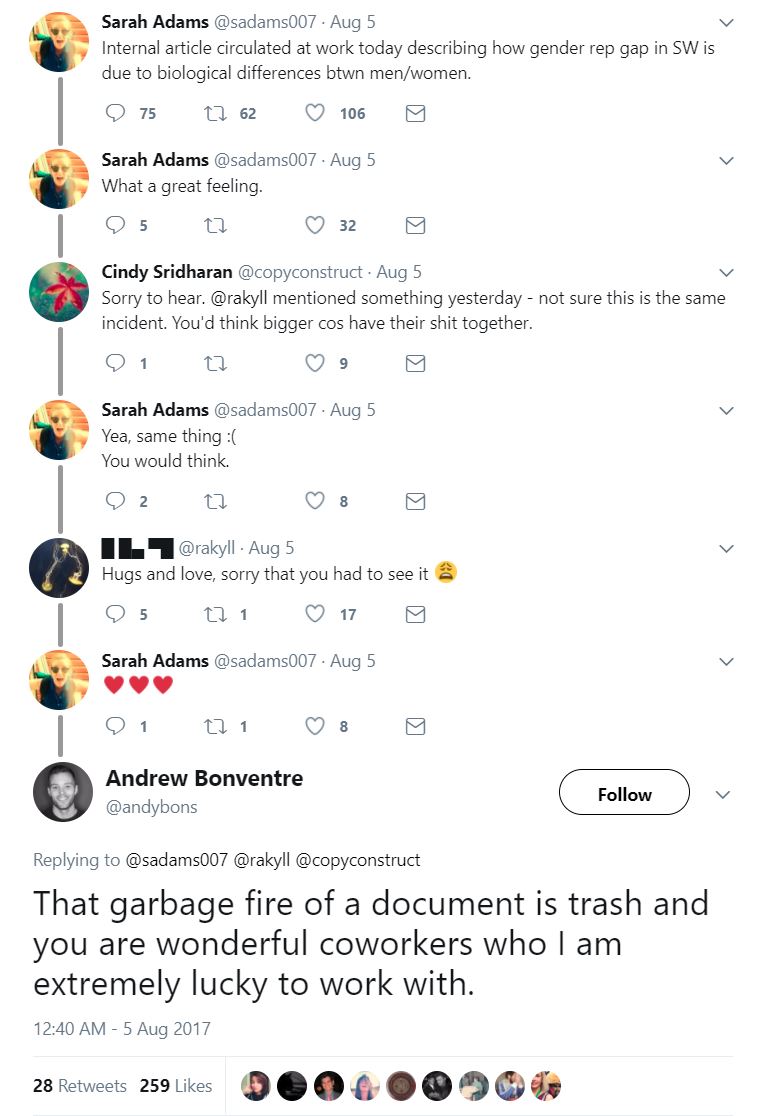
This is difficult to reconcile with reactions from fellow employees, such as, “That garbage fire of a document is trash and you are wonderful coworkers who I am extremely lucky to work with.”
The first official response from Google was from Vice President of Diversity, Integrity & Governance, Danielle Brown.
It is understandable that someone might hold this view, though the document mainly summarised information on Wikipedia. The CEO later said:
This seems to misrepresent the document, which is mainly talking about why women who do not work for Google do not work for Google. It says nothing at all about the ones who do work there. He continues:
It is clear the the offending portion of the document is the part that summarised Wikipedia’s summary of the state of the science on the subject. I wonder whether, as a matter of debating tactics, it might have been possible to make the same points in safety, while omitting this section. On the subject of tactics, there are a couple of interesting comments about this on ESR’s blog:
and
To the extent that these comments are true it does not speak well of the environment at Google or in Silicon Valley, but it is interesting that Damore’s firing was predictable and indeed somewhat predicted in the very document that led to it.
Perhaps comments which sound inflammatory out of context can be avoided. For example, “Women, on average, have more … neuroticism” or “the Left tends to deny science”. But taken as a whole the document has been treated unfairly by some. I wonder how easy it is for Google to hire more women, given that “According to the American Association of University Women, in recent years only 20% of Advanced Placement computer science exam takers in high school have been female.”. Finally, I should like to draw everyone’s attention to the Norwegian television documentary series “Hjernevask”, or “Brainwash” in English, which is on this very topic, and is quite worth watching. I’ve linked to the first of the seven parts below: Please make sure you enable subtitles, unless you speak Norwegian that is. August 11th, 2017 | 74 comments - (Comments are closed)
(This is a reworking of comments I sent to a couple of friends of mine in an email. A few points have been cut out because they would not make sense to outsiders, and others have been added.) I see that Owen Jones, the Corbynite journalist, is in the Guardian pushing the idea that if Jeremy Corbyn and his fellow socialists are elected into government, that elements of the “deep state” and all those dastardly neo-liberal establishment types will try and frustrate him. In a country that has, or should have, checks and balances in a constitutional liberal order, no government, even if elected with a large majority in the House of Commons, should have unfettered power to re-order a country, to trample on property rights and other liberties. It could be argued that naively or less so, the operatives of the “deep state” or even less “deep” state – such as civil servants, lawyers, etc might assume they perform some sort of function along these lines, although in a healthy political order that should be unnecessary. Of course it is outrageous if security services, which operate in the shadows, might try and frustrate a democratically elected government; perhaps, however, this is likely to happen if other, more credible curbs on unfettered power have been eroded, as they have been in the UK, over many years. (The proper solution is to rebuild those restraints. In the US, a great advocate of precisely that is Prof. Randy Barnett.) In arguing that a government duly elected should be able to go all in and do what it wants, and take democracy “to the streets” and workplaces, and who stirs up fears about being frustrated by dark forces, Jones is pushing a sort of “mobocracy”. He is a sort of intellectual descendant of that mad and bad man, Jean-Jacques Rousseau, who considered that no boundaries should exist in the face of any “General Will” of a public to be interpreted by the likes of himself. (I can recommend J Talmon’s book on this episode, The Origins of Totalitarian Democracy.) There is more than just a whiff of the French barricades about Jones, although he would not last long in a fight, I suspect. He imagines that secret agents and other “conspirators” will try and frustrate a government he favours, but frustrating, or delaying, what a government can do is actually not a bug, but a feature, of a liberal order. In short, Jones’ rejection of any kind of restraint demonstrates an authortarian mindset at work. There is a measure of truth in his claim about attempts by the security services in the 1970s to curb the Harold Wilson government of the time; the security services probably really thought that some in the Labour Party were in hock to the Soviets. I am sure that there were genuine instances of this. And for that matter, consider what is being said and done to Trump today and the claims and counter-claims about the “deep state”. Consider this item by leftist/civil libertarian Glenn Greenwald. What is ironic is that the sort of claims about what could happen under Labour are being made by those fearful that Trump is suffering or could suffer the same alleged fate. But beyond such conspiracy theories, there is a broader problem with the Jones article. So much of what is at fault with Jones’ take on the world is his total lack of perspective. For example, he goes on and on about “neoliberalism”. (A term for a sort of hybrid of genuine classical liberalism plus an acceptance of certain state institutions and functions, such as central banking. It is often associated with the influence of the Chicago school of economics and governments of Thatcher, Reagan and other.) But just how “liberal” is our current position? Given that more than 40 per cent of the economy is under state control and a good deal of the rest is regulated, it is laughable to argue that we are in a liberal position although these are matters of degree, of course. The tragedy of it is that Owen Jones is not completely wrong to damn our current situation. If only, if only he could break free of his collectivism. It would be good to see him direct some of his fire towards asking who really gains from, say, central bank money printing and bank bailouts. (Clue: Not poor people.) He should consider the pockets of privilege created by land-use planning/zoning, or restrictions on entry into certain occupations. Or bash the corruption of quangos, NGOs and the whole structure of regulatory bodies endlessly calling for the control of this or that. Or nanny statist interference in the hobbies and pleasures of working people, such as smoking, drinking or whatever. There is a lot of traction in the old Gladstonian class analysis of the “masses and the classes”; this is a tradition of thought that has been overshadowed in how class is often thought of as a concern that mainly comes from Marx. The trouble is that Jones is a socialist and believer in Big Government, and hence hostile to the decentralised market order and thus ignorant of the the information contained in prices; he appears ignorant of the public choice insights of economists such as the late US figure James Buchanan and others. This means Jones lacks the intellectual equipment to understand what is actually going on. At most, he glimpses a problem here and a partial solution there, but never quite breaks through. It is like watching a man try and measure the depth of the ocean by standing over the water with a telescope. It is genuinely frustrating. Jones is maddening because you like to think there is a genuinely intelligent person there, is not beyond redemption (sorry if that sounds patronising), but a central part of how he thinks is fouled up. It is very hard to break this down, no matter how much evidence or logic is deployed. Too much of his thinking involves “boo” words (neo-liberalism, etc). And I suspect it would be too humiliating for him to change course now, although you never can tell. I would conclude by saying that almost without fail, use of “neo-liberal” in an article of any kind suggests the reader is an aggressive statist. (As an aside, here is a sharp review of Jones’ book, The Establishment.) August 10th, 2017 | 20 comments - (Comments are closed)
I’m also not saying that we should restrict people to certain gender roles; I’m advocating for quite the opposite: treat people as individuals, not as just another member of their group (tribalism) No wonder they fired him! Treat people as individuals? The man is literally Hitler. In reality, it’s precisely because the memo was reasonably argued that they freaked out. That is why the left wing media and SJW twitterati put less reasonable words in his mouth that he never wrote. I am stuck with an Android phone, at least for now, but I am in the process of ditching GMail and Google and will probably move to Protonmail and Bing, unless someone has better suggestions. August 10th, 2017 | 61 comments - (Comments are closed)
Surely it was sad when the Renaissance in Florence ended. Sure it is sad that the Renaissance in San Jose and Palo Alto ends. But things move on and bright productive brains meet somewhere else, most likely online now. – A commenter writing on Eric Raymond’s “Armed and Dangerous” blog about the firing of an employee at Google for challenging certain notions around diversity in the workplace. I think it may be too early to judge if this sort of issue is going to dent Google and hit its share price in the next few months but if this culture of SJW bullying does grip more firmly on that business, and others in Silicon Valley, then the prediction made above here may prove to be accurate. August 10th, 2017 | 24 comments - (Comments are closed)
Last weekend I had a nice little surprise. Guido, in his Seen Elsewhere section, linked to a piece by Carl Packman entitled Of course I Remember When Ian Hislop was Eurosceptic. I clicked on Packman’s piece, because I too remembered when Ian Hislop was very EUrosceptic indeed. In particular, I remembered an amazing diatribe which erupted from him on BBC TV’s Have I Got News For You, way back in early 2003. I recalled this Hislop eruption because I wrote a piece for Samizdata about it at the time. Hislop is now a Remoaner, but he certainly wasn’t then, as I then noted, and as Packman recalls and records. What I did not anticipate, when I began reading Packman’s piece, was that Packman would include in his piece a quote from that same Samizdata posting of mine. Very pleasing. What goes on the internet stays on the internet, provided only that someone is curating it capably, and even if it was posted way back in May 2003. It is no big criticism of Carl Packman to say that he seems to have read that one Samizdata posting, but not any other EUro-postings here, and maybe not any other postings here at all, apart from that one. (Fair enough. I have only read this one piece of his.) And Packman seems to have got the idea that we Samizdatistas were not then at all happy about the fierceness of Hislop’s EUro-scepticism. But I for one was delighted by it, and most of our commenters on that posting, and most Samizdata writers and commenters from that time until now, have been very critical of EUrope. It was just that in that particular posting I was concentrating on what Ian Hislop had said and on why it mattered, rather than including a lot of other stuff about why I personally agreed with him, which I did, and was delighted that he had said it, which I was. Indeed, having done some digging back into my other EUro postings here from around that time, I have been surprised by how early and how vehement my personal hatred of the EU and all its works was. Trust me, there’s plenty more EUro-detestation from me in the Samizdata archives. Not everyone who has written for Samizdata hates the EU, but it seems that I have hated it from way back. What is more, this hatred, from me and from others here, might actually have had consequences. The other thing that occurs to me about Ian Hislop’s apparent volte face over EUrope is that there is one way in which he was and is being entirely consistent. Hislop, I believe, really does believe in speaking, if not always truth exactly then at least insults, to power, unlike a lot of the people who merely say that they do. Well, now, thanks to the Brexit vote in the EUro-referendum, Brexit is a dominant political orthodoxy. And Hislop is now determined to keep the argumentative pot good and stirred about the wisdom or lack of it of that attitude. In 2003, on the other hand, when Prime Minister Tony Blair was riding high, very few people indeed would have then have foreseen that Brexit would eventually happen. (I certainly didn’t expect it. I didn’t expect that we would be allowed a vote about it, and until the Brexit vote actually happened, I didn’t think that it would happen.) Which means that, then and now, Hislop was and is aligning himself against the dominant orthodoxy of the time. It’s just that this orthodoxy changed. Yes, on the mere EUrope issue, Hislop is now revealed as a turncoat. But he turned his coat for a very respectable reason. Packman, in his piece, ruminates upon what Hislop really thinks. I think that what Hislop really things is that raspberries and rotting vegetables and brickbats and mockery should always be thrown at whoever and whatever, politically, happens to be in charge at any given time. If only to keep alive the principle that this can be done. Compared to that principle, Hislop’s supposed principles about the mere details of this or that political argument are, to him, relatively unimportant. (See also this posting by me here, also from way back, ahout John Gray, another man who has often been accused of being inconsistent. Gray is presumably even now ruminating about how the hopes now being placed by the likes of me in the benefits of Brexit will be dashed. Because: doom, doom, doom. I couldn’t find any Gray stuff yet along these lines. He seems so far to have confined his EUro-pessimism to the future of EUrope rather than the future of the UK. But once Brexit is sorted and the optimism over here really starts to kick in, trust me, Gray will be heard saying that it will all end in ruin and despair. In Gray world, everything that people think might be really good always ends in ruin and despair, regardless of whether it actually turns out like that for real. And the good news is that he is usually wrong.) August 9th, 2017 | 20 comments - (Comments are closed)
Kicking Livingstone out of London felt cathartic, but I hadn’t realised we were lucky not be shot in our beds as a result. August 8th, 2017 | 19 comments - (Comments are closed)
The Guardian has the story, here. August 8th, 2017 | 16 comments - (Comments are closed)
In the deep Australian winter, comes a chilling judgment from the New South Wales Land and Environment Court, a plan to build a synagogue is refused by a planning authority, partly on the ground that it presents an unacceptable risk to neighbours, due to the threat of terrorist attack. In New South Wales, the Local Authority objected to the proposed development with a ‘Contention 3’, which was tested in proceedings before the Land and Environment Court.
And the Court found against the Friends of Refugees from Eastern Europe, who wished to build a synagogue:
So, as we can’t keep you safe, you can’t build on your own land. I have long wondered how long it would take Lefties to use planning law to well, enforce a policy of ‘Separate Development‘, that well-known Lefty plan from elsewhere in the Southern Hemisphere, now swept away. It is a judgment that presumes that the State cannot uphold the law (and in that it may be right!). It also has an indirect consequence of pointing to something like the ‘Pale of Settlement‘ of Tsarist Russia, where the law determined where Jews may or may not live, but here, live freely. To be fair to those Tsars, others apart from Jews had restrictions on their movements and residence, but that is not to excuse them. And to be fair to the Court, they are not targeting Jews, just simply upholding the law, following precedence perhaps, or even orders. The same could happen to Christians next, all you need to do is terrorise them, it seems. In my understanding, ‘beyond the Pale‘ derived from English settlement in Ireland going out beyond the protection of the law. Ironically, here the law says that under it, you are beyond its protection, at least if you are an observant Jew, or near to one. I have some modest, tongue-in-cheek suggestions for these unsafe Antipodeans: 1. Re-submit the application but ask to build a mosque, church or temple. 2. Offer to become Crypto-Jews, like those of Belmonte in Portugal, who finally felt safe and ‘came out’ in 1917 (rather poor timing given looming events in Germany, but thankfully they remained safe) having hidden their faith for centuries. 3. Build a proper Ghetto like Venice, and with a few canals you might have a tourist attraction, and wait for Napoleon to liberate you. Advance Australia Fair. Footnote (edit): This council is in the Federal constituency of Australia’s Prime Minister, Malcolm Turnbull. Edit: 10th August 2017 H/T to Confused Old Misfit below: The Daily Mail reports that the Council have now agreed to the Synagogue being built. I wonder why? August 8th, 2017 | 20 comments - (Comments are closed)
Political correctness is like HIV: after you’ve caught either, something that you could otherwise deal with easily can kill you.
– Alisa, commenter of this parish, two months ago
– instapundit today August 8th, 2017 | 8 comments - (Comments are closed)
Last night a story broke about a Google employee circulating an email to his colleagues regarding the company’s diversity policies. From skimming it, the email seemed reasonable, i.e. it wasn’t deliberately offensive or insulting. However, some people are appalled that someone working in Google holds such opinions, let alone shares them, and are calling for him to be sacked. Others are urging people not to read the email, as if it were a gorgon’s head. This is wholly unsurprising. The immediate response from many people when faced with opinions they don’t like is to try, using fair means or foul, to silence that person. This has been going on for years, and the latest weapon in the censors’ arsenal is to try to get the person sacked, and to deprive them of their livelihood. August 7th, 2017 | 39 comments - (Comments are closed)
The left talks of a reality-based consensus – but they’re actually living in a consensus-based reality – Ellen August 6th, 2017 | 29 comments - (Comments are closed)
|
   |
||||

All content on this website (including text, photographs, audio files, and any other original works), unless otherwise noted, is licensed under a Creative Commons License. |
|||||

Recent Comments