We are developing the social individualist meta-context for the future. From the very serious to the extremely frivolous... lets see what is on the mind of the Samizdata people.
Samizdata, derived from Samizdat /n. - a system of clandestine publication of banned literature in the USSR [Russ.,= self-publishing house]
|
Thomas Piketty and a bunch of other Europeans have published “Our manifesto to save Europe from itself”.
Our proposals are based on the creation of a budget for democratisation that would be debated and voted on by a new, sovereign European assembly. This will at last enable Europe to equip itself with a public institution capable of dealing with crises in Europe immediately and of producing a set of fundamental public goods and services in the framework of a lasting and solidarity-based economy. The promise made at the treaty of Rome of “harmonisation of living and working conditions” will finally become meaningful.
Are you inspired yet?
Whenever I hear people stereotyping based on gender. “Women vote this way”, “Men act in this manner”, I am reminded of the great contrast between Britain’s two women Prime Ministers. Thatcher, won a brilliant renegotiation of the EEC, trounced the unions, denationalized vast swaths of obscene nationalized industries, and was one of the four people instrumental in ending the cold war. May, the other lady from number 10, apparently couldn’t negotiate the purchase of a sausage supper for fifty quid in the local fish and chip shop.
Apparently, it is more to do with the content of your character than the content of your underpants.
– Fraser Orr
Until we can figure out how to fix WordPress’ “helpful” update that over-rides CSS, Samizdata will be looking a bit weird… sorry folks.
And hey WordPress… fuck you. Maybe time to start looking for an alternative to WordPress.
“Thatcher had to see off the fury of miners fighting pit closures, a dispute that dragged on for a year but which failed to mobilise other industries or the public at large. Macron is confronted by a nationwide rebellion that unites people of different regions, classes, occupations and political allegiances. While protestors rampaged through Paris last Saturday there was also violent unrest in Toulouse, Bordeaux, Calais, Marseille, Narbonne, Nantes and many towns. This week, more than 100 high schools have been blockaded by pupils who, emboldened by the gilets jaunes, have relaunched their springtime protest movement against educational reform. Farmers, lorry drivers, construction workers and ambulance staff are also threatening to go yellow.”
“It has been said that the gilets jaunes movement is to Emmanuel Macron what the miners’ strike was to Margaret Thatcher in the mid-1980s. Not in the slightest. While the comparison might please Macron — who, from the moment he was elected, has staked his reputation on his determination not only to reform his country’s economic model but also to stand firm when the inevitable backlash erupted — it hides the fact that what the French President faces is far more serious.”
– Gavin Mortimer, Spectator (£).
(Apart from the free trade bit)
This is an ad for the Liberal Party going into the 1918 General Election. Note that the Liberal Party split during the First World War with some following Lloyd George and others continuing to follow Asquith. This ad is for the Asquith Liberals. Also note this is not an ideological division; Lloyd George’s Coalition Liberals are standing on much the same platform. Also, also note that the statist rot set in well before the First World War.
In December 1918, this Liberal Party was more or less wiped out with Asquith losing his seat. In subsequent elections the general Liberal vote collapsed even further until by the 1950s the by-then re-unified party had only a handful of MPs.
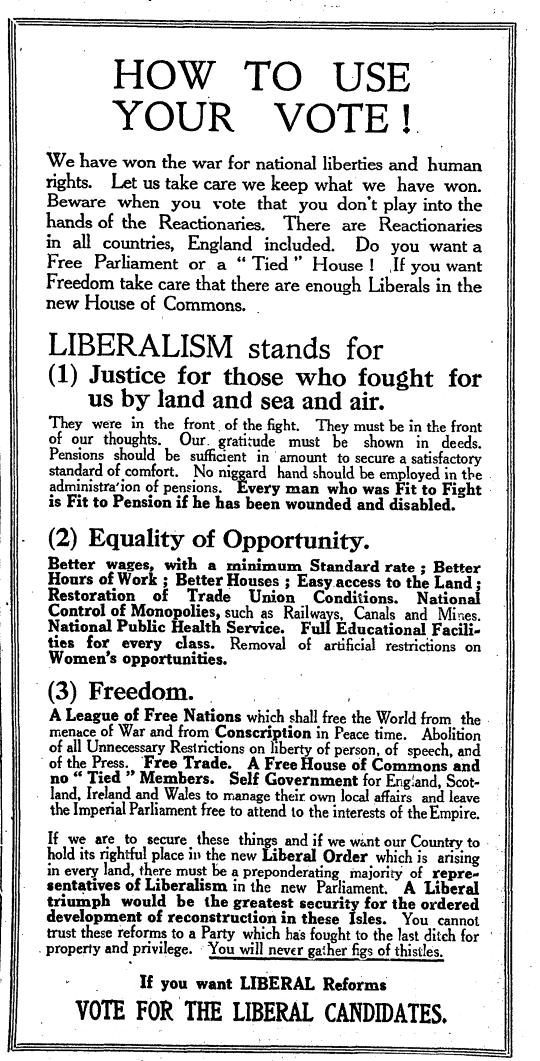 The Times 5 December 1918 p5
Had Samizdata or the internet existed on this day in 1933, Presidential Proclamation 2065 would undoubtedly have been Quote of the Day, and probably Quote of the Year as well.
Prohibition of alcohol in the US only lasted thirteen years. Of course that was time enough to give the Mafia their start, corrupt thousands of policemen and judges, and turn millions of previously law-abiding Americans into criminals, but in retrospect I stand in awe at how quickly the America of eighty-five years ago acknowledged and corrected its mistake.
Pity the same was not true of the ongoing and equally disastrous prohibition of drugs.
“The U.K. is a European country, and always will be. Trade and contacts among the nations of Europe can and should continue much as before. And I have no doubt they will do so. But the political nature of the EU has changed since monetary union. The EU failed to recognize that the euro would demand fiscal and political integration if it was to succeed, and that countries outside the euro area would require a different kind of EU membership. It was inevitable, therefore, that, sooner or later, Britain would decide to withdraw from a political project in which it had little interest apart from the shared desire for free trade.”
– Mervyn King, former governor of the Bank of England. If you read his comments carefully, his displeasure at how the institution he led has become a plaything of Remainer propoganda is plain. His book, The End of Alchemy, contains a devastating take-down of the euro and is an explanation of why the UK had little alternative in the end but to leave. King was never quite of the full “establishment” – too much of the West Midlands grammar school boy to really be at ease in the EU corridors of power. Good.
Whatever one thinks about the gilets jaunes (yellow vests) protests/riots in France – and I happen to know that they are the result of a deal made between a French green activist wishing to see more protests about what the government was doing to combat climate change and a particularly literal minded demon – the choice of the yellow Hi-Vis waistcoat or vest as a symbol of the protests was inspired. As every schoolboy knows, St David told the Britons to wear leeks in their caps to distinguish friend from foe in their battles with the Saxons. In many struggles since then some item snatched up in haste from whatever was lying around in order to improvise a uniform has duly become an icon of that cause. Here are some reasons why the gilet jaune is destined to join that illustrious list:
One: Protesters want to be seen. Hi-vis vests make people highly visible. This is one of those linkages that manages to be both obvious and surprising at the same time. Why did no one think of this before?
Two, anyone driving a car in France has got one in the boot anyway because a 2008 law says they must. Might as well put the thing to use.
Three, and this is the one I love, it turns a symbol of compliance into a symbol of defiance. Cop pulls you over. Cop saunters up to the car. “Is monsieur carrying a gilet de haute visibilité as required by law?” “Why of course, officer. I always carry my yellow vest. One never knows when one might need it.”
“Let me never fall into the vulgar mistake of dreaming that I am persecuted whenever I am contradicted.”
– Ralph Waldo Emerson
The Guardian‘s Matthew d’Ancona is at least honest about his opinion of Brexit voters:
“Let’s be honest about what’s really driving Brexit: bigotry”.
“Dublin’s landlords would rather put their properties on Airbnb than rent to local families,” wails the strapline to an article by John Harris in the Guardian called “30,000 empty homes and nowhere to live: inside Dublin’s housing crisis”.
To give him credit John Harris has never been one to do all his reporting from a swivel chair in Kings Cross. He was one of the few Guardian writers to foresee a Leave victory in the EU referendum, having co-authored with John Domokos a well-regarded series of video and written reports from some of the most depressed parts of the UK. Now he is talking to people struggling to find somewhere to live in Dublin. Here is how he describes the situation:
For want of a flat with a secure tenancy, the two of them have lived here for almost two years, in what the Irish government calls a “hub”…
*
I pay £95 for a single night’s stay (including a £43 “cleaning fee”), which highlights why whoever owns it has decided to rent it out in this way. The same move has been made by scores of other landlords: in August 2018, there were reckoned to be 3,165 entire properties listed on Airbnb in Dublin, compared with only 1,329 available for long-term rent.
*
The city is smattered with key boxes for Airbnb apartments. A stock line among activists demanding action from the government gets to the heart of all this: in 21st-century Dublin, they say, homeless families stay in hotels, and tourists stay in houses.
*
To make things even more difficult, her landlord then decided to sell up, which forced her to suddenly confront a private-rented housing market in which the monthly rent for anything similar was well over €1,500 (£1,300).
*
I am sure this is all honestly reported. But I think Mr Harris might be failing to see what is in front of his nose. All else being equal, most landlords prefer long term tenants to short term ones. A nice steady sum arriving in the bank every month makes for an easy life – and for a relationship of mutual trust to grow between landlord and tenant. In contrast, short term lets carry many risks: that the tenants will not look after the place, having little incentive to do so; that they will get into arrears with the rent or skip without paying it, and, most obviously, that the property will sometimes be vacant and earning you no money.
When most of the landlords in a place are seen to flee the predictability of the long term market for the uncertainty of short term lets, or even more perversely for the sheer unrelenting work involved in “turning over” a property every few days for each new AirBnB customer, there is usually a two word explanation. I did not see those two words anywhere in Mr Harris’s article, though this sentence came close:
Central Dublin – along with 20 other areas of the country – is now classified as a “rent pressure zone”, which caps annual rent increases at 4%, but politicians and activists claim this gets nowhere near tackling the causes of skyrocketing housing costs.
The missing two words were, of course, “rent control”. I don’t know Dublin. I don’t know its housing laws. But as soon as I saw that line “For want of a flat with a secure tenancy” I knew that rent control was at the bottom of this story. And so it proved. It took me only a few keystrokes to find this report by Fiona Reddan in the Irish Times:
Will rent controls start to work in 2018?
That was written in January. It is now December. Judging from Mr Harris’s description, it looks like rent controls in Dublin “worked” exactly as rent controls usually do. If he had happened to read Ms Reddan’s prescient article from eleven months ago (I suppose it would be asking too much for him to have read Henry Hazlitt’s even more prescient words on rent control, written with reference to New York in 1961 but eerily applicable to Dublin in 2018), he might have had a somewhat better idea as to why the 4% cap on rent increases fails to tackle the causes of the crisis, as he sees it. Answer: it is one of the causes. Ms Reddan writes,
If you’re wondering why the much-vaunted rent controls, first introduced this time last year, are having so little impact on stalling price growth, consider this investor’s tale.
He had a house rented out close to Dublin that was bringing in €1,300 a month – far below the market rates, which were more than €1,800. Stymied by the rent controls, which limit rent increases to 4 per cent a year (and 2 per cent a year for tenancies in place before the end of 2016), when his tenants left he was looking only at marginal increases in his rent.
So what did he do? Sold this property and bought the one next door. Previously owner occupied, it wasn’t subject to rent controls, which meant that he could slap a new, higher rate of €1,900 on it. The difference in rent quickly covered his legal and stamp duty costs.
Public Eye was made from 1965 to 1975 and contains adult themes, outdated attitudes and language which some viewers may find offensive.
– Warning message put up by Talking Pictures TV prior to its re-runs of the series. For those unfamiliar with Public Eye, think Colombo meets The Rockford Files in the English suburbs.
|
Who Are We? The Samizdata people are a bunch of sinister and heavily armed globalist illuminati who seek to infect the entire world with the values of personal liberty and several property. Amongst our many crimes is a sense of humour and the intermittent use of British spelling.
We are also a varied group made up of social individualists, classical liberals, whigs, libertarians, extropians, futurists, ‘Porcupines’, Karl Popper fetishists, recovering neo-conservatives, crazed Ayn Rand worshipers, over-caffeinated Virginia Postrel devotees, witty Frédéric Bastiat wannabes, cypherpunks, minarchists, kritarchists and wild-eyed anarcho-capitalists from Britain, North America, Australia and Europe.
|





Recent Comments