We are developing the social individualist meta-context for the future. From the very serious to the extremely frivolous... lets see what is on the mind of the Samizdata people.
Samizdata, derived from Samizdat /n. - a system of clandestine publication of banned literature in the USSR [Russ.,= self-publishing house]
|
Some time in the next week or two, pending only FAA aproval, SpaceX is planning to fly Starhopper, a test device for their next generation Starship launch system. Starhopper looks like a water tower with an attached rocket engine, mostly because it is indeed a water tower with an attached rocket engine. Starhopper is planned to rise to 200 metres into the air and then land, testing control systems and engine technology. This is a follow-up to a previous 5 metre test flight.
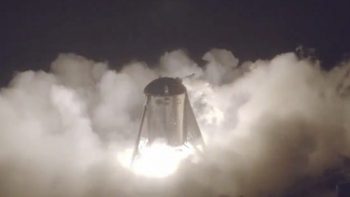
The engine is a brand new design called Raptor, which has a high specific impulse, meaning it is unusually efficient. Eventually, Starship will use up to 41 Raptor engines.
The test flight will be an exciting moment. The reason space travel is so expensive is that conventional rockets get thrown away after only a single use. (Imagine how unaffordable a flight from London to Berlin would be if the aircraft were thrown out at the end of the trip.) While a Saturn V would cost roughly $1bn today, the fuel would only cost about $1m. The bulk of current spaceflight cost is thus the cost of expending an extremely expensive piece of capital equipment instead of reusing it.
So, there is an opportunity to reduce the marginal cost of getting objects into orbit by orders of magnitude. SpaceX have already achieved some re-usability with Falcon 9 and Falcon Heavy. However, Starship will be both much bigger (it will lift 100T or more into low earth orbit compared to Falcon Heavy’s 65T) and is the first ever fully reusable orbital launch vehicle (Falcon 9 and Falcon Heavy do not recover the second stage). It may even cost less to fly 100T into orbit than it currently does to launch a very small rocket like Rocket Lab’s Electron that lifts only 250kg to orbit at a price of about $7m.
Because it will be able to be refueled in orbit, it will also be able take that 100T to the moon or even Mars (albeit at additional cost because of the need for flights to loft the fuel.)
In other words, we are witnessing a revolution in space travel.
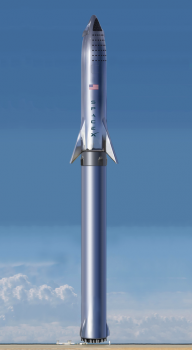
And with that stainless steel design, which can be transpiration cooled to avoid the use of heat shield tiles, it looks just like space travel was supposed to look back in the 50s.
“By stifling his criticisms of human rights-abusing regimes, what Donald Trump may see as the projection of strength is surely viewed by America’s adversaries as weakness. Turkish President Recep Tayyip Erdoğan blames the United States for an attempted coup against his regime, and Trump calls to congratulate him on his suspicious election victory. North Korea murders and purges its nuclear negotiators and Trump gives Kim Jong-un a photo op on North Korean soil. Vladimir Putin counters American geopolitical and economic interests at nearly every turn, and the president can’t bring himself to say a bad word about the autocrat in the Kremlin. What American interest is being advanced by this servility?”
– Noah Rothman, Commentary Magazine.
A father and son duo run a YouTube channel about historical tabletop wargaming called “Imperator Vespasian”. They run through demo games, talk about making and painting models and so on. Recently they were offline for about six months. They explain why in the following ten minute video:
“Unexpected side affects of Gaming! Channel update”
The two of them were creating a game called “A very British Civil War” set in an alternate-history 1938 in which Prime Minister Oswald Mosley was fighting to put down an anti-fascist rebellion. The British Union of Fascists was a playable faction. Here is a video they made about this game from six months ago.
Then the son’s school reported him to the police as a potential terrorist. Note that the father and son both say that the police were quite quick to realise that this case was not the best use of their time, and reserve their criticism for the school.
I am a little more sympathetic than are the “Imperator Vespasian” duo with the dilemma faced by schools over whether or not to bring the police in when they suspect a pupil is involved in crime as victim or perpetrator or both. The pair of them did make one unwise decision. Apparently their standard practice in their YouTube shows is to make announcements of what is happening in their games while “in character” for the various factions, with appropriate props as the backdrop. Fine when your prop is a medieval helmet, not so fine when it’s the lightning flash emblem of the BUF.
But was there really no one among the school staff who had ever wargamed? Or whose kids had wargamed, or whose kids’ friends had wargamed, or who was simply enough in touch with the lives of their male pupils to know that playing the Tyranids in Warhammer 40K does not mean you seek to literally devour all life? Given the nerdiness of historical tabletop gaming, I would have guessed that gamers were just as likely to end up as teachers as in the police force. So why did the police quickly get that this was fictional while the teachers did not?
The 50th anniversary of the Apollo 11 space flight to and from the Moon has been covered extensively in a raft of books, television programmes and films. A few weeks ago I watched the Apollo 11 film of that name. This is a documentary that features, so the film-makers say, previously unseen footage, and it certainly is a remarkable film. One of the good things about it is that it does not involve any narration: the film and the action do the “talking”. I watched it on a large IMAX screen at London’s Science Museum. I heartily recommend it. I actually found it rather moving. That sequence of when Armstrong takes control of the Lunar Module and flies to the surface, with Aldrin counting out the altitude, knowing they have precious little fuel to spare, is one I can watch over and over. (Armstrong is one of my all-time heroes. The very fact that he conducted himself in such a modest way since the mission ended only reinforces that.)
The space missions of the 1960s were, of course, part of a much bigger set of actions involving the US, former Soviet Union and other select powers. Let there be no doubt: the Moon missions were a big “front” in the Cold War. We libertarians will debate whether all the spending on such a programme was justified (I will come back to this point in a bit) but it strikes me that the success of the Apollo missions were surely a valuable morale booster for the West and for America. It showed that for all the Soviets’ early successes in beating the US in some aspects of space flight, that by the mid to late 60s that edge had gone.
Putting the likes of Armstrong, Aldrin et al up there was a way for the US to poke Moscow in the eye. But it was about much more than that. It appears to me (born in May 1966) the product of a time when governments still had tremendous confidence in technology, as did much of wider society. And yet as we know, the end of the Moon programme coincided with events such as various environmentalist campaigns calling attention to the real/alleged damage Man was doing to the environment; it also overlapped with the Vietnam War, the oil price shock and the challenge to established Western assumptions about energy. And there was the rise of radical feminism and the Civil Rights campaign.
A lot of people have noted how the space programme contrasted with all the tumult and messiness of wider American/Western society at the time. At more or less the time that Armstrong was taking his “giant leap” for Mankind, Jimi Hendrix was playing his version of the Star Spangled Banner at muddy Woodstock (he’d probably be condemned by today’s left for being a reactionary conservative for playing it at all); Charles Manson and his fellow monsters were causing havoc. Several major public figures, such as Martin Luther King and Bobby Kennedy, were murdered. The space programme was, on the other hand, all clean, with white rockets and gleaming craft; it had a focus on scientific precision and a celebration of human efficacy. It was about what Man can do and achieve, given rational focus on a goal. It was also a very technocratic thing, and an example – which is often trotted out by politicians who like big vanity projects – of a big government effort actually working pretty well. (From the moment that JFK gave his speech about the Moon in 1962 it took just eight years to pull that feat off. It takes people longer to make James Bond films these days.) The men (and some women) at NASA looked different from the rock musicians and protesters of the time: whenever I see photos and old films of the chaps at Mission Control, for example, they all have air force-style buzzcuts, narrow dark ties and have names like Dave, Deke and Al. They drive Corvettes , live in small neat homes with pools (this impresses a Brit) and talk with clipped Midwestern or occasionally more gravelly Texan accents. They play golf. Al Shepard even took a golf club up to the Moon. How middle class is that?) They don’t look like Janis Joplin fans and probably could not give a damn about recycling of single-use plastics.
→ Continue reading: Book Review: Apollo In The Age Of Aquarius
The BBC reports that the National Grid will “learn the lessons” after nearly one million people across England and Wales lost power on Friday.
But what lessons will those be?
The power outage happened at about 17:00 BST on Friday, National Grid said, with blackouts across the Midlands, the South East, South West, North West and north east of England, and Wales.
Industry experts said that a gas-fired power station at Little Barford, Bedfordshire, failed at 16.58, followed two minutes later by the Hornsea offshore wind farm disconnecting from the grid.
The National Grid director of operations quoted in this BBC article, Duncan Burt, has said that “he did not believe that a cyber-attack or unpredictable wind power generation were to blame”.
I do not know whether to disbelieve his disbelief. Those concerned with managing the UK’s power supply might have good reasons to keep mum about our vulnerability to cyber attack, and less good reasons for playing down the unpredictability of wind power.
Tim Worstall speculates,
One reading could be……wind farm closes down immediately as wind speed is too high. Gas plant on idle can’t spin up for some reason. Drax is low capacity because it’s burning wood chips, not coal.
On the cyber front, even if this power outage was entirely an Act of God in the insurance sense, the next one might not be. The bad guys have seen how much more damaging power cuts have become now that we are so reliant on the internet. As cashless payments become more common it will only get worse. I love cashless payments! What bliss to no longer have to worry about finding change when you’ve just found the last space in a crowded car park, manoeuvred into it with incredible difficulty while holding up the rest of the traffic, and only then remembered that you have to pay for the damn thing. But an entirely cashless society, as they seem to be moving towards in Sweden, might turn out to have its Orwellian nature tempered only by its lack of resilience.
A final observation: I have read a lot of comments from supporters of remaining in the European Union along the lines of “You think a few hours delay on the railways was bad? Just you wait until we leave the EU without a deal.” However, just as with the chaos caused by the Gatwick drone shutdown, that argument cuts both ways. All their frantic efforts to say “No Deal” must not be allowed to happen because it will cause vast queues at the ports and airports start to look a little silly when the same consequences seem likely to arise every time the wind surges or a cyber attacker gets lucky.
Today’s quote of the day was from a longer conversation about water, starting with the conventional wisdom that climate change will inevitably lead to global water shortages. It is not immediately obvious why this should be so, given that melting ice, for example, presumably leads to there being more non-frozen water about.
The impression from the mainstream media is that any water-related problem can be caused by climate change. Floods? Climate change. Drought? Climate change. A summary from NASA suggests that some places, the places that get plenty of rain, will get more rain: so much that it floods. And other more typically dry places will see more droughts. So there is not necessarily a contradiction. On the other hand it is not clear how reliable such predictions are.
Different climate models provide different answers about what will happen to rainfall where. You can almost pick the result you want for a particular place by picking which climate model you want to listen to. You can take the mean of all the model outputs but that only seems useful if they all broadly agree, and even then they could all be wrong. The question of the usefulness of climate models is a big topic. The way they are tuned seems to allow for a lot opportunity for bias to creep in. Also the resolution of GCMs is not high, and the resolution affects the results, especially for precipitation.
In any case, there is a practically unlimited supply of water in the oceans, it is simply a matter of energy to turn it into drinking water and transportation to get it where we need it. With photo-voltaic panels becoming cheaper and more efficient as solar generation capacity has been growing exponentially for the last 25 years, energy is cheap. For desalination there is not even an energy storage problem, since we can make water during the day and water is easy to store. The technology is effective, simple and cheap.
As for transportation, I have heard there is some new technology called an aqueduct.
So there are no technical difficulties, it is not particularly expensive, and with poverty on its way out there seems little to stop any water supply problems from being solved.
As Sir James Bevan, chief executive of the Environment Agency, put it, we will reach the “jaws of death – the point at which, unless we take action to change things, we will not have enough water to supply our needs”. It was ever thus. Luckily the action is not difficult.
If private companies sold people water, they would regard high levels of demand as a market opportunity. When the government runs water systems, high levels of demand mean shortages. It’s insane. Instead of finding good ways to meet demand with technology, we get price distortion, rationing, and glum pronouncements about the sins of mankind.
– Perry Metzger, reacting to this drivel.
“We didn’t always know it at the time, but Hong Kong has been a kind of bellwether for the state of freedom in the wider world.”
– Tyler Cowen.
He’s right, which is why, despite the mockers, I am writing about this topic quite a bit and intend to keep doing so.
United Launch Alliance is a joint venture between Lockheed Martin and Boeing that can put payloads into orbit on expendable rockets. They launched 7 payloads for commercial customers in the last decade, none since 2016. Their only customer is the US government.
In 2018, Spacex launched 14 payloads for commercial customers on their re-usable rocket. They are doing it for a fraction of the cost. Even the US government is using Spacex. ULA must be worried. What are they going to do?
ULA, and its parent companies Boeing and Lockheed Martin, have stood virtually alone in their support of the FAA’s rules revision.
What is this?
“I don’t blame ULA,” Eric Stallmer, the president of the Commercial Spaceflight Federation, told SpaceNews. The revised rules the FAA proposed favor large companies that have bureaucracies in place to comply with onerous requirements, he said. “But for new entrants, small launch companies, reusable launch companies, the rules are backbreaking. It’s a tremendous barrier to entry. It’s almost as if the Russians and the Chinese wrote these rules.”
And now we know how ULA hopes to beat the competition.
“Capitalism” is a Marxist epithet for the condition that normal people call “liberty”.
– Commenter ‘Zero Sugar’ over on Guido Fawkes.
Woman who no-one had heard of until she married a royal “set out to prove that women don’t need men to give them status”. I mean I agree but she’s got her work cut out.
– Rob Fisher, commenting on this.
The Times Saturday magazine features the latest of its series of quick interviews in which a famous person tells the readers “What I’ve learnt”. This one is with that fine actor, Jared Harris. Among the things that Mr Harris has learned and wants to pass on to the reader is that,
“We don’t have another planet. This is it. We’ve nowhere else to go. We’re going through a crisis of denial over climate science. A very small group of people are frustrating the political will to tackle it head on. But when people’s homes become uninhabitable, they will move somewhere else. If you think it’s awkward with tens of thousands of people at the southern border of the US or with a couple of hundred thousand at the borders of the EU, what are you going to do when a couple of hundred million are on the move?”
Very stirring. But I could not help noticing that the little potted biography of Mr Harris at the top of the page says this:
The British actor Jared Harris, 57, played Lane Pryce in Mad Men, King George VI in The Crown and Valery Legasov in Chernobyl, for which he has been nominated for an Emmy. He is one of three sons by the notorious hell-raiser Richard Harris and his wife Elizabeth Rees-Williams. He splits his time between New York and Los Angeles with his third wife, Allegra.
New York and Los Angeles are 2,790 miles apart by road, and 2,450 miles apart by air. It’s a fifty-hour drive, so I think we can safely assume that Mr Harris travels between his two bases by air. Compared to most people’s, his personal carbon footprint is more like a personal carbon Tunguska crater. It must be hard to juggle the claims of a far-flung family and a demanding acting career, so I do not begrudge Mr Harris his air miles. But going from what he said, he begrudges me mine.
When reading the views of celebrities on the environment it is always worth looking out for the words “splits his time” or “divides her time” or equivalents thereof. I first saw this pointed out on a Biased BBC post back in November 2009, about a model called Helena Christensen who held an exhibition of pictures she had taken to document climate change and divided her time between Copenhagen and New York, with occasional side trips to Essex to see her agent.
|
Who Are We? The Samizdata people are a bunch of sinister and heavily armed globalist illuminati who seek to infect the entire world with the values of personal liberty and several property. Amongst our many crimes is a sense of humour and the intermittent use of British spelling.
We are also a varied group made up of social individualists, classical liberals, whigs, libertarians, extropians, futurists, ‘Porcupines’, Karl Popper fetishists, recovering neo-conservatives, crazed Ayn Rand worshipers, over-caffeinated Virginia Postrel devotees, witty Frédéric Bastiat wannabes, cypherpunks, minarchists, kritarchists and wild-eyed anarcho-capitalists from Britain, North America, Australia and Europe.
|





Recent Comments