We are developing the social individualist meta-context for the future. From the very serious to the extremely frivolous... lets see what is on the mind of the Samizdata people.
Samizdata, derived from Samizdat /n. - a system of clandestine publication of banned literature in the USSR [Russ.,= self-publishing house]
|
The British political firmament as a whole is hardly blessed with a multitude of bold, original thinkers, and such figures certainly aren’t among the fabulous seven, the daring eleven or whatever number of forgettable non-entities currently comprise The Independent Group.
All of which is a great pity. As this blog has noted over and over and over and over and over and over again, Britain has entered a period of political discontinuity – a time when the existing political settlement, with its narrow range of policy options, are no longer adequate to the challenges at hand. Such periods of discontinuity require politicians to think the previously unthinkable in terms of policy solutions, not to flee their former political parties in an outrage that people are actually starting to do so.
– Samuel Hooper
“National service should be compulsory for the young, says Chuka Umunna”
Coming out can be a stressful process. All should have sympathy with Mr Umunna’s personal struggle to accept his inner Tory.
Young Britons should do a form of ‘national service’ to end the current ‘social apartheid,’ according to Chuka Umunna. The Independent Group frontman has unveiled a list of policies, including on tuition fees, education grants and how to fund the health service. The former Labour MP has suggested that youngsters be forced to carry out work to break down barriers within society.
Because nothing builds unity in a society like some of its members using force on others. Both sides are participating, right?
The TIG spokesman stressed the plan would not be a return to compulsory military service but would help people meet other Britons from different social backgrounds.
Mr Umunna said his proposal could build on the National Citizen Service scheme introduced by David Cameron, which ‘has suffered by being voluntary’. It could also draw on evidence from France, where Emmanuel Macron made a national service requirement for 16-year-olds a key policy, with trials beginning this year.
Will no one think of the National Citizen Service scheme? We cannot leave it to suffer this way.
“Police waste too much time over silly spats”, writes Clare Foges in the Times. (Paywalled, but I will quote all the bits that matter.)
But perhaps the most time-sucking of new developments has been the resources spent on hate incidents and online crime. Last year it was reported that in 2015-16, 30 police forces dealt with 11,236 hate incidents which were too trivial to be classed as crimes; one every half hour. Among those lodging complaints were a man who claimed a tennis umpire had made racist line-calls against his daughter, a woman who was told that she looked like Peter Griffin from the cartoon Family Guy, and a person who felt a man had stood “intimidatingly” close because she was “a non-conforming gender-specific lesbian in a wheelchair”.
Instead of realising the folly of all this, the National Police Chiefs’ Council responded by restating that “those feeling vulnerable should report any incident of hate crime to the police”. The trouble is that hate crime is astonishingly subjective. The official definition is “any criminal offence which is perceived by the victim or any other person to be motivated by a hostility or prejudice”.
The College of Policing states that “for recording purposes, the perception of the victim, or any other person, is the defining factor in determining whether an incident is a hate incident . . . Evidence of the hostility is not required.” In other words, any crackpot or attention seeker who feels victimised, regardless of the “offence”, may go to the police.
Sucking up police time on “hate” incidents in the offline world is bad enough, but in the past couple of years the police have been expected to protect us online too. In 2017 the Crown Prosecution Service announced that online hate crimes should be treated as seriously as those committed face to face. This has led us to ludicrous cases like that of Kate Scottow, who last December was arrested in front of her children by three police officers and detained for seven hours. Her crime? Calling a transgender woman on Twitter a man.
In 2017 this paper reported that police were arresting nine people a day in the fight against web trolls, a rise of nearly 50 per cent in just three years. The arrests were made under the Communications Act 2003, which makes it illegal to intentionally “cause annoyance, inconvenience or needless anxiety to another” with online posts. Annoyance? Inconvenience? Given the cesspit of spite that social media has become, we can only imagine how many are being arrested today.
Commissioner Dick was criticised when she said that focusing on violent crime must be the over-riding priority for police, over misogynistic abuse, over fraud, even over catching those who view indecent material online. “We can’t go on increasing the scale of the mission, unless we are given more resources, or the public is prepared for us to do some things not very well.” No one wants to give a free ride to certain offenders. But in a world of finite resources there cannot be a bobby on every corner as well as bobbies to guard the good name of the Duchess of Sussex and bobbies to police every spat on social media. There aren’t enough resources for this and never will be.
I do not disagree with any of the arguments Ms Foges makes. But I think she is missing something rather important…
Update: I have decided to stop being coy and just say what I think the problem with Clare Foges’ piece is. She talks as if the main thing wrong with the police “increasing the scale of the mission” (as Commissioner Cressida Dick puts it) to encompass the policing of spats on social media is that it wastes police time. So it does, but the scandal of the arrest of Kate Scottow for calling a transgender woman a man on Twitter did not lie in the time wasted by the three officers who bravely took on that mission. It lay in the violation of Kate Scottow’s liberty.
Martin Howe QC has written an article on the choices facing Parliament with regard to ratifying Mrs May’s agreement (as amended) or extending the Article 50 deadline, the Trojan ass beloved of Remainiacs.
Essentially, he sees the worst option as approving Mrs May deal with its indefinite nature, subjugation to the ECJ as an arbitration mechanism and no exit clause (but I think a suitably-phrased Act of Parliament and, in the event of any nonsense from over the water, a few well-aimed cruise missiles as an ultimate fallback would do). I fail to see the disadvantage of breaching such a bad treaty, President Trump is a great one for saying that this arrangement is screwing us, so screw it and if you don’t like it, tough.
A short extension would be a nonsense as the European ‘Parliament’ will take a break from rubber-stamping or worse, gilding (never ‘gelding’ it seems) the legislation put before it so that elections may be held, and it is needed to ratify the final Withdrawal Agreement. It would give three weeks for more procrastination and delay (which is the whole point of Mrs May’s premiership, in case anyone hasn’t noticed).
As Mr Howe notes of the FFC:
The Prime Minister’s statement to the House of Commons on 26 February 2019 opened the door to a “short, limited extension to Article 50 not beyond the end of June” if the House again rejects her deal on 12 March. She thereby abandoned her commitment, repeated in the Commons more than 100 times, that the UK will leave the European Union on 29 March 2019.
Without any apparent consciousness of the irony, she told the House that she would stick by her commitment to hold a vote on extending Article 50 “as I have [stuck by my] previous commitments”.
Mr Howe sums up the advantage of a 21 month extension over Mrs May’s ‘deal’.
A long extension of 21 months would have the same practical result as the “implementation” period in the deal, except the UK would be much better off than under the deal because we would still have a vote and representation in EU institutions and the European Parliament.
Unlike the deal, we would be free to leave on 1 January 2021 without being trapped in the “backstop” Protocol.
Our financial liabilities during the 21 month extension would be the same as under the deal, but unlike the deal, we would have no obligations afterwards.
Unlike under the deal, we would not be subject to indefinite ECJ jurisdiction after 2020.
As Mr Howe notes:
When you want to get someone to do something by threatening them, the normal protocol is that you threaten them with something which is worse than the thing you want them to do. However, in this case, it is the other way round. The ‘threat’ is manifestly more advantageous in every way than the thing the threatener wants the threatened to do (vote for the Theresa May deal).
Would an extension be granted by the EU?
… there are severe difficulties in the way of getting such an extension in the first place. The EU is wary of the problems which would be created by holding the European Parliament elections in the UK. The Conservative Party should be not simply wary, but alarmed across the board, at such a prospect, since a decimation of the Conservative vote in the face of Nigel Farage’s reinvigorated Brexit party cannot be ruled out. And if the Brexit party establishes itself with a big vote in the European Parliament elections, it will not go away and will be a real vote-splitting problem for the Conservatives in by-elections and at the next general election – an even greater problem than UKIP was in the past.
The EU may well not be willing to agree to an extension. It only takes one member state to veto it.
So this is where the Conservative Party has taken the country, to a point where threats of something better that a final outcome are being deployed with a view to getting the worst possible deal for the UK? And our best hope may well be another EU member government deciding to put a stick in the spokes of the extension? Could, say, nice Mr Orban be our saviour? We might see just how far the euroscepticism of some European politicians will take them.
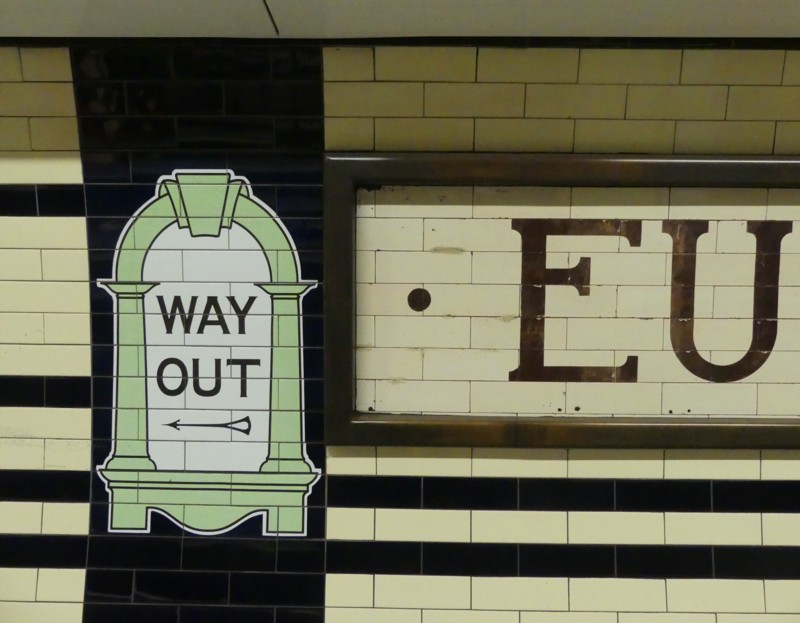
Today I was at Euston tube station, and found myself admiring the antique signage on one of the platforms, the Northern Line I think, done with painted tiles, rather than with a printing press or with electronic wizardry as is the way such things are done now. Way Out signs are not what once they were. So out came my camera.
At this point I realised that there was some weekend, Brexit-related fun to be had, by including also part of the bit where it said, in much bigger letters, “EUSTON”:
If only the way out of the EU was turning out to be as simple as exiting from Euston tube station.
The myth at the heart of the ‘Corbyn project’ is that it is a grassroots movement of enthusiastic young people. This group, so the theory goes, is disgusted by free markets and longs for industries to be nationalised and collectives of workers to seize control of the means of production. Books have even been written about how the ‘young’ have ‘created a new socialism.’ But if this is true, why does a poll today reveal that support for the newly-formed centrist Independent Group predominantly come from young people? Forty-seven per cent of 18-24 year olds approve of the creation of TIG, with just 14 per cent disapproving of it. This is strange behaviour from an age group we’re constantly told are supposed to be most rabidly in favour of Jeremy Corbyn. Listening to high-profile Corbynistas in their plentiful media appearances you would assume that the people most likely to back TIG are ageing Blairites and ‘centrists dads’. Far from it.
Young people are the least likely to oppose introducing competition into government services, and the least likely to favour the government pursuing equality of outcome. Perhaps this explains why so many young people approve of a group that has also won approval from the IEA and the ASI for its favourable view of austerity and Osborne cuts, opposition to renationalisation, anti-tax hike, and pro-tuition fee positions.
In reality any meeting of the hard left looks more like a retirement home than a university seminar, even in London, where more young people live. So Corbynism is not a movement led by a generational shift in the way we view the world, but one driven by the same few hundred thousand people in the country who have always leant towards the left. The only difference is that now they are better organised and able to seize the infrastructure of an old established party thanks to an ill thought-out £3 membership scheme. To put Labour’s support into perspective, the party’s total membership is less than half the number of people who voted Green in 2015.
– Tim Harwood.
It may be true that some of the support for Momentum comes from the young, but the idea that most 20- and young 30-somethings have the hots for an ageing anti-semite, IRA supporter, Hamas chum and Marxist seems a tad far off the mark. The new and devastating book by Tom Bower is hardly going to make life easier. With their penchant for the goodies of modern capitalism (iPhones and all the rest of it), if not being in agreement with the global trade that makes this possible, it always struck me as more likely that a more genuinely liberal creed would appeal. The problem, as I see it, though, is that the breakaway MPs from Labour and the Tories who have formed the Independent Group are largely motivated by a desire to keep Britain inside the clutches of a federalising EU project marked by disdain for what voters want, and squaring that circle is going to be difficult.
Classical liberalism (ie, what I think liberalism actually is) has never been a majority taste among the young, in my experience, but it isn’t doing well at the moment, even though there are student groups and others doing what they can to counter statist nonsense and resist it in colleges, etc. That’s why I applaud the likes of the Atlas Network, Students for Liberty and the work of groups such as FREER, etc. Whatever might be the real support for Corbyn and his fellow socialist troglodytes, more needs to be done to spread better ideas when people are still at a formative stage in thinking about these things. I do what I can in speaking to meetings, and actually a practical step I’d urge those who scoff about such efforts to consider is mentoring students whom they know, giving them reading material and steering them towards ideas that their own lecturers might not be exposing them to. This doesn’t have to be done in a blunt fashion, either.
Via Instapundit I came across this fine editorial from the New York Sun:
“Sometimes You Have To Walk”
The collapse of President Trump’s summit with the North Korean party boss, Kim Jong Un, certainly takes us back — to October 12, 1986. That’s when President Reagan stood up and walked out of the Reykjavik summit with another party boss, Mikhail Gorbachev, of the Soviet Union. We can remember it like it was yesterday. The long faces, the dire predictions, the Left’s instinct to blame the Americans.
“What appears to have happened in Iceland is this,” the New York Times editorialized. “Mr. Reagan had the chance to eliminate Soviet and U.S. medium-range nuclear weapons in Europe, to work toward a test ban on his terms, to halve nuclear arsenals in five years and to agree on huge reductions later. He said no.” The Times just didn’t see that the Hollywood actor turned president had just won the Cold War.
It’s too early in the morning — this editorial is being written at 3 a.m. at New York — to know whether that’s the kind of thing that just happened at Hanoi, whence news reports are just coming in. Messrs. Trump and Kim were supposed to have a working lunch, to be followed by the signing of some sort of agreement. The next thing you know, Mr. Trump is heading home.
It’s not too early, though, to caution against over-reacting to this development. What appears to have happened is that the Korean Reds wouldn’t agree to the complete, verifiable, irreversible denuclearization that we seek. Absent that, we wouldn’t agree to the dismantling of all the sanctions the North Koreans seek. “Sometimes you have to walk,” Mr. Trump told the press.
Good for him, we say. It would be a fitting epitaph for any statesman.
The tags I chose for this post will serve as my only further comment.
Matt Kilcoyne of the Adam Smith Institute writes,
The Guardian’s anti-Brexit fake news
An article, since deleted, made nonsense claims about the treatment of EU migrants.
and
When you try to find the article now you get a page that says it has been removed (rather amusingly, the related stories are eight other removed articles). The Guardian, unwilling to admit to its failures, claims that the piece was ‘taken down because it was found to have been based, in good faith, on outdated information’. This was after 16,000 people had shared it.
In the light of Theresa May offering MPs a vote on delaying Brexit, which is being joyfully and rationally welcomed by Remainers as the crack into which can be inserted the political lever to renege on delivering the referendum vote entirely, this twitter thread from Matthew Goodwin is timely:
One critical point about vote for #Brexit is that it marked the first moment when a majority of British people formally asked for something that a majority of their elected representatives did not want to give. It was always destined to lead us here
Contrary to popular claims, we now know from a dozen + studies that Leavers knew what they were voting for. They had a clear sense about how they wanted to change the settlement; they wanted powers returned from the EU & to slow the pace of immigration
We also know that for large chunks of the Leave electorate this vote -a rejection of the status quo- was anchored in high levels of political distrust, exasperation with an unfair economic settlement & a strong desire to be heard & respected
I do not think that it is hard to imagine what could happen if Brexit is delayed, taken off the shelf altogether or evolves into a second referendum that offers Remain vs May’s deal, which Leavers would view as an illegitimate ‘democratic’ exercise
We have evidence. (1) Professor Lauren McLaren has already shown that even before the first referendum people who wanted to reform the existing settlement but who felt politicians were unresponsive became significantly more distrustful of the entire political system
(2) Professor Oliver Heath (& others) have found that as British politics gradually converged on the middle-class at the expense of the working-class the latter gradually withdrew from politics, hunkering down and becoming more apathetic
This is partly why the first referendum was so important, where we saw surprisingly high rates of turnout in blue-collar seats. Because for the first time in years many of these voters felt that they could, finally, bring about change.
And we’d already seen an alliance between middle-class conservatives and blue-collar workers to try and bring about this change when they decamped from mainstream politics in 2012-2015 to vote for a populist outsider
So I think that we do know what the effects of a long/indefinite delay to Brexit, or taking it off the table altogether, will be. Either we will see a return to apathy & ever-rising levels of distrust which will erode our democracy and the social contract from below, or …
Another populist backlash, anchored in the same alliance of disillusioned Tories & angry workers who -as we’ve learned- are very unlikely to just walk quietly into the night. If anything, this will just exacerbate the deeper currents we discuss here
I have one thing to add: if the establishment (which includes MPs of all parties) demonstrates that campaigning for forty years for a referendum and finally winning it does not work, it will not only be the populist Right who learn the lesson. The radical Left and the Irish, Scottish, Welsh and English Nationalists will also learn that the strategy of peacefully winning consent from voters is a mug’s game.
The problem with this article is it fails to note that becoming a Marxist because you’re young and unhappy is no more laudable than becoming a Nazi for the same reason.
– Samizdata Illuminatus
It is a huge mistake to blame this [anti-Semitism] on Corbyn alone. This did not all appear out of nowhere, Corbyn is just the obvious pustule on a much deeper problem underpinning collectivism
– Perry de Havilland
It is rare that I agree so strongly with a fervent supporter of the European Union. Nesrine Malik of the Guardian argues that “the Brexit reckoning must happen” on the grounds that
A humbling must come to pass. From the beginning, Brexit created its own momentum. Once the question was asked – in or out? – all the grievances, justified or not, could be projected on it, with “in” being widely seen as a vote for the status quo. Within this frame, nothing else matters – not economic predictions, not warnings about medicines running out, nor threats of the need to stockpile foods. The remain campaign could not have done anything differently: it lost the moment the question was asked.
And so, maybe, in the end, we will finally believe that immigration is necessary for an economy and an NHS to function, that the inequality between the south-east and the rest of Britain is unsustainable, that our political class is over-pedigreed and under-principled. We might even believe that other crises, such as climate change, are real, too.
Maybe, in the end, the country outside Europe will find its stride by confronting its issues rather than blaming them on others, and forging its own way. But there is only one way to find out. What a shame Brexit is that path – but better to have a path than none at all.
She is right about our political class being over-pedigreed and under-principled, right that unless Brexit happens the country will be torn apart by claim and counter-claim as to what would have happened, and right that a humbling must come to pass. Let us go forward together and find out whose.
|
Who Are We? The Samizdata people are a bunch of sinister and heavily armed globalist illuminati who seek to infect the entire world with the values of personal liberty and several property. Amongst our many crimes is a sense of humour and the intermittent use of British spelling.
We are also a varied group made up of social individualists, classical liberals, whigs, libertarians, extropians, futurists, ‘Porcupines’, Karl Popper fetishists, recovering neo-conservatives, crazed Ayn Rand worshipers, over-caffeinated Virginia Postrel devotees, witty Frédéric Bastiat wannabes, cypherpunks, minarchists, kritarchists and wild-eyed anarcho-capitalists from Britain, North America, Australia and Europe.
|