Yesterday the Labour leader posted a video to his social media accounts. Dogged for days by accusations he was complicit in passing information in multiple meetings to the Cold War Czechoslovak agent Jan Sarkocy, and having dodged questions on the topic by the press, Corbyn (or Agent Cob as the Statni Bezoecnost called him) decided he would not answer the questions but attack the press that were asking them.
|
|||||
|
The good folks at Lawyers for Britain (all donations appreciated) have cut to the chase with Martin Howe QC’s assessment of the situation as it appears to him.
Do not think that this is just a lamentation, there is a perfectly sensible alternative.
The post goes on to make a lot of valid points about a way forward, and has an excellent analysis. (Although he is wrong about there being no orange production in the UK, I have just finished a pot of marmalade made commercially from English-grown oranges, albeit on a microscopic scale). But let it sink it, what we are facing is Finlandisation, a modern-day ‘Treaty of Versailles’ with us as the Central Powers, when it should be a re-run of 1776 and its aftermath. February 19th, 2018 | 33 comments - (Comments are closed)
 Thus saith the EQUALITY AND HUMAN RIGHTS COMMISSION to its anointed, to the BBC, whose right hand it hath holden, to subdue the unrighteous before it:
February 19th, 2018 | 20 comments - (Comments are closed)
When host Andrew Neil said survival rates for some cancers were worse in the UK than in Costa Rica and Brazil, Soubry responded, ‘And?’. When Andrews said, ‘The principle of universal access has been adopted by everyone, but the centralised bureaucratic system has not and that’s why they have better patient outcomes… Can’t we just look at these systems to try to get some better healthcare in the UK?’, Johnson replied, ‘Why?’. As frustrating as it was to watch their cloth-eared reactions, it at least revealed the absurdity of what has now become the standard response from politicians when it comes to discussing the NHS. This abject denial of any problems within our healthcare system has resulted in the NHS being ringfenced from criticism. Today, criticising the NHS amounts to heresy. February 17th, 2018 | 29 comments - (Comments are closed)
I asked my friends how they’d voted last year. Sanjit’s a Tory, but hard-working Annie and Marion, highly trained and usefully employed, said “Labour” without a pause for reflection. I wasn’t surprised, but I am fearful. Think what they’ll do when their generation puts a Marxist like Corbyn into power, eyeing up those assets we prize, those homes we once took for granted. What would be your instinct, if you’d never been able to buy a house, while the generation above you were getting richer by £35 a day, just by sitting in the home they refuse to let you afford? The issue of the housing supply/demand problem has been noted several times before here at Samizdata, such as here, here and here. February 16th, 2018 | 38 comments - (Comments are closed)
Have you ever watched someone make a speech and caught the moment when the speaker lost the sympathy of the audience? Those friendly to the speaker wince, suppress it, and lock their heads and their eyes into looking straight ahead. In contrast the hostile part of the audience exchange glances – did you hear it too? There can be moments like that when reading a news story too. Suddenly a detail leaps out. The reader who is friendly to the subject of the story winces, while the hostile reader cannot wait to click on the comments. For the Oxfam story I think that detail was the prostitutes half-naked except for Oxfam T-shirts. Without that the story was and is a bit meh. So men far from home use prostitutes? Meh. They call it “the oldest profession” for a reason. Most people, even those with traditional views on sexual morality, would say that is a private matter. So women in countries stricken by war or disaster turn to prostitution to survive? In that case the power imbalance makes the picture look uglier – but realistically it is inevitable. There was a sweet letter in today’s Times in which the writer suggested that we send the army to administer aid rather than these NGOs. Like the writer, I have a higher opinion of our armed services than I do of our misnamed “non-governmental” organisations, but consider the centuries old connotations of the term “camp follower”. Where soldiers are, there will be women offering to sell them sex. Every story on this seems to include the line that some of the prostitutes may have been underage. Serious if proven, but so far, not proven. No one has put their name to a definite allegation citing times and places. May have been underage. Meh. But this is not meh:
That image has deeply unpleasant associations. There is not even the fig leaf of buying the girl a drink and making a little awkward conversation to make it feel more like an interaction of equals. Black women are labelled as available for white men by brand name packaging. Think how that must rankle in Haiti. But we’re libertarians, right? (I have used this line before.) Indeed we are. Neither guilty whites in London nor resentful blacks in Port-au-Prince should have a veto on two individuals making a deal. Subject to some provisos about promises made by either party to their spouses, to local laws, and to agreed conditions of employment, that is still my opinion. However it is not Oxfam’s opinion. Do a search for the word “Oxfam” on this blog. There were a few sensible noises on free trade from this semi-fake charity fifteen years ago, but in recent years Oxfam has grown fat peddling economically illiterate bullshit on the alleged evils of “inequality” and “speculation”. White guilt and black resentment were its stock in trade. Actual trade was something to be taxed, regulated and eternally prefixed with some veto-word like “Fair” or “Ethical” that showed permission had been given by censorious third parties for the transaction to occur. Live by the sword, die by the sword. February 14th, 2018 | 31 comments - (Comments are closed)
Over the past 100 years, women have gained so much. Unlike those in 1918, we can vote, work, live independently, divorce, have sex without getting pregnant; we are free agents. Yet too much of contemporary feminism and mainstream politics seem determined to row back some of these hard-won freedoms. To mark the centenary of votes for women, prime minister Theresa May promised to make it illegal to intimidate politicians. She was largely spurred on to this by female politicians’ complaints in recent years that they face abuse online. In the name of ‘protecting women’, May is seriously threatening our right to protest against powerful people. February 14th, 2018 | 18 comments - (Comments are closed)
I have been known to give Oxfam small amounts of my money. I love a bargain, and if I’m passing an Oxfam charity shop I’ll pop in, and if there is a little something that takes my fancy, I’ll spend a quid or two to have it. Er, not in the Roland van Hauwermeiren sense. Call me over-optimistic, but I would like to think that alongside what Liddle rightly calls Oxfam’s “adolescent political grandstanding and weird warping of reality” – a.k.a. “socialism” – the charity has some employees who are actually quite good at getting help quickly to desperate people after an earthquake or similar catastrophe. That’s my excuse anyway. By the way, so long as they are over the age of consent, I strongly oppose prostitution or the hiring of prostitutes being an offence in law. However I believe it was the case that Oxfam made a rule forbidding its aid workers to employ prostitutes, then covered it up when senior employees broke that rule. Much of Oxfam’s sickness comes from its receipt of government money. No longer was it entirely dependent on the goodwill of ordinary people with their naive belief that the money they gave should be spent on medicine or tents or emergency latrines rather than politicking, and their equally tedious preference that their donations not be spent on prostitutes. Freed from all that, Oxfam could branch out into being a political party for people too sensitive to do the hard graft of going door to door and canvassing for votes, and as a bonus it could use government money to advocate for the policies that would keep the stream of government money coming. February 11th, 2018 | 41 comments - (Comments are closed)
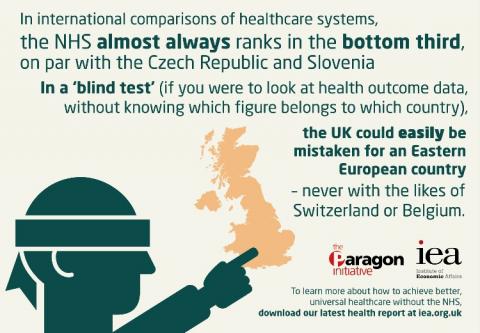
Whenever I have attempted to discuss health care, I am always told about how the US health system fails people. I am sure that this is some combination of untrue (my own experience of US health care was walking in unannounced, paying $100 and being seen and fixed straight away) and unfair. US health care is not wholly private or even very free-market at all, and suffers a high level of regulation. But I do not understand enough about the details. I occasionally hear good things about other health care systems, such as Australia’s method of having people pay and then possibly having the government refund them. While I can understand that it will be hard to convince people that anarcho-capitalist health care is best, it is interesting in the UK that no changes to the structure of health care at all will be considered. Private companies must not be allowed to make a profit! Such profit can only be gained from killing patients. However the IEA have recently made an interesting strategic decision to counter-attack the knee-jerk reaction that the only alternative to the NHS is US-style health-care. What if the NHS and the US system are both weird and there are other sane and functional systems in the world? Kate Andrews has appeared on the BBC pointing this out. Guido covered it. Kate Andrews wrote a piece for the Spectator. All this is to publicise the IEA report Universal healthcare without the NHS. One thing they keep pointing out is that the NHS ranks in the bottom third of the world’s health care systems in terms of outcomes. That will need a lot of repeating if anyone still thinks it is the envy of the world.
It is also, perhaps, a much more effective strategy than attempting to convince people of the benefits of free markets up front. “Let us try to learn something from nice country X” does not require breaking down as many mental barriers as “please abandon a lifetime of carefully cultivated opinions about the unfairness of capitalism”. February 9th, 2018 | 27 comments - (Comments are closed)
The Gambling Commission has said that scantily dressed female croupiers are “unacceptable”.
[…]
“It’s about good regulation and good governance, because businesses that have a more diverse workforce are more likely to make better decisions” is one of the weirder non-sequiturs I have come across lately. It sounds like someone inputted a load of modern buzzwords into a 1980s Turing Test chatbot program. But that is a side issue. What part of the legal remit of the Gambling Commission gives it authority to regulate the style of dress of people working in the gambling trade? It is meant to protect “vulnerable people”, that is, gambling addicts or people at risk of becoming gambling addicts. It also has a role in ensuring the law regarding gambling by minors is followed. Women employees who wear sexy dresses at a gambling trade show come into neither of these categories. How dare Sarah Harrison imply that they are either vulnerable or children. How dare she lay down the law on whether their dress is “acceptable” or “unacceptable” to her, when there is no law to lay down. She exceeds her authority. February 8th, 2018 | 61 comments - (Comments are closed)
10 ‘Conservative’ Councillors (of the 12 complement) on the Town Council in the little town of Desborough in Northamptonshire have resigned after an apparent hostile response to a 400% tax rise imposed by the local council, and there is an alleged undercurrent of unpleasantness in the local reaction, perhaps the spirit of Poujard lives on.
Well, who is the bully? Is it the Council for ramping up tax by 400% from £19.10 to £96.98 per year on those who have to pay, with the sort like the Chairman, Councillor Pearce, of whom it is reported:
and then went on to say:
That’s a ‘Feck you!‘ if ever I heard one, and which I assume is a reference to the true costs coming through after some financial juggling used to disguise the costs of the Council ended (more like that later). And the article goes on, Ms Pearce said that:
So a frank expression of views and voluntarily withdrawing social interactions is shocking when you start robbing people under colour of law? Her observation?
I think that is exactly what the residents are telling you, Madam! Action and re-action, this is not bullying, it is intra-election consultation. For our more international readers, this council is about the smallest unit of local government that can levy taxes, and this council probably doesn’t need to exist, it can add a local ‘precept’ onto the taxes levied by the other local authorities, (4 layers are possible, 3 with taxing powers), all of which is loaded onto the ‘Council Tax’ bill that households pay, overall bills can be in the region of £1,200 to £2,000+ p.a. To the resigning Councillors, I say ‘Oh dear, how sad, never mind‘, and count yourselves lucky that you live in such temperate times. Meanwhile, at a County level, the County Council for Northamptonshire have spent £53,000,000 on a new headquarters, and in true Parkinson’s Law fashion, with the new HQ, matters have started to disintegrate, with spare money running out, so they have had to go to the government and tell them that they have cocked things up and run out of discretionary money to spend. So having moved into a new HQ in October 2017, they are now looking to sell it to keep themselves going (by which they mean ‘sell it to a company who will lease it back to them, so that they can squander the capital and saddle locals with rent charges’ rather than ‘downsize and cut costs’). It’s just as well that the entire County is not rising up to berate the County Councillors, but perhaps the whole thing is too complicated and remote for people to care. But at least the spirit of Poujade stirs from time to time, the BBC might think like Durin’s Bane, but actually more like Beorn. There is hope yet in England. And the Sage might wish to maintain a discretion on this one. Edit: an erroneous ‘r’ removed, my apologies to the Gods of Accuracy, Spelling and M Poujade, and my thanks to Appianglorius, the price of accuracy is eternal vigilance, its true. February 4th, 2018 | 31 comments - (Comments are closed)
He doesn’t mean to be a monster and I don’t want to see him as one, but in his presence my blood ran cold. I was afraid of him. I was even more afraid of the way the earnest folk in the room laughed as he joked about the unintended consequences of various programmes to clean up the act of the idiotic, self-destructive great unwashed, I realised that I might be the only one there who included himself in the category of “the people” to be shaped as opposed to the smug elite doing the shaping. No one seemed remotely concerned for the freedoms of those on the receiving end of Dr Chadwick’s mind bending, “nudging” and manipulation — the benighted mugs who ultimately pay to have such well-shod professionals sneer about them behind their backs. – Tom Paine writing an article titled ‘An unexpected encounter with a monster‘ Oh boy, do I feel Tom’s Pain (sorry). It reminds me of the following remarks I made when speaking to a rather earnest employee of Her Majesty’s government. It was at a PPE dinner at an Oxford college, filled to the rafters with pretty much the same people who filled the room where Tom Paine’s blood ran cold. As I was clearly very off-message, she had just told me that “You’re the sort of person we need to convince”: “Don’t waste your time trying to convince me its all for my own good, because the objective isn’t my good, its making sure the people in this room have power. If you keep nudging people, and you just won’t stop, eventually they’ll punch you in the face. But we both know the reason that doesn’t happen to you is because Mao’s dictum is entirely correct. Your presumed right to do what you do to the hoi polloi is embedded at an axiomatic level, you don’t have any coherent moral argument to back it up, and why should you? The only reason you can do what you do is because you keep the police force funded, which is why you don’t need to convince me of anything.” For some reason I don’t get taken to those kind of dinners any more 😆 February 2nd, 2018 | 40 comments - (Comments are closed)
|
   |
||||

All content on this website (including text, photographs, audio files, and any other original works), unless otherwise noted, is licensed under a Creative Commons License. |
|||||
Recent Comments