We are developing the social individualist meta-context for the future. From the very serious to the extremely frivolous... lets see what is on the mind of the Samizdata people.
Samizdata, derived from Samizdat /n. - a system of clandestine publication of banned literature in the USSR [Russ.,= self-publishing house]
|
Medhi Hasan, former editor of the New Statesman and now political director of the Huffington Post, writes,
Depressingly, you can draw no other conclusion from these facts than that the conspiracy theorists are winning. The deniers of global warming have come in from the cold. The “merchants of doubt”, to borrow a phrase from the science historians Naomi Oreskes and Erik Conway, seem to have perfected the dark art of “keeping the controversy alive”, sowing seeds of doubt and confusion in the minds of politicians, journalists and voters, in spite of the scientific consensus.
Thus, I use both the terms “denier” (rather than “sceptic”) and “conspiracy theorist” advisedly.
If so, Mr Hasan, you are getting bad advice. As it happens I am a “lukewarmer” but if I were as anxious about anthropogenic global warming as Mr Hasan is, the last thing I would do is make a habit of directing public insult upon the heads of people who disbelieve in it.
Not just because it is nasty to compare people to Holocaust deniers, though it is, but because you will make people wonder whether the famous consensus is based on scientific judgement or fear. As I said in 2006 and still say seven years later:
The consensus convinces because there is no good reason to suppose that so many eminent scientists are lying or deceiving themselves when they say climate change is happening. But if you give me cause to believe that departure from the consensus gets a person ostracised, then there is a good reason.
I was rather prescient, wasn’t I? I supplied in advance the answer to Mr Hasan’s next point:
As for the “conspiracy theorist” tag, let me be blunt: climate-change deniers are the biggest conspiracy theorists of all. In order to embrace the delusions of the deniers, you have to adopt the belief that tens of thousands of researchers, some of them awardwinning scientists, from across the world (not to mention the political spectrum) have conducted behind the scenes, undetected by the media, a campaign of peer-reviewed deceit in defiance of empirical data.
One does not have to believe that tens of thousands of researchers consciously carried out an organized deceit in order to become a “denier”. One only has to believe the much more likely scenario that tens of thousands of researchers separately looked around them, noted that opposing the consensus gets you compared to a Nazi and duly – and quite possibly unconsciously – followed the proverbial advice “don’t stick your neck out”.
Next time I meet up with Patrick Crozier, I will be giving him a present.
I hope that the next time we meet will be if he drops by at my place tomorrow evening. Then, Richard Carey will be giving a talk about “The English Radicals: 1640-1660”, but I believe that work commitments may prevent Patrick from being at that.
Richard Carey will be talking about:
The use and abuse of history; the period 1640-1660 as a crucible of political philosophy; Libertarianism and Republicanism and their respective myths; Those great heroes to all honest Englishmen, the libellously-labelled “Levellers”, what they stood for, their impact and influence on the development of politics in this country and America, likewise the Republicans.
As always with these talks, I expect to learn a lot. To find out more about them, click where it says “Contact” here.
The present for Patrick Crozier is this:
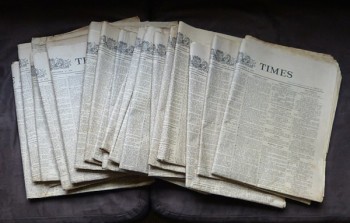
That’s twenty one ancient copies of The Times. I saw a great stash of these in a local charity shop, and, knowing Patrick’s interest in the past of this newspaper, especially when world wars are involved, I purchased one, dated May 24th 1940. I asked Patrick if he’d like this copy, and more. He expressed enthusiasm. So, yesterday I went back and bought all the rest. Originally these copies were sold for 2d. These same copies each cost me exactly as much as a copy of The Times would now cost, £1. Someone else had also had a go at the pile by then, but there were plenty left. The dates of the copies I now have are: 1939 – October 2; November 18, 20, 22, 24, 25, 27, 29; December 5, 13, 15, 19, 27; 1940 – March 27, 28; April 4, 6, 13, 17; May 24, 30.
Giving gifts to one’s friends these days is hard. Stuff worth having tends not to cost nearly as much as it used to. If a friend wants, say, some spoons, he just buys some spoons, of exactly the sort he wants. Why give him other spoons of the wrong sort? Besides which, the gift most of us would really like would not be more crap, but more space to accommodate all the crap we already have. So, when the chance occurs to give a friend a gift that they really might like, costing about the right amount in money or bother, it makes sense to grab that chance.
LATER: I’ve just discovered that what I thought was December 27th 1939 was actually September 27th 1938. Before WW2 began, in other words, which will please Patrick. There’s a big Hitler speech about Czechoslovakia.
The idea that we are living in a period that in retrospect we might call “The Crazy Years” gets an airing in this long, essay by John C. Wright. He takes the term from Robert A Heinlein’s “Future History” series of stories, written decades ago when the Grand Master of Science Fiction was not yet fully famous. (Thanks to Charles N Steele’s excellent blog for the pointer).
Steele, in his own ruminations on this, says:
Robert A. Heinlein explored a possible future history for homo sapiens. One of things he foresaw was a period at the end of the 20th Century and beginning of the 21st that he called “the Crazy Years,” in which cultural fragmentation and decay in advanced countries generates political and economic decline and social disruption. He was prescient in recognizing what happens when commonly accepted principles such as an individual’s responsibility for self are forgotten and political correctness and multiculturalism run amok. As advancing technology places increasing power in human hands, human ethics fail to keep pace. In Heinlein’s world, humans do manage to navigate these shoals without destroying themselves and eventually do settle on a MYOB sort of libertarian ethic…but only narrowly averting nuclear self-destruction and environmental self-destruction, and not without going through periods of dictatorship as well as societal chaos.
Steele then lays out a number of areas where signs of our descent into the Crazy Years might be evident:
-
Iranian or Al Qaeda religious fanatics obtaining nuclear weapons…
-
An American federal government — especially the executive branch — working to acquire unlimited power, and already apparently having the power to spy on essentially all communications, everywhere…
-
A growing segment of the population — some poor and some very rich (think Goldman Sachs) — who live as parasites on the productivity of others while creating nothing of values themselves…
-
An intelligentsia that cannot bring itself to condemn Islamism for fear of being seen as insensitive or racist or ethnocentric, but which regularly denounces, in the most hateful terms, anyone who opposes the continued expansion of state power…
-
An intelligentsia that praises socialism, hunter-gatherer economies, massive interventionism, anything but the one system that actually works, free market capitalism, a system they bitterly condemn…
-
A “press,” our mainstream media, that sees its job as promoting political positions and readily lies when lies serve this goal better than truth, and spouts nonsense the remainder of the time, apparently because reasoned analysis is too hard.
He then goes on to argue – and I hope he is right – that reasons for pessimism are perhaps overdone. For instance, who would have predicted that, after 1945, the continent of Europe (albeit apart from the Balkans in the early 90s) was free of any serious armed conflict of the sort that has routinely ravaged the region for centuries, and that the Cold War came to an end without the Soviets or NATO firing hardly a shot at one another on the continent?
I would add that in the confines of the UK, signs of craziness are evident, for example, from the political classes. Take the recent UK Labour Party conference. Labour leader Ed Milliband wants to impose a freeze on the prices that electricity companies charge their customers, while simultaneously demanding that they invest more in things such as renewable energy; his reversion to the idea of draconian price controls is pure demagoguery. Remember, dear Samizdata readers, that the Millibands of this world are quite popular with large chunks of the electorate. Labour is leading – just – the other main party – the Tories – in the opinion polls. This is what happens when, in such a crazy period as ours, that people are encouraged to think blatantly contradictory things: electricity firms must charge less but do more and invest more; banks must hold more capital in reserve but lend more; we must intervene in foreign lands but only with “surgical strikes” and nothing else; that everyone must be given access to health insurance but that the cost mustn’t rise; that we must ban opinions and notions because someone might be offended, and so on and so on.
Of course, thinking nonsense such as this is hardly new. Big business, for example, has been demonised as long as big business has existed, and political targeting of this has been almost the norm, rather than the exception. But what makes me want to think of this issue within the broader “crazy years” context is that I doubt that Milliband and his fellow socialists would be so confident of pushing these notions were it not for the rather batty political climate in which we now operate. Part of the cause for this may be a temporary reaction to the credit crunch, and the false narrative that quickly took root. But then the willingness of people to believe this narrative (which leaves out the role of central banks and government and blames it on “bankers”) is itself a sign that something is very wrong and cannot be quickly put right.
Robert Heinlein’s “future history” stories certainly do pay a re-visit. Come to that, so do pretty much all of his writings right now.
(Addendum: in case anyone brings this up, Steele could have mentioned any of the big banks as “parasites” in his list of examples. He chose Goldman Sachs, but he’s not picking on it specifically.)
Which is better? A technically superb photo of something you’ve seen many times before, like a wonderful still life oil painting? Or, a technically very average photo of something remarkable, that you never thought you’d live to see?
If you are in the mood for the second sort of photo, and you are someone who likes the kind of ideas that Samizdata seeks to spread, you should definitely take a look at this:

This is a group of Chinese people to whom Tim Evans of the Cobden Centre, seated proudly in their midst, was speaking, on Friday September 20th, about … Austrian Economics. And yes that is people from China China, not from some already strongly capitalistic outlying fragment of China.
My thanks to Simon Gibbs of Libertarian Home for telling me about this. Gibbs writes:
Tim Evans of the Austrianist Cobden Centre shared this image on Facebook. It is unclear who is visiting who but he is depicted front and centre with a delegation of Chinese officials as if he was an honoured guest or leader. Tim has been training the group in the details of Austrianism. The group worked with the Chinese State Council and the Central Committee of the Chinese Communist Party.
Of this exercise, Tim Evans writes:
Spent a great day on Friday lecturing key academic and economic advisers to the Chinese State Council and the Central Committee of the Chinese Communist Party. I regularly work with senior Chinese officials and find many of them to be increasingly well versed in the ideas of the Austrian School of Economics.
Austrian Economics is very persuasive to a certain sort of economically curious person, because it is basically a statement of how things are. It describes a world of realities which are true whether you care about or accept their truth or not. This stuff is true no matter what else you choose merely to believe. You can, in principle, understand that Austrian Economics describes how the world is, yet still believe that the world ought to be a centralised despotism or a socialist nirvana, or maybe even some combination of the two.
But, it is rather difficult to stick with such beliefs on a permanent basis. Once you accept the truths that Austrian Economics tells you, it is difficult not to find yourself believing that the world ought to be different from the tyrannical way that a lot of it still is.
I haven’t read anything by the Guardian columnist Sir Simon Jenkins for a while. He’s one of those infuriating grandees of the media who can be relied upon to say a mix of sensible things along with some jaw-dropping pieces of rubbish. Case in point in the rubbish department, regarding the mass murders by Islamists in a Kenya shopping mall (H/T, Douglas Murray in the Spectator) :
The modern urban obsession with celebrity buildings and high-profile events offers too many publicity-rich targets. A World Trade Centre, a Mumbai hotel, a Boston marathon, a Nairobi shopping mall are all enticing to extremists. Defending them is near impossible. Better at least not to create them. A shopping mall not only wipes out shopping streets, it makes a perfect terrorist fortress, near impossible to assault.
“Celebrity building”. Note the sneer. So what is Sir Simon’s suggestion: that Kenyans go back to living in all those cute little mud huts and not frequent markets where more than a handful of folk are in the vicinity, is that it? And that Westerners, or indeed anyone else, should stop going to large buildings, such as theatres, football stadiums, rock concerts, large rail stations, underground stations, skyscrapers….? We stop running marathons, or gathering for other peaceful reasons, lest nutters go on the rampage? Of course, people can choose to avoid such events and places as much as they want, but Sir Simon, a fan of planning legislation, no doubt would not draw the line at just letting people associate where they want.
It is not as if he is even consistent about this issue of density of people in certain places anyway. Jenkins and those of like minds often also decry suburbia, and wish we all went back to living in denser cities and used public transport (which tends to be more vulnerable to terrorist attacks). It is obscene in my view, as people were still dying as a result of the shootings in Kenya, that this fuckwit writes about “the modern obsession with celebrity buildings”, as if there was something almost shameful or foolish about erecting them and enjoying visits to them.
What this man is proposing is, to put it simply, a form of surrender. I remember when George Bush responded initially to 9/11 by urging people to continue shopping and enjoying life as a way to defeat the Islamists. He got criticised for this, but he was right. According to the logic of what Jenkins says, we should stop being Western, stop making big things, or glossy, flash buildings that people enjoy visiting, and revert to a smaller set of gathering places instead, at least for however long it takes before the death-cultists of Islam decide to turn their attentions elsewhere. Great. Let’s hide under our beds. (So long as the beds are not too large or ostentatious, of course.)
Of course, Jenkins is an opponent of large, modern buildings and has been banging the drum in opposition to such things as long as I can remember. But I did not think he would resort to this line of argument. What is this man going to say if a bomb is set off in one of his favourite classical pieces of architecture, I wonder?
(I have updated my item a bit to remove some clunky expressions. Insufficient coffee and anger do not make for great writing.)
The Guardian has been talking about Islamic dress for woman and I keep waiting to see someone frame this as more than just either “the state needs to ban it” or “it is a matter of freedom of choice for individuals”.
These are both useful points but they actually miss the real issue, which is allowing civil society to actually function.
Yes, I agree the state has no business telling people what they can or cannot wear other than in the most limited utilitarian circumstances (for example you should have to show your face when giving evidence in court and similar situations where identity and personal reactions to question need to be judged by a jury). So if someone wants to wear a burqua or pink rabbit slippers and a tutu or a Nazi arm band, that should be entirely up to them in almost every circumstance.
But that leads us to the real question: I support the right of people to wear whatever they wish. But I also support the right of people to react to that decision as they wish, as long as it does not involve violence or threats thereof.
The reason I mentioned a Nazi arm band in the above examples is that it is an item of clothing that is likely to produce a very negative reaction from many observers. People refusing to do business with, or offering a job to, or actively criticising someone, for wearing a Nazi arm band would strike many as acting perfectly reasonably and within their rights. Hopefully things are not yet so bad that an employer refusing to hire someone who turns up to a job interview wearing a Nazi arm band would find themselves in trouble with the law (but hey, anything is possible these days).
A ‘reasonable man’ on most juries would accept that as a Nazi arm band strongly implies that person supports Nazi values and ideology, it is perfectly reasonable to discriminate against such a person if you find those valued abhorrent, and not want such a person to represent you in the marketplace. After all, that Nazi arm band represents an ideology steeped in collectivist violence, irrational prejudice, misogyny, the complete replacement of civil society with ideologically directed interactions… in short, the totalitarian imposition of certain ways of life on everyone.
Now what else does that remind you of?
In other words, a Nazi arm band is very much like a burqua in the eyes of a great many people.
So yes, I demand that people be able to wear whatever they want without being threatened by the state. And I demand that other people be allowed to infer certain things from what others wear, and treat them accordingly, without the law preventing them from doing so.
That is right, I am in favour of people’s right to discriminate on the basis of another person’s views.
Phrenologists were once considered scientists for disseminating the hogwash that a person’s character may be determined by the shape of his head. The fad passed, but in a top-down, Government-controlled economy, where the citizenry gave to the Government the opportunity to rule its actions upon an inchoate and subjective determination (fairness), our tax dollars might still be paying phrenologists. For a government will not and cannot admit mistakes. Its members thrive through taxation and by ever widening their spheres of influence, selling influence to the highest bidder. We are still paying oil and wheat subsidies, and it is mere luck that the phrenologists of that day did not have sufficiently skilled lobbyists to ensure their own eternal subvention. You might say it is absurd to claim to determine a person’s deserts on the basis of the shape of his head. It is equally absurd to make the claim on the basis of the color of his skin.
– The Secret Knowledge, by David Mamet, page 180.
What moved Americans about Snowden was not just the scale of NSA hoovering of data – though polls indicate strong aversion – but the lying to Congress. Snowden, a Republican former soldier, was simply shocked at the clear collapse of congressional and judicial oversight. The US had lurched into aping precisely the totalitarian regimes it professed to guard against (…) Yet none of this seems to turn a hair in London. While Washington has been tearing itself apart, dismissive remarks by William Hague in the Commons and Lady Warsi in the Lords could have passed muster in Andropov’s supreme soviet. Hague said merely that everything was “authorised, necessary, proportionate and targeted”. National security was not for discussion. British oversight was “probably the strongest … anywhere in the world”. This remark – contradicted by GCHQ itself – went unchallenged.
Meanwhile Sir Malcolm Rifkind MP, head of the intelligence and security committee and supposed champion of citizens against state intrusion, positively grovelled towards GCHQ. He said we should all defer to “those involved in intelligence work”. He even cancelled a public hearing with the security chiefs for fear of embarrassing them.
For Labour, Yvette Cooper claimed obscurely she “long believed in stronger oversight” but she was drowned by a dad’s army of former defence and home secretaries, such as Lord Reid, Lord King and Jack Straw. All rallied to the securocrats’ banner in shrill unison. I sometimes think these people would bring back the rack, the whip and the gallows if “vital for national security”.
– Simon Jenkins
Fortunately Obama and assorted hard-of-thinking folks across the political spectrum in the USA seem to have backed away from becoming allies of Al Qaeda in Syria. But that means it looks like a fascinating lose-lose-win scenario is coming to pass: Al Qaeda and its allies lose, Hezbullah and its Iranian and Ba’athist allies lose, everyone else wins.
Syria’s deputy prime minister says the civil war has reached stalemate with neither side strong enough to win.
So Hezbullah and Al Qaeda are bleeding each other white in Syria in an attrition war that shows no sign of ending, and moreover this state of affairs costs us in the West not a penny.
Awesome.
I still think selling both sides ammo would be a really great idea as it would be hard to overstate the need to keep this on the boil as long as possible. Perhaps now is a good time to urge the UN to remain fixated on vital issues such as ‘climate change’ in Kazakhstan or ‘gender inequality’ in Nicaragua or ‘indigenous rights’ in Mordor or whatever, so they do not make any meaningful attempts to broker any unhelpful ceasefires.
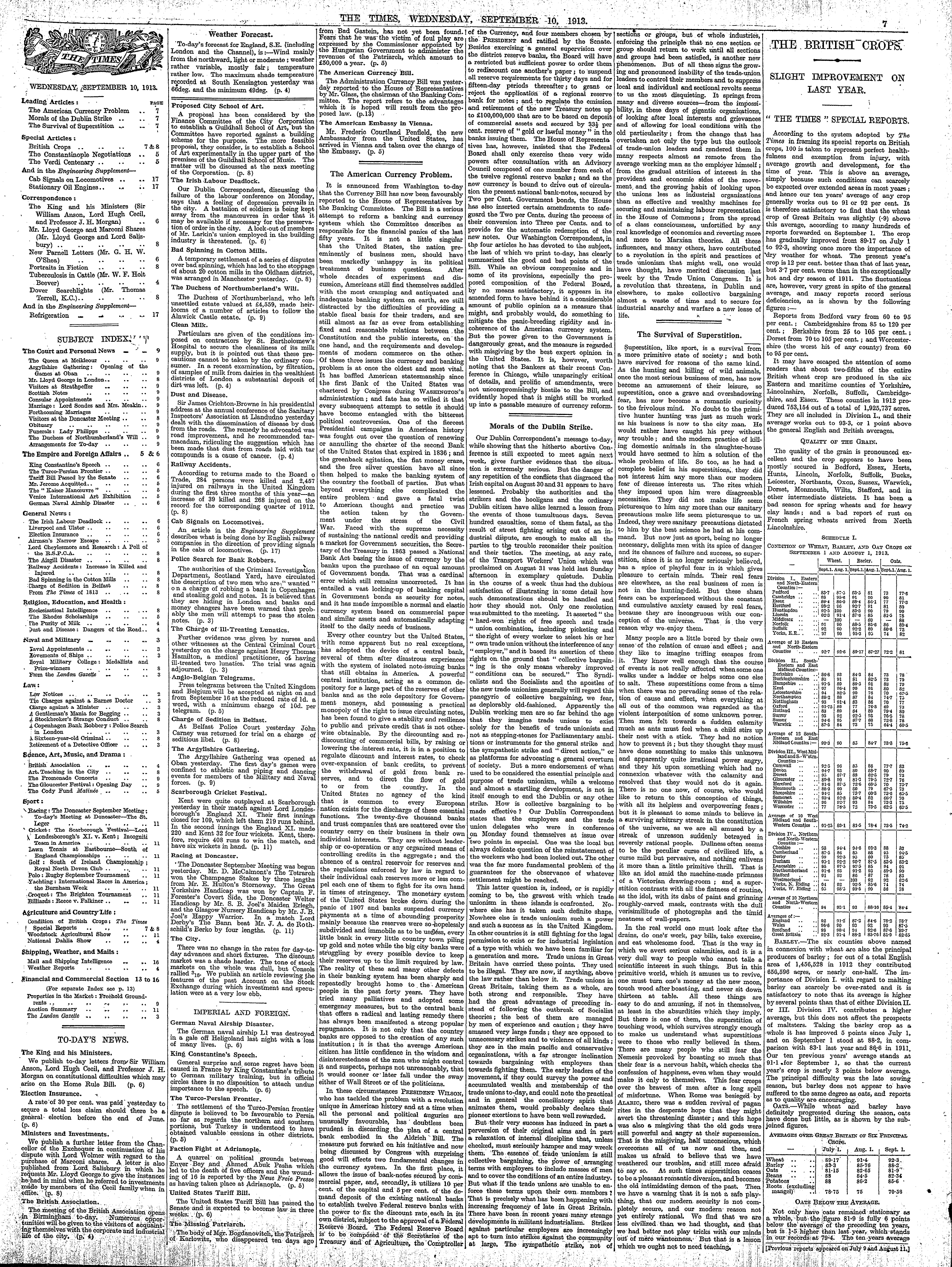
I was reading an article about the creation of the Federal Reserve Bank (boo, hiss) in 1913 and I came across this:
Faced with the supreme necessity of sustaining the national credit and providing a market for Government securities, the Secretary of the Treasury in 1863 passed a National Bank Act basing the issue of currency by the banks upon the purchase of an equal amount of Government bonds. That was a cardinal error which still remains uncorrected. It has entailed a vast locking-up of banking capital in Government bonds as security for notes, and it has made impossible a normal and elastic currency system based on commercial paper and similar assets and automatically adapting itself to the daily needs of business.
Cue utter confusion. For starters, why would a bank want to issue currency? Surely, a bank has all the money it wishes to lend out in the form of deposits. And what is meant here by currency? notes and coins or money in general?
…it has made impossible a normal and elastic currency system based on commercial paper and similar assets and automatically adapting itself to the daily needs of business.
This is really confusing. I can understand how notes work in a goldsmith system. Briefly, a depositor deposits some gold with the goldsmith and in return receives a receipt for that gold. The receipt, or note, is then capable of being used as money because it is literally “as good as gold”. I can see how government bonds might replace gold but it requires a depositor. And surely, once a depositor has deposited his bond the bank can issue its own receipts/notes rather than having anything to do with the government. Or maybe that’s illegal. Or maybe depositors would prefer to use government notes as they are accepted in more places.
“…a normal and elastic currency system”. What do they mean by “elastic”? Do they mean what modern-day Austrian economists mean i.e. inflationary? I doubt it because at the time the UK was on a gold standard which tends to be anti-inflationary [notwithstanding comments I have made about how there was some inflation at the time].
And what’s all this about commercial paper? The modern meaning is short-term business debt. I can kind of see how that would replace government bonds although presumably it would have to be extremely homogenous and what happens when the term is up?
And where, if anywhere, is the link with gold which, as I understand it, was one of the main issues in the 1896 presidential election?
Whatever the case may be it seems clear that the US monetary system was far from being a free market before the Fed came along.
One last thought: there are times when I think the confusion that monetary matters generate is deliberate rather than accidental.
 The Times 10 September 1913 page 8
Anyway, no drug, not even alcohol, causes the fundamental ills of society. If we’re looking for the source of our troubles, we shouldn’t test people for drugs, we should test them for stupidity, ignorance, greed and love of power.”
– P J O’Rourke.
|
Who Are We? The Samizdata people are a bunch of sinister and heavily armed globalist illuminati who seek to infect the entire world with the values of personal liberty and several property. Amongst our many crimes is a sense of humour and the intermittent use of British spelling.
We are also a varied group made up of social individualists, classical liberals, whigs, libertarians, extropians, futurists, ‘Porcupines’, Karl Popper fetishists, recovering neo-conservatives, crazed Ayn Rand worshipers, over-caffeinated Virginia Postrel devotees, witty Frédéric Bastiat wannabes, cypherpunks, minarchists, kritarchists and wild-eyed anarcho-capitalists from Britain, North America, Australia and Europe.
|





Recent Comments