We are developing the social individualist meta-context for the future. From the very serious to the extremely frivolous... lets see what is on the mind of the Samizdata people.
Samizdata, derived from Samizdat /n. - a system of clandestine publication of banned literature in the USSR [Russ.,= self-publishing house]
|
Politicians as a general rule are rapacious by inclination, but what really differentiates them from ‘private sector’ thugs, such as muggers, burglars and home invaders, is their breathtakingly smug sense of morality inverting entitlement to your things… a conviction that anything you ‘own’ is only done so at their sufferance.
Mr Cable’s move to back a land tax is likely to prove the most controversial. Supporters of a land tax, who outlined their case at a fringe event at the conference, say that an annual tax on the rental value of land would be fairer than levying charges on the sale of homes or on the purchase of goods through VAT. Land, they argue, “is a basic community asset” and individuals should be taxed when they claim “exclusive use” of particular plots.
In other words, you cannot ‘own’ land in reality, you can only rent it from the state, who will allow you to control their land only if you can keep paying the annual rent they decide to levy on it. Moreover the notion of taxing a non-producing asset like private residential land is tantamount to a ‘war on retirement’ and wholesale residential collectivisation. It is a literal end to the notion of freehold.
I have never understood how some credulous libertarians and conservatives have ever seen supporters of the Land Value Tax as anything other than the rapacious collectivising rent seekers that they are.
David Heaton is, or rather was, a UK government tax adviser. And he has just resigned after being filmed explaining how the tax rules work and therefore how to work the system and minimise how much you get taxed.
And moreover he had the temerity to use the phrase keeping your money “out of the Chancellor’s grubby mitts”.
In truth, I suspect this is what most annoyed the powers-that-be: not acting as it the act of taxation was somehow a self evident moral thing rather than a threat based appropriation, and refusing to accept the notion that paying as little tax as legally possible is someone immoral. There are few things states hate more than people acting as it the state does not have morality on its side.
So yes, the Chancellor’s mitts are indeed grubby.
And although I am delighted David Heaton was pointing out ways to indeed keep money out of said grubby mitts, I am less glad he was suggesting milking the system to profit at the expense of other taxpayers rather than just avoiding the rapacious hands of the state… and as he made his money from HMRC, I will lose no sleep over him having to give up his taxpayer funded job.
What follows is the final part of a series based on a talk I gave at the end of August at one of Brian’s Fridays. See also Parts I, II, III, IV. & V
When reading about the time it is impossible to be unaware that in less than a year Europe will be plunged into war. It is not as if they are unaware of the risk. Churchill, hardly a pacifist, describes the prospect as “Armageddon”. A recent series of articles have appeared in the Times under the title “Europe’s Armed Camp”.
In the 1900s, Germany began to build up its navy. Britain responded. By 1913 Germany is ready to throw in the towel. Britain has not only shown herself prepared to outbuild Germany at every step but has raised a Territorial Army to fend off a potential invasion. She has also developed plans to send an Expeditionary Force to the Continent should the need arise.
Meanwhile and simultaneously, France and Germany have both expanded their armies.
It is worth spending a little bit of time describing the political systems in Central and Eastern Europe. Germany, Austria-Hungary and Russia all had systems that were partly monarchical and partly parliamentary. In Germany the Kaiser made all the appointments. The Reichstag was elected on a wider franchise than the House of Commons i.e. universal male franchise and it had the power to block the Kaiser’s bills including the budget.
Austria-Hungary had parliaments everywhere although the Hungarian was elected on an extremely restricted franchise and there were some magnificently complicated arrangements for making decisions, such as military spending that affected the whole empire.
In the wake of the 1905 Russian Revolution, a parliament, the Duma, was elected on a universal male franchise. It had rather too many socialists for the Tsar’s liking so the franchise was narrowed until he got something more acceptable. The Duma is not entirely powerless but does not appear to have any control over the budget.
The 1905 Revolution took place in the wake of Russia’s defeat in the Russo-Japanese War. This severly weakened Russia both on land and on sea. She has been rebuilding her forces but it is a slow process.
In the absence of a strong Russia, Austria has been having a field day in the Balkans. It annexed Bosnia in 1908, created Albania to prevent Serbian access to the Adriatic and has detached Bulgaria from her alliance with Russia.
And yet Austria is worried. Historians of the period love telling us how many times Conrad von Hötzendorf, Chief of the Austrian General Staff, urged war on Serbia. The number is well into the twenties. The Serbs make no secret of their desire to add the Austrian territories of Bosnia, Croatia and Slovenia to their own. The Austrians see this has highly destabilising: should Croatia go why not Bohemia, or Slovakia, or Ruthenia?
There are some extraordinarily disturbing ideas knocking around Germany. In his book “The Next War” General Bernhardi talks about the need to smash France, curb Britain and ignore treaties and other promises into the bargain. The Prime Minister, Bethmann-Hollweg, the “Good German”, talks of a coming race war between Teuton and Slav.
In addition to threats abroad they face threats at home. The Socialists are the largest party in the Reichstag and it is becoming ever more difficult to get their army and navy bills enacted.
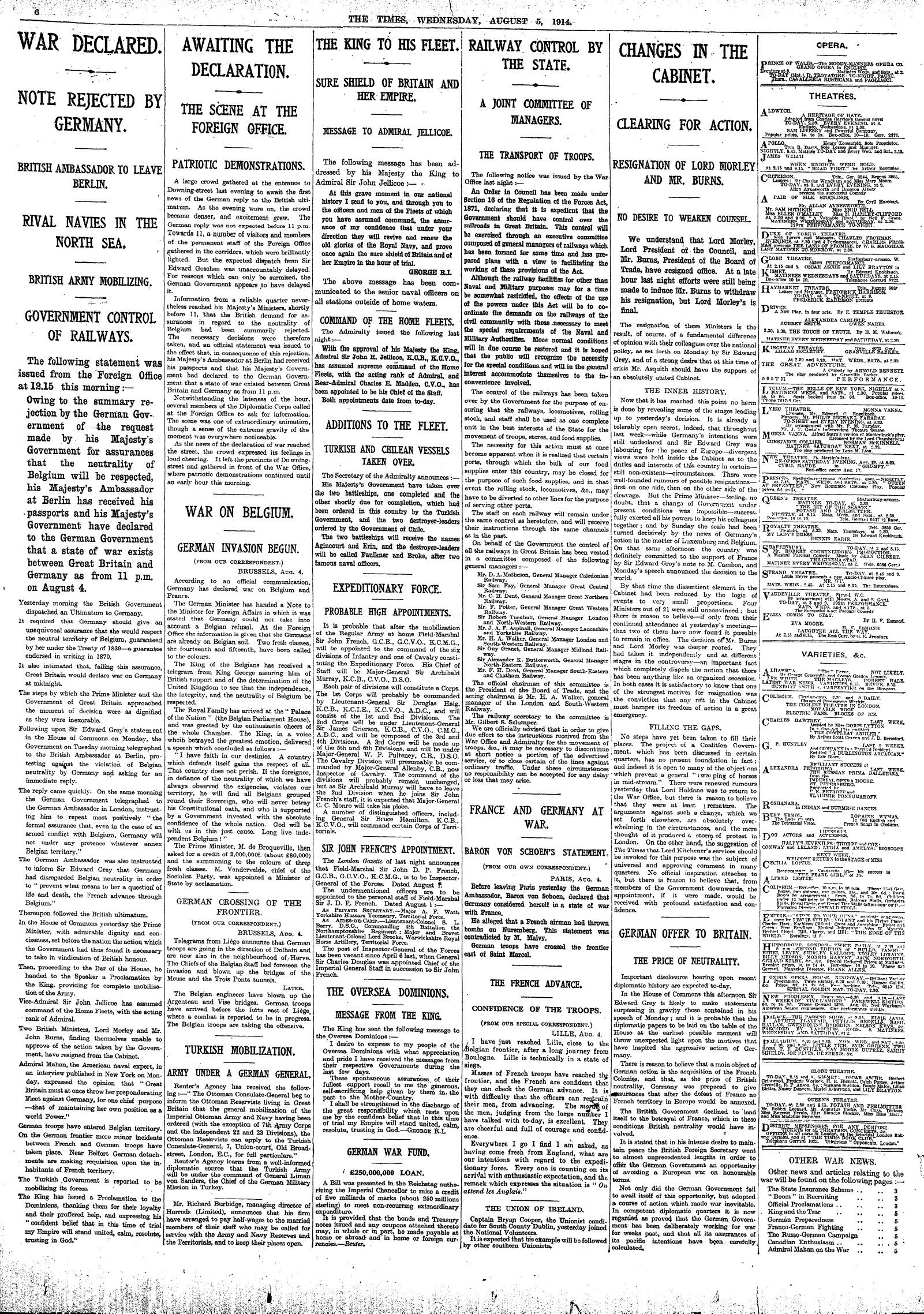
 The Times, 5 August 1914 page 6
I just got an email from the End of the World Club, about their next meeting. This will be at 6.30pm on Monday September 30th, at the Institute of Economic Affairs, London SW1.
Corrie Chipps will talk about “Lessons from Zimbabwe: A Broke Billionaire’s Survival Guide”, discussing her personal experience of watching a prosperous economy spiral into total collapse and how Zimbabweans have adapted.
Email me (click top left here, where it says “Contact”) if you are interested in this, or other EotWC meetings, and I’ll put you in touch.
I have the feeling that there might be rather more than the usual EotWC turnout for this one. Here is a case where the political and the personal overlap, big time. I for one will definitely be attending, barring disaster or memory failure, and I expect to learn a great deal.
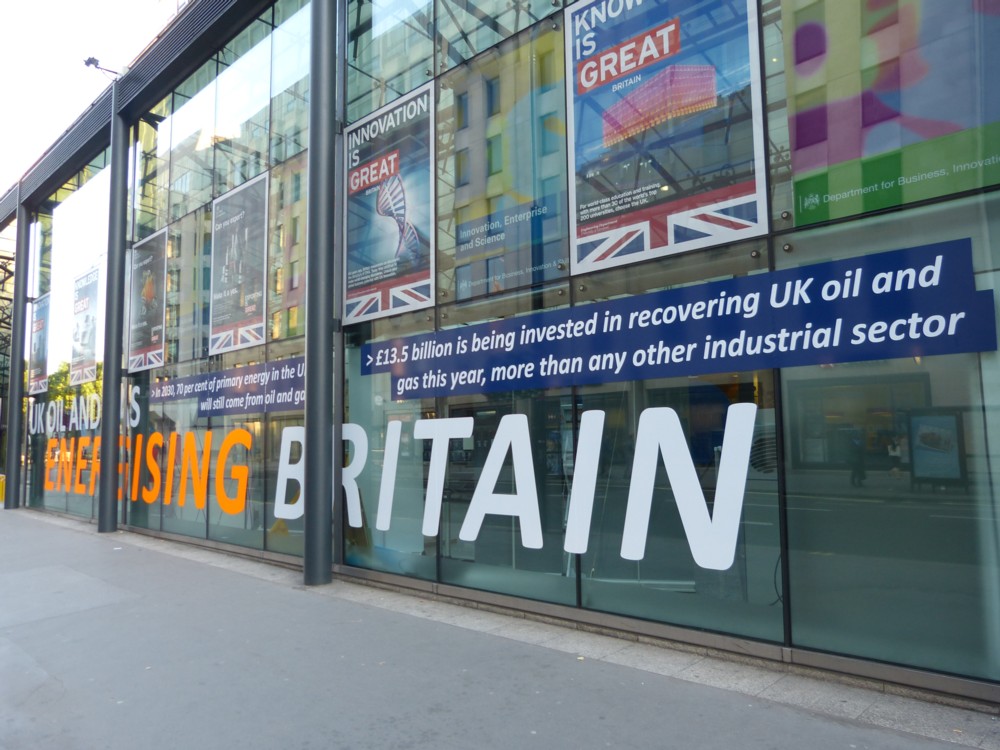
Further to yesterday’s SQotD, which was an MP dissing the Climate Change Act, I spotted this propaganda, on the big expensive greenhouse type front door, in Victoria Street near where I live, of the governmental organ that now calls itself the Department for Business Innovation & Skills:
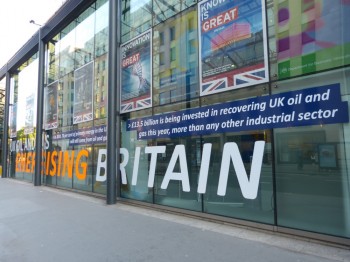
Those wanting to say that my title for this posting is nonsense won’t have to go very far to prove themselves right, in their own eyes. All they need to do is go to the Department for Business Innovation & Skills website, where they will find no prominent mentions of anything about Energising Britain with such things as oil or gas, but plenty of mentions of things like Offshore wind industrial strategy and Multi-million pound investment in offshore wind industry to unlock billions in UK economy. Unlock billions from the UK economy, more like.
I agree, sort of, in other words, with a commenter on that SQotD, who said:
Too late, the scam has been running long enough that there are now too many snouts in the trough.
The above piece of propaganda that I photoed may not be an actual lie, in the trivial sense that 13.5 billion quid may indeed be being invested in Britain this year in oil and gas, despite everything that the Department for Business Innovation & Skills may have done to discourage such investment by instead prattling on about wind farms for the last decade or more. But as an exercise in saying what the Department for Business Innovation & Skills is now concentrating on, it is a lie. The racket continues.
But this is often the way with big government bureaucracies. The truth, and a consequent forthcoming shift of policy emphasis (that later cascades into a truly new and totally different policy), often first impinges in the form of public lies about what they are now doing, even as they persist behind the scenes with the old discredited nonsense.
Never underestimate the reverse-impact of public relations departments, in the form of them telling the other people in the building what they now all ought to be doing. The collapse of the USSR, no less, began as a big old Soviet lie about how the USSR was going to start being efficient and nice and good, by doing something called “Glaznost”. It was wall-to-wall bullshit, but it was wall-to-wall bullshit that helped to change the course of history. The USSR, like “green energy”, “climate change” and so on, was another huge scam that went on for far, far too long, and by the end snouts in the trough was all it was. And the snouts only changed things when the trough was getting seriously near to totally empty. But change things they did. Millions had already died, and millions more had endured lives of utter misery, and in this sense, the change came too late, far too late. But change like that is never not worth doing. There is still a future worth improving, for many millions more.
Suppose you were a green fanatic who had weaselled your way into the Department for Business Innovation & Skills, and got yourself a job giving money stolen from British taxpayers to friends of yours who construct wind farms for a living, and emitting Niagaras of lies about how that was going to “energise Britain”. How would you feel about walking past all this stuff about oil and gas, every time you went into work in the morning?
You might think that all that lovely oil and gas tax revenue would perhaps enable you and your lying friends to keep the wind farm scam going that little bit longer, and if you did feel that, you might well be right. But I don’t think, on the whole, you’d like what you were seeing every morning. Just keeping your little scam going for a few more years until you are safely retired is hardly what you had in mind when you began it. Then, it was a cause, and you and your pals would be all over the history books, in a nice way. Now, history is looking like it might be taking a somewhat different turn.
For starters, there is no mention in this big lump of verbiage, of green, either as a word or in the form of the actual colour green. There is only a rather garish, shamelessly industrial, orange. “BRITAIN” in big letters also has a nasty, nationalistic taste to it. Whatever happened to saving the world?
More fundamentally, “oil and gas” is everything you hate. Oil and gas is vast, clunky metal structures noisily gouging dirty old energy to set fire to out of defenceless Mother Earth like it’s 1925, or if it now isn’t that, you still think it is, as do millions of others who also think: Hurrah! It’s a whole generation of people saying: Bollocks to wind farms, let’s get rich, again. It’s the whole world saying: “Climate catastrophe? Let’s not worry about that when it doesn’t happen, okay?” Despite all the wind farm idiocy that the Department for Business Innovation & Skills is still shovelling out, I think I smell change here, and for the better.
LATER: Green bloodbath in Australia.
SEE ALSO: Alex Singleton, at the ASI blog, says that Parliament’s cushy consensus over climate change is dead.
Never, under any circumstances, take a sleeping pill and a laxative on the same night.
– Lord Ashcroft, spotted by the great Guido.
Too much information? Is that being a tad too transparent? I really did LOL. I say: For once, what sounds like truly good advice from a politician.
I urge the minister, in the light of all the evidence that has come out about the lack of any change in temperature over the past 15 years, to think again about the Climate Change Act and to revoke it, amend it and support home owners and British businesses.
– David Davies MP
What follows is based on a talk I gave at the end of August at one of Brian’s Fridays. See also Parts I, II, III, IV & VI.
In 1913, Britain has an empire. A very big empire. It’s pretty peaceful, doesn’t appear to be very expensive and doesn’t appear to be very controversial. The problem is that the British have no idea what to do with it. It is, let’s face it a pretty disparate and far flung bunch of territories. About the only thing that connects them is that Britain got to them before anyone else. In 1906, the Unionists went into the general election proposing an Empire-wide common external tariff otherwise known as Imperial Preference. Given that this would have put up the price of food and given that that’s what about 50% of average incomes were spent on it is not surprising that the Liberals won by a landslide. What is surprising is that the Unionists refuse to ditch it.
There are proposals to build a Channel Tunnel. Given that it didn’t get built until 80 years later, using much better technology and at great cost, you would have thought the main concern would have been over its feasibility. But no. The main concern, or at least the one occupying the minds of the Times and its correspondents, is how an invader might use it. Could an invader take both ends? Could it be blown up? What if they put the entrance on a viaduct and blew that up? Those are the sort of questions being asked.
Some controversies and concerns will seem odd to us. A lot of space is given over to agriculture, Welsh disestablishment and the teaching of Greek.
One of the big hullabaloos is over the Olympics. Britain did not do very well in the 1912 Stockholm Olympics only coming third in the medal table. This has caused a great deal of wailing and gnashing of teeth not least from Sir Arthur Conan Doyle who feels that Britain risks losing her reputation as the “Mother of Sport”. He believes there are only three options for dealing with this catastrophe: accept the humiliation, withdraw from the Olympics entirely or create a subscription-based fund to pay for the recruitment and training of future Olympic champions. Cue letters to the Times arguing that we should withdraw as quickly as possible as the Olympics already represent a ridiculous perversion of the amateur principle.
At no point has anyone suggested that they should be using taxpayers’ money.
It was twelve years ago now, so it is no particular surprise that nobody here, as September 11th 2013 comes to its end, had much to say about September 11th 2001. But Simon Clarke of Libertarian Home does say something of significance about this tumultuous day. In a posting entitled Libertarian Home started 12 years ago today, he says this:
To say that Libertarian Home is a result of 9/11 sounds like some random happenstance, but it was not. 9/11 woke me up, and got me thinking.
9/11 woke up a lot of people. It got a lot of people thinking. A great many blogs started up soon after that day. It wasn’t merely because, at around that time, they could. In the aftermath of 9/11 people found themselves wanting to say things that the regular media were not saying, and to criticise a lot of the things that the regular media were saying.
Simon did not immediately start writing blog postings, but he did start reading blogs, including this one, which is most gratifying to know.
No one worries too much today about causing pain and suffering to our computer software (although we do comment extensively on the ability of software to cause us suffering), but when future software has the intellectual, emotional, and moral intelligence of biological humans, this will become a genuine concern.
– Ray Kurzweil, How to Create a Mind: The Secret of Human Thought Revealed. At some point a computer ceases to become property and becomes an individual.
What follows is based on a talk I gave at the end of August at one of Brian’s Fridays. See also Parts I, II, III, V & VI.
Drugs. When I was preparing this piece I was under the illusion that drugs were legal. That’s not quite the case. Since as long ago as 1868, only pharmacists could sell opium. In 1908 cocaine was put onto a similar footing. As far as I am aware there are no restrictions on cannabis. At the 1912 International Opium Convention most European states agreed to end the trade although Germany, Austria and Turkey dissented. The Convention was eventually incorporated into the Versailles Treaty.
When I started delving into the pages of the Times my assumption was that there was very little regulation. The more I read the more I realise this isn’t really true. Every train crash prompts a government-led investigation. Companies must submit returns on how many accidents there have been on their premises. Back-to-back housing has been banned. In 2000, the Telegraph reprinted and edition from 1 January 1900. Sure enough, there was a little article reminding readers that a regulation had come into force on the availability of stools for female shop workers. Having said that a few years ago I was reading up on the Regulation of the Railways Act from the 1880s. This made various demands on companies but it turned out that most companies had put these measures into place well before the law was even thought of. In other words regulation was following existing practice. It would be interesting to know if this was still a common feature in the 1910s.
In an editorial in part on the topic of drug regulation the Times of March 18 1913 had this to say. Some of the sentiments may seem familiar:
There is an increasing body of nursery legislation which treats us all as if we were little boys to whom the contents of the cupboard must be doled out by the governess. However deplorable it may be, we are driven to confess from time to time that a strong case has been made out for some additional restriction. The thing has gone so far that there is a section of the public in love with restriction for its own sake. They are always looking for an excuse to forbid something or other, and naturally take the most sensational view of any evil that can be discovered. They would be unhappy in the perfect world which they think they desire, because they would have nothing to forbid. They would rather leave a man with a depraved appetite and forbid him to indulge it, than educate the man out of the appetite altogether. That is diametrically opposed to all that makes for true freedom and progressive citizenship. But, if men and women will not master and obey the laws of life, no political arrangements can make them free, and there is nothing for it but the locked cupboard and the policeman.
Mind you they’re not always banning things. In 1910, an explosion at the Pretoria Pit near Bolton killed over 300 miners. While there was a great deal of sympathy expressed there was very little suggestion that this was a problem to which the solution was more state regulation.
There is an organisation called the Liberty and Property Defence League – incidentally, based just around the corner from the current-day Adam Smith Institute – which occasionally gets letters into the papers and another called the Cobden Club which mainly aims at preserving peace.
It is legal to own a gun so long as you have a licence to do so. The licences themselves cost 10 shillings. And guns get used. Ex-lovers, ex-wives, scab labourers and people hanging around having a quiet drink in a hotel bar have all become victims of 1910s gun crime. In another incident, an actor managed to get himself killed while on stage when a fellow actor, as part of the play, fired on him with blanks. Incidents like this would be shocking today and yet the murder rate was about half what it is now.
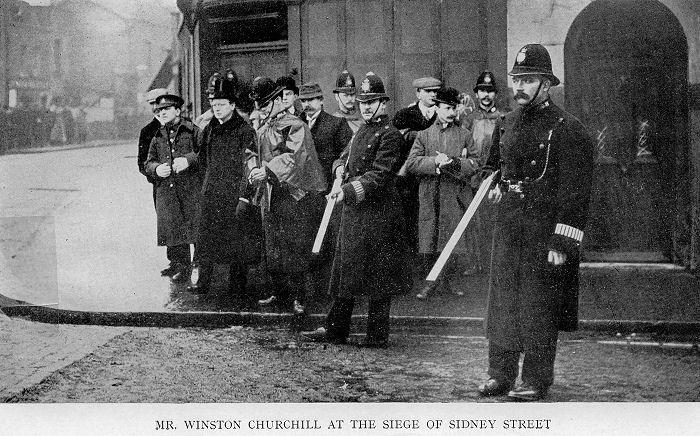
In December 1910, the police were called to a burglary in progress in Houndsditch. The burglars opened fire killing three policemen and sparking a manhunt. In what became known as the Siege of Sidney Street some of the perpetrators, believed to be East European anarchists, were tracked down. The army were called in and in an exchange of fire a bullet narrowly missed the Home Secretary, Winston Churchill.
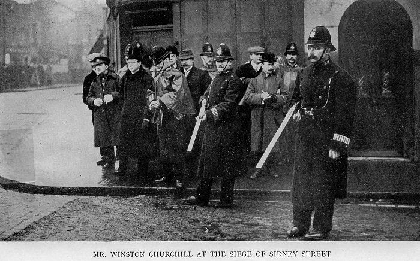 What, exactly, the policemen think they are going to achieve with those shotguns is anyone’s guess. From here. He’s not the only person to have had shots aimed at him. Edward Henry, Commissioner of the Metropolitan Police, was shot by a man he’d turned down for a taxi licence. Leopold de Rothschild had shots fired at him. But the real fun is abroad. In the years leading up to the First World War, the King of Serbia, the King of Greece, the Russian Prime Minister, the Grand Vizier of Turkey, a French President, an American President and (famously) the heir presumptive to the Austrian throne will all be assassinated. On the eve of the First World War the wife of an ex-French Prime Minister will be on trial for the shooting of a newspaper editor.
In the years following the 1905 Russian Revolution something like 2000 Tsarist officials were assassinated.
Mind you, the great and the good were just as susceptible to natural causes. In the years leading up to the First World War a US ambassador to London, a German Foreign Minister and an Austrian Foreign Minister will all die in office. The Russian ambassador to Serbia will die during the July Crisis and a British general, Grierson, will die on his way to the front. A Fortnum’s hamper was found by his side.
Court cases of all kinds tend to be over quickly and juries usually make up their minds within the hour. I suspect the fact that they aren’t paid for their time plays a large part in this. Punishments include hanging and flogging. Flogging takes two forms: the cat if they’re up to it and the birch if they are not.
One thing that still surprises me is access to these courts. Ordinary people, for instance, can and do bring libel cases.
Homosexuality is illegal but it appears to be rarely prosecuted. The word “homosexual” appears once in ten years and that is in relation to a libel case in Germany. I recently read about a blackmail case. A mother accused a merchant of “ruining” her son. I assume this is a euphemism for buggery. The merchant paid her £150 which in those days would buy you 40 ounces of gold – about £35,000 at today’s prices. A few months later the mother made further demands at which point the merchant went to the police and the mother and son were prosecuted for blackmail. At no point is there any question of the merchant being prosecuted for a criminal offence despite the fact that by his actions he’s effectively admitted to it. Could it be, that so long as you were discreet the state wasn’t that bothered?
|
Who Are We? The Samizdata people are a bunch of sinister and heavily armed globalist illuminati who seek to infect the entire world with the values of personal liberty and several property. Amongst our many crimes is a sense of humour and the intermittent use of British spelling.
We are also a varied group made up of social individualists, classical liberals, whigs, libertarians, extropians, futurists, ‘Porcupines’, Karl Popper fetishists, recovering neo-conservatives, crazed Ayn Rand worshipers, over-caffeinated Virginia Postrel devotees, witty Frédéric Bastiat wannabes, cypherpunks, minarchists, kritarchists and wild-eyed anarcho-capitalists from Britain, North America, Australia and Europe.
|





Recent Comments