We are developing the social individualist meta-context for the future. From the very serious to the extremely frivolous... lets see what is on the mind of the Samizdata people.
Samizdata, derived from Samizdat /n. - a system of clandestine publication of banned literature in the USSR [Russ.,= self-publishing house]
|
One of the ideas behind CAGW is that, even if the current CAGW scare turns out to be the great big fraudulent fuss about nothing that most of us here now believe it to be, it would be wise to have in place the political machinery for coping with any future collective human disasters of a similar sort that might require collective human action to survive them, before such a disaster really does threaten to strike, and this time for real. Better safe than sorry. Better to get prepared now. CAGW may be a lie, but this is one of several ways in which it is regarded by those pushing it as a noble lie.
Paul Murphy identifies an important weakness in such thinking. Crying wolf can make the real wolf, if he does finally show up, more rather than less dangerous:
The deeper issue here is not that the political action now strangling western economies is politically motivated, but that accepting the arguments for seeing warmism as sheer political fraud means accepting that the talking heads citing science to sell it to the masses are either deluded or dishonest – but because no wolf today doesn’t mean no wolf tomorrow, it also means that warmist politicization of the research process has to be seen as having destroyed the credibility of all involved, and thus as having greatly weakened the world’s ability to recognize and respond to a real threat should one now materialize.
Indeed.
Quite a few libertarians of my acquaintance (including, I seem to recall from comment threads here, our own Johnathan Pearce) think that libertarians, to quote the words said to me on this topic a few days ago, “miss a trick” by failing to describe what should happen in the event of such a real collective disaster. Yes, CAGW is almost certainly a lie, noble or just plain wicked. But what if something like that really does look like it really is about to happen?
My personal answer is that the decisive variable will probably not be political preparedness, but scientific and technological and economic preparedness. Not: Will we be politically organised to do the necessary? Rather: Will we be able to do the necessary? If our species suddenly finds itself facing a real collective disaster, the political will to tackle it will surely be there. What may be lacking, however, is the means to avert disaster, and even to understand it correctly. The best defence for humanity as a whole, just as it is now for the people in your town facing flood risks or tornadoes, is to be rich and clever and alert. Anything that gets in the way of that is bad.
Murphy is quite right that this ghastly CAGW episode has degraded our collective alertness. Even warnings of disaster from impeccably scrupulous scientists, utterly unconnected with the CAGW argument, will now be taken only with vast pinches of salt added.
For those who do think that political preparedness might make all the difference, I’d add that, in addition to being richer, cleverer and more alert (not least because in a free society a wider range of potential dangers will have been speculated about – e.g. by science fiction writers) than a less free society, a more free society is also more public spirited. You can never, of course, be sure, in the event of a one-off global crisis. But, when collective action really is necessary, free societies tend, quite aside from doing everything else better, to do even that better than unfree societies.
An unfree society may be great at imposing immediate unanimity, but what if what it immediately imposes unanimously is panic and indecision? (Think Stalin when Hitler attacked the USSR in 1942 1941.) And what if it then imposes a wrong decision about what needs to be done? A collectivity that is hastily assembled by freer and more independent persons is just as likely to act in a timely manner, and is far more likely to have a proper argument about what must be done, and hence to arrive at a better decision about that.
Besides which, what is often needed in a crisis is not so much collective action, but rather individual action for the benefit of the collective. That is a very different thing, and clearly a society which cultivates individuality will prepare individuals far better for such heroism than will societies where everyone is in the habit only of doing as they are told.
I will be interested to hear what commenters have to say about this.
The goal has been the same for over a decade: Total Information Awareness. The government seeks to have all the data it can possibly get, and keep tabs on every documented detail in your life. They will share this data with law enforcement agencies that have nothing to do with terrorism, which is itself a minuscule threat compared to what America faced during the Cold War.
The only way to stop this is a nationwide movement to restore the Fourth Amendment completely. No more warrantless searches—for any reason: drugs, guns, taxes, money laundering or terrorism. This system cannot be reformed, because the system, from top to bottom, is all aimed at abolishing every last bit of personal privacy.
We have been told it’s a balance between liberty and security, but look where that game has gotten us. The government wants total control. Only if we reject their entire agenda can we have any footing in restoring our liberties.
In George Orwell’s 1984, everything was monitored, except the protagonist Winston Smith did have a small corner he could hide in, where the cameras couldn’t see him. Where we’re heading, we won’t even have that corner.
– Anthony Gregory
Back in the early 1980s at Auburn University, Roger Garrison (now retired from teaching there) had to give an undergraduate student an “A” grade for an answer to a test question about minimum-wage legislation. The student endorsed the legislation precisely because the legislation prices many blacks out of the labour market – and that southern-boy student believed that consequence to be just dandy. The kid, like Unz, has values that I (and Roger Garrison) abhor. But that kid, like Unz, got the economics right.
– Don Boudreaux
“Yes, just as homeowners with guns make home invasions less likely. Given that merchant vessels have been armed for nearly all of human history, the real surprise is that anyone finds this surprising. On the other hand, the near-elimination of piracy was a major accomplishment of the two centuries of British/American naval dominance that appears to be coming to an end. This is just one small way in which the world will pay a price.”
– Glenn Reynolds, talking about the sharp fall in piracy attacks on vessels in the Indian Ocean since merchant ships began to use armed protection.
So the NSA has spied on Americans.
Guess what…
… if you are one of the approximately 6.8 billion people who do not have the ‘privilege’ of being taxed worldwide by the USA (i.e. you are not a US national), the fact the NSA has made a mockery of the US constitution is of purely academic interest.
I just watched a rather good Guardian presentation on the NSA revelations. As I watched outraged talking head after outraged talking head decrying what the US has done, and generally agreeing with them I might add, I was also struck by the fact some gave me the impression that the fact the NSA (and GCHQ) have actually intentionally damaged the infrastructure of the internet itself was not as important as the fact they had spied on Americans.
No, it really is not the main issue at all, not by a long shot.
The fact the intelligence agencies of Germany, France, Australia, Canada, New Zealand and (particularly) the UK were complicit with the NSA making us all less safe by subverting the encryption upon which our economies increasingly depend (not to mention our right to privacy), well that is a vastly bigger issue. And it is why the Snowden revelations are of global interest, not just American interest.
The First World’s security states, like the foam flecked wild horses pulling the NSA’s chariot, are out of control and that makes this a vastly bigger issue than the breaking of one country’s constitutional limitations.
If the NSA had improbably somehow managed to only spy on foreigners and not a single American, whilst introducing backdoors and flawed encryption standards world wide, it would not make this any less dire.
Michael Eisen is a biologist, who studies the fruit fly drosophila with especial interest as nearly all biologists appear to do for some reason some of our learned readers will, I hope, explain to me. In his own words,
A few weeks ago a postdoc in my lab logged on to Amazon to buy the lab an extra copy of Peter Lawrence’s The Making of a Fly – a classic work in developmental biology that we – and most other Drosophila developmental biologists – consult regularly. The book, published in 1992, is out of print. But Amazon listed 17 copies for sale: 15 used from $35.54, and 2 new from $1,730,045.91 (+$3.99 shipping).
And the price was rising steeply almost as he watched. Why? I had often wondered this myself. Not that the development of the fruit fly has generally been my first choice for a riveting read, but I did once come gulpingly close to pressing the “Buy now with 1-Click” button for Connie Long’s Easy Guide to Sewing Linings before noticing just in time that it was going for more than two hundred pounds. It is now down to a mere £86 new / £44 used. I was kind of hoping for under £10. I am an idle waster who noted the strangeness and passed on; Doctor Eisen is a research scientist. He duly researched and explained all.
Remember, remember the fifth of November
Gunpowder, treason and plot
Today is the Saturday nearest to Guy Fawkes Night. In half an hour I will be off to a fireworks party to commemorate the foiling of a dangerous Catholic plot against the realm. My Catholic family never had the slightest compunction about burning the chief conspirator in effigy. The plot was real, feasible and evil. In the years that followed, many innocent Catholics were suspected and sometimes killed for plots that were imaginary. The cry of “Popish plot” retained its power to whip up the mob for generations afterwards.
The target changes. I do not usually link to articles behind the Times paywall, but this piece by Matthew Parris, “Our need to hate creates another victim”, is so timely and true that I shall break that rule.
On Tuesday an item appeared on page five of this newspaper. Our treatment was typical of most of the national press: only The Independent put it on the front page. Fleet Street does not appear to have judged that readers would see this as a big story.
Our headline was: “ ‘Paedophile’ killed by neighbours was wrongly accused — Disabled man had photographed flower vandals”.
Bijan Ebrahimi, who lived alone and had learning difficulties, loved tending to hanging baskets of flowers outside his Bristol flat. When youths vandalised them he photographed the incident, to complain. A neighbour decided he was a paedophile, the rumours spread, and an angry crowd gathered outside his home, chanting “paedo, paedo”.
…
Every reader will be familiar with the very great difficulty we face when the burden of our advice to an anxious friend is not that a problem is imaginary but that he or she has got it out of all proportion. You are not claiming his worry is groundless; you are not even trying to make light of it. You are really just trying to get the worry into some kind of perspective. How does one strike the balance between scaling an anxiety down to size and appearing to dismiss it?
I find myself in that difficulty now, when what I want to suggest is most emphatically not that the problem of paedophilia does not exist, but that as a society we have become unhealthily obsessed by it. A kind of madness is gripping our age: I felt that as I pictured the terrified Bijan Ebrahimi, the crowd chanting “paedo, paedo” outside his flat, and nobody daring to try to protect him. And this in my own country.
…
I suppose the obvious comparisons are with the 17th and other centuries’ waves of hysteria about witchcraft, and my fellow columnist David Aaronovitch once made those comparisons bravely and powerfully on this page. But (as David acknowledged) there’s a difference: the case is easier to make when the object of the public’s fears simply doesn’t exist and never did. Paedophilia does exist, and this generation’s better understanding of how widespread it can be and what harm it can do acknowledges truths that our grandparents’ generation overlooked or ignored. If we must go back centuries for our parallels in the English imagination, maybe French spies or Popish plots are better comparisons, for these were by no means always imagined. . . but those days seem so distant.
For a public panic that some who are alive today can remember, I’d suggest we cross the Atlantic and return to the 1950s. So poisoned has Senator Joe McCarthy’s reputation become that we tend to forget that the threat to the security of the West from the USSR was probably real. There really were Communist plots, there really was an extensive network of Soviet espionage, there really were unAmerican activities, and Moscow really did hope to foment revolutionary unrest in Western nations. It’s just that McCarthy whipped the American public into a state of disproportionate fear about it all and ruined many innocent lives.
There is an article by Mark Easton on the BBC site which is a classic example of ‘conflation’.
So if buying a dodgy laptop or some smuggled cigarettes were to be regarded as socially beyond the pale, then the black market would crumble.
If offered an implausibly cheap laptop by someone, should you buy it even though you know that odds are it is almost certainly stolen?
- No, because the theft of private property is morally indefensible.
If offered implausibly cheap cartons of cigarettes by someone, should you buy them even though you know it is almost certainly smuggled in from a country that taxes them at a much lower rate than the UK?
- Yes, because the theft of private property is morally indefensible, and that includes when governments do it. Odds are they were legally purchased in France.
So here we have an example of meta-context at work again… perhaps.
Mark Easton, writing on the website of the tax funded state broadcaster, conflates the theft of private property (selling a stolen laptop) with avoiding the taxation by the state (which is to say the state taking your money). Hell, chances are the cigarettes have been taxed (in France), just at a less rapacious rate. So all that is really happening is some enterprising soul is doing a bit of arbitrage.
There is nothing moral about obediently paying whatever your political masters demand of you, but it is most certainly immoral to knowingly purchase stolen property. But these are not the same things.
It is possible that such a notion that these are quite different (which is to say he is making a category error) never even crossed Mark Easton’s mind, given that within a statist meta-context, it is an unspoken and unexamined ‘given’ that moral relationships between the state and an individual are inverted.
But then as he writes for that tax funded bastion of intrusive regulatory statism, the BBC, who knows? For all I know this may be a conscious tactic, just another example of the “But think of the children…” method.
Think of it this way…
If acquiescing to rapacious taxation and pervasive regulation of our lives were to be regarded as socially beyond the pale, then the black market would not be necessary in the first place.
Stick that in yer meta-context an’ smoke it, Mister Easton.
Two coms companies, Lavabit and Silent Circle, are working to make e-mail rather harder for the likes of the NSA to snoop on.
I would be interested to hear from our more tech savvy readers what they think of the proposals when they get more details.
The Guardian is nothing if not dependably incoherent. They rightly decry their freedom of the press being threatened by politicians…
… and then support the asinine Royal Charter that creates the tools for politicians, and anyone else, who wants the Press to STFU by making it harder for the Press to actually do their job.
I really hope many publication tell the state where to stick their ‘Royal Charter’. But then the history of these isles has many chapters featuring the struggle against state control of the media.
The Obama administration has performed the unique trick of alienating the majority of our most important allies, while at the same time causing America to be viewed as a patsy by its enemies…..The situation is bound to get worse now that the administration has taken the position that most financial institutions outside the United States are conspiring to help Americans and others avoid U.S. taxes and, thus, is attempting to require all of these foreign financial institutions to report to — and, in effect, become agents of — the Internal Revenue Service. A global revolt is brewing against the United States for being an international financial bully. The consequences of this revolt are likely to be extremely damaging and long-lasting to the nation
This is by Richard W Rahn, of the Cato Institute.
The United States has been threatening to criminally indict nonresident foreign bank executives for not complying with U.S. tax law, even in cases when the banks were not operating in this country or violating their own nation’s tax laws. This is causing great resentment, as one would expect. Each country has the right to its own tax and financial-privacy laws, whether the United States agrees or not.
Europe and most other countries prohibit capital punishment. What if other nations started indicting and imprisoning our federal or state government officials, including judges when they traveled outside of the country, for carrying out the death penalty? The point is, if the United States tries to enforce its laws on non-Americans working and living outside of the U.S. for acts that are not criminal in their home countries, it will put all Americans at risk if other countries start to retaliate, which is very likely, given the increased anger over U.S. actions.
And this:
The administration has the unmitigated gall to insult others by assuring foreign governments that all the sensitive financial information collected will be kept confidential. If the administration continues on this reckless and irresponsible course, the next president of the United States may well be forced to make an “apology” tour to most of the world’s countries for wrecking the world economy
I suppose it would be rather droll to watch the Light-bringer take to Air Force One to go on a tour grovelling to various nations for spying on them as well as putting the corrupt IRS in charge of the globe’s economy. But it isn’t going to happen under this administration, given the utter shamelessness of those involved in it. And yet those of us outside the US cannot afford to strike too many poses, since I have no doubt that given half a chance, countries in the EU, and the likes of Russia and China, would love to try to enforce extra-territorial legislation such as the US tax code if they could do so. America is not unique in this disastrous course; what is happening is that, given its still-large economic muscle, the US can do this. Most investment firms, for instance, will have some exposure to the US market to some degree and it is very hard to ignore the country. In some ways, though, the US drive, via legislation as described in the article, is a reflection in some ways of US weakness. The country is out of money, and is doing anything it can short of military invasion to get it (it could be argued that that country’s actions against Switzerland are bordering on force).
A small country behaving like this would be told, in so many words, to fuck off.
It was a breezy night last night in England, and because such times are rather rare in these islands we aren’t really organised for it. When the wind does blow a bit, there is damage. There are even deaths. Not funny.
But, this is funny. It’s a wind turbine in Devon, looking somewhat the worse for …. wind:
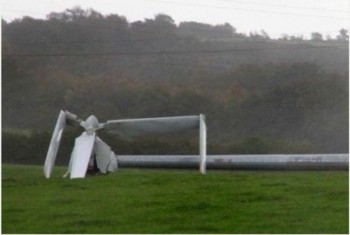
My thanks to commenter number one, on this posting at Bishop Hill today.
|
Who Are We? The Samizdata people are a bunch of sinister and heavily armed globalist illuminati who seek to infect the entire world with the values of personal liberty and several property. Amongst our many crimes is a sense of humour and the intermittent use of British spelling.
We are also a varied group made up of social individualists, classical liberals, whigs, libertarians, extropians, futurists, ‘Porcupines’, Karl Popper fetishists, recovering neo-conservatives, crazed Ayn Rand worshipers, over-caffeinated Virginia Postrel devotees, witty Frédéric Bastiat wannabes, cypherpunks, minarchists, kritarchists and wild-eyed anarcho-capitalists from Britain, North America, Australia and Europe.
|





Recent Comments