We are developing the social individualist meta-context for the future. From the very serious to the extremely frivolous... lets see what is on the mind of the Samizdata people.
Samizdata, derived from Samizdat /n. - a system of clandestine publication of banned literature in the USSR [Russ.,= self-publishing house]
|
“The insurance companies simply do not offer those plans that are being cancelled. And there’s no way they can reformulate them in the 30 days available. And anyway, killing off those plans was the whole point of the design change. They wanted to destroy “insurance” as a concept in health care and to move to something much more like pre-paid health care. Thus plans that had high deductibles (ie, catastrophic plans, aka insurance instead of assurance) had to be banned. This isn’t a mistake, an error, a flaw in the plan, it was one of the very points of it all.”
– Tim Worstall, commenting on calls by former US president Bill Clinton for efforts to be made to prevent insurance firms scrapping medical cover in the US, and hence save the face of the current Obama administration. When a politician as crooked as Clinton is seen trying to come to the rescue, you are, in non-technical terms, up shit creek sans paddling device. (Actually, given how things are going, Clinton’s era was a veritable golden age, although let’s not forget that his own “Hillarycare” reforms were shot down by the-then Congress.)
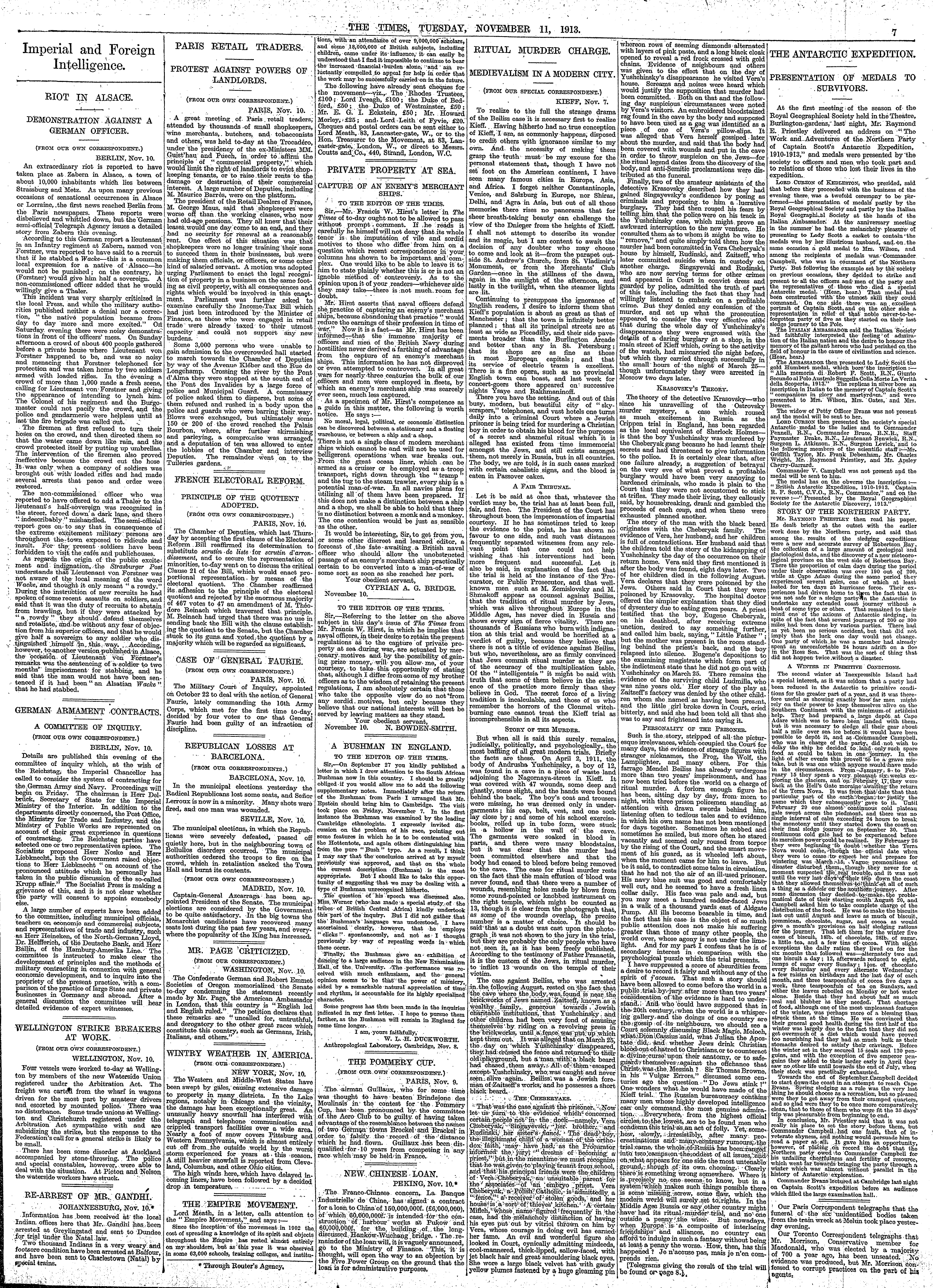
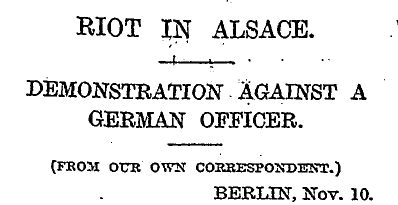 The Times 11 November 1913 p7 The Saverne Affair (or Zabern Incident) occasionally gets a mention in discussions of the origins of the First World War.
It is one of those multi-dimensional disputes in which one conflict slams into another. One of those conflicts is a straight ethnic one – familiar to anyone with a passing interest in Northern Ireland – between Germans and Frenchmen. The other is between the German military and Germany’s burgeoning democracy.
So far, a German officer has been rude (or has he?) about the Alsatians and there’s been a riot. There will be further riots followed by votes of no-confidence in the government.
The point is that it served as a reminder to the French that Alsace had been lost in 1870, while in Germany, it demonstrated that democracy was advancing at the expense of the military. I believe that fear of losing their privileges was one of the factors that led Germany’s rulers to go to war.
The first step to freeing yourself from oppressive power is to find the courage to admit that you are afraid. The more people confess to being afraid, the less reason there is to fear and the easier it is to isolate repressive forces.
– Nick Cohen, quoted by Mark Steyn here.
… the victims of the French Revolution. Today is 20th Brumaire in the year CCXXII. On this day in in Year Two, 10th November 1793 in the former calendar, the Festival of Reason was inaugurated in the Temple of Reason, before and afterwards known as the Cathedral of Notre Dame.
When reading his description of the first Festival modern readers may find it difficult to share the outrage expressed by the highly partisan nineteenth century politician and historian of the French Revolution, denounced alike by Carlyle and Marx, Adolphe Thiers. The Catholic Church under the ancien régime was oppressive and parasitical, and the Festival can seem to modern eyes like nothing much worse than an embarrassingly amateur charity pageant run by the Women’s Institute:
The first festival of Reason was held with pomp on the 20th of Brumaire (10th of November) It was attended by all the sections, together with the constituted authorities. A young woman represented the goddess of Reason. She was the wife of Momoro, the printer, one of the friends of Vincent, Bonsin, Chaumette, Hebert, and the like. She was dressed in a white drapery; a mantle of azure blue hung from her shoulders ; her flowing hair was covered with the cap of liberty. She sat upon an antique seat, intwined with ivy and borne by four citizens. Young girls dressed in white, and crowned with roses, preceded and followed the goddess. Then came the busts of Lepelletier and Marat, musicians, troops, and all the armed sections. Speeches were delivered, and hymns sung in the Temple of Reason ; they then proceeded to the Convention, and Chaumette spoke in these terms :
“Legislators ! Fanaticism has given way to reason. Its bleared eyes could not endure the brilliancy of the light. This day an immense concourse has assembled beneath those Grothic vaults, which, for the first time, re-echoed the truth. There the French have celebrated the only true worship, that of liberty, that of reason. There we have formed wishes for the prosperity of the arms of the republic. There we have abandoned inanimate idols for reason, for that animated image, the masterpiece of Nature.” As he uttered these words, Chaumette pointed to the living goddess of Reason.
Whatever the semblance, nothing about the French Revolution was harmless. The Goddess Reason ascended her throne two months into the Terror. When the Catholic peasants of the Vendée were so ungrateful for the blessings of the Goddess as to attempt counter-revolution, Momoro, the man whose wife had played the role of the Goddess, was deeply involved in its brutal suppression. Chaumette, too, was one of the leading enragés, and soppy modern “liberals” inclined to praise the Cult of Reason as an ancestor of their own views might like to read more about its teachings regarding women. Neither Momoro nor Chaumette had long to enjoy their status as founders. By spring of the next year Robespierre decided to replace the Cult of Reason with the Cult of the Supreme Being. From then on it was the People’s Front of Judea scene from Life of Brian with real deaths. The Committee of Public Safety sent Momoro to the guillotine on 24th March 1794 and Chaumette followed him on 15th April. Robespierre himself fell from power in June and was guillotined in July.
A few paragraphs later Thiers describes “restraints” being imposed on a people that he thought were unprecedented in all prior history. They were not, alas, unrepeated in subsequent history:
If then we survey the state of France at this period, we shall see that never were more restraints imposed at once on that inert and patient part of the population on which political experiments are made. People dared no longer express any opinion. They were afraid to visit their friends, lest they might be compromised with them, and lose liberty and even life. A hundred thousand arrests and some hundreds of condemnations, rendered imprisonment and the scaffold ever present to the minds of twenty-five millions of French. They had to bear heavy taxes. If, by a perfectly arbitrary classification, they were placed on the list of the rich, they lost for that year a portion of their income.
Sometimes, at the requisition of a representative or of some agent or other, they were obliged to give up their crops, or their most valuable effects in gold and silver. They durst no longer display any luxury, or indulge in noisy pleasures. They were no longer permitted to use metallic money, but obliged to take and give a depreciated paper, with which it was difficult to procure such things as they needed. They were forced, if shopkeepers, to sell at a fictitious price, if buyers, to put up with the worst commodities, because the best shunned the maximum and the assignats : sometimes, indeed, they had to do without either, because good and bad were alike concealed. They had but one sort of black bread, common to the rich as to the poor, for which they were obliged to contend at the doors of the bakers, after waiting for several hours. Lastly, the names of the weights and measures, the names of the months and days, were changed ; there were but three Sundays instead of four ; and the women and the aged men were deprived of those religious ceremonies which they had been accustomed to attend all their lives.
It was a straight road from Revolutionary France to Soviet Russia, but if you look carefully the twisty paths from there to nearly all the “political experiments” and other horrors of the twentieth century can be discerned, including the two great wars remembered today.
Don’t buy cheap gates.
– On a Top Gear repeat on Dave TV this afternoon, the celebrity guest was Sir Cliff Richard. Sir Cliff talked about the difficulty of driving out of the gates of his London estate onto the main road outside. Clarkson asked about these gates because, he said, his didn’t work properly. The above was Sir Cliff’s reply.
Wise words.
“Those French bastards. Will they never learn?”, asks Joan Smith in the Independent. And answers. By the grace of the State and in the Most Holy Name of Equality, yes! Those bastards will learn. They will be taught a lesson.
There is a bunch of well-known “bastards” in France who are keen on having sex with prostituted women. Don’t take my word for it: that’s how they describe themselves in a declaration insisting on their right to buy sex. The “bastards” (salauds in French) are so cross about a proposed law which would impose fines on men who pay for sex that they’ve decided to out themselves in a monthly magazine. The “manifesto of 343 bastards” has been signed by writers, actors, and commentators who say they have used, or are likely to use, “the services of prostitutes” – and aren’t ashamed of it.
The question of whether anyone (although it’s mostly men) should be able to buy sex is shaping up to become one of the great battles of the 21st century. France’s socialist government intends to follow the example of some Scandinavian countries, which have criminalised “punters”.
If you believe in equality, it’s hard to see why men should be allowed to pay to use women’s bodies, especially against a background of alarming levels of domestic and sexual violence.
To my astonishment the most logical riposte from among the Independent comments to Ms Smith’s last quoted non-sequitur comes from a man blogging from the bottom corner of the political diamond, conservative-socialist authoritarian David A.S. Lindsay. Mr Lindsay says,
Alike in Britain and in France, by all means let it be made a criminal offence for anyone above the age of consent, raised to 18, to buy sex. And, with exactly equal sentencing, for anyone above the age of consent, raised to 18, to sell sex. Are women morally and intellectually equal to men, or not?
So far as I can tell this is not sarcasm; he wants both buyers and sellers of sex criminalised. I differ, but one cannot fault his logic on the “both or neither” point.
Edmund from King Lear gave me the title of this post. It is mostly there because I am incapable of passing up a nifty lit ref. However it does occur to me that there is a way it might be made relevant. Many people will particularly want to cheer the way the salauds proudly snap their nicotine-stained fingers in the faces of their would-be oppressors:
Nous aimons la liberté, la littérature et l’intimité. Et quand l’Etat s’occupe de nos fesses, elles sont toutes les trois en danger.
Aujourd’hui la prostitution, demain la pornographie : qu’interdira-t-on après-demain ?
Hell, I cheered that, and I’ll be in church tomorrow and I had to look up “les fesses” in a French dictionary. (By the way, does “quand l’Etat s’occupe de nos fesses” have the double meaning I think it might have?) But it would really be nice, and principled, and a bloody good strategy for those who do not cheer, for those godly folk and their secular equivalents whose skin crawls at the thought of prostitution, to also stand up for the bastards. Because as the bastards say, “Today prostitution, tomorrow pornography: what will they forbid the day after next?”
Australia will be represented by a diplomat rather than a senior minister at international climate talks in Poland next week aimed at securing an agreement to cut global carbon emissions. Environment Minister Greg Hunt won’t attend annual United Nations climate change talks in Warsaw, saying he’ll be busy repealing the carbon tax in the first fortnight of parliament. Mr Hunt said through a spokesman that he would be “fully engaged in repealing the carbon tax” while the conference was under way.
– Ben Packham
“Whenever you listen to musicians of a certain age, they’ll always tell you how much better and more real everything was in the old days. This is only natural – because that’s when they were younger, with more energy and more dexterous fingers and a greater vocal range than they can manage today. And it’s also because if there’s one thing that obsesses them above all else, it’s authenticity: a quality, of course, that was abundant in the days when they were playing to two men and a dog in toilet venues, but which no longer applies when you’re filling stadiums.”
– James Delingpole.
Pretentiousness is one of the besetting sins of some music folk. I occasionally like to wind up my more earnest friends by pointing out that one of my favourite albums is Thriller, by Michael Jackson. This is particularly effective among more ostentatiously “conservative” types. Just watch those paleocon jaws hit the floor.
From the world of Star Wars.
Maybe Samizdata’s own Paul Marks could get one and send a death ray in the general direction of the Economist.
The latest addition to my family takes up more room in the car than expected, and the old car is dying more quickly than expected, so I want to buy a new car sooner than expected. To do this I took out a small loan, and shopping around for loans I found Zopa. The feature of their loans that attracted me was the ability to repay early without penalty.
But there is more to it than that. They are a peer to peer lender. Savers can save money with Zopa, and the money is divided into £10 chunks and spread between a large number of borrowers. I can visit a web page that shows a list of the people who have lent me money. For instance, I owe £20 to John Owen in Brighton. I get a cheaper loan, and they get higher returns on their savings than could be had from a conventional savings account.
Of course, though the credit reference checks are quite stringent, there are risks. The web site Money Saving Expert points out:
With normal UK savings, the Government-backed Financial Services Compensation Scheme promises it’d pay the first £85,000 per person, per financial institution if the institution goes kaput. Peer-to-peer lenders don’t have this.
Well, good! Peer to peer lending is about as Samizdata as it gets. Individuals are voluntarily lending their money to each other for mutual benefit, bearing the costs of their own risks. There is not even any fractional reserve banking to worry those who worry about such things. The interest rates are properly Austrian, being set by a market and not by the government. And the company called Zopa is making a profit doing the very valuable middleman job of dividing the labour by taking care of the paperwork and matching borrowers to lenders.
Zopa is a founder member of the Peer-to-Peer Financial Association, “a UK trade body set up primarily to ensure this innovative and fast growing sector maintains high minimum standards of protection for consumers and business customers”. A worthy idea: a voluntary membership organisation that enforces high standards among members thereby helping consumers decide who to trust.
On 24th October the Peer-to-Peer Financial Association issued a press release.
Christine Farnish, Chair of the Peer-to-Peer Financial Association (P2PFA) said:
“We welcome today’s consultation by the FCA on the new regulatory regime for peer to peer lending and crowd funding.”
“Peer-to-peer lenders have been pressing for regulation for some time and believe it is important that all firms entering this important new market behave responsibly, treat their customers fairly and manage their risks.”
So now they want to take all this beautiful voluntary activity and introduce state backed violence. And they think this is a good idea. I give up.
Incoming from David Thompson:
Wondered whether the discussion linked here – about art and public funding – might be of interest to Samizdata readers.
Here are some of my objections to taxpayer-funded arts subsidies:
– It is immoral to steal money to subsidise other people’s hobbies.
– The greatest art seems to happen when high art and low art combine, in the form of something that is superficially entertaining and stirring and popular, and also as profound as profundity seekers might want it to be. Arts subsidies harm art by dividing it into less good entertainment art, paid for by punters, and less good high art, paid for with subsidies. Arts subsidies in Britain are now being cut somewhat. The result will be somewhat better art.
– Arts subsidies turn art into political agitprop, in favour of subsidies for art and for everything else that the subsidising classes consider to be worthy, and at the expense of everything productive that the subsidising classes consider to be unworthy. This is why abolishing arts subsidies is politically and ideologically so much more important than the relatively small sums of money involved, compared to other subsidies, would suggest.
If you want more from me about this, see also this and this, from way back.
LATER: … and this, here, quite recently.
In my previous posting here I asked: What if there is a real collective disaster? Well, from what I’ve been reading, in the US of A now, they’ve got one. Not a day now goes by when I don’t thank the universe that I won’t have to navigate my way through Obamacare, or anything like it, any time soon.
I particularly liked this comment on it, from Peggy Noonan:
I bet America hopes the websites never work so they never have to enroll.
SQotD has already been taken, but had it not been …
I also liked the comment from a few days back (sorry don’t recall where) to the effect that the most secure thing about Obamacare is that not even the hackers are able to get into it long enough to steal anything.
A few years back, whenever one of us Brits here had a moan about the state of things in Britain, American commenters would chime in with invitations to us to give up on dear old doomed, doomed Britain, and come and live in the land of the free. There’s been less of that sort of commenting lately.
|
Who Are We? The Samizdata people are a bunch of sinister and heavily armed globalist illuminati who seek to infect the entire world with the values of personal liberty and several property. Amongst our many crimes is a sense of humour and the intermittent use of British spelling.
We are also a varied group made up of social individualists, classical liberals, whigs, libertarians, extropians, futurists, ‘Porcupines’, Karl Popper fetishists, recovering neo-conservatives, crazed Ayn Rand worshipers, over-caffeinated Virginia Postrel devotees, witty Frédéric Bastiat wannabes, cypherpunks, minarchists, kritarchists and wild-eyed anarcho-capitalists from Britain, North America, Australia and Europe.
|





Recent Comments