We are developing the social individualist meta-context for the future. From the very serious to the extremely frivolous... lets see what is on the mind of the Samizdata people.
Samizdata, derived from Samizdat /n. - a system of clandestine publication of banned literature in the USSR [Russ.,= self-publishing house]
|
I would so like to believe this video is a sick joke. The grinning idiot, swaying and bobbing around, scratching his bum, fiddling with his little red cock’s-comb topknot or bobble hat or whatever that is, rubbing his thigh while talking about the market for slaves… surely he cannot be real, cannot be serious?
Yet those who ought to know think it really is Abubakar Shekau speaking. And if it is, that is further confirmation that the abducted children have already been raped and enslaved.
Faced with Abubakar Shekau’s statement that he will sell for sexual use girls as young as nine, many of those who are usually firmly of the opinion that interference in foreign quarrels is always an evil rediscover a use for Hellfire missiles.
What should be done? Anything?
At one time Lara Pawson, inspired by the works of Basil Davidson and other British Marxists, lionized Angola’s MPLA as a “radical socialist movement that epitomised the heroism of African liberation”. I received the impression that her faith in radical socialism is diminished but not extinguished. Her faith in the MPLA is quite gone. She writes,“Angola’s brutal history, and the MPLA’s role in it, is a truth that we must tell”:
When I arrived in Luanda, the MPLA had long been – and still is – a member of the Socialist International, an organisation that claims to pursue “progressive politics for a fairer world”. I remember my pleasure on hearing politicians and other members of the urban elite calling each other camarada (comrade). Even the party rhetoric sounded remarkably similar to that of the revolutionary years of the 1970s. But a few months into my new job, when the country’s “fourth war” finally erupted, I could no longer hide from the blindingly obvious: if revolutionary politicians were what I was after, I was at least 20 years too late.
In fact, this was also wrong. I began to discover that the idea of a 1970s MPLA heyday was just as misguided. An Angolan colleague told me about 27 May 1977, the day an MPLA faction rose up against the leadership, and the honeymoon of revolution crashed to a halt. Some called it an attempted coup, but my colleague insisted it was a demonstration that was met with a brutal overreaction.
Whichever story you believe, six senior members of the MPLA were killed that day by supporters of the uprising. In response, President Neto, the politburo and the state media made many highly inflammatory statements that incited extraordinary revenge. In the weeks and months that followed, thousands of people – possibly tens of thousands – were killed. Some of the executions were overseen by Cuban troops sent to Angola by Fidel Castro to repel a South African invasion.
…
But what rattled me was that Angola-watchers on the left – intellectuals whom I admired – all seemed to have turned a blind eye to the thousands of killings. It was as if their commitment to the party was so deep that, in the end, they heard only the voices of its leaders and fell deaf to the calls from below.
That white conservatives also had their moment of disillusion regarding an Angolan liberation movement, when Jonas Savimbi of UNITA allegedly had Tito Chingunji and Wilson dos Santos executed – or when whatever really happened with that bloody business happened – is somewhat better known. The MPLA has escaped similar scrutiny, for the usual reason.
Anthony Watts of the “climate sceptic” blog Watts Up With That republished this list by Roy W. Spencer: Top Ten Skeptical Arguments that Don’t Hold Water.
Not everyone agrees with his list. It seemed reasonable to many commenters, the great majority of whom appear to be fellow members of the anti-warmist camp, but there are apparently well-informed replies from those who disagree with individual entries or with the whole concept.
As propaganda, I thought it was terrific. To strip away the bad arguments put forward by one’s own side is to demonstrate that you think your main argument will survive the process. It shows yet more confidence to anticipate that the quality of debate in the comments will not let the side down.
What bad arguments have you come across for causes or contentions that you believe in?
Benefits should be a safety net for the most vulnerable, not a lifestyle choice.
– The TaxPayers’ Alliance
To be honest I am far from convinced tax funded safety nets can ever not end up becoming a ‘lifestyle choice’ for a great many people, but all journeys start with little steps and it is a nice effective slogan.
Even the best democracies agree that when a major war approaches, democracy must be put on hold for the time being. I have a feeling that climate change may be an issue as severe as a war. It may be necessary to put democracy on hold for a while.
— James Lovelock in 2010.
The Revenge of Gaia was over the top, but we were all so taken in by the perfect correlation between temperature and CO2 in the ice-core analyses [from the ice-sheets of Greenland and Antarctica, studied since the 1980s]. You could draw a straight line relating temperature and CO2, and it was such a temptation for everyone to say, “Well, with CO2 rising we can say in such and such a year it will be this hot.” It was a mistake we all made.
— James Lovelock in 2014.
When asked what the next 100 years will be like: “That’s impossible to answer. All I can say is that it will be nowhere as near as bad as the worst-case scenario.”
Incidentally, I am skeptical that heat is disappearing into the oceans, as he now appears to think. I think it is much more likely that the positive feedback needed to achieve high sensitivity to carbon dioxide doubling simply does not exist. Nonetheless, respect is due to James Lovelock for admitting a mistake. Let’s see if the rest of the global warming movement follows suit.
“Indeed, it would be helpful if the climate scientists would tell us what weather pattern would not be consistent with the current climate orthodoxy. If they cannot do so, then we would do well to recall the important insight of Karl Popper — that any theory that is incapable of falsification cannot be considered scientific.”
– Nigel Lawson
For years, those of us who have supported mass migration, and believed in the social and economic benefits its brings, deluded ourselves. We conned ourselves into thinking we represented the majority viewpoint, and reacted with visceral anger towards anyone who dared challenge our cosy world view. And it was a disaster. We did shut down debate, which in turn created a political vacuum. One that was filled initially by the BNP, and is currently being filled by Ukip. But now the pendulum has swung back. With a vengeance. Where once everything was decried as racist, suddenly nothing is racist. Where every legitimate question about immigration was ritualistically dismissed as base prejudice, now every overt and coded racial, homophobic or misogynistic slur is deconstructed, and rationalised and legitimised.
– Dan Hodges.
He deserves credit for recognising that at one stage, a lot of supposedly right-thinking people wanted to regard anyone who challenged unfettered immigration as bigots, when they emphatically weren’t. And he’s also right that when genuinely vile sentiments are expressed, there is a sort of knee-jerk reaction from those who think of themselves as anti-Politically Correct to make excuses for such remarks. (We forget that there is a sort of right-wing version of PC group-think).
As a libertarian, I think it is always good to point out the following: Bigotry that is not backed up by state coercion (as in the apartheid regime in South Africa, Jim Crow in the US etc) is a cost to the bigot; the racist employer who refuses to hire those from certain groups imposes a cost on that business, and in a vigorous free market economy, bigotry gets weeded out over time as a result. Capitalism, and a widely dispersed system of private property, is arguably the greatest force against such attitudes that has ever existed. But I also don’t – unlike some libertarians perhaps – think it is enough to just follow the non-initiation of force principle and leave it at that. I do think that a healthy society, of the sort I want to be a part of, needs to have a critical mass of its population to be rational, tolerant and civilised. If, on the other hand, you have a society in which, say, the majority are none of those things, then even if such a society observes some of the forms of a liberal order, in practice it will be a pretty shitty place in which to live. In other words, culture, or call it what you will, does matter. A lot.
(Health warning: my quoting Hodges, who is a man of the Left, does not imply I agree with all of his views in the article I linked to.)
“A candidate in the European elections was arrested on suspicion of racial harrassment after quoting a passage about Islam, written by Winston Churchill, during a campaign speech,” reports the Daily Mail. “Paul Weston, chairman of the party Liberty GB, made the address on the steps of Winchester Guildhall, in Hampshire on Saturday. A member of the public took offence at the quote, taken from Churchill’s The River War and called police.”
Here is a link to the Mail‘s story: Arrested for quoting Winston Churchill: European election candidate accused of religious and racial harassment after he repeats wartime prime minister’s words on Islam during campaign speech.
I note that the Daily Mail had the guts to quote the Churchill passage in full but not to enable comments, whereas (opposing candidate) Daniel Hannan in the Telegraph has the guts to enable comments but not to quote the passage.
Comments to my post are enabled and the passage is below:
‘How dreadful are the curses which Mohammedanism lays on its votaries,’ wrote Churchill.
‘Besides the fanatical frenzy, which is as dangerous in a man as hydrophobia in a dog, there is this fearful fatalistic apathy.
‘The effects are apparent in many countries. Improvident habits, slovenly systems of agriculture, sluggish methods of commerce, and insecurity of property exist wherever the followers of the Prophet rule or live.
‘A degraded sensualism deprives this life of its grace and refinement; the next of its dignity and sanctity.
‘The fact that in Mohammedan law every woman must belong to some man as his absolute property – either as a child, a wife, or a concubine – must delay the final extinction of slavery until the faith of Islam has ceased to be a great power among men.
‘Thousands become the brave and loyal soldiers of the faith: all know how to die but the influence of the religion paralyses the social development of those who follow it.
‘No stronger retrograde force exists in the world. Far from being moribund, Mohammedanism is a militant and proselytizing faith.’
I wish I could claim that by both quoting the passage and enabling comments I have demonstrated political courage. I haven’t. Might I too not be arrested? I won’t be. At the moment that is not the way the process works. Mr Weston has been arrested but I doubt very much that he will ever brought to trial. Trials can so easily go wrong. In fact I suspect that he will – eventually – be in receipt of an apology and compensation for wrongful imprisonment, as was the Christian street preacher John Craven after his arrest under the Public Order Act 1986.
Mr Craven got £13,000 compensation. According to the Huffington Post article about him linked to above, “The total cost for Greater Manchester Police, including both parties’ legal bills, will be over £50,000.”. It is not clear to me whether the latter sum includes the former, but we can safely say that the total cost of arresting a man in violation of his right to free speech seems to be around £50k – £65k.
That’s peanuts for a government – and yet, the whip broke skin. The point was made. All saw, this is what happens. Cheap at the price.
It is the First of May, a date traditionally associated with Marxism. Let us therefore pause today to remember that at least 100 million people were killed by Marxist governments in the 20th century, a number that dwarfs the predations of every other organized movement in human history.
Richard Carey is a devoted student of the English Seventeenth Century and of its ideological struggles in and around the time of the Civil War. Tonight, he will be giving a talk about all this at the Rose and Crown in Southwark, and I will definitely be there.
There could hardly be a more important subject for an English libertarian. Libertarianism now has a rather American flavour. The biggest libertarian books, especially those of more recent vintage, tend to be written by Americans or at least in America. So, if it is the case (and it is) that libertarianism of the modern and self-consciously ideological sort actually has its origins in the English Seventeenth Century, then that is a fact that we English libertarians should regularly be celebrating and reflecting upon.
My own off-the-top-of-my-head take on this is that libertarianism of the sort I espouse most definitely did make its first big appearance in Seventeenth Century England, in the form of the Levellers. But the impeccably libertarian nature of this first great libertarian ideological eruption has been masked by the kinds of questions that most exercised those first English libertarians. Libertarianism now tends to be about what governments ought to do, and most especially about the many things that governments now do, but ought not to do, or at the very least to do much less. In the seventeenth century, libertarians with unswervingly libertarian views on, e.g., property rights as the correct institutional foundation of liberty, were not quite so exercised about how the government should behave, although they did have plenty to say about this. Their central concern was: Who has the right to be the government in the first place? If you do have to have some kind of government, who should choose it? The central preoccupation of those Levellers was: Where does political authority come from? If there must be government, who decides about who shall be that government?
Charles I – famously or infamously according to taste – claimed that God had chosen the government of England, in the form of … Charles I. This the Levellers, of course, challenged. But having challenged it, and the king having been executed, the question remained: If Charles I is not the legitimate ruler of England, then who is?
The Levellers were “egalitarian” in the sense that they were indeed far more egalitarian about who should be allowed to participate in that political debate, about who should govern. Political authority sprang from … everyone! When it came to deciding who the government was, everyone’s voice counted. This was the sense in which the Levellers really were, sort of, “levellers”.
But this political egalitarianism was seized upon by Seventeenth Century Royalists as evidence that the Levellers were also egalitarians in the modern sense, who believed that economic outcomes should be equalised by the government. They were accused of being socialists. There were indeed real socialists around at that time. These were the Diggers. But the Levellers had very different views to the Diggers.
Later, the Levellers were proclaimed to be socialists by another ideological tendency, namely … socialists.
The irony being that these later socialists mostly had ideas about how government should conduct itself were pretty much identical to those of Charles I. Charles I believed that the state (i.e. Charles I) had relentlessly to intervene in the market and in the workings of the wider society, in order to correct freedom’s economic and other injustices, and never mind any harmful consequences that flowed from such intervention, or “tyranny” as the Levellers called such activities. Modern socialists believe exactly the same, about themselves.
So, the Levellers, historically, have been caught in a pincer movement of lies, proclaimed by two different brands of statists. Royalist statists accused the Levellers of being socialists. Subsequent socialists claimed the Levellers as socialists. Both were wrong. But if we libertarians do not now correct these errors, nobody will.
I still recall with great pleasure the talk that Richard gave at my home last year about the ideological context within which the Levellers first arose, and the questions that they were most keen to answer. Tonight, I am hoping to learn more about the answers they gave to these questions, and, in general, about the nature of their libertarianism. Because libertarianism is most definitely what it was.
I wrote this posting in some haste, to be sure that what I wrote got posted in time to encourage at least some who otherwise might not have done to attend Richard Carey’s talk this evening. I am fully aware that the above is a highly schematic and simplified version of a very complicated story. I have, in particular, supplied no linkage to pertinent historical writings. Comments and corrections, especially with links to pertinent material, will be very welcome to me, and I’m sure to others also.
LATER: I see that in his piece about Richard (linked to above), Simon Gibbs includes yet again an earlier picture taken by me, of Richard sporting lots of hair like a down market Cavalier. Now he looks more like this:
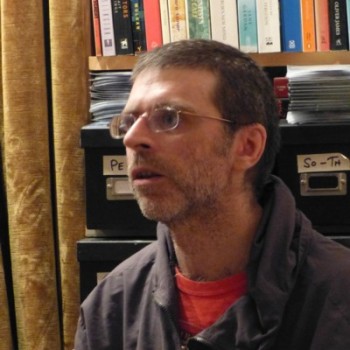
Technically, that is not a good photo, but it’s the best I can do right now.
Hair matters a lot, when it comes to Seventeenth Century English ideological disputes.
I learned about white male Princeton freshman Tal Fortgang and the unearned privilege that got him where he is via Instapundit.
I decided to take their advice. I actually went and checked the origins of my privileged existence, to empathize with those whose underdog stories I can’t possibly comprehend. I have unearthed some examples of the privilege with which my family was blessed, and now I think I better understand those who assure me that skin color allowed my family and I to flourish today.
Perhaps it’s the privilege my grandfather and his brother had to flee their home as teenagers when the Nazis invaded Poland, leaving their mother and five younger siblings behind, running and running until they reached a Displaced Persons camp in Siberia, where they would do years of hard labor in the bitter cold until World War II ended. Maybe it was the privilege my grandfather had of taking on the local Rabbi’s work in that DP camp, telling him that the spiritual leader shouldn’t do hard work, but should save his energy to pass Jewish tradition along to those who might survive. Perhaps it was the privilege my great-grandmother and those five great-aunts and uncles I never knew had of being shot into an open grave outside their hometown. Maybe that’s my privilege.
Or maybe it’s the privilege my grandmother had of spending weeks upon weeks on a death march through Polish forests in subzero temperatures, one of just a handful to survive, only to be put in Bergen-Belsen concentration camp where she would have died but for the Allied forces who liberated her and helped her regain her health when her weight dwindled to barely 80 pounds.
Read the whole thing. The fact that those telling him to “check his privilege” were wrong in their assumptions is only the beginning of his argument.
Some of these claims are false. Some reveal more truth than the writers intended:
Lowest labour cost in Asia.
Highly qualified, loyal and motivated personnel. Education, housing and health service is provided free to all citizens. As opposed to other Asian countries, worker’s will not abandon their positions for higher salaries once they are trained.
Lowest taxes scheme in Asia. Especially for high-tech factories. Typical tax exemption for the first two years.
No middle agents. All business made directly with the government, state-owned companies.
Stable. A government with solid security and very stable political system, without corruption.
Full diplomatic relations with most EU members and rest of countries.
New market. Many areas of business and exclusive distribution of products (sole-distribution).
Transparant legal work. Legal procedures, intellectual rights, patents and warranties for investors settled.
|
Who Are We? The Samizdata people are a bunch of sinister and heavily armed globalist illuminati who seek to infect the entire world with the values of personal liberty and several property. Amongst our many crimes is a sense of humour and the intermittent use of British spelling.
We are also a varied group made up of social individualists, classical liberals, whigs, libertarians, extropians, futurists, ‘Porcupines’, Karl Popper fetishists, recovering neo-conservatives, crazed Ayn Rand worshipers, over-caffeinated Virginia Postrel devotees, witty Frédéric Bastiat wannabes, cypherpunks, minarchists, kritarchists and wild-eyed anarcho-capitalists from Britain, North America, Australia and Europe.
|






Recent Comments