We are developing the social individualist meta-context for the future. From the very serious to the extremely frivolous... lets see what is on the mind of the Samizdata people.
Samizdata, derived from Samizdat /n. - a system of clandestine publication of banned literature in the USSR [Russ.,= self-publishing house]
|
Have an interesting Walpurgis Night Air traffic over Prague this time of year…
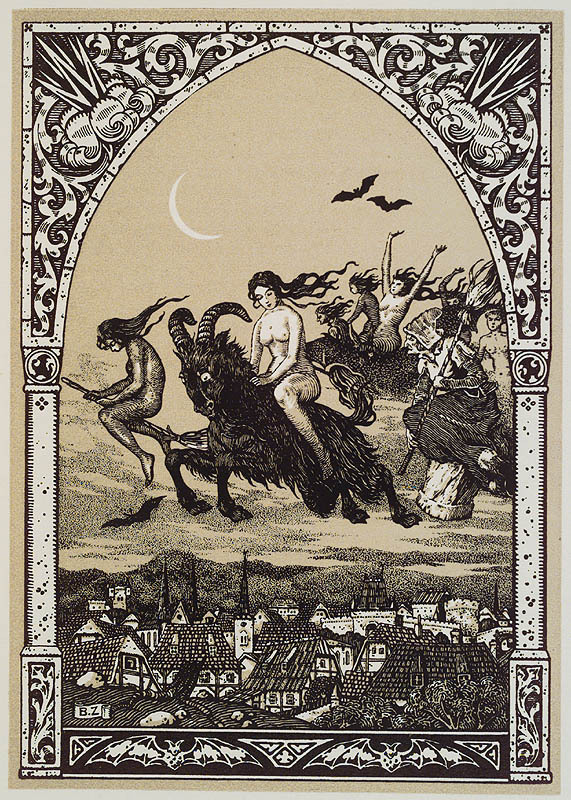
Walpurgis Night by Bernard Zuber
|
Who Are We? The Samizdata people are a bunch of sinister and heavily armed globalist illuminati who seek to infect the entire world with the values of personal liberty and several property. Amongst our many crimes is a sense of humour and the intermittent use of British spelling.
We are also a varied group made up of social individualists, classical liberals, whigs, libertarians, extropians, futurists, ‘Porcupines’, Karl Popper fetishists, recovering neo-conservatives, crazed Ayn Rand worshipers, over-caffeinated Virginia Postrel devotees, witty Frédéric Bastiat wannabes, cypherpunks, minarchists, kritarchists and wild-eyed anarcho-capitalists from Britain, North America, Australia and Europe.
|


Interesting.
And Prague has indeed been known for magic (and other such) for a very long time.
In Bavaria they will be celebrating the witch fighting saint – but I suspect (Perry will correct me if I am mistaken) that in Prague they will be celebrating the witches. And for those people who were busy last night and today – in a few days it will be the April 30 – May 1st again (by the Julian Calendar).
I must correct my error – the Germans (at least SOME Germans) seems to have turned Walpurgisnacht into a celebration of witches – rather than a celebration of a witch opposing female saint. So not just the Czechs.
With the bonfires not being about keeping the witches away – but being about the witches dancing around them.
For example the music group “Faun” which one can find on YouTube.
I apologize for my error. And it is good to see people having fun – as long as they do not take all this too seriously.
Prague has an interesting history, as I learned reading the latest blockbuster from Dan Brown earlier in the year…
It seems to me that paganism is on the rise again in the Western world.
Sooner or later it will be Christians who are being burned on bonfires.
I don’t think pagan rituals are a bit of harmless fun.
I regard both Pagan & Christian rituals as harmless fun. If you want to eat your god and drink his blood, who am I to get in the way?
@john in cheshire
I don’t think pagan rituals are a bit of harmless fun.
So like Christmas and Easter for example? They are directly linked to ancient pagan rituals and most of the activities surrounding them are directly derived from the pagan ritual. Of course they have been decorated by various Christian activities too, but that is just a dressing on a mostly pagan ritual.
FWIW, in Europe, since the emergence of Christianity, most of the burning at the stake has been done by Christian zealots, or at least those claiming to be.
Are you one of those guys who doesn’t give out candy on Halloween?
Perry – Transubstantiation is indeed a difficult one. Lutherians and Anglicans go for Consubstantiation (but do not clearly define it), and the Orthodox say “it is a mystery” – they do not go for full-on Transubstantiation. The Calvinists and others say it is just symbolic.
Tonight is Beltaine (at least according the Gregorian calendar – Pagans may prefer either the Julian calendar or the Lunar calendar) – I hope no one will be burning Christians in wicker cages.
Fraser Orr – yes Augustine opened the door to persecution by Christians (one of his many errors), but one can say “would Jesus have approved of this?” the answer being a clear NO. One great problem is that one can not use this tactic with Islam – as “would Muhammed have approved of this?” gets the clear answer “of course he would approve – he did it himself, many times”.
I remember visiting Dr Johnson’s house in London (now a museum) – and “the dictionary” was open on a table, and it was indeed open on the page containing the word “consubstantiation”.
Dr Johnson defines it as “not transubstantiation, but not just symbolic” – which tells us what it is not, but not what it is.
Walpurgis was an English princess sent over to the Continent to help Christianise the barbarians. She is big in Sweden. A crowd of 10,000 youths gathered in Gothenburg to commemorate her, per the local paper.
Mr Ed – yes indeed the lady was as you describe. I did not know that the lady was still so well known in Sweden.
@Paul Marks
“would Muhammed have approved of this?” gets the clear answer “of course he would approve – he did it himself, many times”.
I’m no fan of Muhammed, after all he did marry a six year old girl, and for someone founding a new religion, it would surely have been nice if he had been able to read and write. The Quran says he could not where he is, politely, described as an “unlettered prophet”. And of course he was a murdering thug. Though in fairness no more so than most other leaders in those days, and most of them could not read or write either.
But if we can step past Jesus for a moment, we can consider God. Would God engage in genocide? Would he kill homosexuals or women who dared to give up their virginity before marriage, or execute those who strayed from the faith by worshiping idols, or kill someone for working on the sabbath? Well he did all of those things, so you judge for yourself.
If you are familiar with the New Testament Narrative you will no doubt know there are two versions of Jesus in the Bible: the one we see in the gospels is the suffering servant who does not enforce the will of God but instead dies for the sins of the world (would God punish someone for the sins of others and call it just? Apparently so.) But there is a second version of Jesus at the second coming when he returns as a vanquishing king where the blood in the street “flows as high as a horse’s bridle”. So there is more than Jesus meek and mild in the Bible.
Of course most Christians are decent folk who wink at such Biblical atrocities and rather stick with the nice bits like “love is patient, love is kind. It does not envy”, much as most Muslims wink at the horrors in their religion and stick rather with the more pleasant parts: “do not despair of the mercy of Allah. Indeed, Allah forgives all sins’.”
Of course there are many dangerous Muslims in the world, but I vehemently refuse to judge people by their group identity.
Fraser:
But this is not about judging people by their identity, it is about judging the dangerous doctrine which is Islam as exemplified by Mohammad. It is further about warning good people – both non-Muslims and (especially) Muslims – about that danger. I would certainly support doing the same if large numbers of Christians were following that second version of Jesus (at least as you understand it) and were murdering non-supporters of it left and right all over the world. But that is not happening, so I think we should act in accordance with reality, as interesting as the various imaginary scenarios may be.
Oh, and I think Aisha was 9, not 6 😐
I had definitely more fun reading Greco-Roman and Viking mythology than reading the Pentateuch.
(The Sagas of Icelanders are even better, after growing up.)
But Christians have nothing to fear from people like me: I approve of Judeo-Christian values (as distilled in Locke’s 2nd Treatise of Government) almost as much as i approve of Viking values.
In fact, i suspect that all improvement in the human condition is due to the intersection of Judeo-Christian and Pagan (Romano-Germanic) values.
No, a god would surely follow MY morality.
(Most gods seem to be made in their followers’ self-image.)
Fraser,
“And of course he was a murdering thug. Though in fairness no more so than most other leaders in those days, and most of them could not read or write either.”
Whilst that may be true (up to a point) very, very few claimed to be “The Seal of the Prophets” and bring back the One True Faith for all of humanity for all time. They raped, they pillaged and did dreadful things but rarely did they claim to be doing it for not just divine reasons but because they were revealing the Ultimate Truth. There is a difference.
In fairness to Muhammed though he married Aisha when she was 6 (he was about 50) he did wait until she was 9…
That is from an Islamic website – Precious Gems from the Quran and Sunnah
A fundamental Islamic belief is that Muhammed was the most perfect human ever and it is righteous to emulate his actions. This is not just yet another Dark Age Warlord ranting in the wilderness – that is on a C21st website.
@Alisa
Oh, and I think Aisha was 9, not 6 😐
She was 6 when they married (he was in his fifties) and 9 when they consummated the marriage. Something that makes me feel dirty even typing it.
@NickM
There is a difference.
Sorry if I’m being dumb, but is there? What is that difference? Every murdering thug throughout history claims some justification for his actions. Every European war since the fall or Rome until modern times has been predicated on the belief in the divine right of kings, which in turn derives from a laughably weird interpretation of the Bible. Nonetheless, however delusional their justifications might have been, their swords were still as deadly.
And sorry, I missed your comment on Aisha before I said the same thing… but you documented it which was helpful.
@Snorri Godhi
In fact, i suspect that all improvement in the human condition is due to the intersection of Judeo-Christian and Pagan (Romano-Germanic) values.
You don’t think maybe the enlightenment, science, engineering, the printing press and the emergence of rational, empirical based analysis might have played at least a small part? All things that particularly Christianity was often quite opposed to, often violently so. I mean, WhatWouldJesusDo if somebody questioned the Genesis narrative of creation? Put him in jail and on the rack until he confessed his heresy no doubt.
Fraser,
I apologise. I don’t think I was clear enough about what I perceive as the difference. Muhammed is different because he was successful not just as a warlord but as presenting himself as the ultimate conduit of the word of God. So, successful that 1,400 years later he has over a billion followers. None of the other assorted warlords, princes or whatnot managed that and moreover I can’t think of a single one who achieved or even aspired to create a whole New World Order.
All of the above happened at the intersection of Judeo-Christian and Romano-Germanic values.
(Although Greek rationalism — and skepticism — also deserve a mention.)
I don’t see how Christianity can claim responsibility for the Enlightenment. Christianity became the dominant religion in Europe around the third century. The Enlightenment didn’t start until about a thousand years later.
On religious intolerance, it seems to me that Monotheism is the most prominent factor. Polytheistic religions don’t seem to have as much of a problem if other people want to worship a different set of gods.
@Snorri Godhi
All of the above happened at the intersection of Judeo-Christian and Romano-Germanic values.
Just saying it doesn’t make it true. On the contrary, the church was often very opposed to the rise of these new technologies and ideas, after all, their power comes from being able to offer an explanation of the world to people, and so science is quite simply a direct competitor. I believe it was Christopher Hitchens who described religion as humanity’s first attempt at science, philosophy, government and morality — and not really a very good one, though what can you expect from ignorant copper age tribal societies?
One only need look at that which is probably the genesis of the whole thing — printing which lead to the widespread distribution of knowledge. The church was often implacably opposed to it, many countries under the imprimatur of religion demanded the licensure of printers to facilitate censorship, people were burned at the stake for the distribution of books. And understandably so, since no doubt the Reformation was launched off the platform of the printing press. And it was that reformation, the idea that we should read the Bible for ourselves and understand it for ourselves, that is one of the roots of scientific rationalism that later overwhelmed it. It is the destruction of religions, especially the old Catholic religion that dominated Europe since Constantine that allowed the advancement of science.
Even into the Victorian age religion was a major weight around the neck of scientific advance — a perfect example was Darwin who was mocked mercilessly and called a monkey frequently in the press all on the basis that his theory did not comport with the Bible. Again, the leaps and strides of science and medicine in the 20th century only took place by people setting aside their religious beliefs and focusing instead on scientific rigor.
And I agree the ancient Greek writings were a new discovery that helped launch this scientific rationalism, though you might find it uncomfortable to find that those Greek writings were largely reintroduced into the west via Muslim scholarship, a group who kept the knowledge alive through the dark ages and released it again later to Europe. There is a reason that words like Algebra, Algorithm, Alkali, Chemistry/Alchemy, all come from Arabic words derived out of Muslim scholarship. And of course this comment on the blog is brought to you by the number zero, also invented by Muslim scholarship.
Needless to say, the Greeks were not at all monotheistic, and the Muslims were certainly not of either Judeo-Christian or Romano-Germanic values.
I’ve always had trouble getting my head around the fact that there was a time when counting systems didn’t have zero and that someone had to invent the concept and was hailed as a genius for having come up with this remarkable breakthrough. I know that these things are always easy with hindsight but this one seems so absurdly obvious that I find it really hard to imagine it having to be invented.
Q. You have three apples, a guy comes up and buys two apples from you. Later another guy comes along and buys the other apple. How many apples do you have left.
A. I have no idea, we don’t have a number for it.
Let us set aside that, in my arrogant opinion, the “enlightenment” is vastly overrated.
The fact remains that Judaism and Christianity teach respect for other people’s life, liberty, and estate.
The Vikings, notoriously, did not have such respect.
(Nor did other people whom i admire, such as the Mongols.)
BUT.
The Vikings were more willing than almost anybody else to use violence to defend their own life, liberty, and estate (LLE).
What do you expect to happen at the intersection of a civilization that teaches respect for other people’s LLE, and a civilization that urges violence against people who do not respect your own LLE?
I expect to happen exactly what did happen.
There is some truth in this. If a Viking was not pleased with Odhin, he could sacrifice to Thor or Frey instead. A monotheist has no such choice. (Although Catholics have a choice of Saints.)
OTOH you must also keep in mind that, before the Jews, people had to rely on the ruling class to tell them the will of the gods. The Jews had to obey no man, but only the (divine) Law. That was progress.
I trust that this also addresses part of Fraser’s last comment.
@Stonyground
Q. You have three apples, a guy comes up and buys two apples from you. Later another guy comes along and buys the other apple. How many apples do you have left.
A. I have no idea, we don’t have a number for it.
But saying “we have none”, is not at all the same as saying “we have zero apples”.
The main power of zero is as a placeholder for decimal arithmetic, its utility becomes obvious if you try to do arithmetic in Roman numerals.
But as to your example, I think maybe you are being a little unfair on those who didn’t have as good an education as you. Zero is a very, very odd (sic) number. It is the only number you can’t divide by for example, it is without scale (for example, zero meters is he same as zero feet, and zero seconds is the same as zero centuries) and it has many odd properties. In regards to lack of scale, it is a very odd thing. What does it mean to have “zero” apples? You have “zero” apples only in a context in which you used to have more than zero apples, because otherwise you might as well say you have zero oranges or zero orangutans. So it isn’t really like any other number in that sense, and for a long time it really offended the sensibilities of people.
Zero’s weirdness leads to a lot of confusion and has a lot of potential for error. For example consider this arithmetic proof:
Let a = b
so a² = ab (multiply both sides by a)
and a²-b² = ab – b² (subtract b² from both sides)
and (a-b)(a + b) = b(a-b) (factor both sides)
and a + b = b (divide both sides by a – b)
and b + b = b (since a = b)
and 1 = 2 (divide both sides by b)
The error here is non obvious until you realize you cannot divide by (a – b) in the 4th step because it is zero.
So we have been raised in our education to think about zero as obvious, but it is really quite unlike any other number in existence.
@Snorri Godhi
Let us set aside that, in my arrogant opinion, the “enlightenment” is vastly overrated.
He says typing on a computer with billions of transistors, powered by entirely reliable electricity, in a warm safe house, still alive having not died during either childbirth or his childhood due to the excellent medical care he received, at no risk of starvation or poverty, with easy access to a huge variety of foods, and goods at the press of a button, with a modern, sophisticated education in everything from the humanities, to the arts to the sciences, with ready access to millions of books for free, and nearly all the world’s knowledge for free on the internet, and easy access to AI to allow him to understand it all. You are so rich a king of two hundred years ago would be jealous of you.
With all due respect, saying something like that means I can’t take anything else you say seriously. I don’t know you but I do know this: you and I are among the luckiest humans who has ever lived thanks to the men and women of the enlightenment. And your lack of gratitude for that and appreciation for what they have given you for free with a cheap throw away sentence like that actually makes me feel a little sick to my stomach.
@Snorri Godhi
Let us set aside that, in my arrogant opinion, the “enlightenment” is vastly overrated.
FWIW, I should also say I recognized we all say really dumb stuff sometimes, I sure as heck do all the time (read some of my dumbest comments on this blog for plenty of examples), so I’m happy to forget you said such a dumb thing and continue to discuss matters here as before.
Paul Marks
Lutherians and Anglicans go for Consubstantiation (but do not clearly define it)
Once again you prove that you understand neither Luther nor his theology. Lutherans (note: not ‘Lutherians’) do not believe in consubstantiation. In fact, they reject it as an explanation of the Eucharist.
Given how much you have previously got wrong about Luther’s understanding of free will and now your failure to understand his doctrine of the Eucharist, it is perhaps time that you shut up about him.
My daughter bought me a book about the history of The Royal Society. Something that really struck me was the fact that, in the early days, the search for knowledge was starting almost from scratch. Some of the cleverest people that ever lived were coming together to try to solve the world’s mysteries and their general ignorance about, well everything really, was quite surprising. Within a few generations they had unravelled an enormous amount of details about how the world works and of course the industrial revolution and all of our technology was built on the foundations provided by that knowledge.
@Stonyground
My daughter bought me a book about the history of The Royal Society. Something that really struck me was the fact that, in the early days, the search for knowledge was starting almost from scratch.
I have often thought about what it would be like to arrive on earth with no education and try to work out what is going on. What does a rock sink but a tree branch float? Why does water fall from the sky? Where do rivers come from? What are those flashes and booms in the sky during a storm? Why does some things I eat nourish me and some, which look almost the same, kill me? How do women get pregnant? How do plants go from tiny seats to mighty bushes? And why do they die in winter but resurrect the next spring? Why do healthy people just die out of the blue? How does this cut on my hand heal itself? I think it is very easy to understand why, without a huge body of scientific knowledge, people sought answers in magic or divine beings, why they gathered round the fire desperate for answers and willing to accept the nonsense coming from shamans staring into animal entrails. Or why, apparently powerless against these forces of nature, they would cling to any promise of power by even sacrificing the lives of people on an altar.
These men and women of the enlightenment were amazing. I was at a University library recently and for some reason found myself in the engineering section. There was this series of books about gaskets, probably about a dozen volumes, and it struck me that the guy who wrote those books effectively dedicated his whole life to studying gaskets and consolidating that information down to make it easier for others.
And the modern world is just that. Many millions of people who have committed their whole lives to understanding one tiny piece of the puzzle and adding it to the gigantic whole. Like a enormous sand castle where a man or a woman dedicates their whole life to determining the correct placement of a single grain of sand. And we have the pure dumb luck of inheriting all that knowledge and all the engineering of products and services that that knowledge produces. Like I say, we are the luckiest humans who have ever lived.
And right now were are in the middle of what I think will be the biggest transformation, the biggest industrial revolution, in human history with AI and robotics. And we, the super lucky ones, have ring side seats to watch it play out. It really is a great time to be alive. I hope I can live long enough to see the denouement.
“…the guy who wrote those books effectively dedicated his whole life to studying gaskets…”
Maybe he had an old British motorbike.
Fraser:
Thank you, i appreciate this after your initial outburst.
But, in my arrogant opinion, said outburst is really dumb, attributing to the “enlightenment” what should be more properly attributed to the Agricultural Revolution, the Industrial Revolution, the Germ Theory of Disease, the Pax Britannica and Pax Americana, and other events that MOST people like us, “typing on a computer with billions of transistors, powered by entirely reliable electricity, in a warm safe house, still alive having not died during either childbirth or his childhood due to the excellent medical care he received, at no risk of starvation or poverty, with easy access to a huge variety of foods, and goods at the press of a button, with a modern, sophisticated education in everything from the humanities, to the arts to the sciences, with ready access to millions of books for free, and nearly all the world’s knowledge for free on the internet“, fail to appreciate; because it was dirty work, unlike the “enlightenment”, and unlike what we do.