We are developing the social individualist meta-context for the future. From the very serious to the extremely frivolous... lets see what is on the mind of the Samizdata people.
Samizdata, derived from Samizdat /n. - a system of clandestine publication of banned literature in the USSR [Russ.,= self-publishing house]
|
There is nothing new about this; it mostly started fifteen years ago, in 2001, and again the Irish were the main target. Ireland in the early 1990s had a high general corporation tax rate of 40%, but it introduced a special low 10% rate for finance companies in its Dublin-based International Financial Services Centre (IFSC). The Commission ruled that this was effectively an improper subsidy to the finance industry under the State Aid rules, and ordered its abolition.
That was really the root cause of the EU’s current row with Ireland, because the Irish response to the IFSC being declared illegal was to reduce all its corporation tax to 12.5%. Because that wasn’t targeted at a particular company or industry sector, it wasn’t illegal State Aid and so the EU Commission could do nothing to stop them, much as it wanted to.
So the EU Commission’s current action against Ireland over Apple is largely “Round Two”, a repeat of what it did fifteen years ago.
– Richard Teather
The Equation Group hack underscores the fact that the NSA is not a perfect fortress. A future leak like the Shadow Brokers’ could lead to even more harmful security vulnerabilities being made public. Or perhaps disclosure won’t happen publicly online: powerful nation-states may hack into NSA systems to steal this information–or offer significant financial compensation to insiders willing to pass on secrets–and then use it secretly. Even if that doesn’t happen, without public data on the so-called rate of “bug collision”, we have to take the NSA’s word that the security vulnerabilities it uncovers will never be discovered by an unfriendly government and used for spying, or by criminals and used for malicious hacking.
– Rainey Reitman
Alexandra Wanjiku-Kelbert, who will help train you as a socialist campaigner for three thousand quid, has done a beautiful thing. Not only has she caused the left to lie down with right on the Guardian comments pages, she has made the left to lie down with the left. Verily, the Corbynite and the Blairite shall dwell together and jointly speak trash of Ms Spellcheck-Kelbert.
Here is the article that gave rise to such wonders:
Climate change is a racist crisis: that’s why Black Lives Matter closed an airport
Today we are saying that the climate crisis is a racist crisis. On the one hand Britain is the biggest contributor per capita to global temperature change.
Those who closely follow the carbon dioxide emissions league tables (app available on Android and iOS) will have been surprised by this sudden promotion of Britain to the top spot. All will be explained if you click on the link. You will see that the figure she quotes for each nation is calculated over all time. Seriously, they are blaming Britain for having been first with the industrial revolution.
It is also one of the least vulnerable to the effects of climate change. On the other hand, seven of the 10 countries most vulnerable to climate change are in sub-Saharan Africa.
We’re not saying that climate change affects only black people. However, it is communities in the global south that bear the brunt of the consequences of climate change, whether physical – floods, desertification, increased water scarcity and tornadoes – or political: conflict and racist borders. While a tiny elite can fly to and from London City airport, sometimes as a daily commute, this year alone 3,176 migrants have died or gone missing in the Mediterranean, trying to reach safety on the shores of Europe.
Got all that? Climate change causes racist borders.
We are coming under fire for the fact that the protesters on the runway today were all white. That is not an accident.
True enough. The SWP (for it is they) can’t be fussing with their lineup of professional protesters every time there’s a black theme month.
Nobody is going to be banning meat in the near future, but that is for political reasons. There are simply too many meat eaters and not enough fanatical vegetarians. It is a question of power, not ethics, and the author of this article – vile authoritarian though he may be – inadvertently makes the libertarian argument very well. If it is the government’s business to prevent people taking voluntary, informed risks about one lifestyle choice, there is no reason to stop at smoking.
He asks whether it’s “OK to allow free choice” or “OK to prevent ‘unhealthy behaviour'”. In my view, the only moral answer is that it’s OK to allow free choice. It is not the government’s business. The author obviously disagrees, but I bet it wouldn’t take long to find something he likes doing that has been linked to cancer. At least his argument makes more sense than the scatter-gun bigotry of people who argue for state force to be used against activities they don’t like while demanding protection for those they do.
– Christopher Snowdon, from an article titled “The NHS as a tool of social control”.
There is a certain sort of Republican who hates Donald Trump so much that he regularly appends the #NeverTrump hashtag to his tweets and would much rather that Hillary Clinton won the election.
Which is fine as far as it goes. It is not as if I, personally, think Trump would make a good president. I have always found him obnoxious and he seems to have little idea of the depth of the economic crisis affecting not just the United States but the western world in general. But, hey, he would at least be amusing. And I have twenty quid on him to win.
But I am seriously turned off by a lot of the Trump hatred that goes on. Particularly because it comes from people I had hitherto regarded as ideological soulmates.
I think this is because they display so little humility. When Trump announced his bid for the Republican nomination no one gave him a prayer. He had no experience, he had no grounding beliefs, he had no connections. He didn’t even have that much money. All he had – seemingly – was his name. And yet he still won.
It was an astonishing achievement.
You really would have thought that some people might be asking themselves how he did it. How was it that in the midst of the greatest depression in history the supposedly fiscally conservative party voted for someone who went around promising to raise spending? How come even candidates like Rand Paul didn’t seem to have anything sensible to say on getting the federal budget into balance? How come that when faced with the Trump threat supposedly sensible Republicans were incapable of uniting around a single candidate?
I think there’s an interesting discussion to be had encompassing, economics, identity, the electorate’s fears and Trump’s media-savvy. But all his detractors seem able to do is to produce a stream of bile.
And this is where it all gets rather troubling. They said of the Bourbons that they had forgotten nothing and learnt nothing. The sense of entitlement prevented them from engaging in anything resembling introspection. #NeverTrumpers sound just the same. “How dare you take my unsuccessful political party away from me!” seems to be the attitude.
It’s not so much #NeverTrump as #NeverLearn.
 About to be re-named?
The BBC reports:
Bolton transgender councillor comment treated as hate incident
A comment in which a transgender Tory councillor was called “he” by a Labour rival is being treated as a hate incident by police.
Zoe Kirk-Robinson, 35, said Guy Harkin, 69, referred to her twice as a man in a debate at a Bolton Council meeting.
The hate crime ambassador, who transitioned 10 years ago, said the comments on 24 August “hurt a lot” and she reported them to police.
Mr Harkin has apologised. Police said “hate incidents are not tolerated”.
[…]
Mr Harkin said: “I inadvertently referred to her as a he during a heated debate.
“As soon as I was made aware of it, I apologised… It is something and nothing.”
A GMP spokeswoman said: “Hate incidents will not be tolerated in Greater Manchester.”
Metro takes the story further:
Councillor refuses to take punishment for calling transgender woman ‘he’ instead of ‘she’
After reporting Cllr Harkin to Greater Manchester Police, officers downgraded it to a ‘hate incident’ rather than a ‘hate crime’ and advised the pair to talk it out through a restorative justice programme.
But the former Labour mayor has refused his punishment, maintaining that his comments were just a ‘slip of the tongue.’
The political affiliations of the parties add spice to this story, don’t you think? When Tony Blair’s Labour government introduced a purely subjective definition of a racist incident following the MacPherson Report, and then in 2006 added new provisions to the Public Order Act 1986 to cover “hatred” based on sexual orientation in the same way that racial hatred had been covered before, I doubt the legislators envisaged the roles of denouncer and denouncee falling this way round. Perhaps, too, they did not envisage that things would go so far that a misspoken word would bring the police to the council chamber. I expect they were quite sure that these laws would never be used against people like them.
Class increasingly defines America’s new Culture Wars, pitting the rising power of well-educated, and self-regarding, supermen (or should I say super-people), against those they regard as less cognitively gifted. This clerisy – the media, academia, the well-funded progressive non-profits – is now waging what the Atlantic recently called ‘a war on stupid people’, which, of course, extends particularly to those who back the loutish Trump. As a group, this educated caste shares increasingly uniformly progressive social views and are almost 50 per cent more likely to be Democrats than Republicans.
There are good reasons for the new cognitive class to like the progressive status quo. Along with the corporate aristocracy who fund the Democratic Party, the hyper-educated have thrived under Obama. In contrast, the bulk of the working and middle class have seen their incomes stagnate or decline.
The new class has little stake in the traditional economy – agribusiness, energy, manufacturing, suburban home-building – that has traditionally provided decent employment to the working and middle classes. Some among them, notably the environmental zealots, even decry rising living standards for ordinary Americans as the primary threat to the environment. The entire progressive agenda increasingly constitutes an attempt to drive poverty out of the centre of cities and into the middle class. And in Trumpian fashion, they want to make the middle class, with their tax dollars, pay for the privilege.
– Joel Kotkin
“Green ownership is about having a stake in what matters, because how else are people supposed to care?”
– Caroline Lucas, usually described as Britain’s First but never Britain First’s Green MP, and recently elected along with A Bloke to be Green party co-leader.
You may ask what this means.
“It means democratising the economy, with banks to serve the people not the other way round.
Corporate taxation back under control, and financial structures that answer to you, not to the City of London and its shareholders.
We need an economy of, by and for the people.”
You see now? We need an economy by the people. Because how else are people supposed to matter?
Private businesses very seldom mount a principled defence of their behaviour. This is why libertarians like to stress that they are pro-market and not pro-business. Business people, being self-interested like anybody else, will attempt to make the most of the circumstances and the majority of them won’t hesitate in accepting legal privilege; indeed many lobby aggressively for it.
– Alberto Mingardi
I have been familiar with some of the details of a Romanian case, which has taken a shocking turn, and it highlights the mess of the European Union’s Arrest Warrant. Stephen Pollard, editor of the Jewish Chronicle, writes about the case. Even the more cynical out there will be shocked at the brazenness of the Romanian government in this case. And it raises a wider issue about governments co-operating to move alleged suspects from A to B and sharing data with one another about their citizens.
Consider a new anti-tax evasion regime called the Common Reporting Standard, under which certain governments swap data to catch alleged tax dodgers. With CRS, there is a presumption that the countries involved can move information around and that this will not compromise legitimate financial privacy. All I can say is “good luck with that”. Abuses will occur. (Governments in recent times have been happy to obtain data from Swiss banks via thieves, for example.)
The UK has an extradition treaty with the US and this has caused controversy at times because of the alleged lack of a need for a prima facie suspicion of guilt to be proven against a person before extradition (instead, a country has to show “probable cause”, which waters the test down marvellously). What may be a crime in the US, for existence (running an internet gambling site, for example) isn’t in the UK. And so on.
The Romanian case in question here is particularly noxious to a sense of justice because of the heavy-handed behaviour of Romania. Its attempt to bully news organisations that are covering controversies, such as arms dealing, is also outrageous – such an attack on freedom of the press hardly meets the sort of test one would have supposed is necessary for a country to be a member of the EU at all. And as long as this arrest warrant remains, I see zero chance of a country such as Turkey joining the EU.
I’d like to know what the UK government’s view is of the case, and of whether any MPs have taken this matter on. Theresa May, the Prime Minister, is not exactly a poster girl for civil liberty, but even she might be shocked at what is going on here. (When she was Home Secretary, she blocked an extradition of a person to the US.)
One way for Mrs May to prove that “Brexit means Brexit” is to ensure that the UK removes itself from the EU arrest warrant process immediately. The reasons why I am so glad the UK voted to get out of the whole wretched structure continue.
Addendum: As an aside, it is also worth noting that these actions by Romania are often typical of certain regimes seeking to crush alleged corruption. Much of the media will applaud this; I even spoke to a fund manager about Romania, who applauded the steps that the country has made against corruption. But as we have seen in countries such as China, anti-corruption sometimes means little more than score-settling or persecution of political opponents or those who are deemed to be embarrassing. (And needless to say, the ultimate case of this is Putin’s Russia, and Romania is to some extent under Russian influence.)
I have been buying coffee beans from Has Bean for several years. Their unique selling point is they ship the beans on the same day they are roasted, so they are really fresh. They also cater to coffee geeks by letting us choose beans by country of origin, plant variety and processing method. And they do not roast the beans too much so it is possible to taste the difference all these things make.
 A coffee roaster, complete with custom Has Bean modifications. On Sunday they had an open day at their facilities near Stafford. They simply opened the doors and did coffee cupping (i.e. tasting), brewing demonstrations, talks and tours. They threw in some real ale and nibbles for good measure. I went along.
The story goes that the boss, Steve Leighton, got fed up with his job as a prison guard and decided to turn his coffee roasting hobby into a business. After trying to sell coffee on Stafford market, he became exasperated when a customer came back to complain that the ground coffee would not dissolve in the water. It was after this that a friend suggested he tried selling coffee on the Internet.
The chief roaster, Roland Glew, after explaining exactly how the roasting is done by smell and sound of cracking, and how roasting for ten seconds too long can ruin the product, told us how speciality coffee buyers interact with farmers. Steve Leighton visits farms, gets invited into the farmers’ family homes and treated like family. Whereas once upon a time their coffee would be thrown into a bag labelled “coffee” and they would get a fixed price, Leighton can work with them to explain what people want, get them to change their methods, try new varieties of plant or different processing methods, divide up the farms differently, and generally get them to make better coffee because he is able to pay a premium for it. He is able to make assurances about how much coffee he will buy so they can safely make the needed investments, and continue to buy coffee if a farmer has a bad year because it is in his interests to keep the farm in business. Has Bean are even experimenting with what would otherwise be waste: cascara and coffee flowers.
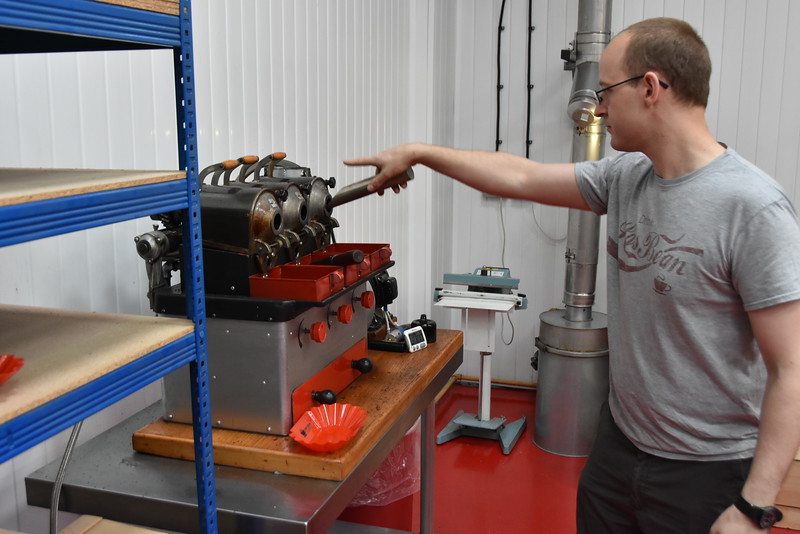
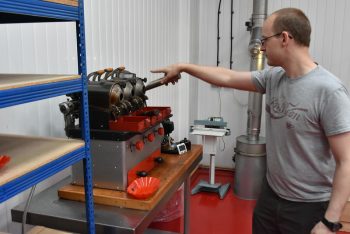 Roland demonstrating the sample roaster. This is what innovation leading to economic growth looks like. It is largely made possible by the dis-intermediation of the Internet. Geeks are all but buying coffee directly from farmers. The Internet also has a way of bringing people with weird hobbies, like getting all serious about coffee, together. An individual becomes part of a global buying market who otherwise might have been the only weirdo in town.
It is a completely different way of making poor people richer than Fair Trade, which a Department for International Development report found does not even work. Steve Leighton is not very impressed with Fair Trade, either.
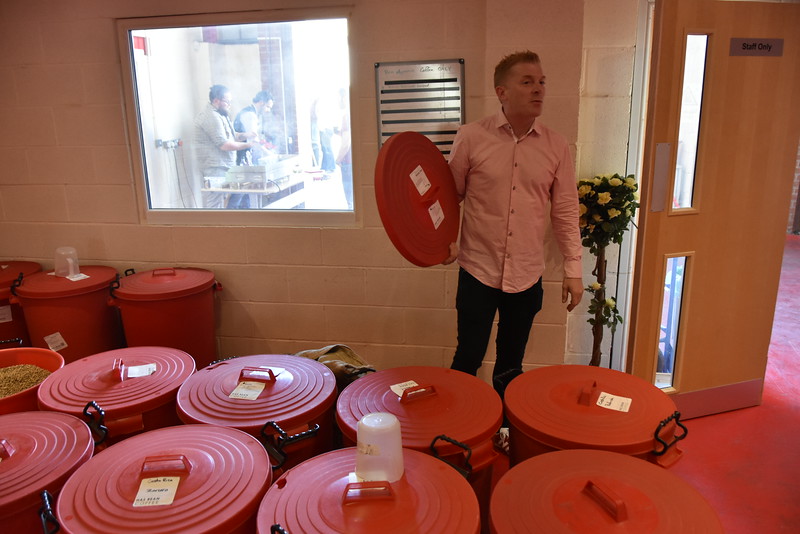
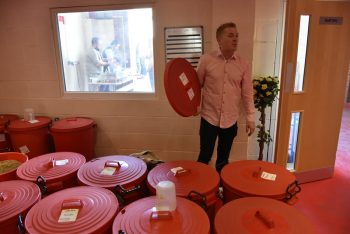 Steve doing his party trick of telling a story about any coffee variety you point to. I asked Steve how much import tariffs affect his business. He said not a lot. Thinking about it, this makes sense. Possibly one reason coffee prices are in general so low is that other things farmers could grow are hit by trade barriers. Only coffee is left. He was much more worried about the exchange rate movements since the Brexit vote.
Steve seems particularly fond of Bolivia. On the visit I heard a lot about how life is hard for Bolivian coffee farmers because the president Evo Morales is more interested in supporting coca farmers. He also told a great story about the Yungas Road, which he travels on. It was the most dangerous road in the world because vehicles would fall off of it. Then a bypass was built, but travelling on the bypass was expensive because bribes would need to be paid at checkpoints. So now Steve uses a company who run bicycle tours for tourists to get down the road.
More pictures from me, here. See and hear more from Steve in his fascinating “In My Mug” videos, like this latest one from Bolivia. You can hear more about his most recent trip to Bolivia in this Tamper Tantrum podcast.
In an astonishing EU ruling, Apple is being told the pay the Irish state €13 billion(!!!) in retrospective taxation that the Irish state never asked for. And the reply from Apple is very well crafted. It is clear they are not going to take this shakedown by the European Commission lying down.
|
Who Are We? The Samizdata people are a bunch of sinister and heavily armed globalist illuminati who seek to infect the entire world with the values of personal liberty and several property. Amongst our many crimes is a sense of humour and the intermittent use of British spelling.
We are also a varied group made up of social individualists, classical liberals, whigs, libertarians, extropians, futurists, ‘Porcupines’, Karl Popper fetishists, recovering neo-conservatives, crazed Ayn Rand worshipers, over-caffeinated Virginia Postrel devotees, witty Frédéric Bastiat wannabes, cypherpunks, minarchists, kritarchists and wild-eyed anarcho-capitalists from Britain, North America, Australia and Europe.
|






Recent Comments