We are developing the social individualist meta-context for the future. From the very serious to the extremely frivolous... lets see what is on the mind of the Samizdata people.
Samizdata, derived from Samizdat /n. - a system of clandestine publication of banned literature in the USSR [Russ.,= self-publishing house]
|
The middle classes in the UK and America are getting richer again. Inequality is diminishing. There are many problems, of course, but they are primarily down to the fact that the impact of the Great Recession ended up dragging on for years, with the previous misallocation of resources and capital wiping out a decade’s worth of productivity gains.
– Allister Heath
So why the rise of populism? While wages are finally improving, there has been no return to boom times. Millions of younger people are despairing at exploding housing costs, fuelled by government-created low supply and rock-bottom interest rates; older workers are facing a nightmarish pensions crisis, also created by ultra‑loose monetary policy.
Voters feel culturally disconnected; they rightly voted for Brexit because they realised that democratic control was being destroyed by technocratic unaccountability. The welfare state’s inherent defects mean that people feel caught up in a Hobbesian war for resources – school places, hospital beds – of all against all, especially with high levels of immigration. But the middle classes should direct their ire towards politicians and central bankers, not free markets or technology.
There are alternatives to Twitter, but it is difficult for them to gather enough users. Perhaps Gab.ai will succeed where others are failing. Its founder seems to be adept at attracting attention. This is important.
Update: Wired are calling Gab an echo chamber. This could be a bug or a feature, I suppose. Multiple such sites with various policies and good aggregation tools would not be a bad endgame.
Douglas Carswell makes some excellent points about the perils of any post-Brexit trade agreements with the EU:
So let’s spell it out. Access to the single market means being able to trade with single-market countries. Membership means being bound by single-market rules.
Why is this difference so important?
Because access is consistent with the vote to leave the EU. Membership isn’t.
Access clearly doesn’t require membership. Countries around the world trade with the single market. Many do so freely, with no tariff barriers, via bilateral free-trade agreements. Britain can do the same. We don’t need to be part of the single market to trade freely with it.
In fact, we will have freer trade once we leave the single market. Because the single market doesn’t enable commerce, but rather restricts it.
The single market is a permission-based system. It stops suppliers from selling things people want to buy unless they conform to standards set by bureaucrats in Brussels. Rather than remove trade barriers, the single market creates them. Not between countries, but between producers and consumers.
The effect is to limit competition. Big corporations with expensive lobbyists rig the rules to shut out disruptive innovation from upstart rivals. Economic progress is impeded.
Indeed, and as Peter Lilly wrote not all that long ago:
How important are trade deals? As a former trade minister it pains me to admit – their importance is grossly exaggerated. Countries succeed, with or without trade deals, if they produce goods and services other countries want. Thanks to the Uruguay Round, tariffs between developed countries now average low single figures – small beer compared with recent movements in exchange rates. So the most worthwhile trade agreements are with fast growing developing countries which still have high tariffs.
Quite so. The sooner we are out of the EU the better.
World order be damned for a corollary to world government, and I expect the waters of the world are not a problem to police if one returns to the policy of hanging pirates instead of playing catch-and-release.
– Commenter ‘Erik‘
The effort to wire the world — or to achieve “extreme reach,” in the NRO’s parlance — has cost American taxpayers more than $100 billion. Obama has justified the gargantuan expense by arguing that “there are some trade-offs involved” in keeping the country safe. “I think it’s important to recognize that you can’t have 100 percent security and also then have 100 percent privacy and zero inconvenience,” he said in June 2013, shortly after Edward Snowden, a former contractor with the National Security Agency (NSA), revealed widespread government spying on Americans’ phone calls.
Since Snowden’s leaks, pundits and experts (myself included) have debated the legality and ethics of the U.S. surveillance apparatus. Yet has the president’s blueprint for spying succeeded on its own terms? An examination of the unprecedented architecture reveals that the Obama administration may only have drowned itself in data. What’s more, in trying to right the ship, America’s intelligence culture has grown frenzied. Agencies are ever seeking to get bigger, move faster, and pry deeper to keep pace with the enormous quantity of information being generated the world over and with the new tactics and technologies intended to shield it from spies.
This race is a defining feature of Obama’s legacy — and one that threatens to become never-ending, even after he’s left the White House.
– James Bamford (£)
Globally, therefore, adoption of American farming techniques could increase agricultural productivity so much that a landmass the size of India could be returned to nature, without compromising the food supply to our apparently “peaking” global population – the world’s population is likely to peak at 8.7 billion in 2055 and then start to decline. Last, but not least, tens of millions of agricultural laborers in Africa and Asia will be freed from back-breaking labor, migrate to the cities and create wealth in other ways.
– Marian L. Tupy & Chelsea Follett
“Those who would give up essential Liberty, to purchase a little temporary Safety, deserve neither Liberty nor Safety.”
It has been fifteen years. Throughout that time most people, however much or little they valued liberty, have talked as if a loss of liberty were the price of increased security. Even Benjamin Franklin’s famous words quoted above assume this tradeoff.
What if it were not true? In what ways could more liberty bring about more safety?
In central London there is an clapped-out old building. One option would be to demolish it and replace it with something nice in steel and glass. Another option, as Michael Jennings likes to point out, would be to demolish it and replace it with tarmac. The building in question stands bang in the middle of two major thoroughfares causing a huge bottleneck.
So, what do our politicians think should be done? Well, they’re not thinking in terms of steel, glass or tarmac. They’re not even thinking of demolition. They think that £5bn of taxpayers’ money should be shelled out on its restoration. Which means it will be at least £10bn by the time they’re finished. If we’re lucky. You could build a lot of hospitals for that kind of money.
You may be familiar with the building in question:
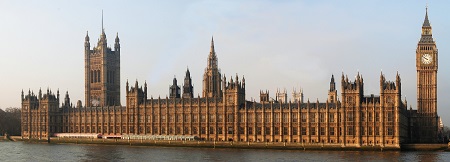
Now I accept that for the time being we have a state and that representative democracies are usually better than the alternatives. I also accept that it is probably difficult to do politics online so Parliament needs some kind of physical location. But where?
Luckily there is a place that seems to cover all the bases. It is easy to get to. There is plenty of land for development. It would take politicians out of the metropolitan bubble. And it would gently remind them of the consequences of over-regulation. Ladies and gentlemen, I give you the location of the new Mother of Parliaments:
Milton Keynes.
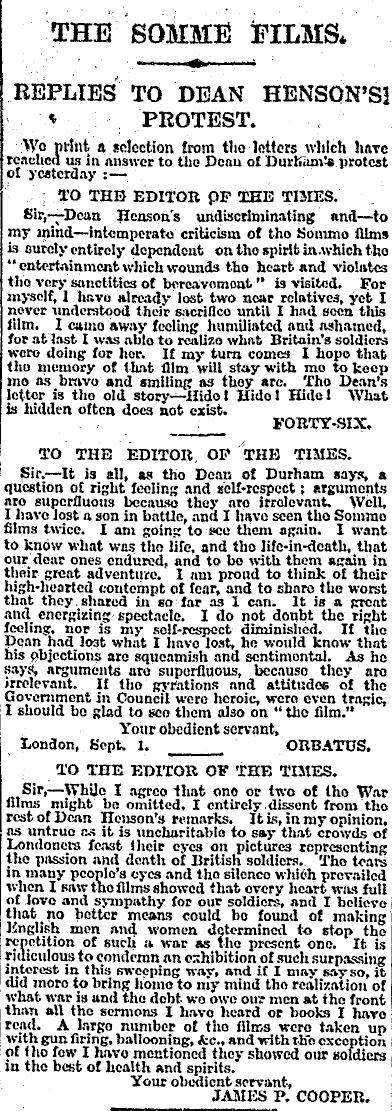
In 1916 Geoffrey Malins, a cinematographer, toured the Western Front filming what he saw. The footage was edited into an hour-long film that was shown in British cinemas. The Battle of the Somme was an extraordinary success with some estimating that it was the most watched movie in British history. Clips from it still regularly turn up when TV people want to refer to the war.
But it didn’t please everyone. The Dean of Durham has this to say:
I beg leave respectfully to enter a protest against an entertainment which wounds the heart and violates the very sanctities of bereavement.
The bereaved – or at least some of them – had different ideas:
Well, I have lost a son in battle, and I have seen the Somme films twice. I am going to see them again. I want to know what was the life, and the life-in-death, that our dear ones endured, and to be with them again in their great adventure.
My guess is that the Dean of Durham is referring above all to one particular scene; that scene, the famous scene, the one we are all familiar with, the one that above all others has come to represent the First World War. This one:
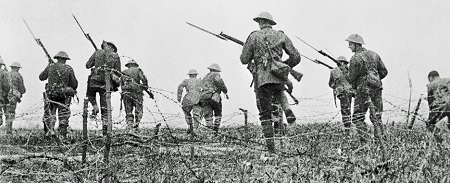 Sadly, I wasn’t able to track down the actual clip which has more evidence of fakery but even in this frame the puniness of the barbed wire and the lack of large packs suggest this was shot some distance from the front. Which is a pity. Because it is a fake.
So if the choice in 2016 is between one bad candidate and another (and it is) the question is, which one will do the least harm. And, judging by the civil service’s behavior, that’s got to be Trump. If Trump tries to target his enemies with the IRS, you can bet that he’ll get a lot of pushback — and the press, instead of explaining it away, will make a huge stink. If Trump engages in influence-peddling, or abuses secrecy laws, you can bet that, even if Trump’s appointees sit atop the DOJ or FBI, the civil service will ensure that things don’t get swept under the rug. And if Trump wants to go to war, he’ll get far more scrutiny than Hillary will get — or, in cases like her disastrous Libya invasion, has gotten. So the message is clear. If you want good government, vote for Trump — he’s the only one who will make this whole checks-and-balances thing work.
– Glenn Reynolds
As an aside, one thing that might change the minds of a lot of sceptics about Trump is whether he gets to choose any decent people on the US Supreme Court, which is an aspect of presidential power that a lot of those in the conventional media ignore. As for Reynolds’ point about pushing back against the bias and corruption of organisations such as the Internal Revenue Service, I am not so sure.
Tim Sandefur, a legal scholar and commentator, is unlikely to be swayed by the checks and balances argument for Trump:
An anti-establishment candidate is a good thing only if he or she knows what he or she is doing. Otherwise, the chances of going wrong are just too great. That’s why revolutions devour their young—and that’s why we built an establishment in the first place. It should not be changed without reason to believe a better alternative is possible. This Trump does not offer. His candidacy is an open assault on the mores of our political culture, such as respecting the rights and dignity of opponents, listening to what fellow citizens have to say, honoring our legal duties and treaty obligations; and it is all done in the name of hatred, envy, and fear, with nothing but the strength of his individual will to replace our hard-won institutions. No, it’s not that he is terribly dangerous himself. He’s probably too unintelligent to do much harm personally. But he will surround himself with a volatile collection of stooges and Pashas, of Rasputins and Grand Viziers, of roaches and rats hiding under his throne, who will wreak true havoc in his name—all with the future of our nation and the world at stake.
I think this is probably over-wrought, but not by a lot. Essentially, what I read from serious libertarians/conservatives/Objectivists who have said they will vote for Trump (yes, I know several Objectivists who are pro-Trump) is a version of “it’s a big gamble, he’s horrible, vulgar and corrupt but less horrible than Hillary and anyway he upsets the right sort of people and we can always impeach him”. That’s quite a big gamble to make when choosing someone with access to the nuclear codes.
I agree with Reynolds, by the way, that Gary Johnson and Bill Weld aren’t that impressive, although in my view they are still the best out of a lousy field. Weld sounds like a US-style liberal on the 2nd Amendment and Johnson did not impress me over support for use of executive orders on immigration (this is regardless of what one thinks of immigration as such). Obama’s use of executive decrees has been one of the worst, if not the worst, parts of his presidency, and surely any serious libertarian should make this point constantly.
The public health system of the Australian state of Queensland required a new payroll system. In 2007, a contract was issued to IBM to provide a new system for $6.19 million Australian dollars.
The resulting system did not work, and went over budget by $1.1 billion. Yes, read that again.
In 2013, the Queensland government was “considering” sacking the bureaucrats responsible for mismanaging the contract. Since then, there has been no publicity concerning any actual sackings. Read that how you will.
In a previous blog posting I may have given the impression that the rediscovery of the missing episodes of the Power of the Daleks Doctor Who serial would be about as welcome to the BBC as a new series of Jim’ll Fix It.
Of course, the impression that I meant to convey was that the BBC would in fact be delighted to be once again be in possession of the telerecordings and failing that would be quite prepared to go to the effort of animating the entire thing and making it available online from 5 November onwards.
|
Who Are We? The Samizdata people are a bunch of sinister and heavily armed globalist illuminati who seek to infect the entire world with the values of personal liberty and several property. Amongst our many crimes is a sense of humour and the intermittent use of British spelling.
We are also a varied group made up of social individualists, classical liberals, whigs, libertarians, extropians, futurists, ‘Porcupines’, Karl Popper fetishists, recovering neo-conservatives, crazed Ayn Rand worshipers, over-caffeinated Virginia Postrel devotees, witty Frédéric Bastiat wannabes, cypherpunks, minarchists, kritarchists and wild-eyed anarcho-capitalists from Britain, North America, Australia and Europe.
|





Recent Comments