We are developing the social individualist meta-context for the future. From the very serious to the extremely frivolous... lets see what is on the mind of the Samizdata people.
Samizdata, derived from Samizdat /n. - a system of clandestine publication of banned literature in the USSR [Russ.,= self-publishing house]
|
Today I went to the cinema, Cineworld, a round trip of some 100 miles, to see the film Bitter Harvest, a film about the Stalin’s Terror Famine in the Ukraine in 1932/3. The film takes the form of a dramatic ‘love story’, starting in a Ukrainian village (most likely but it unspoken – Cossack) as the Bolshevik Revolution has started, and news of the Tsar’s death breaks. The Revolution seems far away in this idyll and the couple who are the heroes are young children. There is an echo of Tolkien’s shire about the place, very beautiful even if life is hard. Then Lenin dies and Stalin (called ‘Koba’ by his Comrades) comes to power. The local Commissar comes around, backed by Red Army troops, and the village is to be collectivised. All land belongs to the State, as the Commissar reminds everyone, and evidently he has some targets to meet, enemies of the people to kill, kulaks to be purged, icons to be seized (for sale) and Collective Farms to be formed. His brutality is probably only tempered only by his anxiety at which target he has the greatest need to meet, something which diverts him occasionally from the most brutal option available.
The heroes of the film are a couple Yuri and Natalka from that same village. Yuri is one of several artists, he is a painter, and all his friends in his age group are keen to go to the Big City Kiev, some eagerly noting how the State has work for artists. Eventually Yuri goes to Kiev (on his internal passport*), leaving behind Natalka. On the way to Kiev, there are encounters with the starving peasantry, a passenger talks about the famine and gets arrested by the NKVD. There is a constant theme of the starving and dying, with an unmechanised disposal system of horse and carts scouring the streets for corpses for mass burials here and there, and corpses in open train wagons. The starving flock to Kiev, simply to die in the streets. The film is simply and properly unrelentingly grim, and it does not shy from showing the brutality of the Bolsheviks.
Stalin is informed of the resistance to collectivisation and the starvation that his policy is causing, he implements Lenin’s plans but without mercy, and the greater the resistance, the higher the targets become until all food is to be seized. The official line is that there is ‘malnutrition’ but not famine, a lie that Walter Duranty and the New York Times were happy to peddle, the latter partially recanting many decades later.
Yuri in Kiev meets up with his friends, and awkwardly hints and the famine and its increasingly visible consequences. He finds himself working as a painter, with his friends all doing political work, but his art lacks the necessary ideological flavour, his boss is purged (we infer) and he is then fired, working as a ‘rag and bone man‘, sorting through the possessions of the dead for sale, the only growth industry apart from terror. His friend from the village, who has risen in Kiev to be local party chief, shows some perhaps surprising independence, before shooting himself as the NKVD close in. Yuri gets arrested after a brawl, but manages to escape. Yuri’s family have been arrested for anti-Soviet activity after realising that they are doomed in the village as it is collectivised. Yuri meets up with Ukrainian partisans, and manages to spring some of his family. The film gives the impression that there was a significant amount of resistance to the Soviets, and also that people in the early 1930s spoke more freely that you might have imagined. Perhaps this has been overlooked in the face of the apparently monolithic Soviet police state. Yuri and Natalka realise that they have to escape, and they hope to make it to Canada, (long before the Trudeaus starting fawning over Castro). They head for the Polish border before making for a break chased by shooting Soviet Border Guards.
The film is very well shot, CGI is minimal, and barely noticeable. The grimy, shrunken starving hordes are a constant presence, very well done. The clothing and fashion are convincing, and whilst the dialogue is a little forced sometimes, the message that the State is your executioner (which it was) is well put across. It also mentioned famines in Kazhakstan and amongst the Jews in Belarus. The plot feels slightly fanciful, being necessarily at the high end of expectations, not in that it obviously shows a fight-back, but that there was so much spirit in those fighting the Soviets. However, it at least tells a story that should be told again and again.
That the film has had minimal publicity is a shame, even in the cinema showing it, it was not advertised except for a partial listing. In its first and only week, 11 people came to this Sunday showing, the nearest to me at 50 miles away. I enjoyed it, I appreciated it, and it was nice to be somewhere watching an anti-Soviet film feeling pretty damn certain that I wouldn’t end up sitting next to Jeremy Corbyn.
As I write, some speeches are perhaps being polished for the Oscars. I’m sure that the people in this film heading for a border as a matter of life and death won’t feature in the minds of the speech makers, and you won’t hear an actor not called, say, Sterile Weep, making a heart-renching condemnation of the system that led to an estimated 7,000,000 to 10,000,000 deaths.
* per Wikipedia, The Ukraine only scrapped internal passports in 2016.
D’Souza thanked the academy for the prizes, saying in a recorded message that “being dissed by you guys, this is absolutely fantastic.
“My audience loves the fact that you hate me.”
“The reason you are giving it to me is because you’re very upset Trump won.
“You’ve never got over it, you probably never will.”
– Dinesh D’Souza, as quoted in the Guardian upon getting four Razzies for the worst film of the year for his Hillary Clinton exposé.
This approach works equally well against both left and right.
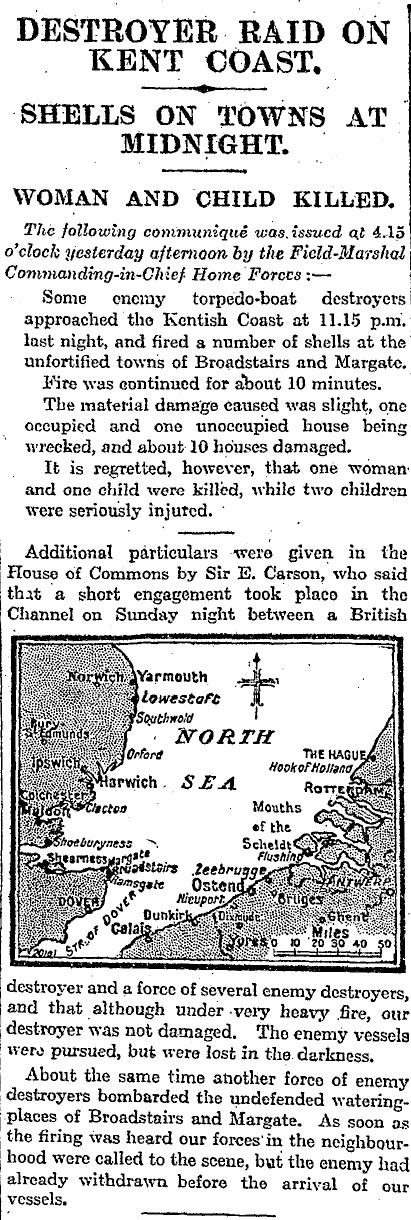
In 1917, as this cutting shows, the German navy shelled Margate and Broadstairs. Nothing strange in that, you might think, they had done much worse to Scarborough and Great Yarmouth.
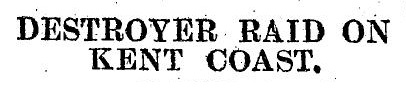 The Times 27 February 1917 p6. Right click for the whole article. However, this raid was a bit different. Far from causing general mayhem and tweaking the tail of the Royal Navy, on this occasion the target was one man: Lord Northcliffe, proprietor of The Times, The Daily Mail and – I kid you not – The Daily Mirror. Not that you would know it from this heavily censored report.
Northcliffe had attracted the ire of the German government by – apparently, I get little impression of this from The Times itself – being the main cheerleader of anti-German and pro-War sentiment in Britain. In 1918, doubtless aided by the Kaiser’s ringing, if unintentional, endorsement, Northcliffe became Britain’s Director of Propaganda.
I appreciate that in writing this article I may be giving the God-Emperor some ideas. So, Donald, if you’re reading, just remember: sailing a battleship up the Hudson, shelling the New York Times building and turning it into a smoking pile of rubble just so you can wipe the smile off the faces of a bunch of smug, arrogant, conceited, snobbish, self-satisfied, aloof, out-of-touch, blockheaded, group-thinking, bubble-dwelling, histrionic, paranoid, lying, devious, dissembling, childish, cry-baby, bitter, vindictive, divisive, conspiratorial, freedom-hating, progress-denying communists… is not nice.
It may even be wrong.
There has been much huffing and puffing recently about gender neutral pronouns. In principle, I rather like the idea. The fact that I dislike some of the other people who like the idea ought not to affect that. Not, I hasten to add, that I feel any animus against anyone purely on the grounds that they prefer to be referred to by one sound rather than another, or that their gender is difficult to specify externally, or that they feel that neither “he” nor “she” describes them, or that they advocate for lexical change. While it is true that the set of people currently talking loudest about gender-neutral pronouns would, if displayed on a Venn diagram, have considerable overlap with the set of people who wish to get others arrested for using the wrong word, that is a symptom of the addiction of our society to the use of force rather than persuasion, not a logical necessity.
The cause of the gender-neutral pronoun is ill-served by many of its current advocates. But in itself, it would be handy. That’s “it” as in “having a third person singular pronoun available to use to describe human beings without specifying gender”, not “it” as in “it”. It (as in the situation, not a person) tends to get an itty-bit hairy when one person refers to another (by which I mean another person, not another situation) as “it”. Thus, if I may reiterate, using “it” (as in “‘it'”) as a gender-neutral pronoun to refer to a person would put the user in a bad situation, even if they (here used in the singular) were not a singularly bad person. Wouldn’t it?
OK, I got drunk on words there. Sobering up, I am not seeking perfect “representation” for every one of Facebook’s 71 gender options. They can represent themselves. I just think it would be nice to have one more option, and to settle on one. That way those prone to being easily offended, and the subset of them that resort to bullying, could be kept from unhappiness and the occasion of sin.
I do think that the traditional use of “he” and “man” to include the female is a little, y’know, presumptuous. I am not one to go through old documents cutting out every offending “he-including-she” with a razor, but I would just as soon have some more inclusive style in new documents. It is tedious have to write “he or she” every time.
Singular “they” sounds all right when the subject is indefinite (e.g. “If anyone wants more details, give them a brochure”) but sounds wrong if the gender is known. At this point someone usually pipes up to say that Shakespeare used it in their plays. Only they don’t say their plays, they say his plays, unless they (gender unspecified here: no problem) are making some sort of claim that Shakespeare was a collective, a Borg or a woman.
The distinction between singular and plural third person is useful. We feel its lack in the second person. The singular/plural distinction keeps trying to creep back in with “youse” and “y’all”. In some dialects spoken in Northern England, “thou” never went away, merely faded a little into “tha”. If making no difference between singular and plural is sometimes confusing when talking to people, it is a swamp when talking about people. Imagine an action scene in a novel where all the characters including the protagonist were referred to as “they”.
This link takes you to a piece called “The Need for a Gender-neutral Pronoun” which lists some of the leading contenders for a new pronoun. By clicking on the suggested pronoun itself (or the title of the set in the case of the Spivak pronouns named after their creator), you can read an extract from Alice in Wonderland using that set of pronouns. The author also rates the proposed words by ease of pronunciation, distinctiveness, and how truly neutral they are. The author prefers the set of pronouns based on “ne” in the nominative case. If you agree that a gender neutral pronoun would be desirable, which option would you like to take hold in the language? If you object to the whole idea, what would you like to see become dominant – strict use of “he” (or “she”), or “they”, or “s/he” and variants?
The thing is, I will not be the first in my circle of acquaintance to start writing “xe” or “ne” in any other context but science fiction for the same reason that I will not be first in my circle to start taking a daily stroll in the nude.
I would if you would, but I know and you know, neither of us will.
If you haven’t already partaken of this bit of video, then you really should. It lasts just under twenty minutes.
Tim Harford is speaking, in 2011, at some gathering of the clever and the smug, but it’s better than that. The name H. R. McMaster comes up several times, and this is, among other things, a very good quick way to learn why McMaster’s appointment by President Trump as his National Security Adviser might turn out to be such a very good one. It certainly explains why this appointment is already so very popular. You don’t have to believe that the USA rearranging matters in faraway countries is always or even ever a wise policy to get the points that Harford is making.
Harford also mentions, in passing, Hayek. From this, you may guess that this is a talk about decentralised decision making, and how on the spot knowledge, again and again, trumps the wisdom of the Central Committee or the High Command. If that is your guess, you would not be wrong.
The story that Harford tells reminds me of another transformation of policy that happened in China, and gave rise to what is now called the Chinese economic miracle. This miracle is now starting to look rather less miraculous, but it was still a massive improvement over what preceded it. That change too is usually attributed to a change of top leadership and of its top-down policies, but that policy also, I seem to recall reading, began at the bottom of the chain of command and in spite of the chain of command.
I even seem to recall having linked to stuff about that from here. Yes, here is that posting, about teeth of all things, and here is the article at Planet Money that the posting linked to. It’s the same story as Harford tells in the above-linked-to video.
“So much of our popular culture depends on the loudly proclaimed pose of being “rebels,” of being outside the mainstream, of being “transgressive”—while repeating clichés that have become deadly boring through decades of repetition. It reminds me of a brilliant little bit in The Onion: “Purchase of Jeans Ushers Man into Exclusive, Ultra-Cool Subculture of Jeans-Wearing Americans.” They all want to be nonconformists just like everyone else.”
– Robert Tracinski
Milo Yiannopolous seems to have got himself into a spot of bother over remarks about homosexual sex with teenagers. The gist of it – especially if you read his clarification – seems to be that he was ready to take it up the bum at 13 and if it was OK for him then it would probably be OK for others. I suspect – given the little I know about him – that Milo at that age would have been capable of weighing up the pros and cons of such a decision. But not many others.
Milo raises – albeit indirectly – an important question: when does a child become an adult? As it happens, I drafted an attempt at an answer to this some time ago but lacked the guts to publish it. It’s time I did:
As the law stands if a man has sex with a female of 15 years and 364 days he is a scoundrel who should be imprisoned for a very long time. However, if he has sex with a female of 16 years and 0 days that’s just fine and dandy.
Or to put it another way, in the opinion of the law all women undergo the transition from young, innocent child to responsible, rational adult in a split second at exactly the same age.
That’s absurd; but, for the law, hardly uncommon. Similar rules apply to all sorts of aspects of growing up: when you can drive a car, enter into contracts, vote, marry, drink alcohol, leave school, get a job etc. And in each case the state’s answer is some arbitrary, one-size-fits-all number. And often it is a different number: 17 for driving (I am referring to English law here), 18 for drinking, 16 for sex. That can’t be right.
Could there perhaps, be a solution that is – to paraphrase H. L. Mencken – simple, neat and not wrong? The argument for numbers is that you have to draw the line somewhere, meaning: the law has to draw the line somewhere. But why should it be the law drawing the line? Why can’t it be the child? What if when the child comes to the decision that he is old enough to take on the rights and responsibilities of adulthood he just does? Obviously, he would have to tell people but that implies some sort of arrangement not unlike marriage with documents, ceremonies and cooling-off periods. Hardly beyond the wit of man.
I’ve been trying to think up some drawbacks. One might be that a girl’s declaration of adulthood might look awfully like a declaration that she wanted to have sex. And women are a bit coy about that sort of thing. Another might be that some children would decide to become adults at an absurdly young age and then proceed to ruin their lives, perhaps by driving the car into a bunch of passers-by. Or drinking themselves to death. But how likely is that? My personal experience of childhood is that I was perfectly well aware of my unpreparedness for taking on the responsiblities of adulthood. Perhaps we should be more worried about the other end of the age scale. Would some people choose to extend their childhood into their 20s and beyond?
Perhaps one way to look at this is to consider when we might ourselves have felt ready for the transition. In my case I think it was about 14-15. The only issue for me at that age would have been the predatory homosexuals who made up the school’s English Department.
A commenter over at the Guido Fawkes blog, with the joyful name of “Rasta Pickles”, comments on the notion that the UK electorate is too thick to figure out the complexities of Brexit, and that such complex matters should be left to a political class that has done such a tremendous job down the years. He or she notes a flaw in this “argument”:
“99.9% of the UK electorate have no idea what they’re voting for every time they vote in a council election; they regard local elections as a popularity poll on what’s happening in Westminster. Your local Labour/Tory council might well be planning on a compulsory purchase order on your house and those around you in order to build a new mega-PoundLand store and you’d still have people voting for them out of sheer ignorance.”
Even so, there are libertarians/classical liberals who point out that democracy, unless hedged with checks and balances, isn’t compatible with liberty and can be harmful to it. Bryan Caplan’s The Myth of The Rational Voter is a good read, as is this recent effort by Jason Brennan. But my problem with the arguments they make is that what, realistically, can they propose other than the sort of return to oligarchy of “smart people” that, as history tends to show, descends into corruption pretty damn quick?
Besides Yiannopoulos, his publishers and the concept of free speech, the big winners here are booksellers. Or at least you’d think so. But at least one Sydney outlet says it won’t stock Dangerous.
“Jon Page, owner of Pages & Pages, Mosman, and the online retailer Boomerang Books, became the first Australian bookseller to publicly declare he would not stock or promote the book by Yiannopoulos,” The Sydney Morning Herald reported last week, describing the author as “a mouthpiece of the hard right and a figure of controversy for his anti-immigration, anti-Islam stand”.
Page is wrong to say he won’t promote Yiannopoulos’s book. He just did, and in a far more effective way than if he’d filled his bookstore’s windows with Milo posters.
By taking his anti-free speech stand, Page ensured further publicity for Yiannopoulos and even more sales — but Page won’t be sharing in the profits.
– Tim Blair
Political correctness is not some sort of politeness, it is a cancer, a disease that eats away at society, allowing the poison to fester, for it stifles free speech and attempts to control our very thoughts, encouraging self-censorship. Freedom to speak means the freedom to offend and those so offended may respond in kind.
These days, if someone calls out “racist” or uses the terms such as “Islamophobe” or “homophobe” or some other variation, I switch off as they have labelled themselves as someone whose opinion I may safely ignore.
It’s nice to see that [Trevor] Phillips has finally seen the light, but the damage has been done and he was part of that.
– Longrider.
But I would respectfully take issue with the last line, which although undeniably correct, suggests a counterproductive sentiment. Nevertheless I strongly suspect from Longrider’s choice of title, Much Joy, that in truth he also sees this much as I do. And thus, although I am an atheist myself, this second quotation actually expresses my view rather well.
“I say unto you, that likewise joy shall be in heaven over one sinner that repenteth, more than over ninety and nine just persons, which need no repentance.”
Welcome to the fight, Trevor, let me show you to your place on the forward edge of the battle area.
The result of [the ‘sharing economy] is that in many ways, private tech companies have ended subsidising new forms of public services, for the public good.
That ought to make them the darlings of the Left. Yet unfortunately, the Left just can’t rid itself of its urge to regulate, legislate and tax. And in their efforts to thwart consumer freedom, they have a useful ally in the shape of a legal framework which was developed for the analogue age.
Uber, for example, is the poster child of the sharing economy. Yet 2017 is make or break year for its European ambitions – and at its core is an age-old political battle of Left versus Right.
This battle isn’t on the streets of San Francisco or London; Uber has already won over consumers. Instead, the fight is moving to a soulless courtroom in Luxembourg. The question is whether the company is a technology or a transport company; and the answer is incredibly complex.
– Daniel Dalton
If you needed yet another reason to reject the EU as an utterly toxic organisation, here is an absolute corker:
European Commission President Jean-Claude Juncker said on Thursday that Europe must not cave in to U.S demands to raise military spending, arguing that development and humanitarian aid could also count as security.
No doubt Jean-Claude Juncker feels that NATO should deploy Oxfam, Save the Children & Charlotte Church to Riga, Vilnius and Tallinn in order to deter any Russian incursions into the Baltic states.
|
Who Are We? The Samizdata people are a bunch of sinister and heavily armed globalist illuminati who seek to infect the entire world with the values of personal liberty and several property. Amongst our many crimes is a sense of humour and the intermittent use of British spelling.
We are also a varied group made up of social individualists, classical liberals, whigs, libertarians, extropians, futurists, ‘Porcupines’, Karl Popper fetishists, recovering neo-conservatives, crazed Ayn Rand worshipers, over-caffeinated Virginia Postrel devotees, witty Frédéric Bastiat wannabes, cypherpunks, minarchists, kritarchists and wild-eyed anarcho-capitalists from Britain, North America, Australia and Europe.
|





Recent Comments