We are developing the social individualist meta-context for the future. From the very serious to the extremely frivolous... lets see what is on the mind of the Samizdata people.
Samizdata, derived from Samizdat /n. - a system of clandestine publication of banned literature in the USSR [Russ.,= self-publishing house]
I liked this statement by Julian Jessop, chief economist (recently appointed) of the Institute of Economic Affairs, the classical liberal think tank in the UK:
“It’s disappointing that the decision to convert existing EU laws is again being justified in terms of continuity and certainty. Instead, Brexit should provide an opportunity to reduce the burden of regulation on UK households and firms alike.
“It’s also disappointing that the default option in the event of no agreement is being framed in terms of the most pessimistic WTO scenario, ignoring any benefits that might come from unilateral free trade. The UK will have the opportunity to lower barriers that prevent our consumers and businesses from accessing the best and cheapest goods and services, wherever they come from. What’s more, we should consider doing so even if other countries – including the rest of the EU – continue to embrace protectionism.
“However, it’s welcome the commitment to a quick agreement on reciprocal rights for people from the rest of the EU already living and working here and for UK citizens on the continent. Now that Article 50 has been triggered there is no longer any excuse for either side to delay. Indeed, this will be an early test of the willingness of politicians in the rest of the EU to put the interests of ordinary people above their own narrow political projects.”
Surely now, no-one can doubt that the EU is so much more than a set of laws regulating trade and commerce? Why did so many UK politicians try and pretend this was just a business or commercial arrangement? As this declaration reminds us in a timely way, at the heart of the EU is the strong desire to create a single country. It will have common borders, one currency, one foreign policy and one social policy. It will have its own energy policy, its own transport policy. Indeed, it has much of that already. It is only those who refuse to read EU documents who can think otherwise.
– John Redwood MP, referring to “The Rome Declaration” of EU states drawn up a week ago, which he says shows a clear intent to create a single European state, from which the UK has today, via the Article 50 process, begun to extricate itself.
Of course, England has been here before. The EU (that’s the Pope and the whole of Catholic Europe) excommunicated Queen Elizabeth and barred all trade with us; not even a WTO-terms deal, only a bit of state-sanctioned piracy and smuggling kept us going. In reaction we went further afield to find new trade partners and accidentally founded the British Empire, established dominance of the seas and oceans and led the world in trade and commerce. They did us a favour, really.
– Raedwald, taking a few liberties but making a great point 😀
A lot of strange stuff has been written about the referendum and its aftermath, so a writer really has to go some to stand out from the crowd. As was highlighted today by Walter Ellis (brilliant Reaction Remainer, who shows we are a broad church while generally being for enthusiastically getting on with Brexit), the case of Christopher Booker is most strange. Booker was, along with his associates, a robust voice for leaving the EU for many years. Now he writes it will be a disaster because we are leaving the customs union and because NO-ONE WILL LISTEN TO HIM AND HIS FRIENDS, or something. Let’s face it. There is a strand in the Eurosceptic movement that liked being a minority interest. There is a similarity there with music fans who like showing their alleged superiority by being into an obscure act. What they hate most is when other people start buying the records of their hitherto little-known favourites.
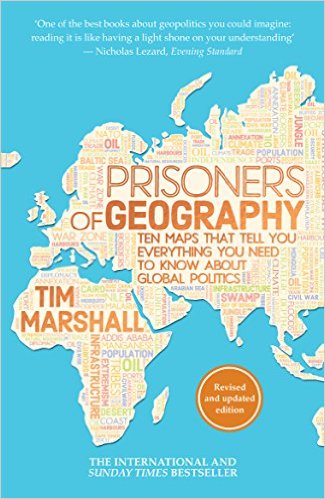
History, goes the old rhyme, is about chaps, while geography is about maps. Tim Marshall’s book, Prisoners of Geography, is all about how these two matters are actually very hard to separate. What the chaps think and do, says Marshall, is profoundly influenced and often downright determined by the circumstances described in the maps.
When I bought this book, in a remainder shop, I did not know who else was reading it. I am fascinated by the impact of geography upon history, but is anyone else? Since buying the book I have learned that it is now a best-seller. This pleases me, because it is a very good book, and in particular a very unsentimental book.
Britain and Western Europe, and then the other parts of the world where English is the dominant language, have mostly been blessed with a degree of geographically conferred freedom of manoeuvre that is denied to the inhabitants of pretty much all other nations. That is why these places got rich first. And it also now means that we Euros and Anglos are able to believe, as a matter of practical political policy rather than merely as privately pious aspiration, in a wide range of idealistic things of very variable value – things like freedom, democracy, equality, human rights, freedom for women, “social justice”. and so on and so forth – things that geographically more constrained people can only, as yet, dream of, and which they often regard as more as a threat to their own ways of doing things than as any kind of promise.
Another book that Marshall refers to quite frequently in this book is Jared Diamond’s Guns, Germs and Steel, which also offers a fundamentally geographical explanation for these facts. I share Marshall’s admiration for this book , and it heads the bibliographical list at the end of Prisoners of Geography, but this is an accident of spelling. I was also intrigued to see in that same list two works by Halford Mackinder, in particular Mackinder’s Democratic Ideals and Reality, a title which Marshall might have picked for his own book had it not already been taken.
Why, for starters, did the modern industrial era that helped to create all that freedom of political manoeuvre for the world’s luckier people, having kicked off in Britain, then, after an imitative surge in Western Europe, then see its centre of gravity shift to the USA? Well, there are many reasons.
It seems natural that people competing for scarce taxpayer dollars would argue about why their area is more deserving and others less so. But we don’t see that. School superintendents don’t complain about business subsidies, mayors don’t criticize the cash paid to state universities, and Medicaid advocates don’t denounce state-paid agriculture marketing. The people who receive government money in one area simply don’t complain about other areas of government spending.
This is why tax-hike coalitions get so many partners.
That’s because there is a Trough Truce: The people feeding at the trough of public dollars implicitly agree to never criticize when other spending interests receive money. Instead, they advocate for more tax dollars. There’s an unwritten agreement for the community of interests paid by public dollars to keep the peace among themselves and use each other to advocate for more resources for all trough-feeders.
It is possible to go through an entire education to PhD level in the very best schools and universities in the British system without any of your teachers or professors breathing the words “Friedrich Hayek”. This is a pity.
Hayek died 25 years ago today, yet his ideas are very relevant to the 21st century. He was the person who saw most clearly that knowledge is held in the cloud, not the head, that human intelligence is a collective phenomenon.
If Hayek is mentioned at all in academia, it is usually as an alias for Voldemort. To admire Hayek is to advocate selfishness and individualism. This could not be more wrong. What Hayek argued is that human collaboration is necessary for society to work; that the great feature of the market is that it enables us to work for each other, not just for ourselves; and that authoritarian, top-down rule is not the source of order or progress, but a hindrance.
Marc Sidwell’s book How To Win Like Trump: Nine Simple Rules for Victory Against the Odds explains how Donald Trump won the US presidential election. It is written in the style of a self-help book and in simple Trump-like language. This makes it a fast and easy read: it does not take itself too seriously. And it avoids “Consequences of Erudite Vernacular Utilized Irrespective of Necessity”. But it is packed with insight.
For example, politicians and the press are between them largely acting out a fiction which has similarities to the kayfabe of professional wrestling.
Trump had two insights, thanks to his grasp of kayfabe. First, Trump recognised the widespread fakery of modern politics. That let him see past the curtain of narrative, revealing the limited insight of political experts and the vulnerability of “inevitable” candidates whether Clinton, Rubio, Bush or Cruz. Second, Trump realised that by injecting the kind of entertainment and character common in wrestling narratives into the meek, grey world of political illusion, he could slam everyone else to the mat.
[…]
It’s underappreciated how much of the mainstream media’s tremendous influence lies in its power to frame big events. Hundreds of thousands of New York Times readers and millions of public radio listeners get taught the same framing story, and learn the socially acceptable limits for discussing whatever just happened.
As such, media organisations and a one-man master framer like Trump were always going to tread on each other’s toes. But Trump had an efficient, reframing response. All attacks on Trump through the media got reframed as evidence of a biased media persecuting a man it hated. This sidelined questions about the merit of any accusation. It established a catchall frame presenting Trump in a flattering light. And when negative stories did run, they only reinforced Trump’s favoured frame. That’s how to frame your way to victory.
It explains that Trump’s tweeting is partly about direct contact with people, and partly about quickly testing the product with real users.
Trump’s constant movement is also an endless process of improvement. It’s always looking for what works better. It is an evolving strategy, one that never gets to the end of the line. And that made his presidential bid more like a startup than a campaign. The Lean Startup movement believes in constantly evolving towards a product that fits the market through a cycle of building, measuring and learning. Rather than sweating to get something perfect, Lean Startups aim for the minimum viable product. Then they test it on an audience. Get it in front of a customer. See what they make of it. Improve it. Rinse and repeat.
This explains his constant changes of mind and hiring and firing, something that his opponents have claimed as a weakness. Another supposed weakness is his apparently defensive and petulant fighting back at anyone who criticises him, as he did with Megyn Kelly.
There is one very, very big way — and it’s so big, gigantic really, massive — that Trump’s haters and losers fail to get him. They think his temperament is unpredictable. Yuuge mistake. Believe me.
Marc argues that Trump’s consistent strategy is to maintain peace until he is attacked, and then consistently fire back, and that this is good game theory.
Trump’s essentially peaceful strategy relies on consistency and clarity to work. Every time he does what he always does, he reminds people of the consequences. The more disproportionate his reactions, the more Trump signals he is willing to bear any cost to get someone back.
This makes him not such a bad person to be holding the nuclear button:
What Trump understands by instinct, and demonstrates consistently in action, are the principles of nuclear deterrence. No first use. Credible threat of massive retaliation. That policy has kept the world safe from nuclear holocaust. Its creator Thomas Schelling worked it out using game theory, winning the Nobel for economics in 2005 in recognition of his breakthrough. Schelling even worked out that it helps if your enemies also think you are a little bit crazy and capable of attacking them at very high cost to yourself. It’s called the Madman Theory. President Nixon used it.
I am left wondering just how much of Trump’s strategies are luck rather than judgement, and it remains to be seen how long they will continue to work. But I do have more understanding of how the things he does that work, work. It is nice to see it all enumerated and made obvious.
Highlights I have not mentioned so far include the description of the way Trump picked off his opponents one by one in the primaries, how he used Clinton’s 3AM phone call commercial against her, and how he makes himself relatable to ordinary Americans. And there is a good bit about how Trump gets inside his opponents’ OODA loops (a concept I heard about years ago from one of my favourite sources of inspiration, Eric Raymond).
The facts are unambiguous: despite public perceptions to the contrary, extreme poverty has declined significantly, to the point where its end may actually be in sight. So next time you hear someone bemoaning a supposed rise in world poverty, encourage them to have a look at the evidence for themselves.
Debt is the Fed’s basic problem, and it doesn’t know how high rates can go without triggering a financial crisis. And even if the Fed could make an assessment for America, there is the knock-on effect of the Fed’s interest rate policy on foreign dollar borrowers, as well as on the Eurozone and Japan. China has indirectly added to the West’s problems by being the largest component of global economic growth. Her massive credit expansion is contributing to higher interest rates elsewhere by financing imports, commodity stockpiles and driving up prices. It is the lack of ability of the ECB and the Fed to raise interest rates sufficiently to counter higher rates of price inflation that’s becoming the most pressing challenge.
I like those elongated cakes with raisins in them referred to on the package as “finger madeleines with raisins”. A few days ago I purchased another stash of them, from the Afghan-run corner shop nearest to me.
They looked like this:
Sorry about the strange blue reflections of something blue in the transparent but shiny packaging, but it is important that you realise that this is a photo of these finger madeleines before I opened them.
Same sized package. Same price. But, six empty spaces where there used to be six finger madeleines. Twenty four finger madeleines instead of thirty finger madeleines.
We are seeing quite a lot of this in the UK just now. Soon the packages and/or the prices will change, but meanwhile, the quickest way to adapt in the short run is just to reduce the amount in the package.
Brexit is not proving to be an economic catastrophe, and I remain very optimistic about it in the longer run, that being why I voted for it. But it is proving something of a dislocation in the short run, if only because the sort of people whose job it was to foresee it mostly did not foresee it. I don’t blame them for this. I did not foresee Brexit either. I merely voted for it.
The Samizdata people are a bunch of sinister and heavily armed globalist illuminati who seek to infect the entire world with the values of personal liberty and several property. Amongst our many crimes is a sense of humour and the intermittent use of British spelling.
We are also a varied group made up of social individualists, classical liberals, whigs, libertarians, extropians, futurists, ‘Porcupines’, Karl Popper fetishists, recovering neo-conservatives, crazed Ayn Rand worshipers, over-caffeinated Virginia Postrel devotees, witty Frédéric Bastiat wannabes, cypherpunks, minarchists, kritarchists and wild-eyed anarcho-capitalists from Britain, North America, Australia and Europe.
All content on this website (including text, photographs, audio files, and any other original works), unless otherwise noted, is licensed under a Creative Commons License. Powered by WordPress & Atahualpa






Recent Comments