We are developing the social individualist meta-context for the future. From the very serious to the extremely frivolous... lets see what is on the mind of the Samizdata people.
Samizdata, derived from Samizdat /n. - a system of clandestine publication of banned literature in the USSR [Russ.,= self-publishing house]
|
Internships are often denounced as the exploitation of cheap labour. Compared to paid jobs, I dare say many internships are indeed rather exploitative, and not in a good way.
But it makes just as much sense to compare internships with higher education. Internship gives you some free education. Universities charge a fortune for something similar but arguably much worse.
Karim Rashid argues exactly this, when it comes to learning how to be a designer:
New York designer Karim Rashid has defended the use of unpaid internships, saying young designers can learn more working at a studio than studying at a fee-paying university.
“I believe some of the universities are far more exploiting than a small brilliant architecture firm that can inspire and be a catalyst for a student’s budding career,” said Rashid in a comment on Facebook, responding to Dezeen’s post about unpaid internships at Chilean architecture studio Elemental.
“In a rigorous office with a respectful mentor, an intern can learn in three months more than a year or two of education, and education in USA is costing that student $60,000 to $100,000 a year,” the designer wrote.
Instapundit, which has for years and quite rightly been banging on about the “higher education bubble“, and about how the “business model” of higher education is broken, should be alerted to what Rashid says. Do the Instapunditeers read Dezeen, where the above report is to be found? I’m guessing: not that often.
Also, has this piece, I wonder, been picked up on the Insta-radar? It’s entitled “The Creeping Capitalist Takeover of Higher Education”?
Whenever the Subsidised and Subsidising Classes stop defending one of their strongholds and instead start denouncing it as a capitalist plot, you know that the stronghold in question is staring some serious trouble in the face. The S&S Classes can see that trouble looms for higher education, because it’s coming for them and because of them. Large swathes of it are an overpriced racket and they can’t any longer pretend otherwise. So, before this becomes as widely understood as it soon will be, they need a narrative that says that this wasn’t their fault, but was instead the fault of their political enemies.
Guido presents evidence that we have God on our side, along with the Queen, 63% of voters, a large part of an infuriated Tory party, and the army (or at least, the parachute regiment – I’ve lived next door to a para, and suspect they would be enough). 🙂
By a possible majority of one vote (at this moment I write), parliament is not on our side but on the side of endless procrastination – nor it would seem is the PM on our side. (I’m not quite sure what happened to “I’ll stay for as long as you want me”, but I assume it’s the same thing as happened to all the other promises.)
Having God on your side is good, but if I understand the theology correctly, He protects free will by using His power to warn, not compel – and helps those who help themselves. A coincidentally-timed lightening strike is welcome – and hilarious – but while I invite all who so wish to pray hard, we should not expect lightning to strike May and Corbyn as they shake hands. 🙂
Having the Queen on your side is good (noting that all is report and she would act sooner than she would formally say in public). Normally, like the almighty, her majesty warns but does not compel. In my opinion, the more letters that arrive at Buck Palace (acknowledging her wise convention of staying out of it normally but expressing calm loyal support for her right to act when Parliament behaves irregularly), the better, and they can certainly do no harm (most of us will have already written to our MP, some with far less reason to think it could have any effect). IMHO, be brief, be polite, be properly-phrased and don’t lecture her on what action to take, just say how loyally you’d support her taking action.
Having the voters on your side is good (if it is so – opinion polls are unreliable, of course, and a bit all over the place, but less so in both respects than parliament at the moment). However the voters cannot easily compel before an election.
We also, I hope, have ourselves – the brexitters – on our side. Guido is one of those brexitters who wanted May’s deal accepted for fear of worse. I respect such people despite disagreeing with them. Now is time for both sides of that debate to leave recriminations since that ship would appear to be sailing, for better or worse. Let’s look at those options.
1) For worse: Ramsay MacDonald was the last PM to betray their party and form an alliance with the opposition and a few like-minded turncoats. Being the nominal head of an overwhelmingly other-party coalition made him largely powerless domestically, so he concentrated on foreign policy: Ramsay MacDonald was the pacifist PM of the UK during Hitler’s first three years in power. This was very useful to Hitler as he moved from its being a military parade to remove him in 1933 to having 36 infantry divisions and 6 armoured ones with which to object in 1936. That precedent is not encouraging.
2) For better: precisely because May is putting up such a sneaky fight, Brexit has proved a stronger lever than I ever hoped for exposing those who are Tory in name only, and enraging the party against them. I doubt anyone is joining the Tory party at this moment but urge all who are there to stay, pro tem. Tearing up your party card in public is a great way to warn, but remember you must not actually resign if you are to use your (imminent, I hope) chance to compel.
After pondering deeply the general trends of the world and the actual conditions obtaining in Our Empire today, We have decided to effect a settlement of the present situation by resorting to an extraordinary measure.
We have ordered Our Government to communicate to the Governments of the European Union and its Member States that Our Empire accepts the provisions of their Political Declaration.
To strive for the common prosperity and happiness of all nations as well as the security and well-being of Our subjects is the solemn obligation which has been handed down by Our Imperial Ancestors and which lies close to Our heart.
Indeed, We declared our intention to leave Europe’s Union out of Our sincere desire to ensure the United Kingdom’s self-preservation and the stabilization of Gibraltar, it being far from Our thought either to infringe upon the sovereignty of other nations or to embark upon territorial aggrandizement.
But now the Brexit row has lasted for nearly four years. Despite the best that has been done by everyone — the gallant fighting of the diplomatic forces, the diligence and assiduity of Our servants of the State, and the devoted service of Our sixty million people — the Brexit situation has developed not necessarily to the United Kingdom’s advantage, while the general trends of the world have all turned against her interest.
Moreover, the enemy has begun to employ a new and most cruel £39,000,000,000* divorce bill, the power of which to do damage is, indeed, incalculable, taking the toll of many innocent businesses. Should we continue to fight, not only would it result in an ultimate collapse and obliteration of the British nation, but also it would lead to the total extinction of human civilization.
Such being the case, how are We to save the millions of Our subjects, or to atone Ourselves before the hallowed spirits of Our Imperial Ancestors? This is the reason why We have ordered the acceptance of the provisions of the Political Declaration of the Powers.
The hardships and sufferings to which Our nation is to be subjected hereafter will be certainly great. We are keenly aware of the inmost feelings of all of you, Our subjects. However, it is according to the dictates of time and fate that We have resolved to pave the way for a grand peace for all the generations to come by enduring the unendurable and suffering what is unsufferable.
* it could be a lot more.
“The dangerous and sectarian practice of prescriptive racialism is an outgrowth of an insistence that we think of people not as individuals but as representatives of groups — we speak of “the Arab experience” as if it were a uniform phenomenon. In a world in which groups are considered more important than people, it was inevitable that we would forfeit the ability to think in terms of unique human beings, each of whom may fall into several categories, but who are ultimately self-made characters. We should remember that the important features of an individual are what they choose to be and not the identities they happen to have inherited.”
– Mohamed Ali, writing in the excellent platform, Quillette.
The ability of the ‘sensible centre’ to define other people’s labels is rapidly decaying as they are mid-suicide collectively & are unaware their sense of rapture is a lack of oxygen to the brain. A Great Realignment is coming & we’ll see some very strange alliances until the new normal emerges.
– Perry de Havilland
April Fool’s day is the day to tell a story that seems real but is in fact a joke. Yesterday was the day when a joke became astonishingly real for me.
Sunday morning, I was casually shown this picture on a friend’s phone. On a brexitter’s blog, it would be no surprise. On that friend’s phone, sent her by her children, it told me the joke was going viral. I laughed appreciatively – and reflected that whatever diminishes the respect anyone still feels for “Parliament knows best what to do on Brexit” was good.
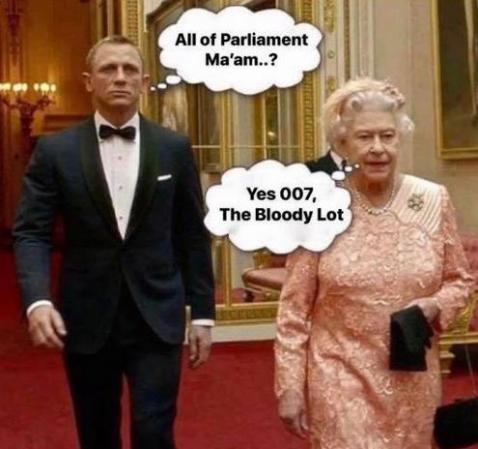
Just what her majesty has told James Bond 007 (licensed to kill) to do with all members of parliament is not explicitly stated – appeal to their (very) latent honesty as regards keeping promises, perhaps? But I saw that it was of course a joke, utterly unreal – the Queen is portrayed uttering a swearword!
That afternoon I saw the Sunday Times. The Times is the ultimate establishment remainer newspaper. It is Sir Humphrey Appleby’s newspaper. Imagine my shock when I read on the front page, illustrated with a picture of her, that
“The Queen has a constitutional role to play in Brexit … The Queen may block a soft Brexit …”
Were parliament to seize control of Brexit, then (this establishment remainer paper stated – in more or less the words I am writing here) Mrs May could well advise the Queen to withhold assent. As the private chats between her majesty and her prime minister are confidential, it did not say – nor would we perhaps know – whether that would be the result of Mrs May begging the use of every lever at her disposal or of the Queen pointedly advising Mrs May to advise her so. Far more important to me was this explicit statement that, in our current state, when Parliament cannot or will not act, or not within the rules, the Queen can – not by invoking any extraordinary prerogative power but as an ordinary constitutional act. I saw that last week but I was very surprised to see an establishment endorsement of it over the weekend.
Like everyone else – like Theresa May, Emmanuel Macron, Angela Merkel and Etc. Etc. – like everyone in the UK and the EU, with the possible exception of Elizabeth R – I don’t know what is going to happen next. But beware making a joke. The papers may report it for real that afternoon.
In other news, while many marched in London, some acquaintances marked the absence-of-Brexit day by climbing the Cumbrian hill called ‘Great Cockup’. It is next to ‘Little Cockup’ but they felt the latter summit was not so appropriate a destination.
French literati embarrassed after Marxist hero admits to murders
An anguished debate has erupted among French intellectuals after an Italian Marxist whom they lionised as a victim of oppression and injustice confessed to being a murderer.
Cesare Battisti, 64, a former member of the Armed Proletarians for Communism…
Who could have guessed that a member of Armed Proletarians for Communism might have been violent?
…embarrassed the French literati who were his most ardent defenders when he admitted last week to a series of killings and knee-cappings in Italy in the late 1970s.
Battisti lived openly in France for 14 years from 1990 despite having been convicted in his absence in Italy of carrying out two murders and aiding and abetting two others. He earned a living as a crime writer, a television scriptwriter and an occasional contributor to Playboy.
When a French court upheld an Italian extradition request in 2004, authors, artists, philosophers and politicians sprang to his defence. They denounced Italian justice as biased, proclaimed his innocence — even though he refused to do so explicitly for many years — and said that he should be able to live freely in France.
Battisti fled to Brazil then Bolivia.
…but was arrested there in January and extradited to Italy. Under questioning he not only admitted to the crimes but said that he had “never been a victim of injustice”. He went on to say that his backers had been interested only in his ideology and not in his innocence or guilt.
Ho ho, what a joke. Except for the people he murdered and their families.
Rightly not trusting our leaders to deliver on their statements (there were, IFUC, no promises about leaving the EU from Mrs May), the Sage of Kettering and I have left the EU in that recently, we have visited our nearest escape hole, the Channel Islands. A fleeting visit, one day in each, but we have seen a future, and it works, more or less. For our more distant readers, Jersey and Guernsey are ‘Crown Dependencies’, historically part of the Duchy of Normandy, owing allegiance to the British Crown but not part of the UK. The UK government has arrogated to itself the overlordship of the islands, holding responsibility for foreign affairs and defence (well, sort of, as we shall see), but the two Bailiwicks are otherwise independent jurisdictions with autonomy in most areas, crucially taxation, and are outside of the European Union, albeit within EU Customs arrangements, allowing them to trade with the EU. Here, they say, the Queen is the Duke of Normandy, although monuments refer to ‘la Reine’. She is the only Duke I can think of married to a Duke. Whether or not they can simply declare independence is constitutionally unclear, but with Labour dangerously close to power, they might be advised to make some plans.
→ Continue reading: Leaving the EU – a Jersey jaunt and a Guernsey gallivant
Build on the flanks of Etna where the sullen smoke-puffs float —
Or bathe in tropic waters where the lean fin dogs the boat —
Cock the gun that is not loaded, cook the frozen dynamite —
But oh, beware my Country, when my Country grows polite!
Thus ends Kipling’s poem on our national habit of becoming very polite when we are about to lose our temper.
Yesterday’s ‘March of Enraged Brexitters’ was polite. ‘Cheerfully furious’, was how someone described the chairman of one Tory constituency association who was there. Reports agree the rage was very real – and self-controlled.
Over in the US a few years ago, Tea Party marches made a similar contrast to left-wing protests (‘left areas tidier than when they arrived’ versus ‘vandalism and arson’) – which did not in the least stop politicians and the media inventing lies against the Tea Party and shrugging it off when caught. When it was clear the PC would report polite dissenters as if they were were rioting racist thugs, they did not (fortunately) get rioting racist thugs (because their understanding of their opponents was zero) but they did get something a little less restrained: Trump and his supporters were not so polite to them.
On our side of the pond, Parliament (Labour and Tory alike) promised us something very specific, as formally and solemnly as possible, in speech, proclamation and manifesto, before the referendum (if we voted for it) and before the election (unconditionally). Promising something and then taking it away is a great way to get people angry.
So, I admire the restraint of “cheerful fury”, but, between the lessons of our national character and the lessons of the Tea Party evolving into the Trump coalition, I think Parliament unwise to go on provoking it. But I also think that if Parliament were wise, we were not be where we are now.
“The irony of Europhiles is that they replace one form of nationalism with another: “country first”, is out, but “Europe first” is in.”
– Nathan Pinkoski. He analyses a recent speech by French president Emmanuel Macron that deserves far more scrutiny than it is getting.
Jemma Beale’s repeated lies caused an innocent man to spend two years in jail, and untold anxiety to many others. Part of Beale’s motive appears to have been to make her lover jealous, but she told a former girlfriend that she did it in order to get compensation money from the government. She was tried and convicted for her crimes and is now in jail.
You’d think that after all that her guilt would have been established beyond reasonable doubt. Yet with what strange new respect for the presumption of innocence (even after conviction!) does the BBC report her case:
Jemma Beale: Rape claim ‘liar’ loses conviction appeal
A “serial liar” who invented false rape and sexual assault allegations has failed in a bid to clear her name.
Jemma Beale, 27, from Hounslow, west London, was jailed for 10 years in August 2017 after claiming she was sexually assaulted by six men and raped by nine over the space of three years.
She challenged her convictions for perjury and perverting the course of justice and her sentence.
Her bid was rejected by three judges at the Court of Appeal.
Beale’s lawyer Gillian Jones QC argued the trial judge should have given the jury directions about the “danger of assumptions, myths and stereotypes” relating to victims of sexual offences.
I agree with Beale’s lawyer. The trial judge should have warned about the danger of the currently fashionable assumption, myth and stereotype that “women never lie about rape”. Fortunately the jury saw through Beale anyway.
What a wretched lot of weaklings we have in high places at the present time!
– Douglas Haig, diary entry 1 September 1918. This was written in response to the Cabinet’s refusal to take responsibility for any failure of Haig’s upcoming offensive. The Storming of the Hindenburg Line was, of course, a huge success. Any similarity between this and more recent events is entirely coincidental.
|
Who Are We? The Samizdata people are a bunch of sinister and heavily armed globalist illuminati who seek to infect the entire world with the values of personal liberty and several property. Amongst our many crimes is a sense of humour and the intermittent use of British spelling.
We are also a varied group made up of social individualists, classical liberals, whigs, libertarians, extropians, futurists, ‘Porcupines’, Karl Popper fetishists, recovering neo-conservatives, crazed Ayn Rand worshipers, over-caffeinated Virginia Postrel devotees, witty Frédéric Bastiat wannabes, cypherpunks, minarchists, kritarchists and wild-eyed anarcho-capitalists from Britain, North America, Australia and Europe.
|





Recent Comments