We are developing the social individualist meta-context for the future. From the very serious to the extremely frivolous... lets see what is on the mind of the Samizdata people.
Samizdata, derived from Samizdat /n. - a system of clandestine publication of banned literature in the USSR [Russ.,= self-publishing house]
|
I have not seen The Passion of The Christ, and don’t plan to. A friend of mine told me that after a while The Passion just became boring, and I think that is probably how it would be for me. It is not so much that I am opposed to Christianity (although I am), more that I do not like horror movies, although of course part of the reason I am opposed to Christianity is that the crucifixion parts of it are to me a lot like a horror movie already.
But as a movie phenomenon, The Passion is fascinating. Mel Gibson has made a fortune with this movie not because he was trying to make a fortune, but because he was trying not to. He wanted other people to invest in it. But everyone else thought it would be money down the drain, so they refused. So Gibson invested great gobs of his own money, and now he gets this Niagara of profit. From a film about Jesus Christ. The ironies just pile up.
Hollywood also disapproved of the The Passion on ideological grounds, because an accurate presentation of the Gospels version of the crucifixion sets the Jews up, yet again, as the villains of Western Civilisation. The Gospels, as far as Hollywood is concerned, are anti-Semitic. I agree with Hollywood about this. This is yet another reason why I am not a Christian. But none of that stopped Mel Gibson from doing The Passion. The great thing about the free market is that anyone can join in.
Changing the subject only somewhat, I note that James Lileks today ruminates about why there has not been much in the way of movie making about or around the subject of the 9/11 attacks. Basically, he says, the reason is that Hollywood disapproves of what such movies would have to say. Arabs bad. America good. George W. Bush good. Israel not part of the story. And Hollywood does not believe any of that. So, no 9/11. → Continue reading: Could someone do with 9/11 what Mel Gibson did with the crucifixion?
The forthcoming Olympic Games which are to be held in the birthplace of this event, Greece, promise to cause a few headaches. In particular, security services around the world must be wondering what level of risk is being run in holding an event relatively close to the Middle East, and in which lots of Americans, Brits, Israelis and other parts of Dubya’s great Zionist/Halliburton conspiracy are taking part.
So while I was chatting to a work colleague about Greeks’ own views of the situation, I came across a corker of a quote from an unnamed Olympic official:
Greece hasn’t hit the panic button yet. That is because it hasn’t even installed the necessary wiring.
Brilliant.
The U.S. Department of Transportation’s Federal Highway Administration is working with four companies to develop new radio-frequency identification technology for roadways. Officials see RFID as a way to warn drivers of, for instance, impending intersection collisions and vehicle rollovers.
Specifically, the government and vendors are investigating technology called dedicated short-range communications, which is related to RFID. The vendors are Mark IV Industries, Raytheon, Sirit, and TransCore.
A prototype system co-developed by the quartet is expected to be ready for testing in about 18 months. The Federal Communications Commission has assigned a block of high-bandwidth radio spectrum for dedicated-communications products–5.850 to 5.925 GHz.
Scaled Composites SpaceShipOne executed its second powered flight on April 8, 2004 and reached a peak altitude of nearly 20 miles. Its first powered flight was on the December 17, 2003 anniversary of the Wright Brothers first flight at Kittyhawk.
Objectives: The second powered flight of SpaceShipOne. 40 seconds motor burn time. Handling qualities during boost, through transonic and supersonic. Reaction control system functionality in-flight and feather configuration stability during transonic re-entry. Evaluation of radar tracking capability.
Results: Launch conditions were 45,600 feet and 125knots. A planned immediate motor ignition was delayed about 2 minutes to evaluate a shock induced stall buffet resulting in an ignition altitude of only 38,300 feet. The 40 second rocket boost was smooth with good control. Pilot commented that the motor was surprisingly quiet; however the boost was heard by ground observers. Burnout occurred at 1.6M and apogee was over 105,000 feet. There was no noted flight control flutter or buzz during the climb. Feather recovery was nominal. Maximum feathered speed on entry was 0.9 Mach. The wing was de-feathered and locked by 40,000 feet. Handling quality assessments during descent were satisfactory and a smooth landing made to runway 30 at Mojave. All video and tracking systems performed well with spectacular footage obtained onboard, from chase and from ground stations.
Space is deemed to begin at 50 miles (the hieght at which a pilot gains his Astronaut wings) and the current (unofficial) record holder is the X15 flight of August 22, 1963 which reached 67 miles.
It appears suborbital flight will be approached over a period of months with a very cautious test campaign. At the current flight rate I would guess early fall. If they pick up the pace to that of last autumn, it is possible we could see an earlier suborbital attempt. The Fourth of July or the 35th Anniversary of the Apollo 11 lunar landing on July 20th are good choices if there is a desire to maximize publicity.
Unless something goes drastically wrong, this is the year of the first manned private suborbital rocket flight.
It still remains unlikely, but I do feel that is at least possible that the Conservative Party may win the next General Election, here in the UK. With Blair increasingly going off the rails, behind in some polls, and trying to ramrod unpopular policies through Parliament, even against the wishes of his patrons and supporters in News International, there is some hope that we may yet be rid of him before he has his heart attack.
But what will replace him? Oliver I Love Socialism Letwin, perhaps, or David Two Welfare States Willets? It could almost be better, in some ways, if Blair stayed in power, as at least then we would still possess an enemy we could focus on properly.
So, this is a call to any Conservative politician out there, anyone who is active within the Conservative Party who stands any chance of a sniff of power should the Blessed Michael shock us and actually win electoral power. Now it may be too much to assume that the Blessed Michael, himself, is a regular Samizdata reader, but if you are with us, Mr H, I have the perfect plan of action for you to make England the wealthiest, the freest, and the happiest country in Europe, except for approximately one million Guardianistas who, basically, can just sod off.
Sean Gabb’s THE ENEMY CLASS AND HOW TO DESTROY IT: A MANIFESTO FOR THE RIGHT, which I read for the first time this morning, really is or should be the plan for your next government. Take time to read it. Then act upon it. Become a hero.
Arts & Letters Daily links to two articles, both protesting against the absurdities and cruelties of political correctness.
David Mamet writes in the Guardian in connection with the forthcoming London production of his play Oleanna, the central character of which is a young woman who falsely accuses a man of raping her:
The play’s first audience was a group of undergraduates from Brown University. They came to a dress rehearsal. The play ended and I asked the folks what they thought. “Don’t you think it’s politically questionable,” one said, “to have the girl make a false accusation of rape?”
I, in my ignorance, was stunned. I didn’t realise it was my job to be politically acceptable. I’d always thought society employed me to be dramatic; further, I wondered what force had so perverted the young that they would think that increasing political enfranchisement of a group rendered a member of that group incapable of error – in effect, rendered her other-than-human. For if the subject of art is not our maculate, fragile and often pathetic humanity, what is the point of the exercise? And if the writer is capable, why enquire, let alone obsess about his sex? No one ever said of a comedy, “I laughed myself sick until I discovered the sex of the writer.”
But as Theodore Dalrymple makes clear, there are limits to the notion that a woman can do no wrong. If the wrong is done to her by her own ethnic minority, and even in particular by a male member of it (her father), then it is all her fault. → Continue reading: She can do no wrong – but it is all her fault
Remember that scene in that dreadful movie The Phantom Menace where Anakin’s mother explains that slaves have tracking devices implanted to prevent them escaping?
An American company has developed such technology, and they have more then just slaves in mind.
The process is oh so easy:
Once implanted just under the skin, via a quick, simple and painless outpatient procedure (much like getting a shot), the VeriChip can be scanned when necessary with a proprietary VeriChip scanner. A small amount of radio frequency energy passes from the scanner energizing the dormant VeriChip, which then emits a radio frequency signal transmitting the individual’s unique personal verification (VeriChip ID) number. The VeriChip Subscriber Number then provides instant access to the Global VeriChip Subscriber (GVS) Registry – through secure, password-protected web access to subscriber-supplied information. This data is maintained by state-of-the-art GVS Registry operations centers in Riverside, California and Owings, Maryland.
And the implications are oh so scary….
The news just goes from bad to worse on the RFID front. Trevor Mendham quoted Tesco CEO Sir Terry Leahy as saying that RFID tracks products, not people, but American tech company Applied Digital Solutions, through it’s subsidiary Verichip Corporation, has already broken through that barrier.
They have developed a RFID product that is implanted in the victim.
The VeriChip minaturized Radio Freqency Identifcation (RFID) Device is the core of all VeriChip applications. About the size of a grain of rice, each VeriChip contains a unique verification number, which can be used to access a subscriber-supplied database providing personal related information. And unlike conventional forms of identification, VeriChip cannot be lost, stolen, misplaced or counterfeited.
Once implanted just under the skin, via a quick, painless outpatient procedure (much like getting a shot), the VeriChip can be scanned when necessary with a proprietary VeriChip scanner. A small amount of Radio Freqency Energy passes from the scanner energizing the dormant VeriChip, which then emits a radio frequency signal transmitting the individuals unique verification (VeriChipID) number. The VeriChip Subscriber Number then provides instant access to the Global VeriChip Subscriber (GVS) Registry – through secure, password protected web access to subscriber-supplied information. This data is maintained by state-of-the-art GVS Registry Operations Centers located in Riverside, California and Owings, Maryland.
It’s a password protected website- anyone with knowlege of the internet knows that password protected websites are not that secure; anyone that says that they can guarantee the security of such a webserver is whistling in the wind.
It’s rather like that dreadful George Lucas film, The Phantom Menace, where the slaves are fitted with a tracking device. Verichip Corp. doesn’t have slaves in their sights as a target market- they have a wider target market in mind.
VeriChip products are being actively developed for a variety of security, defense, homeland security and secure-access applications, such as authorized access control to government and private sector facilities, research
laboratories, and sensitive transportation resources, including the area of airport security.
In these markets, VeriChip is able to function as standalone
personal verification technology or it is able to operate in conjunction with other security devices such as ID badges and advanced biometrics.
In the financial arena, VeriChip has enormous potential as a personal verification technology that could help curb identity theft and prevent fraudulent access to banking and credit card accounts.
In other words, they are after a world where everyone is fitted with these devices. Does Big Blunkett own shares in this company? At the moment, they are working with gun manufacturers. Who will be next?
A good many of the Australian bloggerati (including Scott Wickstein and myself) attended a fine blogger bash in Melbourne over the weekend. A splendid evening was had by all, and photos have been put up in various other places, but there was just one additional thing I have to share with the world.
This is Tim Blair.
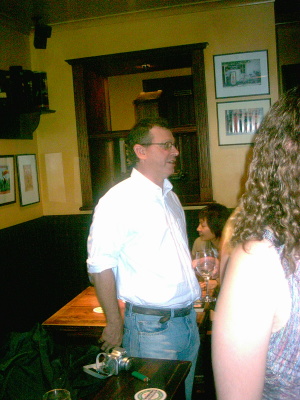
Notice the glass of the pale coloured yellowy stuff in his hand. Tim spent the whole evening drinking chardonnay. He made some feeble excuse about how is is trying to reclaim chardonnay for capitalism, but I was not entirely convinced about his protestations. He did, after all drink a lot of chardonnay. In fact he couldn’t stop.
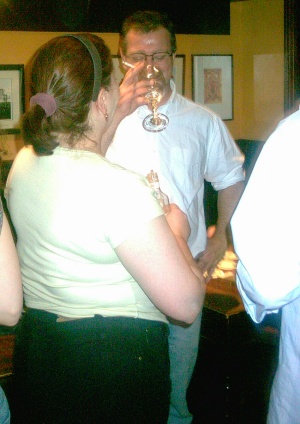
Could the whole Right Wing Death Beast thing be an act, when Tim has such an extreme characteristic of the enemy? I am fearful.
Tuscan Tony Millard is very unhappy that Britain’s civil servants are on strike. No, not really
I for one was relieved that 110,000 civil servants went on strike today claiming the urgent need for more taxpayers money, presumably to spend down the pub during their 37 days annual paid leave. I calculated that, assuming their refusal to honour their employment contracts results in the withholding of a day’s pay, this little exercise alone has saved us the grand total of £7,403,846 (US$ 13,549,843) without us even having to put down the TV remote/let go of the mouse/whatever.
I assume that you civil ‘servants’ are all now sufficiently dissatisfied with your lot to seek employment elsewhere, preferably not funded by my tax receipts. Viva il mercato, as we say in Tuscany! Well done, lads, and thanks.
Tony Millard
This editorial by Electronic security expert Bruce Schneier that was published in the Minneapolis Star Tribune does a pretty good job of demolishing the case against compulsory ID cards. The case is a pretty familiar one to readers of this site, but the main points are there: it’s not about the card itself, it is about the people who use it and check for it. And the question really is does the card help or hinder them in improving security, and does it help or hinder them if they wish to break the rules themselves, and in any event, knowing someone’s identity doesn generally greatly help in knowing their intentions.
In fact, everything I’ve learned about security over the last 20 years tells me that once it is put in place, a national ID card program will actually make us less secure.
My argument may not be obvious, but it’s not hard to follow, either. It centers around the notion that security must be evaluated not based on how it works, but on how it fails.
It doesn’t really matter how well an ID card works when used by the hundreds of millions of honest people that would carry it. What matters is how the system might fail when used by someone intent on subverting that system: how it fails naturally, how it can be made to fail, and how failures might be exploited.
The first problem is the card itself. No matter how unforgeable we make it, it will be forged. And even worse, people will get legitimate cards in fraudulent names.
Two of the 9/11 terrorists had valid Virginia driver’s licenses in fake names. And even if we could guarantee that everyone who issued national ID cards couldn’t be bribed, initial cardholder identity would be determined by other identity documents … all of which would be easier to forge.
Not that there would ever be such thing as a single ID card. Currently about 20 percent of all identity documents are lost per year. An entirely separate security system would have to be developed for people who lost their card, a system that itself is capable of abuse.
Additionally, any ID system involves people… people who regularly make mistakes. We all have stories of bartenders falling for obviously fake IDs, or sloppy ID checks at airports and government buildings. It’s not simply a matter of training; checking IDs is a mind-numbingly boring task, one that is guaranteed to have failures. Biometrics such as thumbprints show some promise here, but bring with them their own set of exploitable failure modes.
But the main problem with any ID system is that it requires the existence of a database. In this case it would have to be an immense database of private and sensitive information on every American — one widely and instantaneously accessible from airline check-in stations, police cars, schools, and so on.
The security risks are enormous.
→ Continue reading: Bruce Schneier on why ID cards will not make us safer
It is not often I quote Nikita Khrushchev in any context, but Al Qaeda is quite correct that western civilization poses a clear and present danger to their cherished notions of a universal social life centred on submission to God. An economically successful western civilisation underpinned by severalty and free intellectual enquiry is caustic to a civilisation based on the submission to non-rational ideas which are propagated by force. To put it bluntly, we will enervate them and eventually destroy them by gradual assimilation.
The best and brightest muslims are already hard pressed to not see the glaring practical and intellectual flaws in their societies and want better for themselves, and as a result there is already a small but fairly well integrated middle class of secularized American and Euro-Muslims who can be observed in the markets, cinemas, offices, pubs and bars of the west. But far more dangerous to the broader Islamist project is the example not of western thought but of western affluence and the ease and secular self-direction it yields.
The sheer material wealth of the more advanced west is almost guaranteed to subvert the broad masses who come in contact with it. The current difficulties in assimilating the lower parts of the socio-economic western muslim population should not blind us to the fact that western culture’s corrosive effects on the Islamic world view really counts far more when they are felt in Peshawar, Ankara and Cairo than in Marseilles, London and Chicago. In that theatre of the war of civilisations our truly effective weapons are not the gunship helicopters, laser guided bombs and 5.56mm small arms being used in Iraq right now, but rather our cheap DVD players, Internet connections, music/porn/action videos and smorgasbord of good, accessible but inexpensive Tex-Mex, Thai, Italian and Lebanese foods that globalisation has brought us, etc. etc. I have made this point before but as we concentrate on the more local and violent issues being resolved in the streets of Iraq, it does not hurt to put it all in the broader context within which our enemies certainly see things.
It is the horror of this viral characteristic of western consumer culture which really lies at the heart of the antipathy of the Islamists to the west: as secular society and severalty is the true heart of our civilisation, by our very nature we cannot and will not just ‘leave them alone’. It is not a matter of what western governments want to do, because western businesses and cultural influences will go wherever there are receptive markets and audiences. It is not a western ‘conspiracy’ to subvert Islam, merely the very nature of western civilisation at work. Short of turning the entire Islamic world into a hermit empire like North Korea writ large, the mullahs and ayatollahs cannot avoid their flocks hearing our siren songs.


Our weapons are varied and effective
|
Who Are We? The Samizdata people are a bunch of sinister and heavily armed globalist illuminati who seek to infect the entire world with the values of personal liberty and several property. Amongst our many crimes is a sense of humour and the intermittent use of British spelling.
We are also a varied group made up of social individualists, classical liberals, whigs, libertarians, extropians, futurists, ‘Porcupines’, Karl Popper fetishists, recovering neo-conservatives, crazed Ayn Rand worshipers, over-caffeinated Virginia Postrel devotees, witty Frédéric Bastiat wannabes, cypherpunks, minarchists, kritarchists and wild-eyed anarcho-capitalists from Britain, North America, Australia and Europe.
|






Recent Comments