We are developing the social individualist meta-context for the future. From the very serious to the extremely frivolous... lets see what is on the mind of the Samizdata people.
Samizdata, derived from Samizdat /n. - a system of clandestine publication of banned literature in the USSR [Russ.,= self-publishing house]
|
It seems a bit odd that the construction industry is going on a spending campaign to persuade smart young graduates to go into the trade. I am surprised that young people really need persuading. In this age of job offshoring, redundancies in the City and suchlike, it actually makes a lot of sense to get a skill in an area that cannot be easily outsourced. Many people in the construction, plumbing and electrical trades seem to be well off, far more so in fact than some young graduate toiling away in an office job. And thanks to new British regulations designed to prevent homeowners from performing any DIY activity more complex than install a shelf or rewire a plug – for their own good! – demand for construction and home maintenance professionals looks set to go on rising into the distance.
Anyone with a supposedly “secure” job ought to think about adding another, non-outsourceable, skill. One thing I always notice about British plumbers, for example, is that they all drive Jaguars or Mercedes. It is not rocket science to figure out why.
I love this headline:
Castro Lauds Cuban Municipal Elections
I bet he does.
Under Cuba’s one-party system, city and provincial leaders, as well as representatives of the National Assembly, are elected by citizens on a local level. Anyone can be nominated to these posts, including non-members of the island’s ruling communist party – the only one recognized in Cuba’s constitution.
So, in theory, anyone can stand for election, and if they win they can then take part in choosing anyone as President.
Well, not quite.
Cuba consistently defends its system as democratic, but critics of Castro’s government argue that tight state control, a heavy police presence and neighborhood-watch groups that report on their neighbors prevent any real political freedom on the island.
It is easy to sneer, and I hereby sneer, at elections like this. But what also strikes me is that fraudulent though this system obviously is at the moment, it might eventually mutate into something genuine. To put it another way, window dressing can end up taking over the shop.
What if Castro dies – Castro will, I predict, eventually die – and there is no longer any widespread agreement about who it is proper to vote for, and who those voted for should themselves vote for when they choose Castro’s successor?
At least Castro now feels sufficiently pressured by the challenge of true democracy to feel the need to arrange his own fraudulent version of it. And the experience of participating in this charade is quite likely to make at least some of those taking part in it wonder how it might feel to vote in a real election.
It is a distinct possibility that the French Left will mobilize enough folks to vote down the EU constitution because, get this, it favours the free market too much. Well whatever, just so long as they vote Non, does it really matter that their reasons are completely antithetical to the reasons most Brits oppose the EU Constitution?
Or does it?
For people such as myself who do not believe that the EU can be reformed, it seems to me that far more damage will result to the EU by a British ‘no’ than from a French ‘non’. Why? Because France is inseparable from the whole neo-Carolingian Franco-German ‘Greater Europe’ project and thus accommodating French political realities are inevitably what will happen in the aftermath of French rejection of the Constitution. Britain on the other hand is seen rightly or wrongly as peripheral in the long run and thus a British rejection could well lead to the increasingly held view amongst the Europhiles that only with the UK out of the EU, either completely or in effect, can their grand aspirations be achieved… and that sounds pretty damn sweet to me as I want the UK out of the EU altogether.
That said, a French rejection which leads to so extreme a second attempt to draught a Euro-constitution that even the Europhiles in Britain blanche from trying to sell it to the Eurosceptic Brits works for me as well. Only time will tell.
There is a name for a country where the police tell us what the law ought to be, and give us heavy hints which way to vote. It is called a police state.
In a constitutional monarchy such as ours, the police keep the Queen’s peace and uphold the laws as they are; they do not bluster and threaten the public for publicity, nor do they enter the political process and shill for attempts to change that constitution.
Your resignation would be appropriate. Before you go and do something even more repugnant.
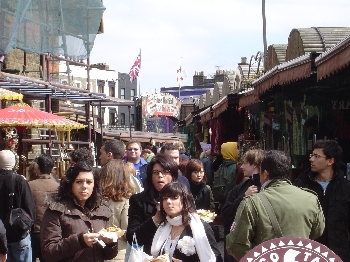
Today I went for a wander around Camden in London, visiting Camden Market, Camden Lock and The Stables, contiguous areas filled to overflowing with small shops and open air stalls selling exotic Goth clothing, lampshades made out of old computer motherboards, Tibetan jackets, New Age crystals, Latex fetishware, fur-lined handcuffs, AC Milan supporters posters, weird furniture made out of tree stumps, flashing clothes with fibreoptic weaving, magic mushrooms to go, bongs, ‘No one knows I’m a Lesbian!’ tee-shirts, and food from West Africa, Morocco, Japan, Indonesia, Lebanon, Korea, Venezuela, France, Italy, China, Jamaica, Thailand, Holland, Scotland and even England.
The political content was endless racks of tee-shirts emblazoned with Che Guevara, Bush=Hitler and McShit Hamburger logos and stands owned the Socialist Worker’s Party and various other fringe folk manned by quixotic and very earnest folks handing out “Bush is the biggest terrorist!” posters.
Now my guess is that 75% of the people who thronged around Camden (the crowds were dense over a very large area indeed) are more or less completely indifferent to those particular the messages and certainly 95% of the stalls and shops were not selling politically oriented things at all. Yet what was available was entirely of the left and almost all of it was either Communist (Che Guevara’s image was widely seen) and/or anti-American.
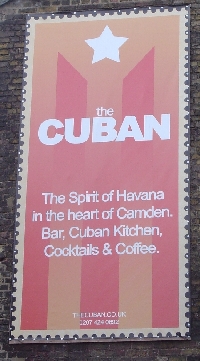
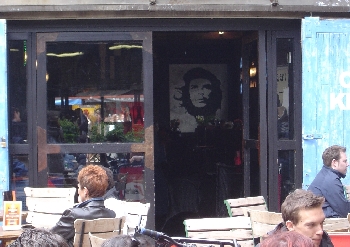
Right in the centre of the large shopping area called The Stables is a Cuban Restaurant called rather unambiguously The Cuban. Giving it the benefit of the doubt, I stuck my head inside as for all I knew the place was owned by some Cuban refugee who had fled Castro’s communist dictatorship. But no. The first thing I see is a large image of Che Guevara. The outside of the building has a sign saying this place brings “The Spirit of Havana in the heart of Camden”…
…which presumably means that criticizing the restaurant gets you dragged off to jail by uniformed thugs as that is truly the spirit of Havana.
Now if someone wants to portray a benign fantasy version of Cuba (“Castro chicken tenders!“), well that is entirely up to them. But the moment I see that Che image up on the walls, The Cuban takes a position on who ‘the good guys’ are and it becomes more than just a Cuban restaurant. Too harsh? Well imagine a German restaurant. Now put a picture of Himmler on the wall of that restaurant and suddenly the entire context of the place changes. I wonder how people would react to a Cambodian restaurant which offered a “Pol Pot Roast” or a “Killing Fields Kocktails!” whilst a smiling image of Pol Pot looked down on the gorging clientele. My goodness what fun that would be. Still, perhaps a closer examination of The Cuban’s menu may reveal such dishes as “Jailed Journalist Jambalyah” or “Dead Dissident Daquiris” whereupon my views of the place would have to change somewhat. I have not looked but somehow I doubt it.
But it got me pondering. I wonder how many of the anti-globalisation activists who probably regard areas like Camden as ‘home turf’ and perhaps even eat at The Cuban realise how the area only looks the way it does because of the global movement of goods within a market economy. Do they seriously think that there is a place like Camden anywhere in Cuba? Do they think the new Age crystals, the fetish shops, the Goth gear purveyors, the mountain bike shops and, hell, even the clothes they wear, the mobile phones they all carry, the iPods they listen to, would all be available in a politically directed command economy? Please, show me such a place.
The thing is, their own lifestyles and environments are examples of the benefits of what they profess to reject. Quite funny really if you think about it.
This “trade and cheap labour for manufacturing is the rich world exploiting the poor” argument is not precisely new to my ears. When I was a kid in the 1970s I heard the same thing about how we were taking advantage of poor world sweatshops. The only thing that has changed since then is the location of the sweatshops. In those days people talked about Taiwan, South Korea, Hong Kong, those kinds of places. And what do these places have in common? Well, today they are the rich world. Ten years ago we started seeing “Made in China” on our cheap imports. A lot of this stuff then came from Shenzhen, just over the border from Hong Kong. Well, today Shenzhen is for practical purposes a developed world city. The manufacturing has now moved inland. The process is getting faster, and the more of the world is rich, then it gets faster still for the rest.
– Michael Jennings, getting enraged at Christian Aid yesterday evening.
The fine U.S. blogger and libertarian scholar, Tyler Cowen, who’s blog Marginal Revolution is well worth a visit (as if I did not have enough things to read, aarrgghh, Ed) has started a specialist blog devoted to tracking developments and medical research surrounding avian flu. Tyler is clearly worried about the spread of new and more powerful viruses and the threat this poses to the health to millions of people around the world.
Rather interesting, I think, that the Internet, which helps to spread ideas with the speed of a virus, is now spawning blogs which are devoted to actual, existing viruses.
Favouring open immigration into integrationist societies within the context of an eventual end to the welfare state and strengthening of civil society is a view widely shared in these parts. But I can also say will little fear of contradiction that not one of the regular writers for Samizdata would describe themselves as a multiculturalist.
The term did once have some appeal but in the end what it has come to mean is someone who thinks all (non-western) cultures are as desirable as each other. However I do not believe that all cultures are equally worthy and I doubt that in reality all too many other people really think that either is you dig deep enough. For all its many and varied flaws, the modern dynamic, secular and above all tolerant western civilisation of the early 21st Century is considerably superior to the alternatives. But of course even within the west, not all the societies that make up that great civilisation are as dynamic and successful as each other.
But what is a society? Definitions vary. In the crudest sence it is a group of people who interact with each other by simple virtue of their proximity (something the internet may change), and as a result follow broad (but often loose) cultural norms which have evolved to facilitate interaction and order. So by this very simple (prehaps even simplistic) definition is also pointless to pretend that having long term un-assimilated communities with certain key antithetical values within western societies is anything but a recipe for catastrophic strife.
The stunning and very under-reported race riot by Arabs and North Africans in France last month shows what happens when the state interferes for decades by subsidising parasitic behaviour based on identity politics and pretending that state fiats can either enforce or obviate the need for integration. When the French state bans chadors and all other religious symbols in French educational conscription centres (schools), it is not a case of France ‘defending western culture’ but rather admitting that civil society has so decayed under the weight of generations of politicization that natural social mechanisms no longer exist to integrate newcomers as effectively as once was the case. In the end nothing gets done in France without it being planned and implemented politically by the enarques in Paris and racial no-go areas are the result.
The solution in the end may be less government so that civil society can actually regenerate but in the short to medium term it is hard to see how the French political class, not a group known for frank introspection and honest analysis, can prevent France gradually sliding into ever more atavistic violence. Even Britain, which has far better race relations than France, learned in 2001 that playing identity politics and handing out other people’s money based on ethnicity is a dangerous thing to do. But whereas in the USA the 1992 Los Angeles riots spurred some soul searching in the USA and the emergence of excellent bipartisan social organizations aiming at economic and social integration, in France a significent race riot barely makes it into the press and in Britain, far from looking to enhance integration and the adoption of western cultural norms, we find that we now risk prosecution for making critical remarks about Islamic culture.
Is it any wonder so many Americans react to the European political classes’ pretensions of moral superiority with little more than a contemptuous and well deserved sneer?
So that’s it then. As Mark Steyn says at the start of this, the surprise is how long it lasted.
Here is how this guy sees it:
Thanks to Patrick for spotting this, but only in the original immobile version.
Michael Totten has been putting some rather compelling articles up on his blog from Lebanon. That Michael, who is clearly a ‘glow in the dark American’, should wander into the ‘Hezbollahland’ section of Beirut with a camera suggests to me that he has some serious stones.
Make the strangely named ‘Spirit of America’ Lebanon blog part of your daily bloggage because it is extremely interesting stuff reported from the sharp end… and maybe even drop a dime or two into the plate to help him out.
Mark Steyn with an extended meditation in the Spectator on globalization. Just go read it, already. Its worth the registration and annoying pop-ups.
Wired reports how in an attempt to establish equity in the world of surveillance, participants at the Computers, Freedom and Privacy conference in Seattle this week took to the streets to ferret out surveillance cameras and turn the tables on offensive eyes taking their picture.
The opposite of surveillance — French for watching from above — sousveillance refers to watching from below, essentially from beneath the eye in the sky. It’s the equivalent of keeping an eye on the eye. With that in mind, Mann conducted his tour with conference participants to see how those conducting surveillance would respond to being monitored.
In the stores, as conference attendees snapped pictures of three smoked domes in the ceiling of a Mont Blanc pen shop, an employee inside waved his arms overhead. The intruders interpreted his gesture as happy excitement at being photographed until a summoned security guard halted the photography.
Mann asked the guard why, if the Mont Blanc cameras were recording him, he couldn’t, in turn, record the cameras. But the philosophical question, asked again at Nordstrom and the Gap, was beyond the comprehension of store managers who were more concerned with the practical issues of prohibiting store photography.
Mann quoted Simon Davies of Privacy International, a London-based nonprofit that monitors civil liberties issues:
The totalitarian regime is the regime that would like to know everything about everyone but reveal nothing about itself.
He considered such a government an “inequiveillant regime” and likened it to signing a contract with another party without being allowed to keep a copy of the contract.
What I argue is that if I’m going to be held accountable for my actions that I should be allowed to record … my actions. Especially if somebody else is keeping a record of my actions.
|
Who Are We? The Samizdata people are a bunch of sinister and heavily armed globalist illuminati who seek to infect the entire world with the values of personal liberty and several property. Amongst our many crimes is a sense of humour and the intermittent use of British spelling.
We are also a varied group made up of social individualists, classical liberals, whigs, libertarians, extropians, futurists, ‘Porcupines’, Karl Popper fetishists, recovering neo-conservatives, crazed Ayn Rand worshipers, over-caffeinated Virginia Postrel devotees, witty Frédéric Bastiat wannabes, cypherpunks, minarchists, kritarchists and wild-eyed anarcho-capitalists from Britain, North America, Australia and Europe.
|

.gif)





Recent Comments