We are developing the social individualist meta-context for the future. From the very serious to the extremely frivolous... lets see what is on the mind of the Samizdata people.
Samizdata, derived from Samizdat /n. - a system of clandestine publication of banned literature in the USSR [Russ.,= self-publishing house]
|
WHEREAS, any members of the House of Representatives or the Senate of the Legislature of the State of Idaho who choose to vote “Nay” on this concurrent resolution are “FREAKIN’ IDIOTS!” and run the risk of having the “Worst Day of Their Lives!”
-US State of Idaho House Concurrent Resolution No. 29, commending Jared and Jerusha Hess and the City of Preston for producing a movie. (via Oxblog)
The campaign to impose the Olympic Games upon Paris and the French taxpayer, rather than upon London and the British (and London – i.e. me) taxpayer, is lunging strongly towards the finishing tape:
. . . Mauritanian head of CONFEJES Youssouf Fall explained support for Paris’s candidacy by stressing “France’s important experience in organizing sports competitions, as well as Paris’s excellent quality infrastructure.” Paris’s official commission said in a press release, “This decision is a major international push for Paris’s candidacy, which is now guaranteed of strong support in the final vote on July 6 in Singapore.” The choice of the site of the Games is not voted on by the countries as such, but rather by the members of the IOC, who can vote as they wish. Nevertheless, . . .
That is the most eloquent “nevertheless” I have read recently.
. . . among the 39 countries that support Paris, there are many whose representatives have a vote, including Morocco, Canada, Egypt, Cameroon, Luxembourg, Switzerland, Guinea, and Tunisia, and the Paris 2012 committee stresses that “the Francophone community of Belgium and the Canadian provinces of Quebec and new Brunswich have also given their support.” Among other countries at the CONFEJES meeting were Benin, Burkina Faso, Burundi, Cape Verde, Central African Republic, Comoros, Congo, Ivory Coast, Djibouti, Gabon, Guinea-Bissau, Greece, Haiti, Lebanon, Madagascar, Mali, Mauritius, Mauritania, Níger, Democratic Republic of the Congo, Rumania, Rwanda, Senegal, Seychelles, Chad, Togo, and Vietnam. In addition, French sports minister Jean-Francois Lamour stated yesterday that this vote shows “one additional proof of the support and determination Paris’s candidacy can count on. . . .
Allez France! Allez neo-colonialism!
And an interesting reminder, I think, of how different the world can look when viewed from somewhere . . . different.
My guess would be that all this talk of democracy that has been bubbling up in the world lately must be quite a nuisance to a number of the regimes listed there. Which might explain why France, despite being democratic itself, is not that keen on the idea spreading.
Robert Kilroy-Silk is a laughing stock in sophisticated circles, even in those slightly askew sophisticated circles—sophisticated ellipses?—Samizdatistas belong to. But should he be?
A glance at the manifesto of Veritas, the man’s own personal political party, suggests not. Not only is it produced in a deep purple colour that readers of this blog will find comfortingly familiar, but some of the views expressed there wouldn’t be so far out of place here either.
Let’s speed past the tosh about immigration, this year’s must-have fearful tic for every pol-about-town, and see what’s hidden in the exotic interior… → Continue reading: Image is everything, unfortunately
Paul Staines writes:
New data shows that the developing world’s share of global trade has surged to a 50-year peak. Rising oil and commodity prices coupled with vigorous global trade growth meant developing countries saw their share in world merchandise trade rise sharply in 2004 to 31%, the highest since 1950, according to WTO figures released this morning.
The data provides clear evidence that trade liberalisation continues to play a growing role in economic activity and is increasingly important for development and poverty alleviation. More countries are engaging in international trade and participating more actively in setting and negotiating trade rules.
Just like with India and Hong Kong, trade liberalisation is key to African prosperity. If we truly want to Make Poverty History, the world needs free trade – not protectionism.
Incoming email from Sean Gabb:
Dear Brian,
I know this is not the best time or place for the debate – I believe much of the audience wants to leave afterwards to wander up and down outside Parliament waving candles or some such. I hope to be abed by then. But it may be an important event. If you cannot attend, please circulate.
Regards,
Sean
I could attend but do not want to. I am going through a quietist phase just now. But I am happy to pass it all on:
Free Trade v Fair Trade
A Debate Organised by Christian Aid
St Margaret’s Church, Westminster (Near Parliament)
Friday 15th Aril 2005 – 11.50pm to 1am
What is best for poor countries? Do they need global free trade in goods and services? Or is this just a cover for western neo-imperialism? Do such countries instead need fair trade – a system in which local producers are encouraged to develop without competition from larger foreign countries?
Come along and listen, and have your say.
Chair: Alan Beattie, The Financial Times
For Free Trade: Dr Sean Gabb, Libertarian Alliance; Alex Singleton, Globalization Institute
For Fair Trade: Martin Khor, Third World Network; Prosper Heoyi, Oxfam
For further details, contact:
Leo Bryant
Campaign Events
Christian Aid
020 7523 2264
camtemp3@christian-aid.org
Sean adds the following:
Assuming other speakers will give permission, Sean Gabb will video the whole event, and will make DVDs available. He will certainly record his own contribution.
This flyer was put together by Sean Gabb on the basis of limited information. He had nothing to do with what he considers the dreadful time and place of the debate, but is told that around 700 people will attend.
Good luck gentlemen. I look forward to viewing the DVD.
The Daily Texan reports that State Rep. Larry Phillips, R-Sherman, isn’t happy that one-quarter to one-third of all Texans drive without automotive insurance, according to his research. He aims to change that with his proposed House Bill 2893, which includes a subsection that some find disturbing: the addition of an electronic tracking and identification system onto each vehicle.
The RFID tag would transmit a unique frequency that would show the vehicle’s make, model, identification number, the title as registered with the Department of Transportation and whether or not the driver has insurance coverage. The proposed law also makes clear that the state will create a database of insurance provider and coverage information, keeping track of who has what insurance policy and whether it is paid or not. Scott Henson, a Texas American Civil Liberties Union police accountability and homeland security specialist warns:
The language opens up the whole tracking system for any conceivable law enforcement use,” Henson said. “Once that happens, Texans’ cars might one day appear as electronic dots on law enforcement’s computer mapping screens.
The transponder lets the government track you wherever you go, whether to visit your grandmother, secretly visit a gay bar or drive to a medical supplies office, whatever.
Philip Doty, associate director of the Telecommunications and Information Policy Institute at UT-Austin goes to the heart of the matter:
In post-Patriot Act America, people have lost awareness of the little changes that lead to a chain of effects that restrict us politically and individually.
Here is proof that Jeremy Clarkson and his fellow petrolheads have definitely got under some green skins, if you get my meaning:
Environmental campaigners have called for the BBC’s Top Gear programme to be scrapped as they claim it promotes irresponsible driving. But how fair is this criticism?
For many motoring enthusiasts it is among the highlights of the television week.
But, with its irreverent style and penchant for high-speed stunts, Top Gear attracts fans and critics in equal measure.
Now the BBC Two programme has come under fire from the Transport 2000 pressure group, which has called for it to be taken off the air and replaced with a show that promotes “sensible driving in sensible vehicles”.
Yes, that will pack them in.
Greenies: try to understand. Most drivers spend their lives driving sensibly in sensible vehicles, except when you lunatics have stuck bumps in the road, in which case they are obliged to drive senselessly, accelerating and decelerating and generally spoiling the air and the neighbourhood. The idea that TV’s premier driving show should surrender its position as TV’s premier driving show by doing nothing but reflect this dreary reality is crazy, and cruel. Kill Top Gear, and you will have alienated yet another big brick in the human wall that is Middle England.
Transport 2000, which is committed to reducing the environmental and social effects of transport, argues that Top Gear falls short in its responsibility to educate viewers and acknowledge the interests of women drivers.
Personally, I am in favour of the “social effects” of transport, the main ones being that because we are able to travel, we can get to see interesting places and appealing people, and get and do far better jobs than would otherwise be possible. And as for the environmental effects of transport, I know what they mean, but once again, I think transport makes the environment far more congenial, not least because we can travel about in it and see what it all consists of.
Obviously the most environmentally friendly thing, in the sense these people mean, that humans could do would be to drop dead en masse. But most of us, thank goodness, are not these people. For most of us, life is for living, and life would be very lifeless if we were to do away entirely with exciting cars, and drove only sensible ones, and worse, if we were not even allowed to watch crazy cars being driven crazily on TV.
From Instapundit, the excellent news that traffic cameras have been voted down in Virginia, New Hampshire, and Indiana.
A number of jurisdictions still have such cameras in place (or at least a place for them has been reserved, legal authority-wise), but fortunately there is a solution.
Downfall (Der Untergang) proved the perfect foil to the Europe of the Diversities conference, referred to earlier by Johnathan Pearce. This is a controversial film that has excited some who argue that representations of the Nazis which humanise their actions, and detail their suffering, downplay the consequences of the regime. There is weight to this argument, as the film focuses fully on the people within Hitler’s bunker, their loyalty, their duty and their concerns in those final days.
Deftly underscored by Stephan Zacharias’s string-laden soundscape and cinematographer Rainer Klausmann’s truly terrific skill in capturing of the grim reality of the horror that was 1945 Berlin, Hirschbiegel pushes many buttons: the collective guilt of a nation for atrocities committed by their state balanced against the horrific human price of no surrender; the astonishing loyalty of the women around the cold-hearted dictator and the SS who vow to fight on because “we cannot outlive the Fuhrer’s death”; the double standard of being superior but cleansing themselves of traitors and the imperfect until there’s no leadership left to carry the torch.
Although Friedrich Hayek argued that totalitarian regimes allowed thugs and psychopaths to enter positions of authority, this film shows that traditional values of honour and duty were perverted and strengthened by the Nazis. In the film, it is Prussian values which sustain the dying regime, bring the Hitler Youth onto the streets and motivate the soldiers.
One should watch Shoah prior to this, as an inoculation, since one must make a conscious effort to recollect the camps in order to avoid feeling any empathy with these monsters.
UPDATE: For those who thought my link to a revisionist website was too obscure a warning signal that these memes still exist, here is an interview with Lanzmann, the director of Shoah, explaining the reasons why his work must exist.
“The East Coast Forestry scheme should be abolished”
“Why?”
“Because it is a scheme”
– A conversation that took place between a senior minister of the government of New Zealand and an adviser who had been sent to “evaluate” said scheme, back in the glorious days of yore when New Zealand had been taken over by rabid free-marketers. (Sadly, New Zealand is these days once again run by some of the world’s squishiest leftists).
I attended a one-day conference on the EU Constitution today, drawing together an eclectic mixture of people from all parts of the political spectrum, both British and foreign, and all united on the need to get a decisive No vote in the event that Mr Blair decides to hold a referendum on one (let’s pray it is not done by postal vote, god help us). I attended the morning session and drifted home for lunch with my head still ringing with one of the best speeches by a politician I have heard for years.
The politician’s name is Steve Radford and he is a Liberal Party councillor in England. His party is the bit that refused to merge with the old Social Democrats and decided to keep the flame of Gladstone, Richard Cobden and Joe Grimmond burning bright. Well, if Mr Radford’s performance was a guide, the Liberal Party is a very interesting outfit indeed. He denounced the European Union’s economic tariffs most effectively by holding up a bag of sugar and pointed out that the price of the bag is inflated fourfold by tariffs. He denounced the rampant corruption, cronyism and lack of democratic accountability of the EU, a situation which will get only worse if the EU Constitution becomes a fact. He was passionate in making the free market case – all too rare these days, and frequently very funny.
It is refreshing to hear an actual big-L Liberal refer to the anti-Corn Law League and the great campaign to promote free trade by the likes of Richard Cobden. I don’t know about all his views on other subjects, but if every member of the Liberal Party were like this man, I’d very seriously consider voting for it.
I hope we haven’t heard the last of this gentleman.
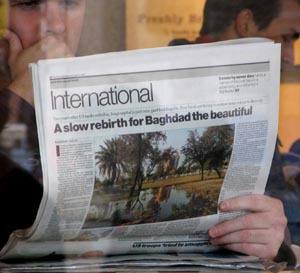
A Guardian headline spotted today:
The complete story is here.
Basically, and especially in recent months, things are improving.
The story ends thus:
Six months ago Bradt Travel Guides published what was probably the first postwar guidebook for Baghdad. If you do not enjoy Iraq’s capital, at least appreciate the residents, it said.
“They are a justifiably proud people, whose city was the capital of the world when London was an overgrown village and Columbus several centuries away from America.
“War has not destroyed this and western condescension is met with the scorn it deserves.”
So, whatever happens, the West is still wrong. It would not be the Guardian if there was no defeat to snatch from the jaws of the victory they dreaded, but are now having to concede.
|
Who Are We? The Samizdata people are a bunch of sinister and heavily armed globalist illuminati who seek to infect the entire world with the values of personal liberty and several property. Amongst our many crimes is a sense of humour and the intermittent use of British spelling.
We are also a varied group made up of social individualists, classical liberals, whigs, libertarians, extropians, futurists, ‘Porcupines’, Karl Popper fetishists, recovering neo-conservatives, crazed Ayn Rand worshipers, over-caffeinated Virginia Postrel devotees, witty Frédéric Bastiat wannabes, cypherpunks, minarchists, kritarchists and wild-eyed anarcho-capitalists from Britain, North America, Australia and Europe.
|





Recent Comments