We are developing the social individualist meta-context for the future. From the very serious to the extremely frivolous... lets see what is on the mind of the Samizdata people.
Samizdata, derived from Samizdat /n. - a system of clandestine publication of banned literature in the USSR [Russ.,= self-publishing house]
|
Only a wilful fool would dispute that racism moved from being the unremarkable default mainstream view in the western world to being a prejudice which scarcely dare speak its name. I would argue that this did not come about just because a few anti-discrimination laws got passed. A great many things are illegal and yet doing them does not put you ‘beyond the pale’ in polite society. In most circles lighting up a spliff or speeding or paying your builder/nanny/housekeeper in cash are matters of little or no account and few people would think less of you if they discovered you were doing so. Overt racism on the other hand has precisely that effect because regarding that there has been a cultural shift. To be a racist is not just wrong, it makes you a jackass in the eyes of others. Most racists are now more prone to keep their views to themselves, not because someone will call the cops and have them hauled off to a re-education camp, but because they can no longer safely assume others will share their meta-context.
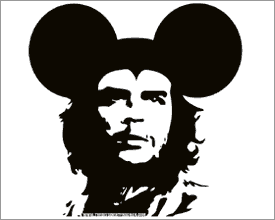
And so with that in mind, it may seem trivial to rail against people who display or wear images of Che Guevara but what is at stake is far more than a battle for mere tee-shirt space. The fact that a person wearing a Himmler or Hitler tee-shirt would attract scorn is quite appropriate, and so it is really quite intolerable that fans of the mass murderers of the left get to think images of their favoured mass murdering thug makes them look cool. Why just let that slide?
Groups like the ‘animal rights’ activists PETA provide a fairly good example of ‘going to the culture’ with some success at portraying people who wear fur coats as wicked and getting that meme into the zeitgeist fairly effectively at least in the USA and UK (though rather less successfully elsewhere). So do not shrug off efforts to portray people who wear images of communist mass murderers as jackasses rather than ‘cool’ as wasted effort over something something of no account. Little things like this add up and if you believe, as I do, that the single biggest factor determining the triumph or defeat of liberty is a cultural expectation of liberty, then fighting for the cultural issues really does matter. And if the lumpen wearing the Che Guevara tee-shirt does not even know who he was, as will often be the case, then tell him in no uncertain terms so that next time he looks at his pile of shirts, perhaps he will think twice before putting it on and maybe, just maybe, look at other people wearing those vile tee-shirts a bit differently.

I am due for a fascinating teleconference in 10 minutes, but I thought this Glenn Reynold’s post nicely illustrated a real blind spot for libertarians. We tend to be market- and economics-oriented, and any concentration of attention in one area creates blind spots in others. One of those blind spots has to do with the economically irrational but irreducibly human craving for non-material benefits in the form of status, recognition, etc.
My historian-brother often says that one of the most interesting phenomena that he’s observed is the cross-cultural willingness of people to trade away economic benefits for status. I suspect that this is one example of that. So, in a surprisingly similar way, is being a politician. That’s an obviously poor economic move for most folks. But one of the drug dealers in Price’s book talks about how he likes the way he becomes the center of attention when he enters a room full of junkies. Politicians, I think, get the same thing, especially in the bubble-environments of Washington, or state capitals. I suspect, in fact, that people are, to varying degrees, hardwired to get an endorphin rush from that sort of attention, just as they’re hardwired in varying degrees to respond to drugs.
As I say, I don’t know if Levitt talks about that or not, but I think it’s one possible explanation for a lot of stuff that looks economically counterproductive.
I have a niggling sense that there is a lot more to be said on this subject, but duty calls. Go read the Instapundit post, and as always, be sure to click the concluding “Indeed.”
Selected research on bread:
More than 98 percent of convicted felons are bread users.
Fully HALF of all children who grow up in bread-consuming households score below average on standardized tests.
In the 18th century, when virtually all bread was baked in the home, the average life expectancy was less than 50 years; infant mortality rates were unacceptably high; many women died in childbirth; and diseases such as typhoid, yellow fever, and influenza ravaged whole nations.
More than 90 percent of violent crimes are committed within 24 hours of eating bread.
Primitive tribal societies that have no bread exhibit a low incidence of cancer, Alzheimer’s, Parkinson’s disease, and osteoporosis.
Newborn babies can choke on bread.
Most American bread eaters are utterly unable to distinguish between significant scientific fact and meaningless statistical babbling.
Providing all the scientific support any nanny-stater will need to implement controls.
John K added a comment to the Rover over story here last week which Mark Holland liked so much that he reproduced it over at his blog in its entirety. I agree, and had in mind to do something similar here when I first read it. But now that Mark has already immortalised it, I will confine myself to reproducing the final enraged paragraph of what John K had to say about Stephen Byers:
I know we sometimes make jokes about jumped up Polytechnic lecturers going into Parliament, but Byers really was a jumped up Polytechnic lecturer, a man with no experience of anything outside of the Senior Common Room and Labour Party hackery, and this spineless imbecile, a man so hopeless that despite living up Tony’s rectum eventually even el Presidente had to realise he was not up to the job, or indeed any job, and expel him like the compacted turd he was, is and forever will be, this man completed the Labour Party’s destruction of the British owned motor industry.
So far so entertaining. We think Byers is a fool. We would. But then last Sunday evening, in the tube, I picked up a discarded copy of the Observer business section. And I later read, on its front page, this piece about the Rover debacle, which contained the following choice invective, also about Stephen Byers:
But there is nothing ‘natural’ about the Longbridge scandal; it is no act of God. It is an entirely man-made catastrophe, which can be blamed on a relatively small number of individuals. They can and should be made to pay.
The first culprit is Stephen Byers, who pushed the BMW-Phoenix deal through in 2000. Confronted on TV with his guilt, he all but sang ‘Je ne regrette rien’, while praising himself for keeping the Longbridge workers in employment for the past five years. This is the man who sold the original deal as a way of guaranteeing a long-term volume car business in Britain.
Now we are asked to believe the real plan all along was to ease the workers into redundancy, and to view industrial policy as an extension of the social security department. That speaks volumes about new Labour’s attitude to business. Byers, who harbours ambitions of a return to government after the election, is a busted flush who should stay on the backbenches for the rest of his hopefully brief political career.
The other culprits are, of course, the Phoenix Four, led by their still maddeningly smug chief, John Towers. . . .
Something tells me that Byers will not actually pay anything, and incompetence by the standards of normal life is not the same as political incompetence, is it? So he may indeed make a political comeback. However, the fact that Byers is being trashed in the Observer makes me optimistic that this particular incompetent may have had his day.
If so, then I guess he will have to go back to Polytechnic lecturing. If they’ll have him.
Three newspapers caught my attention today, in relation to what they had to say about the Conservative party.
Mark Steyn in the Daily Telegraph pointed out that the Conservative party was not even arguing against the doctrines of social democracy and therefore could not complain with the fact that the forces of an ever larger government were going to win the general election in Britain. If one will not even argue one can not blame the people for siding with one’s opponents.
Mr Richard Littlejohn in The Sun newspaper (sorry, not in on-line edition) also argued that timidness of the Conservatives would mean that they had no hope of victory.
Finally the Financial Times had on its front page the fact that almost 7 out of 10 voters believed that the Conservative party would put taxes UP if elected to government.
I believe that two things are wrong with the Conservative party. One is indeed the timid nature of its policies, as the Economist journal pointed out weeks ago the tax and spend policies of the Conservative and Labour parties are so similar as to be almost indentical.
But it is not just a matter of policy, it is a matter of the arbitrary power of the leadership. In the late 1970’s (when the Conservative party was last out of government) many Conservatives showed interest in ideas, they visited the Institute of Economic Affairs, they set up research bodies of their own (such as the Centre for Policy Studies) they freely debated both the practical details of policy and the political principles on which policy should rest.
All this has been much more muted in recent times. First, pressure was put on people to only say what the party wished them to say (and this pressure started long before the election campaign) and now first candidates and then an actual member of Parliament have been turned on – turned on for absurdly mild ‘crimes’.
First a candidate was told he must stand down because he had been photographed with firearms (that did not even belong to him) in the background of the photograph – this in the party that once represented not just shooting for hunting but the British National Rifle Association and the Constitutional Club network (once stronger in Britian than in the United States).
Then a candidate was told he must stand down because the socialist Guardian newspaper had attacked his use of the term creative destruction in relation to the public services. It did not matter that the candidate was simply quoting Joseph Schumpeter (the non Austrian school, Austrian economist). It was not a question of the leadership thinking that, say, Hayek and Mises were better economists than Schumpeter – the leadership of the Conservative party were not interested ideas at all. The Guardian had attacked, so the candidate must go.
Then Mr. Flight a member of Parliament (whilst Parliament was still sitting) was told he would not be allowed to stand for Parliament as a Conservative again – regardless of the fact that his Constituency Association and the local voters supported him. His crime? Saying that he thought there was more scope for savings in government spending than the leadership had said.
Mr Flight said nothing about ‘secret plans’, but he was not just removed from the Shadow Cabinet, – he was removed from the list of candidates for the Conservative party.
It is this “list” that is the key problem.
It is not a simple matter of Mr Howard (the leader of the Conservative party) being a bad man – no person should have the arbitary power to effectively expel someone from Parliament simply because they do not happen to like something they have said.
It is as if President Bush could expel any Republican from the House of Representatives simply because they said that they thought that there was more scope for savings in government spending than President Bush has said.
This arbitrary power of the leadership of the Conservative party did not use to be used liked this (so some fault does go to Mr Howard as an individual), but it is the power itself that must be removed if their is to be a real chance of an intellectual restoration of the Conservative party.
The Conservative party was once called by its enemies the ‘stupid party’. Whatever the truth or falseness of this charge, a political party today that is uninterested in ideas, indeed expels anyone who shows an interest, has no chance of returning to power.
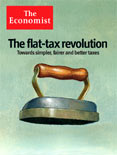
Yesterday I was out and about and spotted multiple front cover display of the latest Economist, with a headline which went: The flat-tax revolution.
I liked this, and took a photo of it, but it came out blurry, and before I could take a decent number to make blurriness less likely I was chased away by a security guard mumbling about copyright, etc. So here is the Economist version:
Final paragraph of the story:
It is true that the flat-tax revolutionaries of central and eastern Europe are more inclined to radicalism than their politically maturer neighbours to the west and across the Atlantic. Mobilising support for sensible change is far harder in those more advanced places – but not impossible. In tax reform, as 1986 showed, the radical programme can suddenly look easier to implement than the timid package of piecemeal changes. Now and then, the bigger the idea, and the simpler the idea, the easier it is to roll over the opposition. The flat-tax idea is big enough and simple enough to be worth taking seriously.
Portillo was wittering on yet again, on the telly last night, about how the Conservatives had to go for the “middle ground”, and electorally speaking that may well now be true, if getting votes for whatever will get votes is all that you care about. Accordingly, I look forward to the time when a flat tax is middle of the road, and when flattening the damn tax into the road so that there is nothing left of it is the “extremism” that Portillo et al will then be warning us all against.
The UN continues to confirm that it is everything its detractors says it is and so much more. Kofi Anan is now blaming the UK and USA, the two countries which produced people in official positions who were willing to point out that the UN ‘sanctions’ in Iraq were a complete scandal, for the way things played out. The sooner this bizarre organisation is destroyed the better.
Sean Gabb now has a report up about his efforts to knock some freeness into the heads of those self-styled fair traders. And in Alex Singleton’s Globalization Institute email this morning was a link to a write-up of the Globalization Institute in the Church press, although how significant this particular example of the Church press is I do not know. Still, it all helps. See also this posting.
In the comments on that earlier posting that flagged up the meeting in the Church last Friday night, puzzlement was expressed about why so many of these Fair Traders are in favour of free trade for the rich countries, especially in things like agriculture, yet opposed to free trade for poor countries. How come? Are they not being inconsistent?
I can suggest a possible answer that makes sense of such an apparent contradiction. Suppose that (a) you are an egalitarian, and that (b) you think free trade is harmful to whoever has it imposed upon them. That would explain it, I think. Trade freedom makes rich countries poorer, and trade unfreedom makes poor countries richer. Total bollocks of course. Egalitarianism is stupid, and the claim that trade freedom makes countries poorer and that trade unfreedom rescues poor countries is the opposite of the truth. But if that is what you are and what you think, it becomes reasonable. As in: a madman is someone who has lost everything except his reason. Impeccable logic, based on false axioms.
The result of such agitation is actually to make rich countries richer, and to keep the poor countries poor, which is the very thing these self-righteous morons spend their lives saying they object to. But there you go. There’s one born every time a celebrity clicks his/her moronic finger on the telly.
For some further thoughts on these and related matters from me from way back, see this.
Over the past month or so there have been repeated anti-Japanese demonstrations and riots in China. That in itself is unusual as the Chinese authorities are not keen to allow demonstrations to become a habit, but are signs that this series of demonstrations have the support of the Chinese government.
One of the great things about the blogosphere is that if something noteworthy happens somewhere, there is bound to be a blogger to write about it. Andres Gentry is in Shanghai and popped on down to the Japanese Consulate to have a look – his report has photos and is well worth a read.
But what I found eye-opening was the attitudes of the locals.
Most of the protesters were young 20-somethings and though there were more males than females there were still a fair number of women involved. On not a few occasions it seemed the demonstration was an opportunity for a date as I watched couples walk past. A few parents brought their infant children.
We stayed at the main intersection near the Japanese Consulate General for about half an hour, enough time for one fellow standing next to us to tell us his opinions on Japan. He said he had done his BA work in Nanjing and was doing research at a nearby financial school. He made the obligatory reference to how much he hated Japan and the Japanese. The UN Security Council seat didn’t come up for him. I asked him what the goal of the protesters was and he gave me two: 1) to let Japan know how much Chinese hate Japan and 2) to show Beijing how much Chinese hate Japan. I wasn’t surprised at reason number 2. I asked him why he didn’t just choose a new government for China if he was dissatisfied with the current one and he emphatically said that would be a bad idea becaue the last time that China experienced that kind of freedom it had broken up into smaller states. He did not seem keen on the idea of democracy. I asked if he thought foreigners would start leaving China for other countries, especially India, in light of the protests and he seemed very confident that this wouldn’t happen. He explained he had done research on the Indian economy and that its efforts to modernize had so far failed. He also seemed quite keen to tell me that Indians are fundamentally lazy and that Chinese are fundamentally hard workers so foreign companies have little incentive to leave China.
This wasn’t a conversation, I was only asking questions since I had no intention whatsoever to tell people my own opinions. I confess I repeatedly pressed the student on his attitude towards democracy and the strangeness that he was allowed to protest Japan but not allowed to protest anything about China, much less choose his own leaders. He was adamant that freedom would not be good for China at this time. We spoke almost entirely in English, something which was his choice and one I thought was reasonable since if we spoke in Chinese and everyone around us knew what he was saying than perhaps he might get into trouble. I tried on a number of occasions to ask his girlfriend some questions but she refused to answer and was self-evidently uncomfortable with her boyfriend’s loqaciousness.
Anyway, read the whole thing, which includes a diversion to a local Hooter’s restuarant and links to other accounts.
One of the fables that socialists like to tell is how wonderful life is in their peoples’ paradises. From risible stories about how the Cuban people have world-class health care freely available to all and are 100% literate, to more plausible, but equally erroneous, tales about how our Scandinavian brethren manage to have a high standard of living, short work weeks, a benevolent welfare state, etc., these tales are inevitably spun by statists seeking to cast dust in the eyes of their more plebeian subjects the better to hide the failure of their grand schemes.
The received wisdom about economic life in the Nordic countries is easily summed up: people here are incomparably affluent, with all their needs met by an efficient welfare state.
Not so fast. Even in the notoriously socialist-freindly confines of the New York Times, hard economic truths have a way of making themselves felt eventually. What the Times has belatedly discovered about its beloved third way socialist-lite economies is that they are falling behind, shackled to the dead weight of the welfare state, the enervation it breeds, and the taxes it imposes.
All this was illuminated last year in a study by a Swedish research organization, Timbro, which compared the gross domestic products of the 15 European Union members (before the 2004 expansion) with those of the 50 American states and the District of Columbia. (Norway, not being a member of the union, was not included.)
After adjusting the figures for the different purchasing powers of the dollar and euro, the only European country whose economic output per person was greater than the United States average was the tiny tax haven of Luxembourg, which ranked third, just behind Delaware and slightly ahead of Connecticut.
The next European country on the list was Ireland, down at 41st place out of 66; Sweden was 14th from the bottom (after Alabama), followed by Oklahoma, and then Britain, France, Finland, Germany and Italy. The bottom three spots on the list went to Spain, Portugal and Greece.
Alternatively, the study found, if the E.U. was treated as a single American state, it would rank fifth from the bottom, topping only Arkansas, Montana, West Virginia and Mississippi.
While the private-consumption figure for the United States was $32,900 per person, the countries of Western Europe (again excepting Luxembourg, at $29,450) ranged between $13,850 and $23,500, with Norway at $18,350.
Faced with the undeniable economic reality that they have almost eaten their way through the economic seed corn laid up by their frugal ancestors, what do the current panjandrums of the welfare state do? Why, they lie, of course.
Meanwhile, the references to Norway as “the world’s richest country” keep on coming. An April 2 article in Dagsavisen, a major Oslo daily, asked: How is it that “in the world’s richest country we’re tearing down social services that were built up when Norway was much poorer?“
Ian Grey urges people to read the fine print when Greeks politicians come bearing gifts
Through a remarkable coincidence of timing, families are being encouraged to save lots of money on childcare courtesy of that benevolent Labour Government of ours, launched and promoted during the General Election.
Within the Grey household, we are fortuitous enough to have both a private and a public sector employer providing our household income stream and both of them have decided to jump on the employee benefits bandwagon of offering childcare vouchers.
The way it works is that an employee agrees to take some of their salary as vouchers (to a maximum of £2,600 a year, i.e. £50/week) and this sum is free of Tax and NI. (The incentive to the employer is that it is free of Employer NI as well). The vouchers can be paper or electronic, they are given or allocated to the carer who redeems them without penalty to the parent and everyone is happy. Or are they?
Well, I am not. I have read the forms and there seem to be some ambiguities in the process, which is somewhat convoluted. What happens if I want residual money back because I do not need childcare any more? Not covered. What if I want to pay some on one and some on the other? In theory yes, but the forms I have will not cope with this scheme properly. What happens when the third party scheme management Company makes a pig’s ear of the payments to my son’s nursery (and they will, think every other Government IT project managed by third parties)?
What is even more interesting are the online calculators provided by the service providers, the two of which I have looked at being SodexhoPass and Accor.
Supposedly, the scheme is simple. To quote Accor,
You will save £816 per year if you elect to take £50 per week with paper or electronic Childcare Vouchers and are a standard rate taxpayer. If you are a higher rate taxpayer you will save ££1,066 per year
Sounds good, yes?
However… → Continue reading: Election bribes
Gallipoli Memories
Compton Mackenzie
Cassell, London, 1929
First Athenian Memories
Compton Mackenzie
Cassell, London, 1931
Greek Memories
Compton Mackenzie
Chatto & Windus, 1932
Aegean Memories
Compton Mackenzie
Chatto & Windus, 1940
(All out of print)
Compton Mackenzie, A Life
Andro Linklater
Chatto & Windus, London, 1987
Compton Mackenzie (1883-1972) has left little in the way of reputation behind him. Both his early “serious” and his later “lighter” novels are now unread. Like all “personalities” dependent on attention from and appearances in the media, memory of them and him soon faded and disappeared when these ceased. In Scotland, to which he retired, physically and metaphorically from a wider scene, he is little more remembered, even as a founder member of the Scottish National Party, with which he became disillusioned. Yet when young, before the First World War, he was widely regarded as a near-genius of great literary promise and when it was learned that he was bound for Gallipoli there were plaints in cultured circles that the country, after the death of Rupert Brooke in the same theatre of war, could not afford to lose another of the same calibre. Yet it was as a result of his decision to participate (for this was still a voluntary act) that he produced his masterpiece, in four volumes of “Memories”, which I hope will at some time be republished to ensure him a deserved immortality. His ninety-three other books do not include a credible competitor and it would be a pity if the film Whisky Galore, from the book of the same name, was his only and inadequate memorial.
Gallipoli Memories, published in 1929, was the first in what Mackenzie seems to have projected as a four-volume account of his First World War experiences. He was as eager as anyone of his age to do his bit (we must put aside any sort of back-projection of a pacifist atmosphere generated amongst intellectuals by four years of trench-warfare) and could pull strings to do so. A military doctor told him he would only be fit for service in a warm climate such as Egypt. It was Orlo Williams, to whom the book is appropriately dedicated, who, having noticed that Sir Ian Hamilton, the Commander-in-Chief of the Gallipoli Campaign, was reading Mackenzie’s novel Sinister Street, found him the job on Hamilton’s staff, ensuring Mackenzie his share in the campaign. Though he wholeheartedly approved of it, after a while he had the gut feeling that it would not succeed, justified later by his realisation that it was insufficiently supported by the military back home.
He was not trying to make an historical contribution in this book. He did not keep a diary and such letters as survived were mainly useful for fixing dates. Perhaps the most prominent feature of all the books are his studies of his associates, largely favourable and observed without malice, those otherwise regarded being left anonymous. It is a loss that he never met Churchill (anyway not at this time), but Maurice (later Lord) Hankey who came out instead, “did make a most definite impression” on Mackenzie. He was only 38, not that much older than Mackenzie, but was “always . . . alluded to as if he were trembling on the verge of eighty” and was “the only man throughout the war for whom I never heard anybody suggest a better substitute”. → Continue reading: Spying in Greece during World War One
|
Who Are We? The Samizdata people are a bunch of sinister and heavily armed globalist illuminati who seek to infect the entire world with the values of personal liberty and several property. Amongst our many crimes is a sense of humour and the intermittent use of British spelling.
We are also a varied group made up of social individualists, classical liberals, whigs, libertarians, extropians, futurists, ‘Porcupines’, Karl Popper fetishists, recovering neo-conservatives, crazed Ayn Rand worshipers, over-caffeinated Virginia Postrel devotees, witty Frédéric Bastiat wannabes, cypherpunks, minarchists, kritarchists and wild-eyed anarcho-capitalists from Britain, North America, Australia and Europe.
|





Recent Comments