We are developing the social individualist meta-context for the future. From the very serious to the extremely frivolous... lets see what is on the mind of the Samizdata people.
Samizdata, derived from Samizdat /n. - a system of clandestine publication of banned literature in the USSR [Russ.,= self-publishing house]
|
“Really, think about this: A 4.6 billion-year-old planet with an 8000-mile diameter, with a molten core (heat, etc.), with an atmosphere that is only 50 miles/240,000ft thick (being rather generous), that orbits a star only 93 million miles away with 330,000 times the earth’s mass and that emits enough radiation to burn your naked ass in 30 minutes, is having its weather unalterably changed over the course of the next 5/10/15 years (whatever it is now) by the presence of a weak greenhouse gas, CO2, that happens to now be at its lowest level in damn near the entire history of the planet — a history punctuated by global glaciations while that weak greenhouse gas was far higher than it is now — and that also happens to be the basis of plant life (and therefore atmospheric oxygen), a gas whose greenhouse effect is dwarfed by that of water vapor (on a planet with a surface area that consists of 70% water), and that geologically is currently in an interglacial period. The models that generated this political bullshit have predicted nothing correctly — not sea level change, polar ice cover, or weather.”
– Mark Rippetoe. Mr Rippetoe is a strength training coach, based in Wichita Falls, Texas, and a pioneering figure in what is called barbell weight training. (Full disclosure: I use his methods and have got results.) Here he is in full Texan “growl” mode here. He’s also, in my view, very funny and a real character. We need more like him.
“One of the few sensible things Noam Chomsky ever said was that if you want to understand the world, read the New York Times backwards; that is, start at the end of the story and read up.”
– Steven F Hayward, making this comment in a long and damning critique of “climate crisis” viewpoints and suppressors of dissent.
(Thanks to Instapundit for the pointer.)
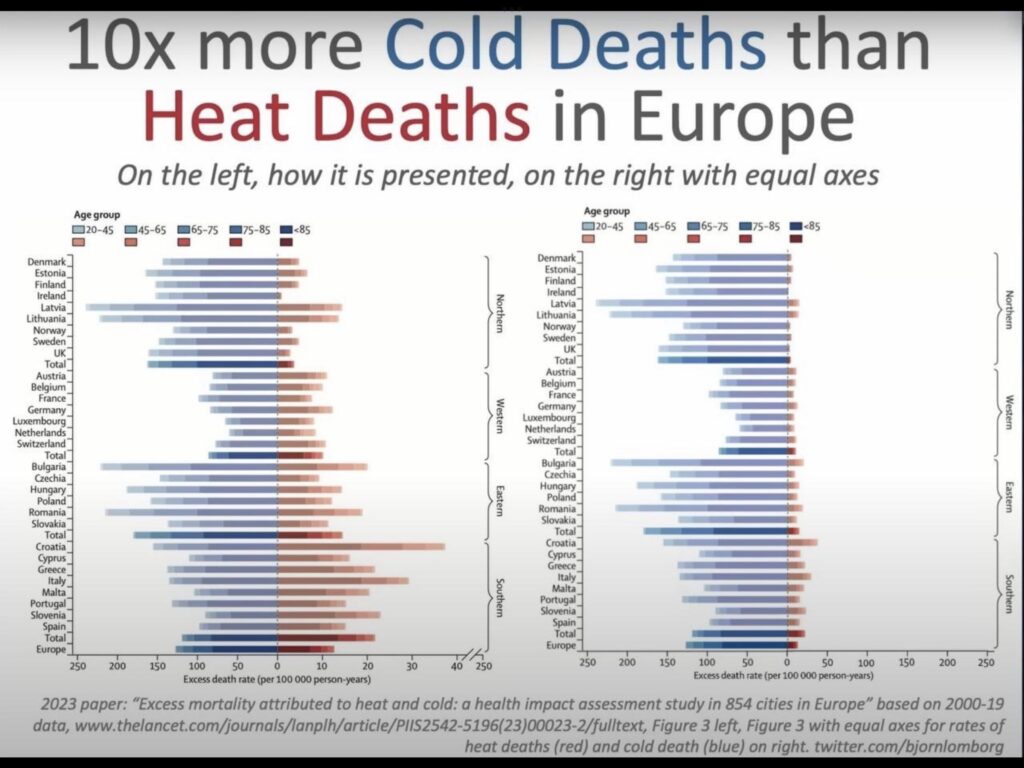
The Lancet published the chart on left with a different X-Axis to downplay fact that cold causes ten times more deaths than heat in Europe. Björn Lomborg corrected that with the chart on right.
“How many environmental justice majors does it take to calculate the CO2 emissions of a light bulb? This isn’t a joke. Businesses now employ scads of college grads to do this. For years America’s political class has lamented that too many college grads are working in low-paying jobs that don’t require post-secondary degrees. The diversity, equity and inclusion and environmental, social and governance industries—DEI and ESG, respectively—are solving for this problem while creating many others. In the modern progressive era, young graduates are finding remunerative employment as sustainability coordinators, DEI officers and “people partners.” Instead of serving up pumpkin soy lattes, they’re quantifying corporate greenhouse gas emissions and ensuring employers don’t transgress progressive cultural orthodoxies.”
– Allysia Finley, Wall Street Journal ($).
“If we don’t learn from the Dutch eco quagmire we might end up with Farmer Clarkson as PM”, warns the Times.
Jeremy Clarkson is a bit too much of a Remainer for my political tastes, but we could do a lot worse. But Robert Colvile’s article is not really about Britain’s most famous petrolhead. It is about the slow but relentless growth in the scope of a law for which nobody voted, Council Directive 92/43/EEC on the Conservation of natural habitats and of wild fauna and flora, a.k.a. the “EU Habitats Directive”.
This was designed to protect and restore rare species and conservation sites. One thing they needed protecting from was nitrogen pollution.
In November 2018 the European Court of Justice ruled (after a referral from the Netherlands) that any “plans or projects” near such sites were permissible only if there was “no reasonable scientific doubt as to the lack of adverse effects”.
In other words, before you could build a house or spread fertiliser on a field, you had to prove it would not increase nitrogen emissions. Which you couldn’t.
This ruling — known as the “Dutch case” — triggered the nutrient neutrality crisis, which is blocking an estimated 145,000 new homes in England.
But in the Netherlands the results were even more dramatic. The country’s highest court quickly suspended 18,000 construction projects and ordered drastic cuts in nitrogen emissions. Given that 46 per cent came from cow dung, MPs proposed halving the number of cattle. Which led to outraged farmers blockading roads with tractors, and the formation of a new party, the Farmer-Citizen Movement. Which is now well ahead in the polls.
As the article points out, Brexit has not prized the UK loose from these laws, although it has made it less inconceivable that one day we might be.
Above all, this story illustrates the dangers of the precautionary principle at the heart of EU law, and in particular our interpretation of it. This principle holds that before you do anything, it must be proved to be absolutely safe.
In the nitrogen ruling, the language about “no reasonable scientific doubt” set an extraordinarily high bar. One that drove Natural England to unilaterally halt the construction of 145,000 desperately needed houses across 74 council areas, because there was a risk of nitrogen from flushed lavatories running into rivers — even though planning permission had already been granted, and the homes would be responsible for only a fraction of local pollution.
What’s striking is the absolute nature of such decisions. There is no evaluation of trade-offs, no way to argue that, yes, we need to protect rivers, but also to build homes and fill bellies with crops. The Economist notes that the Netherlands’ environmental rules have imposed “wide-ranging restrictions on new economic activity”. Same here.
For many Brexit campaigners, the hostility to innovation embedded in the precautionary principle — for nitrogen emissions, read gene-editing, or AI — was a key justification for leaving. But the poison has entered our bloodstream.
“Switching transport to electric in a short timescale will inevitably mean buying Chinese. Are we really about to force ourselves to become even more reliant on a totalitarian regime that stamps out freedom in Hong Kong, commits genocide against the Uighurs, threatens war on Taiwan and refuses to be transparent about how a pandemic began near its leading virus laboratory?”
Matt Ridley.
Just Stop Oil march gets hijacked by stag-do leaving protesters furious
Video courtesy of the Daily Mail via Instapundit.
The Mail writer reveals an unexpected talent for understatement:
The demonstrators are then seen continuing their march, looking displeased.
The cancellation of eminent science writers and statisticians like Dr. Whitehouse and Professor Fenton for ‘wrongthink’ highlights the ever-shrinking boundaries of the discourse around science and medicine and the unwillingness of science’s gatekeepers to challenge groupthink and politically sensitive dogmas. As Dr. Whitehouse says, “science thrives on debate and scrutiny”. Silencing those who challenge prevailing orthodoxies was the approach favoured by the Catholic church in 17th Century Italy and is completely at odds with the scientific method.
– Richard Eldred.
I used to read every issue of New Scientist ‘back in the day’ but it has been a bastion of approved high-status groupthink for many years, suitable for cat tray liner only.
Will someone please ask the Swedish Doom Goblin if I have time for another Armagnac?
But grinding poverty is, so far as ministers are concerned, a price worth paying for the cult of net zero. Few independent experts pretend that either solar power or wind power are remotely adequate for the needs of heating and powering a country of approaching 70 million people. We are facing this serious crisis because of the demented opposition to nuclear power that has taken root in the last 20 years – a bacillus that entered the Conservative Party’s bloodstream with the leadership of Dave Cameron – and a chronic determination to make promises about improving our environmental record that would undermine the economy of any advanced country that relies on the generation of electricity, the heating of buildings and water and, of course, on moving people and goods around from A to B.
– Simon Heffer
A short but important presentation by Jørgen Peder Steffensen …
What do ice cores tell us about the history of climate change and the present trend? This video explains one perspective – arguably the most accurate one. And if you skip to 2:25, you will see the huge error we have made and the assumptions and extrapolations based on that error.
‘Government insulation scheme ruined my home’ is the headline of this BBC piece about a man who says his flat has been ruined by black mould caused by a government “green” insulation scheme. The words “insulation” and “home” could be replaced by many other words and the headline would still hold.
Although the piece describes Blaan Paterson as a “homeowner”, it seems from the text that his ex-council flat is still under the control of South Lanarkshire Council to some extent. He insists he was signed up to the Universal Home Insulation Scheme (UHIS) in 2011 without his consent.
Things done by governments to people without their consent often turn out badly.
Things done by governments for people who grab them with both hands under the impression that they are getting a free benefit often turn out badly, too. “Don’t look a gift horse in the mouth”, goes the proverb. Buyers have an incentive to think carefully about whether a proposed purchase is wise before they commit their money. Recipients of free stuff don’t. The incentives on government contractors not to think about whether insulation is right for a particular property are also strong.
Tom Woolley, a semi-retired professor of architecture, has been highlighting “cavity wall insulation disasters” for a number of years.
He has also advised pressure group Cavity Insulation Victims’ Alliance (CIVALLI), which has given evidence at the UK Parliament and Welsh Assembly.
He told BBC Scotland: “The problem with filling up the cavity either with glass fibre and perhaps, to a lesser extent, polystyrene is that it stops the building ‘breathing’.
“Vapour collecting in the building or dampness that gets into the walls can’t escape because it’s blocked up by this stuff.
“It tends to lead to dampness and mould inside the houses. We have plenty of evidence of this. I would say there are hundreds of thousands of examples of this throughout the UK.”
|
Who Are We? The Samizdata people are a bunch of sinister and heavily armed globalist illuminati who seek to infect the entire world with the values of personal liberty and several property. Amongst our many crimes is a sense of humour and the intermittent use of British spelling.
We are also a varied group made up of social individualists, classical liberals, whigs, libertarians, extropians, futurists, ‘Porcupines’, Karl Popper fetishists, recovering neo-conservatives, crazed Ayn Rand worshipers, over-caffeinated Virginia Postrel devotees, witty Frédéric Bastiat wannabes, cypherpunks, minarchists, kritarchists and wild-eyed anarcho-capitalists from Britain, North America, Australia and Europe.
|