We are developing the social individualist meta-context for the future. From the very serious to the extremely frivolous... lets see what is on the mind of the Samizdata people.
Samizdata, derived from Samizdat /n. - a system of clandestine publication of banned literature in the USSR [Russ.,= self-publishing house]
|
The Ashes, for the benefit of cricket infidels, is the name given to the more than a century long cricketing rivalry between England and Australia. Whoever won the last series has them. And today, an Ashes Marathon begins, in the form of no less than ten five day international cricket matches between England and Australia in the space of less than a year. In order to get the Ashes to stop clashing with the Cricket World Cup, or something, there will be a five match Ashes series here in England, and then straight after that another five match Ashes series in Australia.
England now have the Ashes and all the smart talk says that on paper they are by far the stronger side, and will still have the Ashes in a year’s time.
But sport is not played on paper. I remember as a child being utterly bewildered when Australia defeated, by the sickening margin of four games to nothing, an England cricket touring team containing batsmen May, Cowdrey, Graveney and Dexter, and (get this) bowlers Tyson, Trueman, Statham, Laker and Lock. To many Samizdata readers, those names will only be names, but believe me, those are names. You want paper? The paper they wrote that team on was paper all right. Yet England, on the actual pitches, were hammered. (Also hammered rather too much off the pitches, from what I have since read.) I learned the lesson good and early that with sport, you never know.
Consider that final British Lions v Australia rugby union game, last Saturday (highlights here – don’t click if you don’t want noise). Michael Jennings and I and a couple of mates watched it in a pub in Southwark, with me getting there about fifteen seconds before the kick-off, which was just as well because the Lions, having scored no tries at all in the previous game, scored their first try of this game in hardly more than a minute. We all then sagely agreed that going down in a game very early can be an advantage, because you then have to forget your nerves and really play, and often you do, with the resulting momentum sweeping you to a big win. Australia will be back, we said.
At first we were wrong, as the Lions opened up an amazing 19-3 lead. But although the Australian backs were operating behind a losing scrum they still looked dangerous, and Australia scored thirteen unanswered points either side of half time. Who was to say they wouldn’t carry on scoring? We all then expected a game just like the previous two, of the sort that would be settled by whoever kicked their penalty kicks in the final few minutes coming out one or two points ahead, in a series that could easily have gone either way, 3-0 in either direction if just a few kicks had fallen just a bit more this way or that way.
So, Lions only 3 points up, and from having been unstoppable suddenly looking very vulnerable, with about half an hour to go. What then happened? What happened was that the Lions backs suddenly sprang to life and scored three dashing tries, sweeping the Lions to victory by the mind-boggling margin of 25 points. Who saw that coming? Not me. Not Michael, or the two other blokes. In retrospect, that most flawless of observational procedures, it was all inevitable, given the scrum advantage the Lions had established. But at the time, it was astonishing.
Or consider Andy Murray’s Wimbledon win the following afternoon. No less a personage than former champion Boris Becker, commentating for the BBC, said that the one score-line he had really not been expecting was three sets to nil. He didn’t think either player would let that happen. Yet Djokovic, famously a man who is never beaten until truly beaten, did. Murray, who had come back from two sets down in an earlier round and who lost the first set of his semi-final, did not, come the final, lose a single set. What odds could you have got beforehand against that happening?
I am sure that there is some suitably Samizdata-ish moral to append to the above, about how the uncertainty of sport mirrors the uncertainty of life itself, and that the uncertainty of life proves the necessity for the private ownership of the means of production, distribution and exchange. Well, that will have to be it. I have a cricket match to attend to.
England have won the toss, and will bat.
First I read Leo McKinstry’s Boycott book, and loved it. Then I read his Spitfire book, and liked that a lot also. But while reading Spitfire, I thought to myself that what I would also like to read – would really like to read – would be a book by Leo McKinstry about the Avro Lancaster, the big four-engined bomber that inflicted most of the British bomber damage on the cities of Germany during the latter half of World War 2. The Lancaster was one of my favourites during my Airfix years. Seeing a real live Lancaster flying at Farnborough in the summer of 2010 made me even more curious about this famous airplane. The more I thought about it, the more I realised how ignorant of the Lancaster’s history I was. So when McKinstry obliged with Lancaster, I did not hesitate. I bought it, and devoured it.
Ever since doing that, I have been meaning to write about this book here, but I never got around to finishing what I started. So instead of trying to say everything I might want to say about this excellent book, I will instead now focus mostly on the most interesting thing among many interesting things that I learned from reading Lancaster. I will focus on what a very strange birth the Avro Lancaster had.
In the late 1930s, believing that bombers would always get through and that they therefore had to have lots of bombers or lose the war, British Air Officialdom had two ideas about how to build a bomber. They accordingly announced two specifications, which different potential bomber-makers were invited to meet with their designs. They wanted a two engined bomber, like those that the Germans bombed Britain with in 1940 but better, or like the Wellington but better. And they wanted a much bigger four engined bomber, such as the Germans never got around to building, and like … well, like the Avro Lancaster.
So, the Lancaster was Avro’s answer to the second requirement? Actually, no. Or, not at first. Britain ended up with three four-engine heavy bombers, the Short Stirling, the Handley Page Halifax, and the Lancaster. But strangely, by far the worst of these three, the Short Stirling, was the only one of the three that was all along intended to be a four-engine bomber. Both the Halifax and the Lancaster started out as answers to the two-engine specification rather than the four-engine one.
This strangeness was caused by Rolls Royce then being engaged in producing two engines, the Merlin and the Vulture. The Merlin was proving itself to be very good (arguably it became the greatest single piece of mechanical kit of the entire war), but the Vulture was only revealing itself to be terrible. The idea was that the Vulture would power the two-engined bombers. But, with the Vulture already looking so bad, Handley Page quickly got permission to change their Vulture-powered two-engine bomber into a Merlin powered four-engine bomber. They switched specifications, in other words.
Avro persisted with their two-engine design, the Manchester, and Air Officialdom, in addition to ordering lots of Halifaxes, also ordered two hundred Manchesters to be made, long before they could be sure that it was a good airplane. Soon, they upped the order to over a thousand. Despite the Manchester being, to put it mildly, unproven, Avro started manufacturing them.
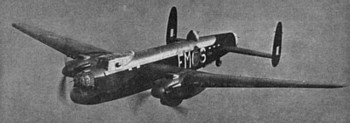
But the Manchester was a clunker. It was slow. It couldn’t carry many bombs. It handled abominably. It was a death trap. The pilots hated it. Avro did everything they could to make the Manchester work, but it never did, not least because Rolls Royce were never able to make much of their Vulture. As the Merlin began to prove itself to be the Merlin, Rolls Royce understandably concentrated on that.
At which point, in 1940, Avro proposed the Halifax solution to the Manchester problem. Turn the Manchester from a Vulture-driven two-engine bomber into a Merlin-driven four-engine bomber. Avro dramatically illustrated this idea when they showed a model of a Manchester to a visiting party of Air Officialdom. Right in front of their little audience of grandees, they took off the Manchester’s wings and shoved on different and bigger wings with two more engines attached to them. That, said Avro, is what we should be building.
→ Continue reading: The strange birth of the Avro Lancaster
By the time he gets to foreign policy, Rothbard has been on such a jihad against the state, and the U.S. government in particular, that he goes berserk and accuses the United States of being the bad guys in the (then ongoing) Cold War. In the First Edition (1973) he went so far as to attribute to Stalin a libertarian foreign policy, alleging the USSR practiced non-interventionism. When it was pointed out to him that the USSR invaded Finland, Rothbard added to his Second Edition a defense of Stalin’s attack, arguing that Stalin only wanted to reclaim traditionally Russian Karelia and liberate all the Russians supposedly living there. All of that is a-historical nonsense and Rothbard simply invented it. The Soviets planned to capture all of Finland and had even assembled a new Marxist government they hoped to install in Helsinki. The areas Stalin invaded are not “traditionally Russian.” But even if Rothbard’s interpretation were true, how can Rothbard justify on libertarian grounds the bloodiest dictatorship in history attacking a free country in an effort to get “its” land and people back? It makes no sense, but Rothbard’s only concern is to defend his indefensible claim that the United States surpasses the rest of the world in doing evil. Unfortunately for Rothbard, long before the First Edition came out there was ample evidence that the Stalin and other Soviet leaders engaged in interventionism all around the world, often quite bloodily (Katyn Forest anyone?) Rothbard’s “libertarian” defense of Stalin is despicable and intellectually dishonest — and that’s the real problem with this book. Rothbard pretends that he’s doing careful analysis and finds the state wanting while showing that his own anarcho-capitalist system shines. But in fact, no argument is so bad, no intellectual sleight-of-hand too dishonest, if it will get Rothbard to his pre-chosen conclusion.
Charles Steele.
How often do we see the “enemy of my enemy is my friend” error among even pretty smart people – and Rothbard was not a stupid man. I have come across some libertarians who, out of an entirely rational desire to be wary of state adventurism, moral panics and so on, bend over backwards to play down threats and problems that statists talk about even when those threats and problems might actually be real. (This can be seen sometimes on issues such as Islamic terrorism or, for that matter, on environmental issues.) This can undermine the credibility of the argument. Far better for the libertarian to say: “Yes, I agree that X or Y is serious and cannot be ignored but a free society such as the one I favour is a far better position to deal with it than your Big Government-model one.”
Rothbard, it also should be said, was also an enthusiastic stirrer and practical joker: I think he enjoyed being outrageous for the sake of being outrageous; his pranksterism sometimes became an end in itself. (Sometimes those on the receiving end deserved it.) But this sort of behaviour carries its costs. It also leaves one with a sneaking sense that the joker might use the “but I was only joking!” defence as a ploy in case he or she was actually serious.
As Charles Steele writes in the same piece, this is all a great shame given that Rothbard could also be right on a lot of issues. I can recommend Brian Doherty’s Radicals For Capitalism, which gives Rothbard a lot of detailed treatment.
I think it was Rothbard who once came out with the crackerjack line: Say what you like about Marx, but at least he wasn’t a Keynesian.
How odd. No one seems to be commenting or posting, but there seems to be a bit of a racket going on down our street, people shouting and stuff.
The trashtastic AOL home page instructs me to “Guess why this woman was kicked out of a water park?”
“Because her bottoms were too small,” claimed the staff of the water park, in opposite talk. As commenter rmsaerials put it, “She will never drown.”
The lady concerned, Madelyn Shaeffer, is now suing the water park. She says, “I felt like it was both age and body discrimination and I felt like I could look around me and I could see a handful of other girls half my age, wearing the same size swimming suit and not being singled out and told to put on clothes or leave.” The instant I read the words “suing” and “discrimination” the sympathy I had for Ms Shaeffer evaporated – but I have condensed some of it back by mental effort. Although I support the right of clubs and other private establishments to admit and eject whom they please for good reasons or bad, those reasons ought if possible to be honestly stated in advance and predictably and consistently applied. I can see why Ms Shaeffer is angry that she was ejected on grounds of costume when other women in similar costumes are not ejected. The trouble is, both sides are pretending. Both know but do not say that the actual reason she was ejected was that her artificially enlarged breasts mean that in a bikini, any bikini, she is emitting a loud and continuous sexual signal.
It is a difficult situation for the water park. I stand by my statement that it is desirable that their rules be known and predictable, but nobody can write rules in advance for every situation, which is why it has to come down to the manager’s discretion in the end. I hope Ms Shaeffer loses her suit, but I also hope her entrance fee was refunded. The rule behind the rule against nudity or near nudity is a rule against unignorable sexual signalling. She was doing that, and I think she knows it. When I look at her pose I see someone who is more than ordinarily aware of her appearance. (Truly, the first thing I noticed about her picture was that her stomach was really, really sucked in, to the extent that for a moment I thought it was photoshopped.)
A water park should have the right to position itself in the market as a “family” place where customers are not going to be bombarded with sexual signals. Equally, the water park down the road should have the right to position itself as the place where the hot girls go. The latter ought to have the right not to admit people for not having sexy enough body shapes, whether self-chosen or not. Oddly, this right is often honoured even in our unlibertarian society – the bouncers at many a club will not let ugly or fat people in and nobody sues.
We hold these truths to be self-evident, that all men are created equal, that they are endowed by their Creator with certain unalienable Rights, that among these are Life, Liberty and the pursuit of Happiness. — That to secure these rights, Governments are instituted among Men, deriving their just powers from the consent of the governed, — That whenever any Form of Government becomes destructive of these ends, it is the Right of the People to alter or to abolish it, and to institute new Government, laying its foundation on such principles and organizing its powers in such form, as to them shall seem most likely to effect their Safety and Happiness. Prudence, indeed, will dictate that Governments long established should not be changed for light and transient causes; and accordingly all experience hath shewn that mankind are more disposed to suffer, while evils are sufferable than to right themselves by abolishing the forms to which they are accustomed. But when a long train of abuses and usurpations, pursuing invariably the same Object evinces a design to reduce them under absolute Despotism, it is their right, it is their duty, to throw off such Government, and to provide new Guards for their future security.
– from a document that may soon be given a security classification the way things are going. Simply following that link could brand you as a potential terrorist. Not to mention get you in trouble with the IRS.
We are contemplating sanctions for misbehaviour in the healthcare and banking sectors; why not in the energy policy sector?
– Professor Michael J. Kelly, “Prince Philip Professor of Technology”, University of Cambridge, in a letter to the Times yesterday, putting Britain’s energy decision-makers right down where they belong, alongside central bankers, bankers, NHS malpractitioners, etc.. The Times is behind a pay wall, but Bishop Hill picked up on this, and has the whole (quite short) letter.
There have been extended periods, from the early 1960s onwards, when it has taken moral courage to stand up and be counted as a British conservative. Almost all of the institutions that enable public debate and engagement – universities, the BBC, the wider education establishment and the relevant parts of the Civil Service – have fallen under the control of the liberal Left. No matter what government was elected, a tough-minded and highly disciplined progressive elite has been in charge. This elite has been ruthless in imposing its doctrines and making sure that the relevant placemen were appointed to key positions. The fundamental assumption of this new ruling class is that government is benign. It does not like or understand freedom. It has extended its control far beyond the classical liberal functions of the state (which did not reach much beyond defence of the realm and maintenance of law and order).
– Peter Oborne
Oborne can be wrong-headed at times on certain things – his veneration of the old BBC is something I just don’t agree with – but this is a nice tribute. I met Professor Minogue a few times but did not really know him all that well. He ranks alongside Roger Scruton and Professor Anthony Flew as one of those academics whom I have met that I regard very highly indeed. Alas, of that trio, only the fox-hunting Prof. Scruton is with us (and hopefully still around for a long time to come).
When we learned how to make carbon our slave instead of other people, we started to learn how to become a civilised people. Thorium has a million times the energy density of a carbon-hydrogen bond. What does that mean for human civilisation? Because we’re not going to run out of this stuff. We will never run out.
So says Kirk Sorensen in a 5-minute YouTube video summarising the benefits. See also his company Flibe Energy and the Energy From Thorium Foundation. Between this and fracking there really is no need to worry about energy. That whole debate is simply between those who are for and those who are against civilisation.
Mongolian neo-Nazis rebrand themselves as environmentalists.
As recently reported by the McClatchy Newspapers, the Obama administration views whistleblowing and leaks as a species of terrorism. According to McClatchy: “President Obama’s unprecedented initiative, known as the Insider Threat Program, is sweeping in its reach. It has received scant public attention even though it extends beyond the U.S. national security bureaucracies to most federal departments and agencies nationwide, including the Peace Corps, the Social Security Administration and the Education and Agriculture departments. It emphasizes leaks of classified material, but catchall definitions of ‘insider threat’ give agencies latitude to pursue and penalize a range of other conduct. … Leaks to the media are equated with espionage.”
Glenn Reynolds, talking about the role of leakers and whistleblowers.
This can be a complex issue, for all that I share much of what Reynolds says. Take, say, Switzerland, famous for its bank secrecy laws. What happens if an employee of a bank (this has actually happened in real life) gets all upset about the fact that, due to the laws, he or she cannot divulge the identity of a client even that client might be avoiding or evading taxes? (In the latter case, evasion is not a crime in Switzerland, but tax fraud is. The difference is technical). Now, suppose that person divulges all to Wikileaks, or the local Swiss newspaper, or the New York Times. Is he or she a hero? Well, if you hate Swiss banks and think its 1934 law is an abomination and that everything should be out in the open, maybe. (It might be worth noting that the person is not forced to work in a bank if he or she finds it objectionable.) But clearly, privacy, confidentiality, or call it what you will, is something that a lot of law-abiding people worry about. The same might apply in a case, where, say, a person who works for a pornography video firm starts, after having suddenly developed a “conscience”, to start sending out the names and addresses of the people who have bought videos or downloaded the stuff.
Whistleblowers can and do do a vital job and sometimes their lives are made very uncomfortable about it. There is the recent case of a person who tried to alert the public about the dreadful situation in the Mid-Staffordshire part of the UK National Health Service, for instance.
I guess one broad way to consider the issue is that with governments, unlike private sector companies, the former are paid for by taxes, and the taxpayers are entitled to expect those bodies to be run appropriately. Although watchdogs and politicians in theory are supposed to enable this to happen, in practice, monopolistic organisations with the powers of coercion are vulnerable to abuse. I have already mentioned the NHS. Consider also the less-than-perfect UK police force, which has been mired in various corruption scandals in recent years, or the BBC, the state-privileged UK broadcaster that for years allowed a paedophile by the name of Jimmy Savile to work there (although it is not known if the BBC ever had enough evidence to kick him out). In these sort of cases, a leaker of information can do the public a favour. The risk of leaks is also one of those things that keeps organisations on their toes – well, good. On the other hand, journalists need to use a bit of commonsense so they don’t become the tools of someone else’s agenda. Not all leakers are heroes, or even all that bothered about issues of liberty and justice.
One issue of course is that while it is right for a whistleblower to blab to the press about a systemic problem, it is and can be wrong to leak in cases where a private individual’s privacy and welfare might be put at risk. And for that matter, where a leaker passes on information that might aid an enemy force and endanger lives (this is sometimes argued to be the case with some of the Wikileaks stuff about the Middle East), this also crosses a line.
As far as the Obama, or indeed any other administration, is concerned, fighting against leakers may sometimes be necessary, but by and large, the best way to avoid problems in the first place is to do fewer shameful and stupid things that people want to leak about. And the Obama administration seems to be intent on collecting scandals the same way that some folk collect stamps.
Meanwhile, it appears Mr Snowden cannot find a country that will have him.
Intertwined with government hubris is shameless incompetence. This is demonstrated regularly on CSPAN, though it is often appreciated only by people who know the details of the often plausible sounding pontifications from the floor of the house and senate. But when you think about it, who could possibly know what one really needs to know in order to make sound decisions about the massive pile of things Congress attempts to control.
– Nicholas J. Johnson
|
Who Are We? The Samizdata people are a bunch of sinister and heavily armed globalist illuminati who seek to infect the entire world with the values of personal liberty and several property. Amongst our many crimes is a sense of humour and the intermittent use of British spelling.
We are also a varied group made up of social individualists, classical liberals, whigs, libertarians, extropians, futurists, ‘Porcupines’, Karl Popper fetishists, recovering neo-conservatives, crazed Ayn Rand worshipers, over-caffeinated Virginia Postrel devotees, witty Frédéric Bastiat wannabes, cypherpunks, minarchists, kritarchists and wild-eyed anarcho-capitalists from Britain, North America, Australia and Europe.
|





Recent Comments