We are developing the social individualist meta-context for the future. From the very serious to the extremely frivolous... lets see what is on the mind of the Samizdata people.

Samizdata, derived from Samizdat /n. - a system of clandestine publication of banned literature in the USSR [Russ.,= self-publishing house]

On the militarisation of the US police

For as long as I have been reading blogs, one regular blogger I followed has been Radley Balko. And Balko has developed a strong reputation for targeting threats to civil liberties in the US and the militarisation of the the US police forces. He has a strong article over at the Wall Street Journal, and here are a couple of paragraphs:

The new century brought the war on terror and, with it, new rationales and new resources for militarizing police forces. According to the Center for Investigative Reporting, the Department of Homeland Security has handed out $35 billion in grants since its creation in 2002, with much of the money going to purchase military gear such as armored personnel carriers. In 2011 alone, a Pentagon program for bolstering the capabilities of local law enforcement gave away $500 million of equipment, an all-time high.

The past decade also has seen an alarming degree of mission creep for U.S. SWAT teams. When the craze for poker kicked into high gear, a number of police departments responded by deploying SWAT teams to raid games in garages, basements and VFW halls where illegal gambling was suspected. According to news reports and conversations with poker organizations, there have been dozens of these raids, in cities such as Baltimore, Charleston, S.C., and Dallas.

Here is another good article at the Atlantic Monthly on the same issue.

Back here in Britain, there are echoes of this. In the Huffington Post over a year ago this point was made, although Samizdata regulars might want to adopt a skeptical stance about HP material, but in this case the argument seems sound enough.


Divide and rule – an old idea that never gets old

Alisa Presenti has a few thoughts on the Zimmerman case and the state of American politics

It had just occurred to me that the Zimmerman-Martin story highlights something interesting about where the American Left finds itself at this point in time. From the beginning it was clear to me, as well as to many others, that someone with Obama’s ideological background on the one hand, and his lack of any relevant experience on the other (not to mention absence of any real charisma), would have remained mostly obscure, and would have never made it to the national political stage – let alone the Presidency – had he not been black. Whoever picked him and groomed him for this job, played the implicit black-race/white-guilt card quite well, and it paid off big time at election (and re-election) time. But now, against the backdrop of the Z-M story, Obama’s race actually proves to be a liability. Just imagine any white person sitting in the White House right now (well, granted, any white person but Bill Clinton): would the black communities have remained as indifferent to the verdict as they are proving to be? Where are the riots their leaders and organisers had promised us? Could it be that finally having a black President for the first (well, second) time in history has rendered the whole perceived racial divide hollow?

It used to be that they pitched the poor against the rich. When that got old, they switched to pitching blacks against whites. Then it was women against men, gays against straights,…. They still seem to have the immigrants against the rest of us up their sleeve, but something tells me it is not going to deliver as promised. And it is not that they have ever abandoned any of the older, mostly artificial but useful divisions – rather, they always managed to find new ones to add to their arsenal of manufactured hatred. Thing is, I think they are now, or soon, will be running out of those. What that means is that they are going to go back to the oldest division of them all, and it looks like they are working hard on creating enough of the new poor, to be pitched against whoever it will be that manages to remain relatively rich – or, more likely, whoever will be deliberately labeled as “rich”. Interesting times are still ahead.

Sexism is fun!

I regularly read David Thompson’s blog, and like many of his postings, this recent one pokes fun at a Guardian article, this time a piece by Mike Power, complaining about the alleged sexism of barbecues. The outdoor cooking of meat is bad, because men think that this is men’s stuff!

Thompson copies and pastes Power asking the following:

But, as several thousand years have passed since men had to kill our protein, make a fire, cook it and eat it, why is barbecuing seen as something women don’t or can’t – or, more accurately, shouldn’t – do? How – and why – do men continue to claim this sacred fire-space as a male-owned sanctuary where women are not permitted?

My immediate reaction to reading this quote at Thompson’s was that Mike Power was confusing a comedy routine with a seriously held idea.

I recall enjoying a TV show that happened on ITV4 TV a couple of years back, called Richard Bacon’s Beer and Pizza Club. Series 1 was particularly good, I thought. Series 2 got a bit above itself and happened in a bigger studio and with a bigger budget, and the guests became less quirky and amusing, and I didn’t enjoy it so much, but it was still great fun. The basic agenda was a bunch of blokes sitting around discussing their man-ness, with a mixture of genuine pleasure at often decidedly daft male rituals but also a healthy dose of self-mockery.

I recently caught a repeat of one of these shows, in which comedian Rufus Hound described how a typical male stunt, namely doing something that looked dangerous but wasn’t actually that dangerous, had become truly dangerous. It involved him putting a small puddle of something flammable in his hand and setting fire to it. His story of how this had all gone very wrong, on account of him making the puddle too big and then the setting of it on fire being delayed until the fluid had seeped between his fingers, won Hound the round where they were taking it in turns to recount their worst injuries. That his injury was self-inflicted while pursuing manly fun was central to why Hound was victorious. Doing it to yourself trumps anything that merely happens to you. How manly is that? In both a good way, and a ridiculous way.

The Beer and Pizza Club regularly featured shots of women in the audience, creasing up with laughter at the various masculinities that were being thus both enjoyed and mocked. Ah, men.

And, getting to back to the original point of this posting, I recall another Rufus Hound fire-based comedy moment on the B&P Club, when they were each describing their idea of a perfect day. Hound’s perfect day involved him cooking meat out on his patio and inviting the neighbours round. He said something like: “Nothing says manliness like cooking meat, out of doors, over a naked flame.” Much audience laughter, from both men and women. And from me. “Bacon” being a good name for the man genially presiding over this meaty mirth.

This is the kind of thing Power was on about. But what he misses, probably on purpose because he’s such a puritan, is that … it’s a joke! No, says Power. It’s not funny, I tell you! Stop enjoying yourselves!

And guess what, David Thompson agrees with me, although really he said it first and I am agreeing with him.

He quotes Power again:

This grilled-food gender split is ubiquitous, odd and unacknowledged.

And he responds thus:

This may strike readers as a bold, indeed preposterous, claim to make. One of the rituals of the barbecues I’ve attended is the good-natured parodying – one might say acknowledgment – of precisely those conventions. “Man make fire. Man cook meat,” etc. But perhaps we’re to imagine that only the keen social observers who write for the Guardian have ever noticed such things or found them worthy of amused comment. More to the point, it doesn’t seem to have occurred to Mr Power that quite a few people, male and female, actually enjoy the role-play opportunity of the barbecue – the theatre, the ritual, the fun. Even – heresy! – gendered fun.

Gendered fun. Spot on. Can’t have that.

I particular like Thompson’s invention of:

The Plastic Spatula of Oppression.

Not that men oppressing women is always and everywhere such a joke. That other favourite blogger of mine, Mick Hartley, recently did a posting about how a woman in Pakistan was stoned to death by her male relatives for the crime of possessing a mobile phone. What does Mike Power make of that, I wonder? My guess (please prove this wrong if you can) is … nothing, on account of him being (I further guess) an anti-anti-Islamist. It’s not that stoning women to death for having mobile phones is right, you understand. Merely that complaining about it is wrong.

Samizdata quote of the day

Companies have no broad “duties” if you believe in private sector, and in a civil society based on voluntary relationships. That means if I set up a firm, with capital of mine or entrusted to me by others with their consent, then apart from not breaking rules about force, fraud, etc, there is nothing else one is required to do. Professor Milton Friedman has this all understood years ago. The proper response to calls for “corporate social responsibility” is “fuck off”.

Johnathan Pearce

On the nonsense of corporate “duties” from a Tory MP

Great minds think alike: I had been meaning to fisk Jesse Norman’s recent defence of the idea that companies have wide social and other “duties” – not just to that nasty stuff about doing what the owners want – but Tim Worstall, at his Adam Smith Institute perch, beat me to the punch. (As readers might have noticed, my Samizdata productivity has been hit by my being very busy at work, and, er, lots of trips abroad lately.) Here’s Tim:

Well yes Jesse: but you’re a Tory MP, not a Labour one. You’re not there to defend the idiocies of the past Labour Government you’re there to try to correct them. This part of the Companies Act was deliberately brought in to try and appease the more drippingly social democratic parts of the Labour Party. Rather than now stating that this is the aim and purpose of a company you’re supposed to be shouting from the rooftops that they got this wrong. The point and aim of a company is the enrichment of its shareholders, nothing else. You should be agitating to get the law changed to reflect reality, not accepting the fantasies of your predecessors: otherwise what’s a Tory for if not to be a reactionary? Alternatively, if we’re to have Tory MPs being so drippingly wet what’s the reason for the existence of the Labour Party any more? Who would need them?

Here is Norman’s original article – in the Daily Telegraph – so readers can judge for themselves whether Tim Worstall has him accurately pegged. He has, in my view.

Companies have no broad “duties” if you believe in private sector, and in a civil society based on voluntary relationships. That means if I set up a firm, with capital of mine or entrusted to me by others with their consent, then apart from not breaking rules about force, fraud, etc, there is nothing else one is required to do. Professor Milton Friedman has this all understood years ago. The proper response to calls for “corporate social responsibility” is “fuck off”.

When Norman talks of a “corporate duty” in some broader sense, he makes no attempt, from what I can see, to validate that by reference any fundamental principles. He is, I see, the author of a new book about Edmund Burke, and he uses Burke quite clearly to push against all this terrible “individualism” (ie, belief in personal freedom) and suchlike that he sees as causing all our problems. Never mind that libertarians/classical liberals have plenty to say about the benefits of a community based on voluntary interaction, not coercion. (How many more times does this have to be explained to the dullards who keep banging on about how we are “atomists”?). It is also well worth remembering that Burke was not a “Conservative” in the sense people today understand it; he was “Old Whig” and friend of the likes of Adam Smith and David Hume, and had little time for economic intervention.

To get back on the nub of the tax/company issue, as Tim Worstall says, if big firms are able to use their accountants and advisors to get around onerous local tax laws, then perhaps Norman and his fellow MPs should consider whether to make local tax laws as simple, and as low, as possible. Another point he ought to consider is something that Worstall again writes about on a regular basis: tax incidence. Companies are not people: if you tax a firm’s profits, then those taxes are paid by people in some way. The taxes are passed on in the form of lower dividends, lower capital gains, crappier products, lower wages paid to staff, shoddier products and services, etc. Norman should consider the sensible ideas of the 2020 Tax Commission.

Norman is a member of a political party that, however dimly, ought to be aware of such basic facts. Yes, I know that many of the Cameroons are utterly useless, but there surely are enough bright Tory MPs who can take Norman aside and explain the basic facts of economics to him. I can think of several MPs well suited to the role. Does Norman have Steve Baker’s contact details?

Addendum: I suppose some on the libertarian camp might argue that calls for corporate duties are what you get when firms receive subsidies, privileges from the state of various kinds, soft loans from central banks, etc. But the solution is not to grant these things in the first place. Simple.

Extreme weather – and some thoughts about what publicity stunts do and do not accomplish

Earlier this year, we here in the UK had a spring that felt more like winter. Now we are enduring the frightful ordeal of a summer that is exactly like a summer, only more so. I don’t know about other UK-based Samizdatistas, but this current burst of local warming saps my will to blog. When it is this warm, my idea of fun is not sitting next to a typing machine that happens also to be a fan heater. But I will give it a go anyway, and in a way that doesn’t change the subject from the weather.

Last week, there was a publicity stunt by some lady mountaineers, who climbed up the Shard, to protest against oil and gas drilling by Shell in the Arctic. Measured with a tape measure and a stop watch, media reactions to this escapade say that it was a big success.

Nevertheless, the mainstream media angle on all this may have somewhat disappointed the lady mountaineers. It was: Does This Kind Of Thing Work? Does a bunch of women showing off their shapely bottoms on nationwide television by clambering up a rather irrelevant but shapely new London tower really do much to change opinion on such matters as Arctic oil and gas drilling? That was the BBC’s original slant on this, and I heard the same thing on the Channel 5 TV news in the evening. Maybe I am reading too much into this, but such questions suggest to me a slight pulling back from this argument on the part of the media people, a feeling that a whole generation of broadcasters is detaching itself from a previously definite point of view, the obvious truth of which would have been their starting point only a few years ago, but which they now regard as just another of those arguments that people have, which it is now their job to report rather than to take sides in.

The pessimistic line on this, from the anti-alarmist point of view, is that all that the media people were really asking was: How Can We Best Make Everyone Into Climate Alarmists? Will this stunt accomplish this, or do we need to try other methods? We. They are still all on side with the climate alarmists, but some of the climate alarmists, especially those in the media, are now starting seriously to fret about tactics. But even if there was a big whiff of that about the coverage of this stunt, does not the suggestion that these lady climbers might not actually have been persuading anyone to think differently at least suggest that maybe their team in this argument might be wrong about matters of far greater substance, such as – whisper it ever so quietly – the alleged scientific fact of forthcoming climate catastrophe?

What is not deniable, if you will pardon the expression, is that a libertarian, Simon Gibbs of Libertarian Home, was asked to join in the coverage and say what he thought about it all,. You can listen to what Simon said here, and read Simon’s further thoughts on all this here. It was an email from Simon Gibbs that alerted me to this story. He knows that I am fond of the Shard.

→ Continue reading: Extreme weather – and some thoughts about what publicity stunts do and do not accomplish

Samizdata quote of the day

[O]rdinary businessmen appear to tend to be less difficult to deceive – perhaps because they are such busy people, and tend to make the mistake that people are motivated by money so are knocked sideways by people who are motivated by POWER

– Paul Marks, below.

Imagine it’s 2013, when New Labour has grown old

Guy Lodge and Jessica Asato looked ahead ten years, ten years ago.

Imagine it’s 2013 and the pendulum of the electoral cycle has finally swept the Labour Party out of office. What might be the legacies of three terms of a New Labour government and what would be the direction of the Labour Party in opposition?

Contrary to expectations, Labour’s record on public services will be quite good. In health, waiting lists will be practically non-existent, patients will be able to choose when to see their GP and where to go to hospital, and towards the end of the third term the recruitment drives of the early 2000s will pay off as shortages of key medical staff begin to ease.

….

It will be widely thought that the Labour Government missed a key opportunity to totally reshape the life opportunities of children by failing to introduce universal childcare and early years education, despite the obvious success of SureStart.

….

The main achievement in foreign policy for Labour will be membership of the Euro; narrowly won after holding a referendum on the back of a third term win. The EU will also agree to reform the Common Agricultural Policy after successful campaigning by an ever-growing trade justice movement supported by the UK government. Disparities between economic growth in developing and rich countries will continue to widen, however, and peacekeeping and conflict resolution will become more important as global insecurity escalates. Global warming and sustainability will also begin to make more of an impact on the public’s consciousness forcing Labour to rediscover its environmental soul.

….

The Labour Party will still be going strong in 2013, though radically altered in outlook and shape. With EU enlargement transnational political parties might be established, sharing ideals in common at the European level, but acting independently at home. If Labour were to eventually split with the unions over public service modernisation, state funding of political parties would become necessary and the character of the party would change.

That last line might yet prove to be a quite good prediction.

In 2003 Guy Lodge was Chair of the Young Fabians and Jessica Asato was a researcher at the Social Market Foundation. Nowadays Guy Lodge is Associate Director for Politics and Power at the IPPR thinktank and Jessica Asato is prospective Parliamentary candidate for Norwich North and political adviser to Tessa Jowell MP.

Samizdata quote of the day

Much like the good folks over at Samizdata I had no interest in commenting on the recent trial of Mr George Zimmerman for the killing of Mr Trayvon Martin – not in my fields of interest and I knew nothing about it. However following the jury decision to find Mr Zimmerman innocent it turns out that a lot of my friends are psychic and know that Mr Zimmerman deliberately went out of his way to murder mr Martin due to his colour. Now sadly these friends weren’t able to make their unique skills available to the court, but I would suggest that they need to get themselves a super hero identity as their skills are vitally needed. Until they do that all we have is the rule of law where a person is innocent until proven guilty by a jury of their peers having heard all of the available evidence (and I believe the same applies across the pond where the trial took place). Now I’ve not heard yet anyone claiming it was a mistrial or that evidence was withheld or tampered with, I’ve not even heard anyone claiming that the law was at fault – at least not amongst my amazing psychic friends.

Anonymong

Martyrdom: an Oxford don writes

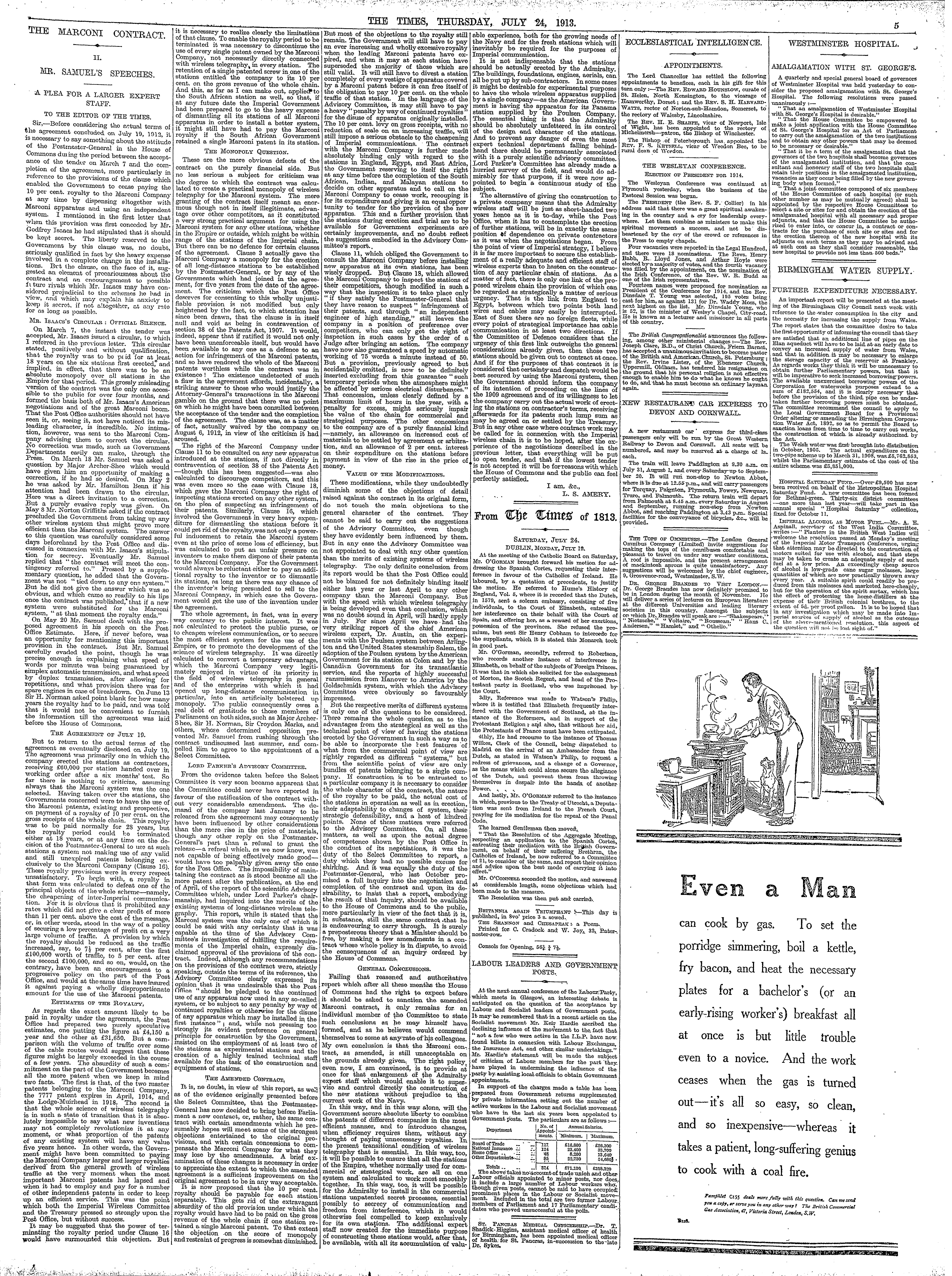
George Bernard Shaw was a playwright. He was also a supporter of Stalin. Therefore, it’s always amusing to see people poking fun at him. Here is one Charles Mercier responding to Shaw shortly after Emily Davison was trampled to death at the Derby:

The Times, 4 July 1913 p4 (right click to see original)

The Times, 4 July 1913 p4 (right click to see original)

If I understand Mr Bernard Shaw aright, his contentions are two – first, that a martyr is a person who seals his belief with his blood; and, second, that if a person seals his belief in his blood, we ought at once to adopt that belief, or at least act as if it were true. “Sealing one’s belief with one’s blood” is a picturesque expression which has always hitherto been understood to mean choosing the alternative of death when we are compelled to choose between death and abandoning, or pretending to abandon, a belief. No one offered this choice to Miss Davison, and in this sense she certainly did not seal her belief with her blood, and was not a martyr. Mr Shaw would extend the expression to the act of committing suicide in order to demonstrate the truth of a belief; and his opinion seems to be that, if a person offers this proof of the truth of any belief, we ought to act as if the belief were true. There seems to me to be a flaw in his reasoning, and the practice would be inconvenient.

I, for instance, have a settled and profound conviction that Aristotle’s logic is utterly erroneous, and that my own system is immeasurably superior to it, but if I cut my throat in order to seal this belief with my blood, and thereby compel the University of Oxford to supersede Aristotelian logic with my own, what is to prevent the eminent Waynflete Professor of Logic from blowing out his brains, and demonstrating that Aristotle is right, and I am wrong? In such a case ought the University to revert to Aristotelian logic, or ought it to suspend its judgement until Professor Schiller, who agrees with me, drowns himself in the Cherwell? It seems to me that if Mr Bernard Shaw’s doctrines are carried into practice they will lead to the sacrifice of many useful lives with but little compensating advantage. If, however, he really holds these opinions with the fervour that his expression of them seems to indicate, he has himself shown the proper way to impress them on the community, a way that I hesitate to commend to him, lest I should find myself in the unpleasant position of an accessory before the fact to a felony.

In those days suicide was a crime.

Much as this is amusing there is a flaw: George Bernard Shaw didn’t actually say it.

So what do these people know that the jury did not know?

In the USA there as been a high profile case involving a neighbourhood watch person by the name of George Zimmerman, a half-Hispanic, half-White man who killed a young black man called Trayvon Martin. Zimmerman was acquitted of murder and indeed the jury also declined to find him guilty of the lesser charge of manslaughter as well.

This seems to have sparked gasps of disbelief and protests from left-of-centre commentators and the racial identity industry.

I only know what I read in the mainstream media, and previously felt no need to comment on a foreign murder trial as I had no opinion on the subject of the guilt or innocence of George Zimmerman. I was not privy to anything beyond the usual reportage and concluded that case would all come down the the minutia of corroborating evidence that you really needed to be the courtroom to see and hear.

So my question is… so what do these people know that the jury did not know? Why exactly are they protesting the verdict? I have not read any coherent arguments as to why the jury in this case got it wrong.

A slightly more temperate post about unwanted contact

Before being overwhelmed by phone-induced homicidal rage the other day, I had intended to discuss a subject that has been interesting me lately, namely how difficult it is to specify in advance rules for social interaction. More specifically, I was pondering how hard it is to lay down rules for dealing with unwanted contact. Cold calling is one form of that; what are traditionally described as “unwanted advances” are another.

The problem is that word “unwanted”. To say, as the organisational psychologist quoted in this article does, that “An unwanted advance is a form of injustice”, strikes me as unfair. We are not telepaths. Quite often the only way one can find out that unwanted contact is unwanted is to ask, that is, to initiate unwanted contact. On the other hand while we may not have telepathy, we most of us do have empathy to help us guess in advance when advances might be unwelcome. Phone sales companies know to the fifth decimal place exactly how likely their calls are to be welcome. They know that the first four of those decimal places are filled by zeros, scumbags that they are. Few men asking a woman out have quite such a large database of prior results upon which to draw. I’m glad I’m not a guy! That last breath before you open your mouth to begin the sentence that might get you rejected cruelly or rejected kindly must be painful.

So I pondered, and while pondering hopped from link to link, as one does, and I came across a really interesting article in Gawker from July 7th which encapsulated several relevant issues. It describes a bitter row in the community of atheist activists. Given that I was out of sympathy with both the parties to the row when it came to politics (both of them are left wing progressives, one I already knew to advocate coercion reaching quite deeply into private lives and the other is a radical feminist) and religion, I was better able to think about the issues rather than the individuals.

Then a nagging feeling that I had read about something very similar a couple of years ago led me to finally notice that the post was not from July 7th 2013 but from July 7th 2011.

Then I slapped myself round the side of the head and said, “what does the fact that these events happened two years and a few days ago rather than a few days ago matter?”

You are now commanded to read the article that I linked to above by the then-editor of Gawker, Remy Stern, on pain of not understanding what on earth I am on about. It puts the case for “Skepchick” (real name Rebecca Watson) in her “Elevatorgate” dispute against Richard Dawkins well if a little one-sidedly.

You are also commanded (on pain of only getting one side of the story) to read post by Alison Smith called “Take back the elevator” which was the most persuasive argument against Skepchick’s position that I read, particularly where she talks about “Leap of Logic Number Two”.

The reason why many people, particularly women, immediately sympathised with Skepchick in the incident is described by commenter “Ivriniel” to Remy Stern’s Gawker article:

To anyone who doesn’t understand why Rebecca Watson was uncomfortable, let’s put it another way.

It’s late at night, and you get into an elevator alone, oh, let’s say in a parking garage. A stranger gets on with you. As soon as the door closes, the stranger asks you for money. You’re now in a confided space with a stranger who wants something from you. You do not know how they will respond if you turn them down. It’s different than being asked for money on the street, because at least on the street there are other people around, and you have the choice to walk away, or even run away if things become threatening. You’ve had that option taken away from you.

Yes, there are buttons in the elevator you can press for help, however, if things get violent, the stranger will do everything they can to keep you away from the buttons.
Yes, the guy who approached Watson in the elevator was harmless. But she had no way of knowning that. Not everyone has the luxury of going through life assuming that everyone’s intentions are benign.

On the other hand, the lift wasn’t in a parking garage, it was in an atheist convention in a hotel in Dublin. I have never been to an atheist convention, but I have been to many science fiction conventions full of the same sort of clever but dorky guys. Indeed, while taking the lift to bed in the wee small hours at one SF convention I recall being invited round to someone’s hotel room for talk and coffee. That memory is why this story caught my eye. In my case the invitation came from two guys, one of them moderately famous, and I did not doubt that coffee meant coffee. (I politely declined because it was late and I was exhausted.) In the context of an event whose main purpose is talk the probability that a request for a talk means what it says is higher than in other situations. And even if it was a coded request for sex, that is neither a crime nor a threat, and the overtone of menace because it happened at 4 a.m. is much reduced since conventions tend to be nocturnal anyway. Having said that, the elevator man would still have shown more tact to have approached Ms Watson somewhere else and some other time. I won’t go on layering “buts” and “on the other hands” because there are a lot of layers there. You see what I mean about the difficulty of specifying rules that cover all situations?

Below is another comment to that thread, this time forcefully supporting Dawkins, from Joel Rubin. My eye was struck by the line ” Just because you’re a “feminist” doesn’t mean people have to let you have the elevator to themselves, doesn’t mean you have the right to completely avoid human interaction on a personal level.” Some commenters to my earlier post, Rob Fisher, Joebob and Ben, made a similar point that having a front door or a phone, or in this case going to a convention in a public place, is to some extent giving permission for others to peacefully initiate contact, so long as it is not pursued if demonstrably unwelcome. Mr Rubin wrote:

Okay, Dawkins went overboard with the hyperbole, yes, but everyone else did too.

Here’s where the flaw lies: Rebecca Watson. Yes, you. Don’t go online an publicly disparage a person who respectfully and politely asked you for coffee. I don’t care that you were in an elevator, I don’t care that you were alone, I don’t care that you just finished up a feminist speech—none of that matters.

What matters is this: The man asked you for coffee, and you declined. That was it. He did ABSOLUTELY NOTHING WRONG. But you decided to use a public forum to act like an asshole about it, and someone else called you out.

I don’t give a fuck if you “felt offended” by basic human interaction—that just makes you hypersensitive. Nothing in what you told us he said “sexualized” you in any way. And then responding to Dawkins with this nugget: “[To] have my concerns—and more so the concerns of other women who have survived rape and sexual assault—dismissed…” was absolute bullshit.

He wasn’t talking about rape, or sexual assault, he was talking about the fact that you overreacted and belittled a person who, by all accounts, was respectful and direct in asking you to coffee. YOU BLEW IT UP to something it shouldn’t have been.

Just because you’re a “feminist” doesn’t mean people have to let you have the elevator to themselves, doesn’t mean you have the right to completely avoid human interaction on a personal level. Just because he asked you for coffee and conversation doesn’t mean you were hit on, propositioned, or had to “survive rape and sexual assault”—it means you were asked for coffee.
You, dear, give humans in general, and feminists in particular, a bad name. Because you know what? It was insensitive for Dawkins to use the oppression of some women in the way he did—it was trollish and overboard. But HE MAKES A SOLID POINT, one that I probably would have made myself—you are flailing for attention and belittling a person for no reason.

The problem began not when a person talked to you in an elevator, or when another person used excessive hyperbole to prove a point—the problem began when you sensationalized and mocked a person who didn’t deserve it in a popular forum. It was arrogant, and rude.

I take issue with the part where Mr Rubin says, ” I don’t care that you just finished up a feminist speech—none of that matters.” The speech to which he refers was not just generally feminist. In it Ms Watson specifically said she did not like having passes made at her at these conventions. The man who asked her for coffee in the elevator was in the audience for that speech. That does matter, actually. He should have listened. Even if he did not intend to make a pass, it should have been obvious that his approach was likely to be read as one. She had just asked people not to do that.

In the end I incline to Skepchick’s side of this particular argument about this particular incident, by a degree or two. Remember that her initial video did not denounce the lift guy, it just advised men in general “don’t do this”. I would second that advice. But the scales are almost even. I am not convinced of Ms Watson’s general reasonableness, which is relevant. Judging from her internet profile, either she has had the remarkable ill fortune to be repeatedly taken in by apparent friends and allies who in the end turned out to be misogynists, or she has a hair trigger.

Screeching sound! Skid marks! Smell of burnt rubber! I am letting myself get pulled away from the point, which is not how nice anyone in the story is but how very difficult it is to specify whether it is right for one human being to ask another human being for something when the request itself might be offensive.